
A Founder's Guide to Launching a Tech Startup in Dubai

Building in MENA? You don't have to do it alone.
Join 300+ founders in the Founder Connects Residency. Monthly squad calls, warm intros, $3M+ in perks, and much more. All for less than your monthly coffee budget.

Thinking about launching a tech startup in Dubai? This guide gives you a clear, actionable playbook. The city has a powerful mix of pro-business government policies, a prime global location, and a serious influx of capital. It's the launchpad for founders with their eyes on the MENA region and beyond.
Why Dubai Is a Launchpad for Ambitious Founders
Let's skip the fluffy talk. As a founder, you care about practical advantages that move the needle. Dubai has deliberately engineered an ecosystem to accelerate ambitious tech companies. It’s not just about why you should come, but how the city actively greases the wheels for your growth.
Dubai’s geography is a massive advantage, serving as a natural bridge between Western markets and high-growth economies in the East. For any startup with global ambitions, that positioning is gold.
The Momentum You Can Feel
Dubai’s tech scene is exploding. This rapid growth creates an environment buzzing with opportunity—for partnerships, funding, and talent. Instead of building in a vacuum, you're dropped into a dense network of peers, mentors, and potential partners.
The numbers back this up. Dubai's startup ecosystem shot up by an incredible 33.4% in 2025 alone, landing it at #44 globally. It's now home to over 1,747 active startups that have pulled in more than $1.18 billion in funding. Tech hubs like Dubai Internet City now house over 1,600 companies, from global giants to hungry new ventures. You can dig into the data on StartupBlink.
That's the kind of tailwind that makes a real difference for a new company.
Dubai Tech Ecosystem at a Glance
This table cuts straight to the chase, highlighting the core metrics that define Dubai's startup landscape.
MetricStatisticWhy It Matters for FoundersGlobal Ecosystem Rank#44Shows Dubai is a competitive and recognised global player, not just a regional one.Ecosystem Growth (2025)33.4%This rapid expansion means more opportunities, more connections, and more resources are constantly becoming available.Active Tech Startups1,747+A large and active community means you're not alone. There's a deep well of peer support and collaboration.Total Startup Funding$1.18 Billion+Capital is flowing. This signals strong investor confidence and a healthy funding environment for new ventures.Tech HubsDubai Internet City (1,600+ companies)Concentrated tech hubs create a high density of talent, potential partners, and customers right on your doorstep.
These numbers represent tangible advantages you can tap into from day one.
Key Advantages for Your Startup
The city’s appeal for founders boils down to three core pillars that directly impact a startup’s success:
- Pro-Business Government Support: The government acts as a partner, not just a regulator. Initiatives like the Golden Visa, zero personal income tax, and efficient company setup in free zones are designed to attract top talent and investment.
- Access to a Global Talent Pool: Dubai is one of the most international cities in the world. You can build a diverse, world-class team by tapping into a global talent pool without the usual hiring headaches.
- A Maturing Funding Landscape: The venture capital scene is growing fast. Local and international VCs are writing bigger cheques, and there’s an expanding network of angel investors and government funds searching for the next big thing.
Next Action: Ask your founding team this critical question: "How would launching in an environment with this momentum and government support change our one-year roadmap?" This simple exercise shifts a vague idea to a serious strategic evaluation.
Choosing Your Legal Structure: Free Zone vs Mainland
So, you’ve decided to launch your tech startup in Dubai. Your first big practical decision is where to legally set up shop. This isn't just paperwork; it's a strategic move that dictates ownership, market access, and operations. For founders, it boils down to two paths: setting up in a Free Zone or on the Mainland.
Think of it like this: A Free Zone is a specialized racing chassis—incredibly efficient and purpose-built for global trade or tech. A Mainland setup is a versatile, all-terrain chassis, giving you freedom to drive anywhere in the local market, but with a more complex initial build. Getting this right from day one saves you from costly restructuring later.
The Core Difference
To cut through the noise, ask yourself one question: "Who am I actually selling to?"
If your startup targets international clients or operates digitally (SaaS, global e-commerce, remote dev hub), a Free Zone is almost always the answer. These are specific economic areas with their own rules, designed to attract foreign investment with perks like 100% ownership and tax exemptions.
If your business model requires direct access to customers across the UAE, or if you plan to work with government bodies or open a physical store, a Mainland company is the way to go.
The Founder's Rule of Thumb: Go Free Zone for global reach and simple 100% foreign ownership. Go Mainland for unrestricted access to the local UAE market. Nailing this choice aligns your legal framework with your go-to-market strategy from the start.
A Closer Look at Dubai Free Zones
Dubai has over 40 free zones, but for a tech founder, only a handful really matter. They are genuine ecosystems packed with mentors, investors, and other founders.
This flowchart breaks down why Dubai is such a powerful launchpad, covering everything from the funding landscape to the supportive ecosystem.
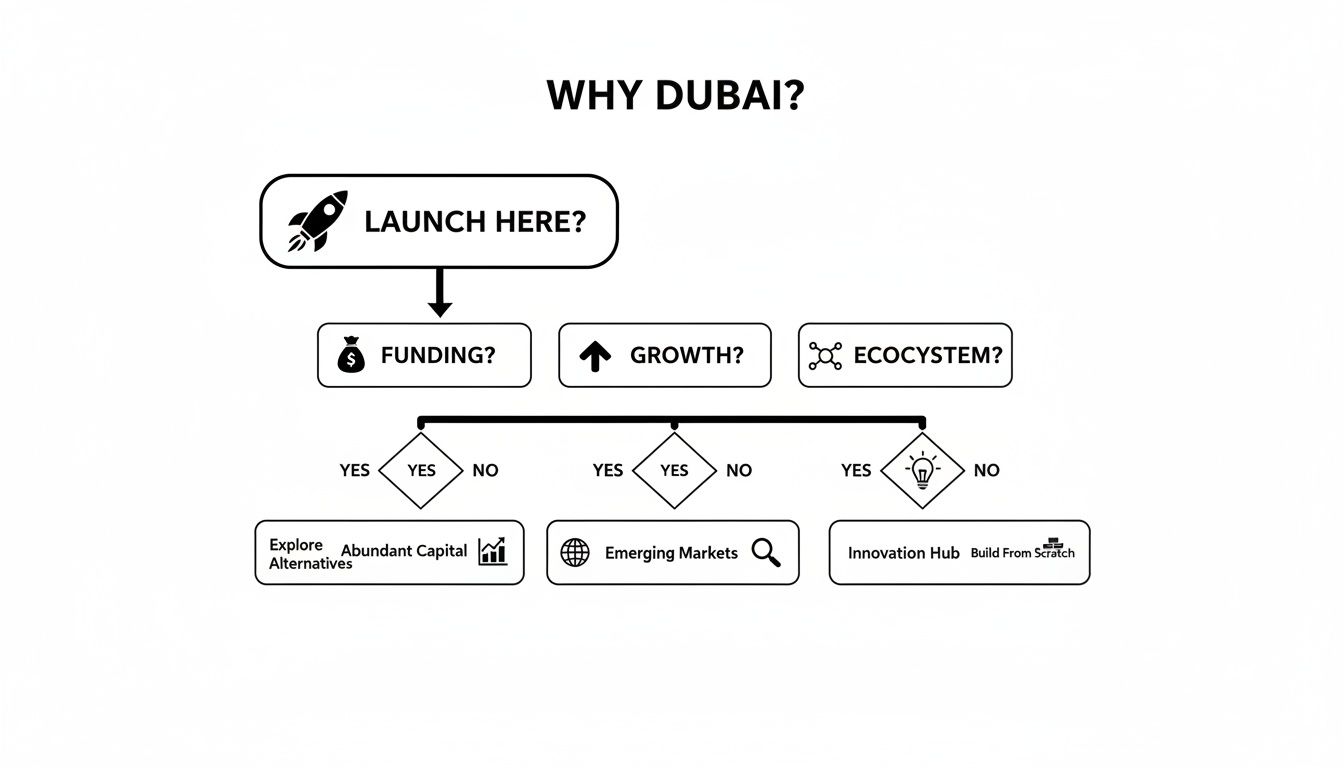
The visual drives home how Dubai’s unique mix of capital, growth potential, and a tightly-knit network creates the ideal conditions for building something big.
The top choices for tech startups usually include:
- Dubai Multi Commodities Centre (DMCC): The go-to hub for crypto, blockchain, and Web3 startups, with specific licences and a forward-thinking regulatory approach.
- Dubai Technology Entrepreneur Campus (Dtec): Purpose-built for tech startups. It’s a community-driven zone with co-working spaces and its own venture capital fund.
- Dubai International Financial Centre (DIFC): The undisputed champion for FinTech, operating under an independent legal system based on English common law.
For a deeper dive, check out our guide on the best UAE free zones for startups.
The speed and ease of setup are massive draws. Dubai recently ranked third globally in the 2026 Startup Friendly Cities Index, beating out London and New York. Thanks to digital-first governance in zones like DIFC, a new startup can be operational in about a week. You can read more on The Startup Scene.
Free Zone vs Mainland A Founder's Decision Guide
This table breaks down the key differences that matter most to a startup founder.
FactorFree Zone SetupMainland SetupOwnership100% foreign ownership is standard. No local sponsor needed.100% foreign ownership now possible for most activities, but requires a Local Service Agent (LSA) for professional services.Market AccessCan trade internationally and within the free zone. To sell on the Mainland, you need a local distributor.Unrestricted access to trade directly with any customer or business across the entire UAE.Office SpaceMust lease or own a physical office within the specific free zone. Co-working and flexi-desk options are common.Can lease office space anywhere in Dubai. More flexibility on location.VisasVisa eligibility is often tied to the size of your office space. Simpler, more streamlined visa processing.No direct link between office size and visa count. Visa process is managed through the Ministry of Human Resources & Emiratisation.Business ActivitiesLimited to the specific activities licenced by that free zone authority. Best for specialised startups (e.g., FinTech in DIFC).Broader range of business activities available. More suitable for diversified business models.Government ContractsGenerally cannot bid on government tenders directly.Eligible to work on lucrative government and semi-government contracts.Setup Cost & TimeTypically faster and more affordable to set up. All-in-one packages are common.Can be more complex and costly, involving multiple government departments (DED, MoHRE, etc.).
The best path depends entirely on your business model. A Free Zone offers a protected, streamlined environment for global-facing businesses, while the Mainland provides freedom to operate anywhere within the local economy.
Securing Capital in the Dubai Funding Landscape
Once your legal structure is sorted, the next mountain is funding. Dubai’s funding scene is maturing, with a layered ecosystem of angel investors, VCs, and government-backed initiatives. For a founder, navigating this world requires a smart strategy, not just a slick pitch deck.
Your first step is to match your startup's stage to the right type of capital. You wouldn’t walk into a Series A VC with a sketch on a napkin.
Mapping the Local Investor Scene
Dubai’s investment community is all about relationships. Cold emails rarely land. Warm introductions are the currency of the ecosystem. Your goal is to build genuine connections long before your bank account looks thin.
The landscape is diverse, with players focused on specific stages and sectors:
- Angel Investors and Networks: These are typically the first external cheque for a pre-seed or seed-stage company. You'll find formal groups like Dubai Angel Investors (DAI) and many influential angels who fly under the radar. The key is getting into the right circles.
- Venture Capital Funds: Once you have product-market fit and traction, VCs are your next target. Regional heavy-hitters like BECO Capital, Wamda Capital, and Middle East Venture Partners (MEVP) have backed major MENA success stories. Do your homework—check their portfolio to see if you’re a good fit.
- Government-Backed Funds: The government is a major investor. The Dubai Future District Fund, an AED 1 billion fund, backs seed to Series B tech companies. Getting one of these funds on your cap table often brings strategic perks beyond cash.
The UAE's pull in regional funding is undeniable. A staggering 33 of the 50 most funded startups in MENA are based here. This concentration of capital is why building your network here is so critical.
What Dubai Investors Actually Look For
Investors here look for the same fundamentals as anywhere else: a massive market, a killer team, and a scalable product. But there are a few local quirks.
Key Insight: Many regional investors put a huge emphasis on a founder's ability to execute beyond the UAE. If you don't have a clear, credible plan for tackling markets like Saudi Arabia, you'll struggle to get a serious cheque.
Before your first outreach, get your financial house in order. Knowing your burn rate and runway cold is non-negotiable. It shows you're a disciplined founder—a massive green flag for any investor. For a practical guide, check this resource on Calculating Burn Rate and Runway for Startup Survival.
The Rise of Corporate Venture Capital
Corporate Venture Capital (CVC) is a growing trend. Big players in logistics, real estate, and banking are launching venture arms to find startups that give their core business a strategic edge.
Getting a CVC on board can be a game-changer. It’s not just money; it can unlock distribution channels, provide instant market validation, and even land your first major customer. For a B2B tech startup in Dubai, this can be a shortcut to growth.
For a deeper dive, see our guide on the top 5 funding sources for UAE tech startups in 2025.
Your Next Action Plan
Don't wait until you're down to your last few months of runway. Building investor relationships is a long game.
- Create a Target List: Research and identify 15-20 investors (angels and VCs) whose focus genuinely aligns with your startup.
- Map Your Network: Use LinkedIn to find a path to a warm intro for every person on your list. Who do you know that knows them?
- Ask for Advice, Not Money: Your first conversation should be a request for guidance, not a pitch. Frame it as, "We're building X and I saw you invested in Y. I'd love your perspective on the market if you have 15 minutes." This builds a relationship before you ever make an ask.
This strategic approach turns fundraising from a scramble for cash into a deliberate process of building a team of partners invested in your journey.
Building Your Team: Hiring Talent and Managing Visas
Your product is ready and the legal paperwork is sorted. Now for the part that makes or breaks every scaling company: people. For a tech startup in Dubai, this means diving into a uniquely global, competitive, and often transient market. Success is about finding great talent and giving them a compelling reason to join your mission.
A brilliant idea with a mediocre team will fail. Every time. In Dubai, where top talent can easily jump between opportunities, your ability to hire effectively and navigate the visa system is a core competitive advantage.

The process can be broken down into a clear, manageable playbook.
Finding Top Tech Talent in Dubai
Dubai’s talent pool is a melting pot, with a workforce from over 200 nationalities. The trick is knowing where to fish and how to stand out against multinational corporations with massive budgets.
Posting a job and hoping for the best won't cut it. You need to be targeted.
- Go Beyond LinkedIn: While LinkedIn is a must, don’t ignore regional heavyweights like Bayt.com and NaukriGulf. These are often the first stop for professionals already in MENA.
- Lean on Your Network: Warm referrals are gold. Show up at events and join communities where your ideal hires hang out. A personal recommendation is worth more than any job ad.
- Tap into Universities: Build relationships with institutions like the American University of Sharjah and Khalifa University. Offering internships or attending career fairs is a great way to spot emerging talent early.
To build a more flexible team, consider strategies like leveraging nearshore staff augmentation for your startup to access specialized skills without the overhead of a full-time hire.
Demystifying the Visa Process
The visa process can seem like a black box, but it’s a well-oiled machine designed to attract skilled people. A smooth, hassle-free visa experience is a huge part of your value proposition to a potential hire.
There are a few main pathways:
- Standard Employment Visa: The most common route. Your company (Free Zone or Mainland) acts as the sponsor. The process is straightforward and is usually handled by your free zone’s admin or a dedicated PRO (Public Relations Officer).
- Golden Visa for Entrepreneurs: A game-changer for founders. This 10-year, long-term residency visa lets you sponsor yourself, your family, and key team members without a local sponsor, offering incredible stability.
- Green Visa for Skilled Employees: A newer, 5-year residency for skilled professionals who don’t need a specific employer sponsor. For senior talent who value independence, this can be a very attractive perk.
Next Action: Pull up your 6-12 month hiring plan. For each key role, determine the best visa path now. This upfront work will save you from major delays when you’re ready to hire.
If you’re just starting, getting a handle on the options is key. We break it down in our UAE startup visa guide for pre-seed founders.
Crafting a Winning Compensation and Culture Package
In a city with zero personal income tax, a high salary is just table stakes. You have to compete on more than just the paycheque. Think of your offer as a complete package: compelling compensation wrapped in an irresistible culture.
Your package should include:
- Competitive Base Salary: Benchmark your salaries against local market rates for tech roles.
- Equity/Stock Options: This is your secret weapon. Giving your team skin in the game creates a powerful sense of ownership.
- Solid Benefits: Health insurance is mandatory, but think about what else you can offer, like a wellness allowance or genuine work flexibility.
Remember, money only gets you so far. Culture is what makes people stay. In a transient city like Dubai, creating a real sense of community and purpose is your most powerful retention tool.
Your Go-To-Market Strategy for Dubai and Beyond
You have the legal structure and funding. Now for the real test: getting customers. For any tech startup in Dubai, a razor-sharp go-to-market (GTM) strategy is non-negotiable. See the city not just as your first market, but as a launchpad into the entire MENA region.
Don't just copy and paste what works in Silicon Valley. It won't fly.
Think of your GTM as building a series of bridges. The first bridge connects your product to early adopters in Dubai. Once solid, you build more bridges to Saudi Arabia, Egypt, and the rest of the region. Each bridge needs different engineering.

Your first move is to win decisively in Dubai’s concentrated market before expanding.
Mastering Customer Acquisition in Dubai
Dubai’s population is hyper-connected, with smartphone penetration over 98%. This makes digital channels powerful but competitive. Find the channels that deliver the best return on ad spend (ROAS) and can scale.
- Social and Search Dominance: For B2C, platforms like Instagram, TikTok, and Snapchat are table stakes. For B2B, a targeted LinkedIn strategy paired with high-intent Google Ads is your starting point.
- Content Localisation is Key: Just translating content into Arabic is a rookie mistake. True localisation means adapting messaging, visuals, and cultural references. Acknowledge local holidays and use regional slang in ad copy.
- The Power of Strategic Partnerships: Business in Dubai still runs on relationships. Teaming up with established local companies or other startups can give you instant credibility and a ready-made customer base.
Key Insight: Don't just translate; culturalise. A campaign that works in Dubai might fall flat in Riyadh or Cairo. Your GTM strategy must be modular and ready to adapt.
A Framework for Running GTM Experiments
Don't burn your seed round guessing which marketing channels will work. Get systematic. Adopt a lean approach to test, measure, and scale your customer acquisition.
- Hypothesise: Pick three channels. For each, write a clear hypothesis. Example: "We believe we can acquire qualified B2B leads for under AED 200 each using targeted LinkedIn ads."
- Test: Set a small, fixed budget (e.g., AED 2,000) and a short timeframe (e.g., two weeks) to test each channel.
- Measure: Track everything. Obsess over metrics like Customer Acquisition Cost (CAC), Conversion Rate, and Click-Through Rate (CTR).
- Decide: Look at the data. Go all-in on the channel that performed best and ruthlessly kill the ones that missed targets.
Expanding Beyond the UAE
Once you have a repeatable customer acquisition machine in Dubai, look next door. Saudi Arabia, with its massive, young population and Vision 2030 projects, is often the next logical step. Egypt offers enormous volume but has different price sensitivities.
- Saudi Arabia (KSA): A mobile-first market with insane engagement on YouTube and Snapchat. E-commerce and FinTech are booming.
- Egypt: A huge potential user base, but extremely price-sensitive. You’ll likely need a different pricing model or a strong freemium offering to get traction.
Next Action: Book a 90-minute GTM workshop with your founding team this week. Use the four-step experiment framework to map out your first three acquisition tests. Assign a clear owner, budget, and deadline to each. This turns strategy into action.
How to Find Your Community and Avoid Founder Isolation
Building a tech startup in Dubai can be a rollercoaster. Founder isolation is a genuine business killer. But in Dubai’s hyper-connected ecosystem, you don’t have to build in a vacuum. The trick is to be intentional about finding your tribe.
This isn’t about collecting business cards. It's about finding high-signal environments where you can build real relationships—rooms where founders share their actual numbers, talk openly about screw-ups, and offer advice based on trust.
Differentiating Signal from Noise
In a city buzzing with events, your time is your most valuable asset. You must learn to tell the difference between a low-value mixer and a high-value community.
A great first step is to show up in spaces designed for collaboration.
- Co-working Spaces: Hubs like in5, AstroLabs, and Dtec are more than just desks. They are curated communities hosting workshops, demo days, and mentor sessions. You’re in the same room as founders on the same rollercoaster.
- Major Tech Conferences: Events like GITEX Global are unmissable. They give you a sense of the regional tech scene and are an efficient way to connect with investors, partners, and talent.
- Specialised Meetups: Look for smaller, niche events focused on your industry (FinTech, SaaS, AI). These gatherings attract a more targeted crowd, making meaningful conversations easier.
The Power of Peer Accountability Groups
While big events build a wide network, real breakthroughs happen in smaller, trusted circles. This is where peer accountability groups come in. Picture a personal board of directors made up of 5-7 other founders at a similar stage.
Key Takeaway: Peer groups provide a confidential space to stress-test ideas, get brutally honest feedback, and hold each other accountable. This structure turns shared experiences into a powerful tool for growth and resilience.
These groups are the ultimate antidote to founder isolation. They create a disciplined rhythm of connection and force you to think strategically.
Next Action: Your mission for the next month is to find one high-signal community or event to join. Don't just attend—participate. Introduce yourself to three new people and have a real conversation. Ask them what their biggest challenge is right now. This shifts you from a passive attendee to an active community builder.
Still Have Questions? Here Are Some Real-Talk Answers
Even with the best plans, questions pop up before you take the plunge. Let's tackle the most common ones I hear from founders considering a tech startup in Dubai with direct answers.
What's the Real Burn Rate Going to Look Like?
Forget initial setup fees. Your real ongoing costs are salaries, visas, and office space. The game-changer is the 0% personal and corporate income tax (for most companies). This is a massive advantage that directly impacts your bottom line and your team's take-home pay.
Free zones often offer packages, making initial costs predictable. A basic flexi-desk setup in a hub like Dtec can start around AED 15,000-20,000 a year, covering your trade licence and eligibility for one visa. As you grow, you'll need a proper office, and visa costs will climb.
Key Insight: That zero-tax policy isn't just a perk; it's your single biggest financial lever. It means you can offer compelling net salaries that compete with London or New York while keeping payroll costs lower. Bake this into your financial models from day one.
Are There Big Cultural Hurdles to Clear?
Yes and no. Doing business in Dubai is a unique mix of Western-style efficiency and Middle Eastern relationship-building. Show up on time and know your numbers—that’s non-negotiable.
But don't dive straight into your pitch. Personal connection is everything. Take time for small talk, ask about their family, and show genuine interest. It’s how trust is built. While English is the language of business, showing respect for local holidays and cultural traditions will earn you a lot of goodwill.
What Do Exits Actually Look Like in the Region?
The exit scene in MENA is maturing. It's not Silicon Valley yet, but a solid acquisition is a well-trodden path. Both regional giants and international players are actively buying startups.
- Strategic Acquisitions: When Uber bought Careem for $3.1 billion, it sent a clear signal. Now, local heavyweights in logistics, FinTech, and real estate see acquisitions as a fast track to innovation.
- A Maturing IPO Market: Going public is also becoming a real option. Regional stock exchanges, especially Abu Dhabi's ADX and Riyadh's Tadawul, are increasingly viable launchpads for late-stage tech companies.
Next Action: Grab a notepad and write down your top three worries or unanswered questions about launching in Dubai. For each one, think of one person you know (or could get a warm intro to) who’s already on the ground. Reach out and ask for their unvarnished, honest opinion.
Building a business is hard, but you don't have to go it alone. Founder Connects creates curated peer groups for founders in the UAE to share challenges, get honest feedback, and build the meaningful connections that drive real progress. Stop building in a vacuum and find your tribe. Learn more and apply to join at https://www.founderconnects.com.

Building in MENA? You don't have to do it alone.
Join 300+ founders in the Founder Connects Residency. Monthly squad calls, warm intros, $3M+ in perks, and much more. All for less than your monthly coffee budget.
Popular posts





Founder Connects is a premium MENA tech founder community. Meetups in Dubai and across MENA, Residency Squads of 8–10, and 400+ vetted WhatsApp founders (apply and screened).