
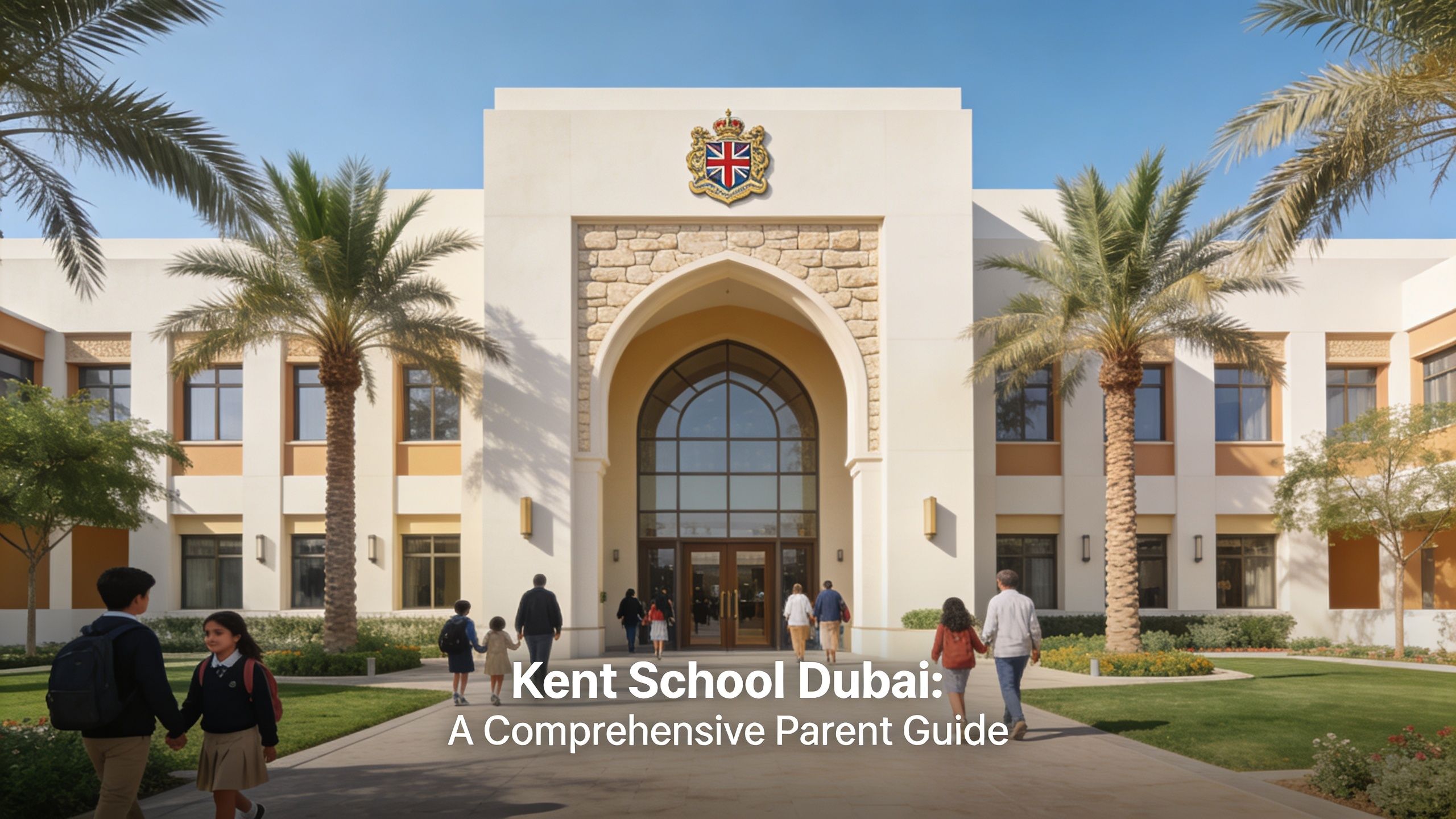
You're probably doing what most Dubai parents do when school search turns serious. You've got too many tabs open, every school promises “excellence”, and you're trying to work out whether kent school dubai is a smart long term bet or just a polished tour and a strong marketing team.
My blunt view: Kent College Dubai is one of the more interesting British schools in the city because it combines three things that don't always sit together. It has a real UK governance link, it has scaled quickly, and it shows credible academic outcomes across both A Levels and BTEC. That mix matters if you want a school that feels established enough to trust, but not so rigid that every child must fit one narrow definition of success.
If you're a founder, operator, or senior exec, treat this like any other major family decision in Dubai. Ignore slogans. Look at governance, quality signals, operating trajectory, and fit for your child. That's how you avoid paying premium fees for the wrong environment.
You visit a polished Dubai campus, hear the word “British” ten times, and still leave with the underlying question unanswered. Is Kent School Dubai a school on a durable upward path, or a newer entrant that has marketed itself well? For busy parents who treat education like a long-term investment, that distinction matters more than the brochure.
Kent College Dubai opened in 2016 as a UK-directly managed British curriculum school through a joint venture with Kent College Canterbury, according to Kent College Dubai's official overview. That is a better starting point than the usual heritage claim. In Dubai, plenty of schools borrow British language and aesthetics. Fewer have a live governance and operating relationship with the founding UK institution.
That difference shows up in positioning. Kent is not trying to compete as a legacy brand with decades of local history. It is competing as a growth-stage British school with real parent demand, clearer oversight than a loose franchise, and a wider appeal than a narrow academic-pressure model. If you assess schools the way you assess a business, those are positive signals.
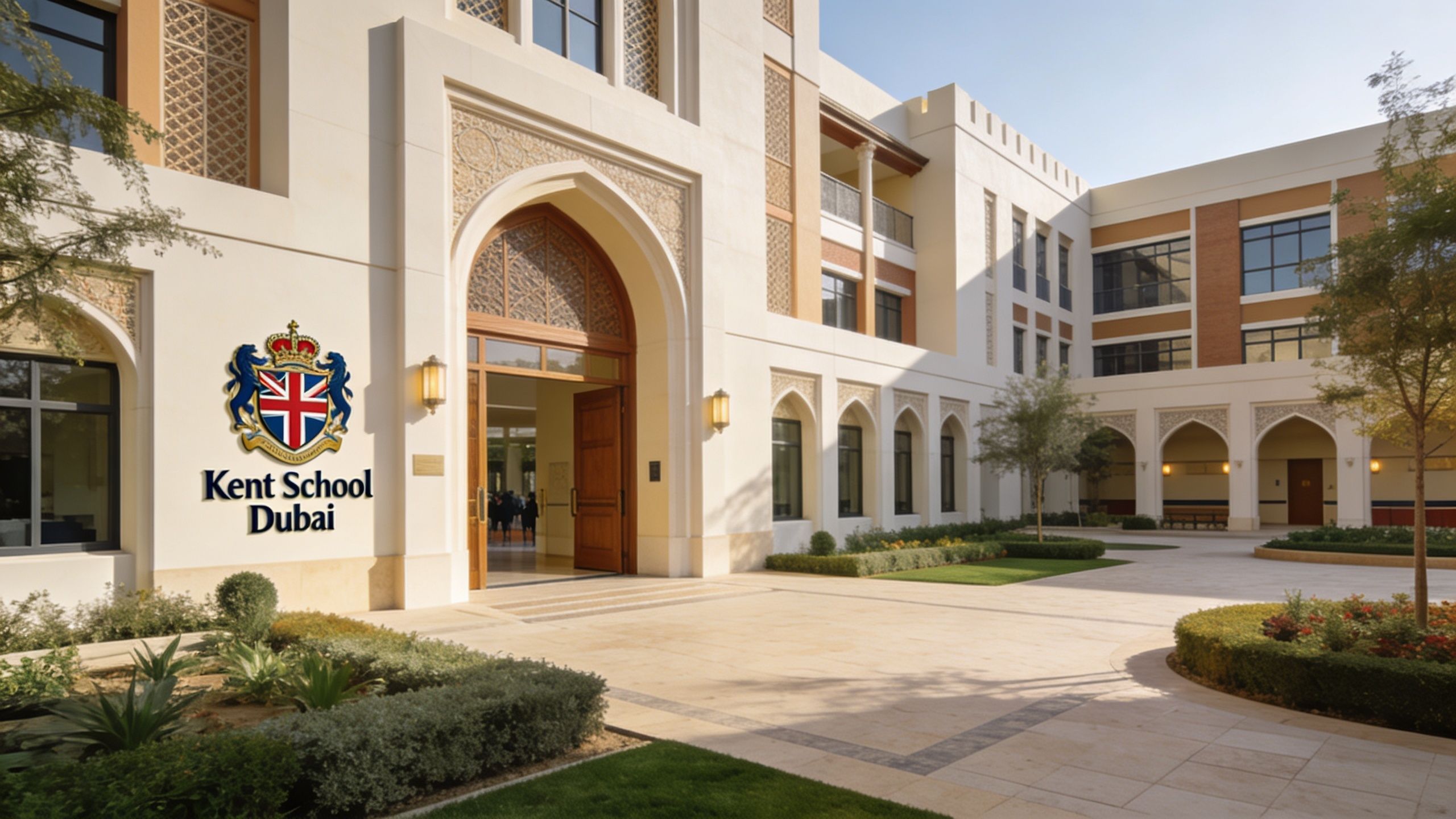
Dubai rewards schools that find product-market fit fast. Kent has done that.
The school has grown from a new entrant in Nad Al Sheba into a recognised mid-market to upper-mid-market British option with scale. It now sits in a more serious competitive bracket than many newer schools ever reach. That matters because growth, on its own, means little. Sustained enrolment growth in Dubai usually reflects a school that is converting tours into registrations, holding enough families to build continuity, and gaining traction in the expat parent network that drives this market.
The parent mix also matters. Kent has attracted an international community with a noticeable British-facing profile, which helps if you want a school culture that feels familiar to UK, Commonwealth, and globally mobile professional families. If your world already overlaps with founders, operators, and executives building careers in high-growth sectors, that kind of peer group often carries through into the school gate. Dubai's broader innovation economy gives context here, especially if your family is already plugged into the emirate's education technology leaders in the UAE.
One caution. Fast growth is good only if quality keeps pace. A school can fill seats faster than it builds culture, leadership depth, and academic consistency. Kent has enough momentum to deserve attention, but this is still a school you should assess by execution, not just by brand association.
Kent sits in a strong middle lane of the Dubai market. It has enough UK substance to feel credible, enough scale to feel established, and enough growth to look like a school still climbing rather than coasting.
My read is straightforward:
Kent School Dubai is best understood as a school with credible upward momentum and a clear market position. That makes it worth shortlisting, but only if the culture and academic fit match your child, not just your spreadsheet.
The curriculum question is simple: does the school offer a coherent path from the early years to university-facing senior outcomes, or does it start strong and get vague later on?
Kent is stronger than average on that front. Its curriculum closely matches the National Curriculum for England, and the school runs from Nursery through Year 13. For most families, that means continuity. You're not solving one problem for primary and another for secondary.
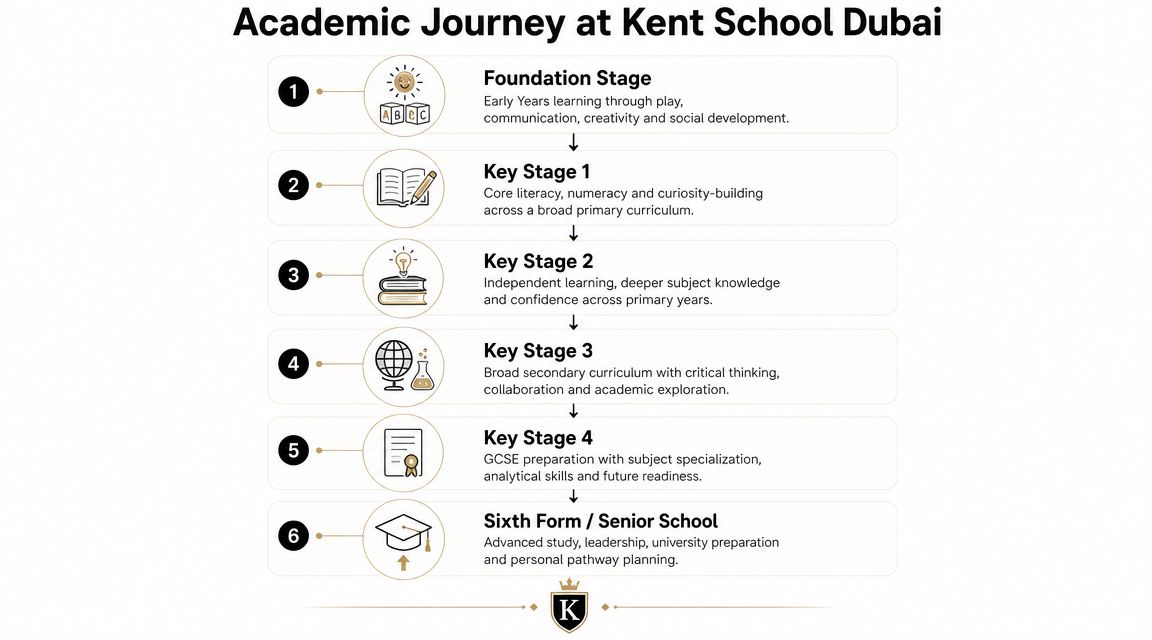
The structure is familiar if you know the British system.
| Stage | What it means for parents |
|---|---|
| Early Years | Play-based learning with strong foundations in routine, communication, and readiness |
| Primary | National Curriculum for England structure, with breadth and progression that should feel recognisably British |
| Secondary | More subject specialisation, higher expectations, and a clearer academic spine |
| Sixth Form | A choice between A Levels and BTEC, which is one of Kent's most useful differentiators |
That final point matters more than many parents realise. Some schools are excellent for highly academic students and weaker for anyone who needs a broader route. Kent's senior offering looks more balanced. If your child is university-bound but may thrive better in a practical or applied learning environment, the presence of BTEC is a real asset, not a backup plan.
The school's strongest public evidence is in Sixth Form outcomes.
According to a 2024 results report covered by SchoolsCompared, 37% of A-Level grades were A to A, and 40% of BTEC entries achieved Distinction, with a 100% pass rate in both. The same report also notes 14% of A Level grades were A*, while 36% of BTEC entries earned Distinction.
Those aren't throwaway figures. They show the school can produce serious outcomes across two different pathways.
A separate review cited in that same published coverage also reported 134 A Level exam entries, with 10% at A, 25% at A to A, 90% at A to C*, and a 99% pass rate. The variance between reporting sets doesn't change the broad conclusion. Kent's Sixth Form has moved beyond “promising” and into “credible”.
A school becomes easier to trust when it can point to real A Level and BTEC performance, not just glossy facilities and talk about holistic education.
Dubai parents often get confused by ratings because there are multiple frameworks. Kent's inspection profile is a good example.
Its latest inspection evidence shows it meets BSO requirements with an overall “excellent” quality of education, while the KHDA-linked profile rates the school's overall quality as “Good”, as set out in the BSO report published by the school.
That isn't a contradiction. It means the school is being judged through two different lenses.
If I were advising a busy parent, I'd read that as positive. You've got international validation of the school's British educational quality, plus local compliance under Dubai's inspection system.
Kent's academic proposition is strongest for families who want options without chaos.
It looks particularly sensible for these groups:
If your child is in the IGCSE years, I'd also look at outside support selectively rather than waiting for stress to build. Tools for AI-powered IGCSE preparation can be useful when a student needs structured revision outside school hours. And if you want a wider view of how education technology is reshaping support models in the region, this roundup of education technology leaders in the UAE is worth a look.
My recommendation is simple. If Kent is on your shortlist, ask the admissions team one hard question: how do they advise families between A Level and BTEC, and at what stage do those pathway conversations start? Their answer will tell you a lot about whether the school really understands student fit or just offers both on paper.
A school can look strong academically and still feel wrong day to day. That's where campus life matters.
Kent College Dubai has the kind of setting many families want in Nad Al Sheba. It feels purpose-built for a modern private school experience rather than adapted from an older site. For children, that changes the daily rhythm. For parents, it affects whether the place feels calm, organised, and worth the commute.

The school's profile suggests a fairly classic premium British-school blend. Strong campus presentation, visible extracurricular life, and a broad enough student mix to feel international without becoming culturally unmoored.
That matters in Dubai. Families often want diversity, but they also want social coherence. A school can be “international” and still feel fragmented. Kent looks more likely to attract families who broadly understand the same style of school experience and expectations around behaviour, communication, and progression.
The inspection picture supports that sense of order. As noted in the published inspection evidence, the school meets BSO requirements with an overall “excellent” quality of education, while KHDA rates it “Good”. For practical purposes, that says the school isn't operating as a loose premium lifestyle brand. There is real educational structure behind the campus presentation.
Practical rule: Don't judge community by the open day alone. Watch how pupils move between spaces, how staff speak to children, and whether the school feels warm or merely polished.
Most parents tour schools badly. They look at the theatre, the pitch, the pool, and the displays. Then they leave without checking the details that shape a child's week.
At Kent, I'd focus on these:
A good campus doesn't just offer facilities. It uses them well.
A true test of a school community is what happens outside class. That includes clubs, sport, performances, leadership roles, school events, and the softer signals of belonging.
For families moving into Dubai or rebuilding social circles after relocation, that matters more than many expect. Children settle faster when the school gives them obvious routes into friendships and identity. Parents settle faster when the community has enough overlap in values and lifestyle to make connection easy.
If you're thinking about how schools fit into broader social life, this guide to social clubs in Dubai is useful context. Schools don't exist in isolation here. They sit inside wider patterns of where families live, who they meet, and how they build community.
Here's a useful visual if you want a feel for the campus environment:
My view is straightforward. Kent looks like a school where many children would have a rounded life, not just a timetable. If your child needs an ultra-intense, highly traditional academic pressure cooker, you may prefer another environment. If you want a balanced British school with visible attention to both standards and student experience, Kent is in the conversation.
Admissions at kent school dubai shouldn't be treated like admin. It's an assessment of fit from both sides, and the families who handle it well usually move faster and make better decisions.
The process itself is standard for a Dubai private school. You enquire, tour, submit documents, complete assessment steps, and then decide whether the offer matches your expectations. What catches parents out isn't the sequence. It's the quality of preparation.

Use this as your operating checklist.
Start with a live conversation
Don't rely on a website form alone. Speak to admissions and ask direct questions about year-group availability, waiting pressure, and whether your child's profile is a natural fit.
Book a proper campus tour
If you're relocating, virtual is better than nothing. In person is much better. You're assessing pace, tone, discipline, and whether the school feels settled.
Prepare your document pack early
Most schools will want passports, visa-related documents where applicable, previous school reports, and identification records. Don't leave this until after assessment.
Expect an age-appropriate review of the child
Younger children are usually observed more informally. Older students may face more explicit academic checks and discussion around previous attainment.
Respond quickly once you get a decision
Good schools in Dubai can move from “available” to “full” faster than families expect.
Parents often think admissions is purely about whether the child can pass a test. That's too narrow.
Schools are usually assessing three things at once:
That last point matters more than people admit. Schools want families who understand what they're buying and won't create friction because they never asked the hard questions upfront.
Ask the admissions team how they handle students who join mid-phase, especially those entering key exam years. A clear answer signals operational maturity.
Don't leave with generic reassurance. Leave with specifics.
If Kent is on your shortlist, treat the admissions meeting like a due diligence session.
Take a one-page note with:
That forces a better conversation and helps you compare schools properly afterwards.
The biggest mistake parents make is asking, “Can my child get in?” The better question is, “Will my child do well here for several years?” That's the question worth solving.
You visit Kent, your child likes the campus, admissions is polished, and the brand feels reassuring. Then the essential question lands. Can you fund this school comfortably for several years, not just for the first invoice?
That is the right lens for Kent in Dubai. Treat it like a long-term investment decision, not an emotional purchase.
I am not going to fake a fee table without verified current numbers. Get the latest official fee sheet from the school and read the small print before you sign anything. This is a required step.
Kent is positioned as a premium British school in a crowded Dubai market. That matters because premium schools rarely become cheaper in practice once your child is enrolled. The headline tuition is only the starting point. The true number is the all-in annual cost across fees, transport, uniforms, devices, trips, lunches, and the extras that become standard once your child is part of the community.
As noted earlier, Kent has shown clear growth and still has room to scale. For me, that is a market signal. Families are buying into the proposition, and the school is still building toward fuller capacity. In business terms, that often supports brand confidence. It does not guarantee value for your child.
Use this framework.
| Cost lens | What to ask |
|---|---|
| Tuition | Can you cover the annual fee without relying on bonus income or best-case assumptions? |
| Hidden extras | What do uniforms, transport, meals, trips, clubs, and devices add over a full year? |
| Duration | Are you likely to stay long enough in Dubai, and at the school, to make the move worthwhile? |
| Return | Are you paying for outcomes your child will actually use, academically and socially? |
Many parents face an unexpected challenge here. They approve the tuition fees in isolation and ignore the ongoing operating costs of attending the school.
A school can be good and still be the wrong financial decision.
Kent is not trying to win on price. It is competing on British brand strength, campus experience, and perceived quality signals. That puts it in the category where parent expectations rise with the fee level. If you are stretching to afford it, pressure builds quickly. By Year 2 or Year 3, that pressure usually shows up in resentment about trips, add-ons, and every new request for payment.
The best school choice is one you can sustain without constant financial irritation.
If you are comparing formats as well as schools, this guide to private school costs vs online alternatives is worth reading. It is especially useful for families balancing relocation costs, long commutes, or more than one child.
Before you commit, ask Kent for a written breakdown of:
Then do one hard test. If the full annual cost looks uncomfortable on a spreadsheet, it will feel worse in real life.
Kent may be good value for families who want its positioning and can fund it with margin. If your budget is tight, be honest with yourself and choose a school you can sustain confidently.
A school only makes sense in context. Kent can look strong on its own and still be the wrong pick if another school is better matched to your child, location, or budget.
The challenge is that comparison data gets messy fast. To stay factual, I'm only including verified information for Kent in the table below. Use the same framework when you compare other schools directly through their current official materials.
| School | KHDA Rating | Curriculum Focus | Annual Fees (Year 9) | Location |
|---|---|---|---|---|
| Kent College Dubai | Good | British curriculum with A Level and BTEC pathways | Confirm directly with school | Nad Al Sheba |
| Repton Dubai | Confirm directly with school | Confirm directly with school | Confirm directly with school | Confirm directly with school |
| Dubai College | Confirm directly with school | Confirm directly with school | Confirm directly with school | Confirm directly with school |
| Brighton College Dubai | Confirm directly with school | Confirm directly with school | Confirm directly with school | Confirm directly with school |
That may look sparse, but it's the honest version. If data isn't verified here, I'm not going to pretend otherwise.
Kent's clearest positioning advantages are qualitative, but they're still useful.
Kent won't win every comparison.
Another school may be better if you prioritise:
That last point is underestimated. In Dubai, school choice and neighbourhood life overlap heavily. Parents often build business, friendship, and family routines around school communities.
If you're curious how operational systems shape school-like service businesses more broadly, this piece on how tutoring centers streamline operations is a useful parallel. Good education organisations usually feel organised in similar ways. Clear communication, fast admin, sensible tracking, and fewer avoidable headaches.
Compare schools like you'd compare a senior hire. Brand matters, but execution, consistency, and fit matter more.
Put Kent on your shortlist if you want a British school that feels modern, credible, and not one-dimensional.
Then compare it side by side with your alternatives using only five filters:
That framework is far more useful than ranking schools by prestige alone.
My answer is yes for the right family, and only if you're clear about what you're buying.
Kent School Dubai is a strong fit if you want a British curriculum school with real UK linkage, a campus that feels contemporary rather than dated, and a senior school model that doesn't force every capable child down one narrow academic path. The combination of A Levels and BTEC is one of its biggest strengths because real children are varied. Not every successful student is built for the same route.
Kent is likely to suit you if the following sounds familiar:
It may be less ideal if you're chasing the oldest-name prestige play in Dubai at any cost, or if your child would thrive better in a very specific niche environment.
Don't ask whether Kent is “good”. That's too vague to be useful.
Ask three sharper questions:
If the answer is yes to all three, Kent is a serious option.
For many families, the deciding factor won't be the headline academics alone. It will be the package. Governance, culture, pathways, and whether the place feels stable enough to trust over years, not months. That's where Kent makes a solid case.
If you're relocating, also look at where you'll live in relation to the school. Daily logistics matter more than most parents admit, especially once traffic and routine hit. This guide to Bayut properties in Dubai can help if your housing search is running alongside school decisions.
Do these next:
Kent School Dubai looks like a school with substance, not just surface. For the right family, that's enough reason to take it seriously.
If you're a founder in the UAE building a company while making high-stakes family decisions like this, Founder Connects is worth knowing. It's a private founder community built for practical support, trusted peer relationships, and honest conversations that help you make better decisions faster.


