

Legal Challenges in Cross-Border VC Partnerships

Building in MENA? You don't have to do it alone.
Join 300+ founders in the Founder Connects Residency. Monthly squad calls, warm intros, $3M+ in perks, and much more. All for less than your monthly coffee budget.

Cross-border venture capital (VC) partnerships offer UAE startups access to international funding and expertise, but they come with legal hurdles. Here's what you need to know:
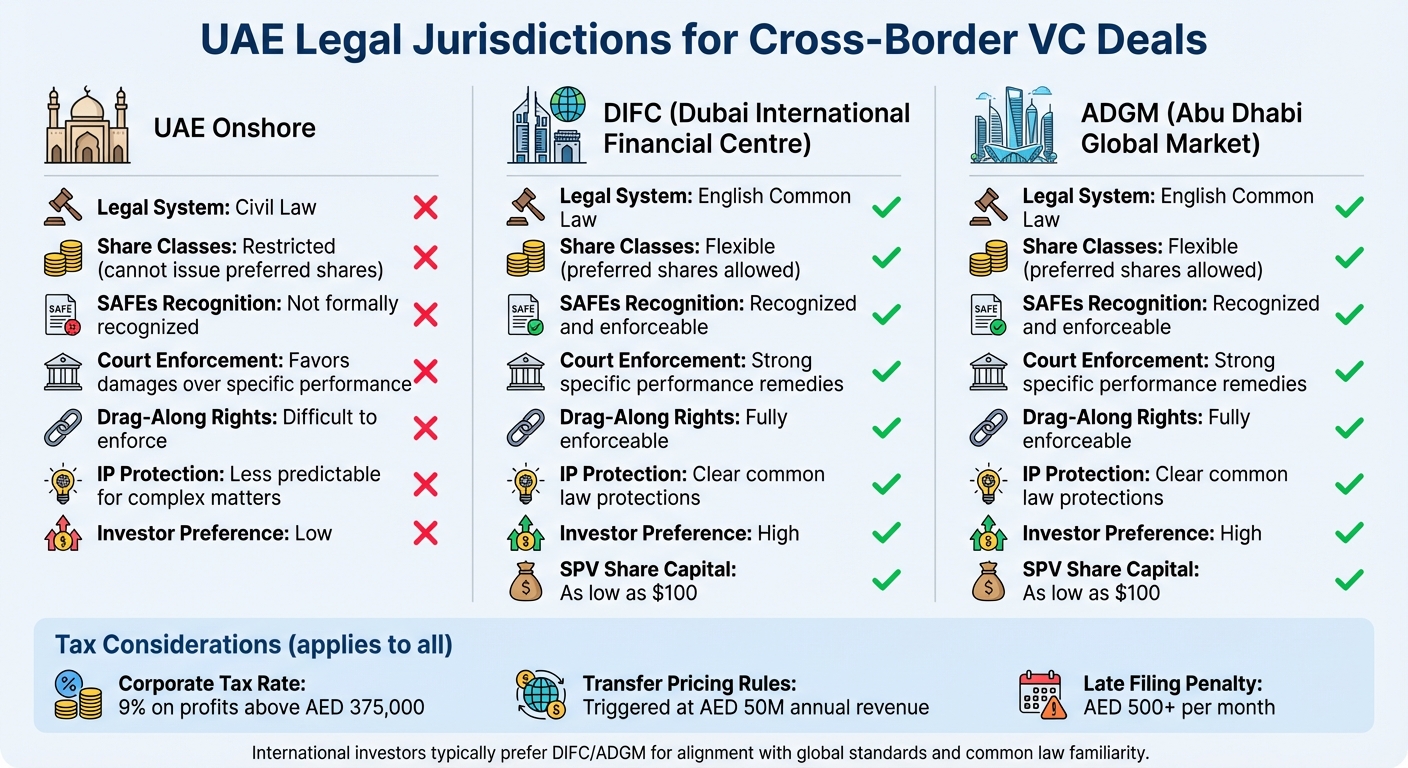
- Legal Systems: The UAE's "tri-system" legal framework includes UAE Onshore (Civil Law), DIFC, and ADGM (both Common Law). International investors often prefer DIFC or ADGM for their familiarity with common law.
- Key Challenges:
- Corporate Structures: Onshore UAE restricts share classes and SAFEs, complicating VC deals.
- Taxation: The 9% corporate tax on profits above AED 375,000 and double taxation risks impact deal structuring.
- IP Rights: Enforcement varies by jurisdiction, with DIFC and ADGM offering clearer protections.
- Solutions:
- Restructure within DIFC or ADGM to align with global investor expectations.
- Consult legal and tax advisors for compliance across jurisdictions.
- Use strong agreements, including Shareholders' Agreements, and safeguard IP through proper registrations.
Cross-border disputes: An introduction to navigating legal issues arising in multi-jurisdictional...
Main Legal Challenges in Cross-Border VC Deals
UAE startups diving into cross-border venture capital agreements often encounter legal hurdles that can complicate or even derail deals. Knowing these challenges ahead of time equips founders with the tools to navigate them effectively when engaging with international investors.
Regulatory Compliance Across Different Countries
International investors frequently insist that UAE startups restructure as holding companies within the DIFC or ADGM. These jurisdictions offer legal frameworks that align with global investor expectations and provide better protections [2][4].
Onshore UAE presents its own set of complications. For instance, share class restrictions prevent many onshore companies from issuing preferred shares - an essential feature in most VC agreements. Preferred shares often come with special voting rights or economic privileges, which are hard to implement in the mainland system [4][6]. Adding to the complexity, SAFEs (Simple Agreements for Future Equity) are not formally recognised under mainland UAE law, raising questions about their enforceability and conversion into equity [6]. Onshore courts also tend to favour awarding damages over enforcing specific contractual terms, making it harder to implement provisions like drag-along rights [4].
"Onshore UAE frameworks impose statutory limits that cannot be contracted around. DIFC and ADGM offer greater flexibility but require a demonstrable nexus between restrictions and legitimate business interests." – Taylor Wessing [5]
These structural limitations also influence tax obligations and how investments are eventually converted into equity.
Tax Issues and Double Taxation Risks
The introduction of the UAE Corporate Tax under Federal Decree-Law No. 47 of 2022 has added a new layer of complexity to deal structuring. Companies now face a 9% corporate tax on profits exceeding AED 375,000, which directly impacts how investments are structured and exited [6]. For example, the conversion of SAFEs into equity in cross-border scenarios could trigger taxable events, potentially lowering returns for international investors [6].
Cross-border transactions also bring new tax challenges, particularly with related-party dealings. Startups operating through SPV structures in the DIFC or ADGM need to carefully model their capitalisation tables to account for possible tax-driven dilution during the conversion of SAFEs or convertible notes [6].
Securing intellectual property is another critical step to solidify legal foundations in these partnerships.
Intellectual Property Protection
IP rights are territorial by nature, which can create enforcement challenges when a startup’s assets are registered in one jurisdiction but the business operates across borders. Mainland UAE’s civil law system is often seen as less predictable for handling intricate IP matters compared to the common law frameworks in the DIFC and ADGM [1]. As a result, international investors often push for startups to transfer IP ownership to holding companies within the DIFC or ADGM, where English common law offers clearer protections [1].
Dispute resolution and enforcement add another dimension. Breaches of confidentiality, for instance, can lead to criminal liability under the UAE Penal Code, regardless of whether the issue arises in the mainland, DIFC, or ADGM [5]. This underscores the importance of robust IP strategies in cross-border deals involving sensitive or proprietary information.
How to Navigate Legal Complexities
Proactive legal planning is crucial for UAE startups looking to sidestep costly errors and foster trust with international investors by joining a community of experts. Taking the right steps early can make all the difference.
Working with Legal and Tax Advisors
Before signing a term sheet, it's wise to consult with international VC lawyers and tax specialists. These professionals help startups manage the UAE's unique regulatory landscape while ensuring compliance with foreign jurisdictions. With the UAE's 9% corporate tax on profits above AED 375,000, careful tax planning is essential. This becomes even more critical when annual revenue exceeds AED 50 million, triggering transfer pricing rules. Startups must also conduct thorough due diligence on corporate documents, licences, sanctions exposure, and tax liabilities to avoid fines exceeding AED 500 per month [3]. Expert advice at this stage can also help startups take advantage of treaty benefits when structuring deals.
Using Bilateral Investment Treaties
The DIFC and ADGM frameworks offer an added layer of confidence for international investors through reciprocal enforcement treaties. These treaties ensure that investors' rights are enforceable across borders, making these financial free zones particularly attractive. Structuring deals within the DIFC or ADGM provides access to English-language common law courts, known for their judicial clarity and effective remedies [1][5]. Additionally, using Special Purpose Vehicles (SPVs) in the DIFC can help startups manage financial risks and streamline capital pooling from global investors [1]. Once cross-border enforceability is in place, strong contractual governance further safeguards all parties involved.
Creating Strong Agreements and Governance Protocols
Comprehensive Shareholders' Agreements (SHAs) are a must. These should include clauses like drag-along rights, tag-along rights, liquidation preferences, and "Reserved Matters" requiring investor consent [1][2]. Aligning all agreements - such as non-compete, confidentiality, and non-solicitation clauses - is equally important to avoid enforcement issues [5].
"Best practice requires explicit cross-referencing and alignment. The employment agreement should acknowledge the founder's shareholder status and confirm that restrictive covenants survive termination" [5].
For contracts governed by DIFC and ADGM laws, including severability clauses is a smart move. These allow courts to remove unreasonable parts of a covenant without invalidating the entire agreement. For onshore operations requiring a local partner, notarised internal Side Agreements can safeguard real ownership interests, even if official records suggest otherwise [3]. These measures not only protect the startup but also build investor confidence, paving the way for successful cross-border ventures.
How Community Platforms Support Cross-Border VC Deals
For UAE startups navigating cross-border venture capital deals, having more than just legal expertise is crucial. Robust networks and access to seasoned mentorship can make all the difference. This is where community platforms step in, simplifying these intricate partnerships.
Networking and Collaboration Opportunities
Community platforms are invaluable for connecting founders with international stakeholders, especially as global interest in UAE startups grows. Take Founder Connects, for example - it links tech, fintech, and AI startups with investors who have deep experience in equity structures. These connections are especially helpful when founders need insights into jurisdictional preferences, given that many international investors lean towards English common law frameworks [1][4].
Through events and virtual masterminds, these platforms offer founders a chance to learn directly from peers who’ve successfully navigated cross-border deals. This shared knowledge helps founders avoid costly mistakes while also opening doors to specialised resources and advice. By fostering these connections, community platforms act as a bridge to global opportunities.
Access to Curated Resources and Expert Advice
Beyond networking, community platforms provide practical startup resources and news to help startups tackle the complexities of legal and funding processes. For instance, curated investor lists save founders time by narrowing down the right partners for their ventures. Additionally, live sessions and expert consultations cover essential topics like the use of DIFC Prescribed Companies (SPVs) as feeder funds. These SPVs, with a share capital requirement as low as $100 [1], can simplify capitalisation tables for international investors.
Platforms also guide founders through advanced fundraising tools like SAFEs and Convertible Loan Notes, which are gaining traction in the region for seed-stage funding [6][4]. For those preparing for due diligence, these resources break down international standard documentation - such as Term Sheets and Shareholders' Agreements - making the process less daunting. By filling knowledge gaps and facilitating access to expert guidance, community platforms empower UAE startups to tackle the legal and procedural challenges of cross-border VC deals with confidence.
Conclusion
Cross-border venture capital deals can pose legal challenges for UAE startups, but they are far from insurmountable. Issues like navigating regulatory requirements across jurisdictions, managing tax complexities, and safeguarding intellectual property demand a well-thought-out approach. As Mohammed Tartir, Senior Counsel at Taylor Wessing, puts it:
"The enforceability of restrictive covenants in UAE venture capital transactions depends fundamentally on clarity, proportionality, and consistency" [5].
One effective strategy is establishing your business in financial free zones like the DIFC or ADGM. These zones offer legal frameworks that align with international standards, providing clarity and boosting investor confidence. Partnering with experts familiar with both common and civil law systems is another critical step. While the upfront costs may seem high, the long-term benefits in terms of legal certainty and smoother investor relations often justify the investment.
Preparation is equally crucial. Undertake thorough due diligence before engaging investors - verify potential partners using public registers and ensure your business is structured for a seamless exit from the outset. With investor interest in the region growing, a solid legal foundation can make your startup stand out.
Community support also plays a pivotal role. Platforms like Founder Connects offer resources that are invaluable for first-time founders. These include access to experienced mentors, curated investor lists, and guidance on tools like SAFEs and SPVs. Such resources can bridge knowledge gaps and ease the complexities of cross-border transactions.
Ultimately, success in cross-border VC partnerships hinges on proactive planning, comprehensive documentation, and expert advisory support. By addressing these elements, UAE startups can confidently navigate the challenges and seize the opportunities that come with international investment.
FAQs
Should I incorporate in DIFC, ADGM, or mainland UAE for VC funding?
The UAE offers distinct options for startups looking to establish a presence, each with its own advantages. DIFC (Dubai International Financial Centre) and ADGM (Abu Dhabi Global Market) stand out as financial free zones with several perks. They operate under a common law framework, provide a 0% corporate tax rate for qualifying funds, and offer flexible legal structures. These benefits make them attractive hubs for venture capital (VC) funding and financial activities.
On the other hand, mainland UAE offers access to a broader market, which could be ideal for startups targeting a more diverse customer base. However, businesses operating in the mainland are subject to a 9% corporate tax on profits exceeding AED 375,000.
Choosing the right jurisdiction depends on your startup’s goals, target investors, and operational requirements. It’s always a good idea to consult with legal and financial experts to ensure your decision aligns with your growth strategy.
How can I use SAFEs or convertible notes legally in the UAE?
SAFEs (Simple Agreements for Future Equity) and convertible notes are permitted in the UAE, but their use must adhere to the country’s dual legal framework. This framework consists of the mainland UAE laws and the regulations specific to free zones like the DIFC (Dubai International Financial Centre) and ADGM (Abu Dhabi Global Market).
The DIFC operates under English common law, which is well-suited to accommodate these financial instruments. On the other hand, mainland UAE has updated its commercial laws to introduce greater flexibility, including provisions for multi-class shares, making it easier for businesses to adopt such mechanisms.
To navigate the complexities of these frameworks effectively, it’s crucial to consult experienced legal professionals familiar with UAE regulations. This ensures that your agreements are compliant and tailored to the specific jurisdiction within the UAE.
What’s the best way to structure IP ownership for cross-border investors?
When structuring IP ownership in cross-border venture capital deals involving UAE startups, it’s crucial to have clear agreements in place. These should outline ownership rights, licensing terms, and confidentiality obligations. Agreements must align with the UAE's legal frameworks, such as those of the DIFC (Dubai International Financial Centre) or ADGM (Abu Dhabi Global Market), to ensure they are enforceable both locally and internationally.
To cover all bases, include provisions that explicitly recognise international IP rights. Conducting thorough due diligence is equally important to identify any potential risks tied to the intellectual property. This approach not only ensures compliance with both local and global laws but also helps build trust between parties involved in the deal.
Related Blog Posts

Building in MENA? You don't have to do it alone.
Join 300+ founders in the Founder Connects Residency. Monthly squad calls, warm intros, $3M+ in perks, and much more. All for less than your monthly coffee budget.
Popular posts





Founder Connects is a premium MENA tech founder community. Meetups in Dubai and across MENA, Residency Squads of 8–10, and 400+ vetted WhatsApp founders (apply and screened).