

Is One Business Center Right for Your UAE Startup?

Building in MENA? You don't have to do it alone.
Join 300+ founders in the Founder Connects Residency. Monthly squad calls, warm intros, $3M+ in perks, and much more. All for less than your monthly coffee budget.

You’re probably in one of three situations right now.
You’re working from home and your team is starting to feel scattered. You’re bouncing between Zoom calls, cafés, and WhatsApp. Or you’re about to set up properly in Dubai and wondering whether a traditional lease is a smart move or an expensive distraction.
That’s where one business center enters the conversation.
Founders often treat this as a facilities decision. It isn’t. It’s a capital allocation decision, an operating model decision, and in many cases a focus decision. The wrong office setup drains cash and attention. The right one buys speed, credibility, and breathing room.
I’ve seen founders sign leases too early because they wanted to “look established”. I’ve seen others avoid any office at all, then lose momentum because the team had no rhythm and no professional base. Both mistakes are common. Both are fixable.
The Founder's Workspace Dilemma in the UAE
The UAE rewards speed, but speed without discipline burns cash fast.
Dubai keeps attracting founders, operators, and international teams. That’s not a vague impression. Dubai’s DIFC registered 1,081 new companies in H1 2025, up 32% year on year, which shows how fast the business base is expanding and why demand for flexible workspace keeps rising, according to business centre market data referenced here.
The three common founder moves
Most early-stage founders in the UAE drift into one of these options:
- Stay informal: work from home, cafés, hotel lobbies, and borrowed meeting rooms.
- Go traditional: sign a standard office lease, fit it out, hire support, and commit.
- Choose flexibility: move into a serviced office or business centre.
The first option is cheap, until it starts costing you credibility and concentration.
The second can work, but it’s usually the wrong first move unless you already have stable revenue, headcount clarity, and a reason to lock yourself into infrastructure.
The third is why one business center keeps coming up in founder conversations. It compresses setup time and removes operational noise.
Practical rule: Your first office should reduce decisions, not create new ones.
The real question founders should ask
Don’t ask, “Which office looks best?”
Ask this instead.
| Question | Why it matters |
|---|---|
| What problem am I solving? | You might need compliance, team rhythm, or client credibility, not just desks. |
| How much monthly burn can I absorb calmly? | Office stress compounds when revenue is still uneven. |
| Will this setup help my team execute better next month? | Nice spaces don’t automatically improve output. |
A business centre can be a smart answer. It can also be an expensive comfort blanket if your real issue is strategy, not space.
What Exactly is a Business Centre
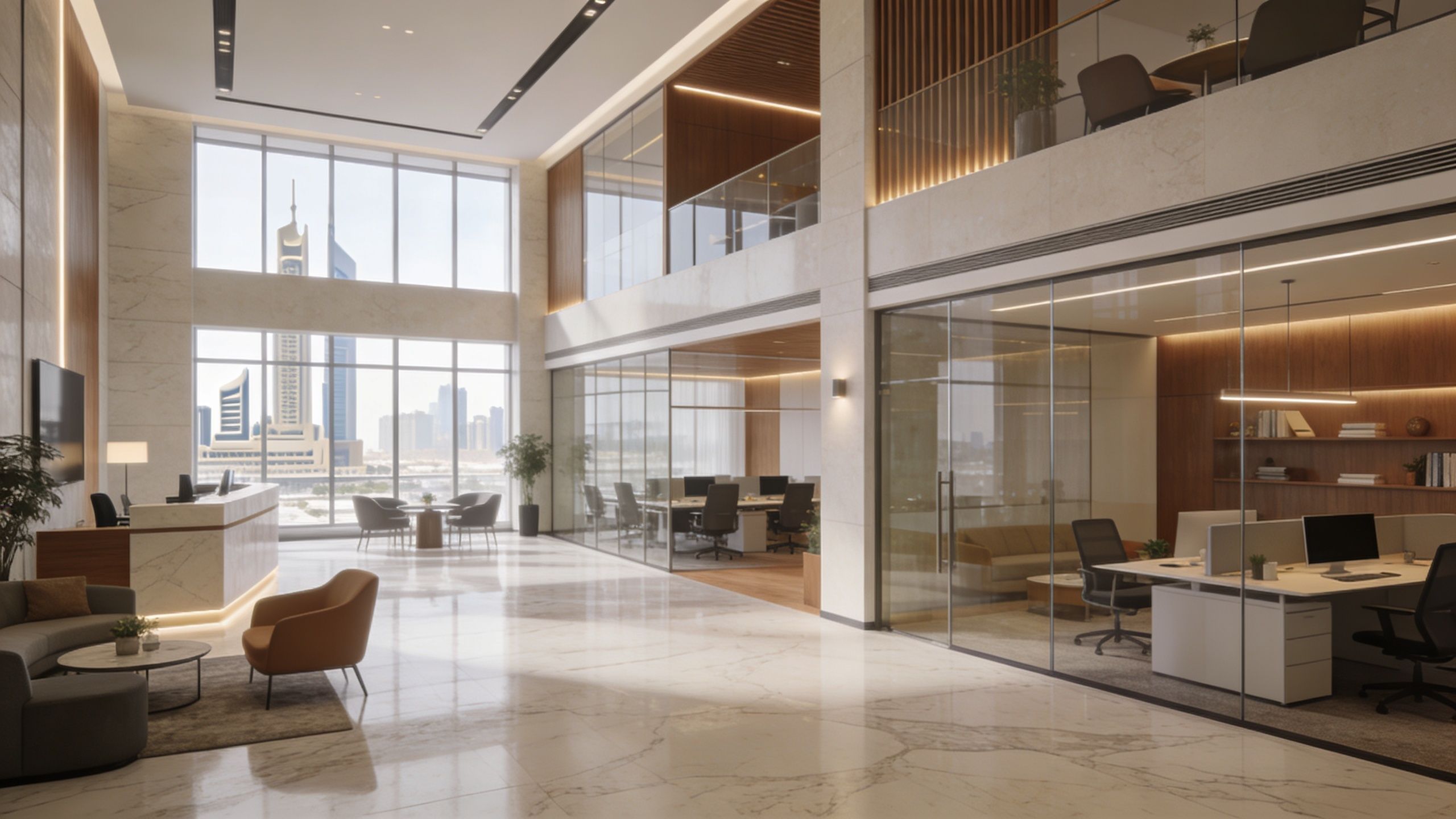
A business centre is the all-inclusive version of an office.
Instead of leasing empty space, then sorting furniture, internet, utilities, reception, cleaning, meeting rooms, and admin support separately, you get a ready-to-use setup under one provider. For most founders, that’s the appeal. You pay for convenience, speed, and fewer operational headaches.
What you usually get
A proper UAE business centre is more than a desk and coffee machine.
You’ll typically get:
- A furnished private office: not a hot desk, but a dedicated space your team can operate from.
- Shared professional infrastructure: meeting rooms, reception, mail handling, printers, and common areas.
- Operational support: IT setup, internet, security, and in some cases PRO-style assistance.
- A business-ready address: useful when you want your company to look established from day one.
If you’re still comparing formats, this guide to flexible corporate workspaces is useful because it separates co-working, serviced offices, and other hybrid setups in plain language.
How it differs from the two obvious alternatives
A hot-desk co-working plan is lighter and cheaper, but it often lacks privacy, permanence, and the sense that your company has a real home.
A traditional lease gives you more control, but it also gives you more responsibility. You become responsible for setup, vendors, fit-out decisions, and all the little distractions founders love to underestimate.
A business centre is not about luxury first. It’s about removing friction.
When the model makes sense
A business centre usually fits when you need to operate properly, but you’re not ready to build an office machine around yourself.
It’s especially useful if:
- You need to launch quickly.
- You want predictable monthly costs.
- You don’t want capital tied up in fit-out and office administration.
- Your team size may change soon.
That’s why one business center appeals to founders in that awkward middle stage. Too serious for cafés. Too early for a long lease.
A Closer Look at One Business Centre's Model
One Business Centre sells the thing founders want. A plug-and-play office in Dubai without the usual mess.
That matters more than glossy brochures suggest. Early-stage teams don’t fail because they lacked marble floors. They fail because founders spent time and money on things that didn’t move the business forward.
The cost difference is the main story
Here’s the number founders should pay attention to.
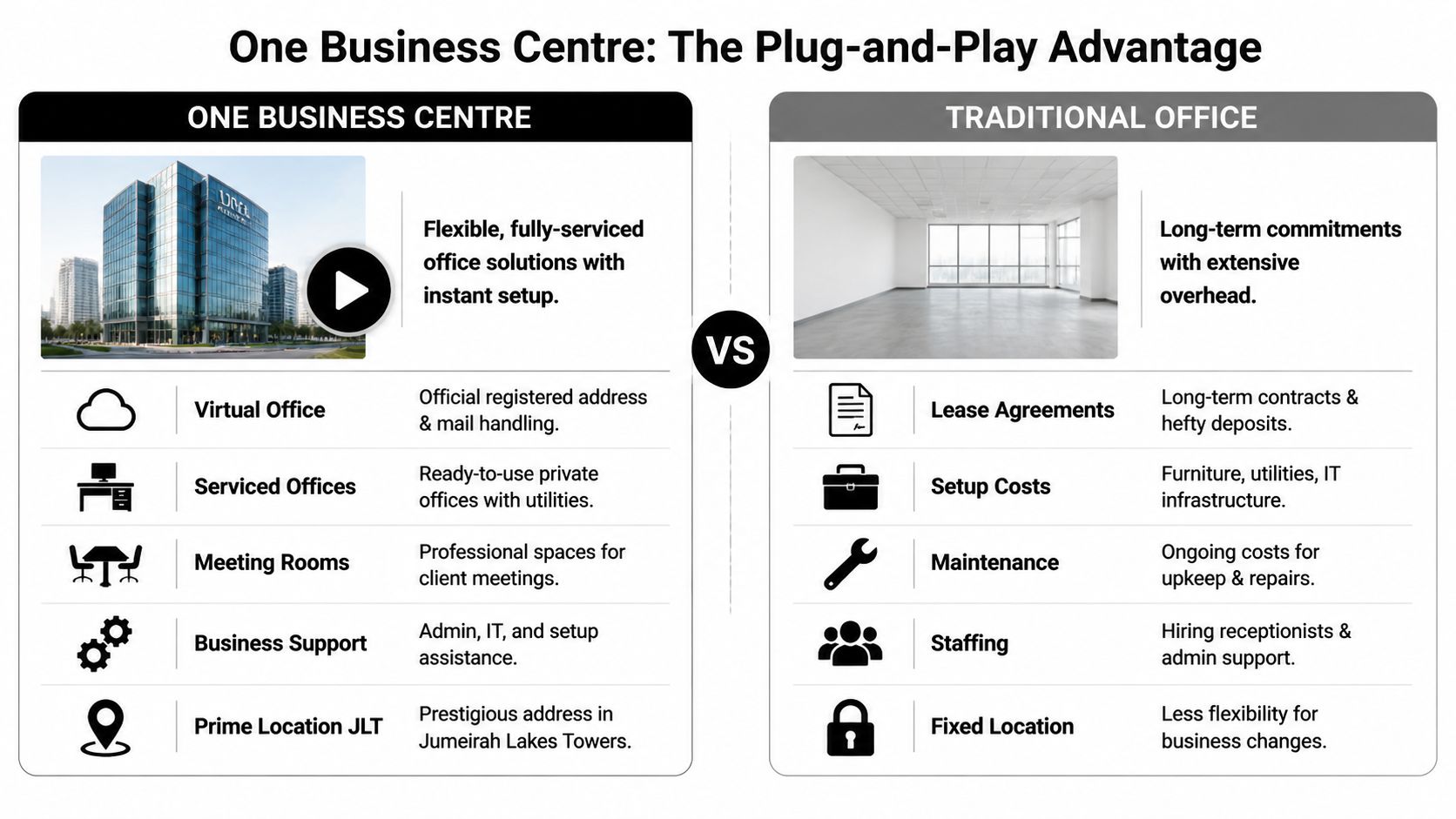
According to One Business Centre’s comparison of its model versus traditional offices, an all-inclusive monthly office fee of around AED 12,399 contrasts with a traditional Uptown JLT office where rent, service fees, and utilities can total over AED 96,000 monthly, before adding fit-out investment that can reach AED 450,000.
That is not a small pricing gap. It’s a completely different cash-flow profile.
What that changes for a founder
When your office cost is bundled, your planning gets simpler.
You don’t need to keep revisiting separate line items for electricity, cooling, service fees, reception support, and setup. You also avoid the classic founder trap of treating fit-out as some future problem, then discovering it becomes a major upfront hit at exactly the wrong time.
Side-by-side view
| One Business Centre | Traditional office |
|---|---|
| Single monthly fee | Separate rent, fees, and utilities |
| Ready to use | Requires setup and fit-out |
| Lower upfront strain | Heavy capital commitment before you start |
| Flexible posture | More rigid commitment and slower changes |
This is why I tell founders to stop looking only at rent. Rent is never the full number. Total cost of ownership matters more.
The strategic value is focus
The best part of the One Business Centre model isn’t the furniture. It’s the reduction in founder distraction.
Every operational task you remove creates room for hiring, sales, product work, and customer conversations. If your office setup still requires daily problem solving, it’s not serving you. You’re serving it.
Teams thinking about building operations across multiple sites often also benefit from tools outside the office itself. For example, Remote property access management is relevant if you need a cleaner way to control entry and manage building access across distributed locations.
Where founders still need to be careful
Convenience can hide lazy thinking.
Don’t choose One Business Centre just because it feels safe and polished. Choose it if the following are true:
- You need immediate operational readiness: your company has clients, hiring activity, or licensing needs now.
- You want clean monthly predictability: not endless one-off setup spending.
- You expect headcount changes: growth is uneven and flexibility matters.
- You’re protecting attention: you know founder time is more valuable than office micromanagement.
If you’re weighing this against broader startup ecosystem options in Dubai, this piece on programmes beyond the basic co-working offering is worth reading because it highlights the difference between space as infrastructure and space as part of a wider support system.
Founders rarely regret flexibility early. They often regret fixed overhead.
The Real Pros and Cons for a MENA Founder
One business center is a strong option. It isn’t a universal answer.
Founders in the UAE and wider MENA region need to judge this through three lenses. Speed, cost structure, and community quality. If you only look at the office itself, you’ll miss the trade-offs.
The upside
The immediate benefit is speed. You can operate quickly, host meetings professionally, and avoid a long setup cycle.
There’s also a credibility benefit. A polished address and organised front-of-house experience help when you’re speaking with enterprise clients, partners, or investors who still read physical presence as a signal of seriousness.
The best reasons to choose it
- Fast setup: you can move in and start working without building everything from scratch.
- Cleaner budgeting: monthly costs are easier to understand than a pile of separate vendors and fit-out tasks.
- Less founder admin: fewer calls about cleaning, internet, maintenance, and office operations.
- Scaling flexibility: if your team expands or changes shape, you’re not as boxed in as a conventional lease.
The downside
The biggest risk is staying too long because it feels easy.
A business centre is often the right early move, but not always the cheapest long-term structure once a team becomes stable and predictable. At some point, mature companies should compare the ongoing premium for convenience against the control and economics of a more permanent setup.
The less obvious founder problem
Community can be weak.
You may sit in a polished building and still feel professionally isolated. Many business centres create proximity, not trust. You’ll meet service providers, consultants, and transient tenants. That’s fine. It isn’t the same as a real peer group of founders dealing with pricing, hiring, product, fundraising, and the emotional mess of building.
If your office solves logistics but not loneliness, you’ve only solved half the problem.
A simple founder test
Choose a business centre if most of your pressure is operational.
Hold back if most of your pressure is strategic or relational. In that case, your next move might need to be people, not premises.
Is a Physical Office the Right Answer for You
A lot of founders say they need an office when what they really need is momentum.
That distinction matters. A physical space can improve routine and professionalism, but it won’t automatically fix indecision, weak accountability, or isolation.

In the UAE, this issue is sharper than many founders admit. According to One Business Centre’s site, 68% of UAE startups operate in a hybrid model, and 72% of early-stage founders in non-Dubai Emirates report limited access to high-signal networking. That’s the true gap for many teams. Not desks. Not Wi-Fi. Access and connection.
Diagnose the actual bottleneck
Before you pay for space, answer this.
| If your problem is... | Then a physical office may help | If not, look elsewhere |
|---|---|---|
| Client perception | Yes | |
| Licensing or formal business presence | Yes | |
| Team routine and in-person coordination | Often | |
| Founder isolation and weak feedback loops | Yes | |
| Lack of strategic accountability | Yes |
Many founders confuse structure with progress. They think a nicer room will create better decisions. It won’t.
If you’re redesigning how your team works, it helps to review different types of office layouts because layout affects focus, privacy, and collaboration more than most first-time founders realise.
Hybrid work changed the decision
The old question was, “Do we have an office?”
The smarter question now is, “What mix of physical and virtual support helps us execute best?” For hybrid teams, the answer is often a lighter physical footprint plus stronger systems for connection, accountability, and introductions.
This discussion on virtual networking and UAE startup growth points to the practical side of that shift.
A short explainer helps if you’re thinking through the physical-versus-hybrid trade-off:
My advice
If you’re a solo founder or a tiny team, don’t assume office first.
Start by asking whether your biggest constraint is infrastructure or isolation. If it’s isolation, a lease won’t cure it.
Business Centres vs Founder Peer Communities
At this point, founders often make a category mistake.
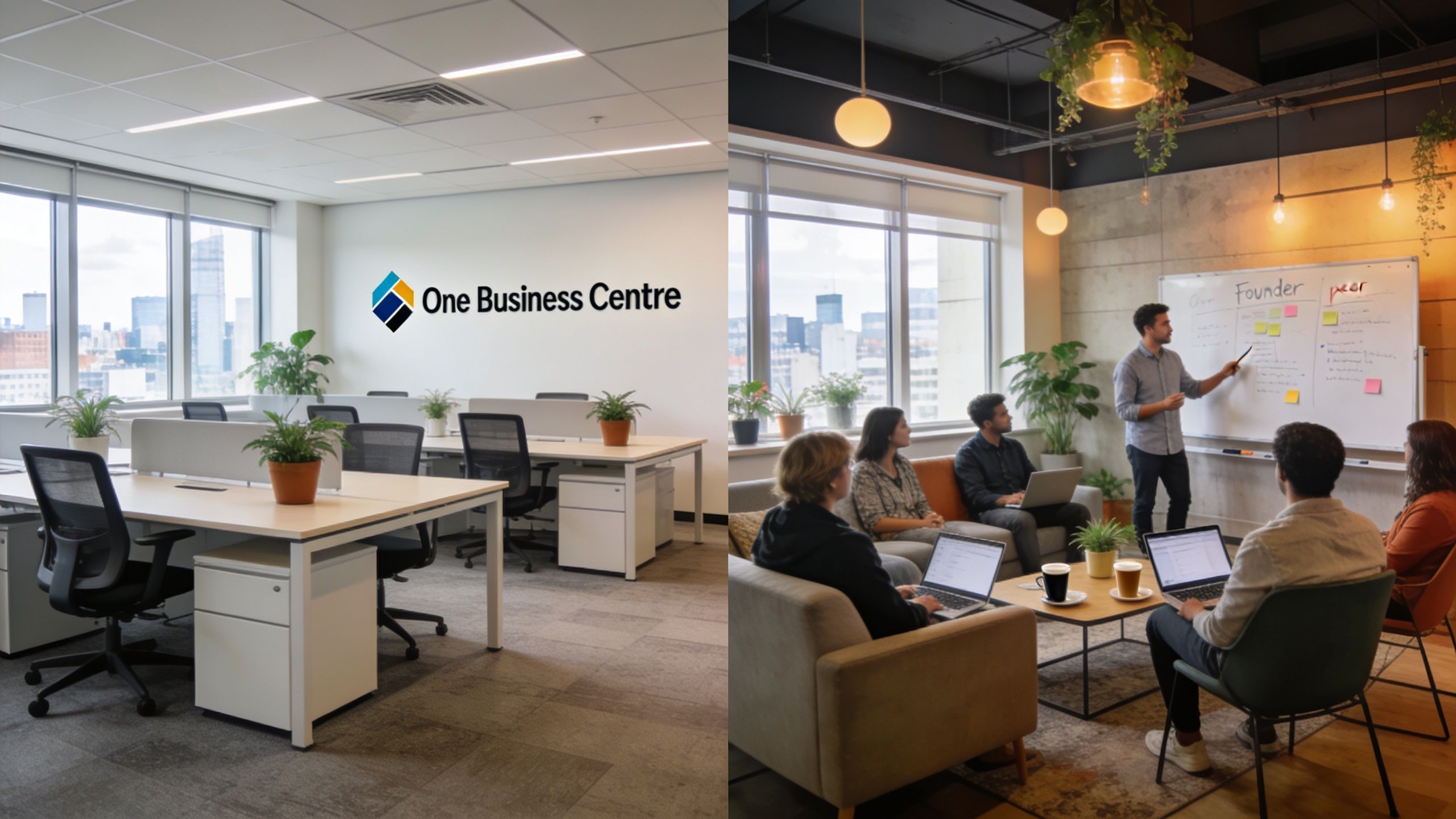
They compare one business center to another business center, or one co-working brand to another. The more useful comparison is different. Compare a space solution with a people solution.
They solve different problems
A business centre solves operational problems.
A founder peer community solves judgement problems.
That sounds abstract until you’ve built a company for a while. Then it becomes painfully obvious. One gives you rooms, admin support, address credibility, and a cleaner setup. The other gives you feedback, accountability, perspective, introductions, and a place to say what’s going wrong.
Head-to-head comparison
| Need | Business centre | Founder peer community |
|---|---|---|
| Registered business presence | Strong fit | Weak fit |
| Meeting rooms and office infrastructure | Strong fit | Weak fit |
| Founder accountability | Weak fit | Strong fit |
| Trusted strategic feedback | Weak fit | Strong fit |
| Warm peer relationships | Limited | Strong fit |
| Daily operating convenience | Strong fit | Weak fit |
The hidden mistake
Some founders buy space to compensate for a missing community.
They hope proximity to professionals will create the same value as a trusted founder circle. Usually it doesn’t. You may meet useful people, but that’s different from being in a room with peers who understand CAC pressure, hiring mistakes, co-founder tension, and when not to raise.
The better way to think about it
Use a business centre if you need infrastructure now.
Use founder community if you need better decisions now.
For some teams, the right answer is both, but in a very specific order. Get your strategic environment right first. Then choose the physical environment that supports it. Don’t reverse that order.
If you want a better sense of how intentional founder networking differs from generic proximity, this look at a Dubai business network built around relevance and trust is a useful contrast.
A room can make you look established. The right peers can help you become established.
My blunt view
If cash is tight, choose support over image.
A polished office feels good. Honest peer feedback makes you better. Founders usually need the second one more than they admit.
Your Action Plan Choosing Your Founder Home
You don’t need a long strategy deck for this decision. You need a clean filter.
Use these five questions. Answer them in writing, not in your head. Founders lie to themselves when they do this mentally.
Five questions that cut through the noise
What’s my main bottleneck this quarter?
If the answer is compliance, client meetings, or team coordination, one business center may be the right tool. If the answer is confusion, isolation, or slow decision-making, office space won’t fix it.What monthly office spend can I carry without anxiety?
Don’t choose based on what you can technically afford this month. Choose based on what you can sustain while revenue is uneven.Do I need a physical address right now?
“Right now” matters. Not six months from now. Not “it would be nice”. If you need business presence immediately, a business centre becomes more attractive.Will my team use the space well?
A nice office that sits half-empty is a vanity purchase. Be honest about how your team works.What kind of community helps me grow faster?
Some founders need better infrastructure. Others need better conversations.
The decision framework I’d use
| Your situation | Best next move |
|---|---|
| Need speed, low setup friction, professional presence | Choose a business centre |
| Stable team, predictable headcount, long-term certainty | Compare against a traditional lease |
| Solo founder, hybrid team, feeling stuck | Prioritise peer support before office spend |
| Need both structure and connection | Start with community, then add flexible space intentionally |
My recommendation
If you’re early, keep overhead flexible and your thinking sharp.
One business center is a sensible choice when you need operational readiness without the nonsense of a traditional office buildout. It’s strong on convenience and cash-flow clarity. That’s real value.
But don’t confuse a workspace with a growth system.
Before you sign a lease for a space, invest one month in a community of people. Join a curated peer group. The clarity you’ll gain on your real needs might be the best investment you make all year.
If you’re a founder in the UAE or wider MENA region and you want more than random networking, Founder Connects is worth a serious look. It’s built for founders who want practical peer support, curated introductions, honest accountability, and real progress. If your next bottleneck is isolation, decision quality, or access to the right people, start there before you commit to more overhead.

Building in MENA? You don't have to do it alone.
Join 300+ founders in the Founder Connects Residency. Monthly squad calls, warm intros, $3M+ in perks, and much more. All for less than your monthly coffee budget.
Popular posts





Founder Connects is a premium MENA tech founder community. Meetups in Dubai and across MENA, Residency Squads of 8–10, and 400+ vetted WhatsApp founders (apply and screened).