

A founder in Dubai gets this message every week. A friend of a friend has a “scalable growth model”. There’s a product, a referral layer, a digital community, and a promise that customer acquisition can start moving through people instead of paid ads.
The pitch sounds efficient. No agency retainers. No long SEO runway. No rising CAC from Meta or Google. Just motivated individuals, social selling, and compounding reach.
That’s exactly why online network marketing deserves a hard look from founders in the UAE and wider MENA. It’s big enough to matter, digital enough to feel modern, and risky enough to damage a young company if you treat it like a shortcut.
A lot of founders first meet online network marketing when they’re tired. Paid campaigns are underperforming. Organic content is slow. Partnerships take time. Then someone shows up with a cleaner story. “Let your users become your sales engine.”
Sometimes that’s a sensible channel discussion. Sometimes it’s a dressed-up recruitment scheme.

The reason this conversation keeps coming up in the UAE is simple. The market is large and visible. The UAE had over 500,000 active direct sellers as of 2022, with 15% year-over-year growth, and the broader regional market is projected to reach $4.5 billion by 2028, according to Epixel’s direct selling market statistics.
That scale makes online network marketing easy to underestimate. Founders see real volume and assume the model is automatically a valid growth lever for a startup. It isn’t that simple.
Founders hear three things that sound attractive:
The issue is that these benefits often get mixed together with incentives that don’t match how a startup should grow. A software founder selling a workflow tool does not face the same go-to-market reality as a wellness brand selling repeat-purchase consumer products.
Practical rule: If the opportunity is explained more through “team building” than customer value, treat it as a risk review, not a growth meeting.
Don’t ask, “Can this scale?”
Ask, “What behaviour does this model reward?”
If it rewards real product usage, compliant referrals, and clear customer outcomes, you may be looking at a channel worth testing. If it rewards hype, inventory pushing, or endless recruitment, you’re looking at a distraction.
For founders who want a cleaner starting point, it helps to compare online network marketing with a straightforward affiliate program structure. That frame usually strips away the noise. You can see whether the model depends on genuine customer acquisition or on creating layers of sellers under other sellers.
Online network marketing is easiest to understand if you stop thinking about it as “magic community growth” and look at it as a distributed sales model.
A company provides a product or service. Independent distributors promote it. They earn when they sell directly, and in many models they also earn when people they recruited make sales. The online part means those activities now happen through social platforms, messaging apps, landing pages, webinars, personal content, and e-commerce flows instead of living-room product parties.
At a practical level, online network marketing usually has four moving parts:
A core offer
This might be a supplement, beauty product, course, subscription, or service package. If the offer is weak or hard to explain, the whole system starts leaning too heavily on recruitment.
An independent distributor
This person isn’t your employee. They operate more like a micro-channel partner. They use their own audience, credibility, and contacts to sell.
A referral or downline layer
In many models, distributors can recruit other distributors. That recruited group is commonly called a downline. Once this layer becomes the main focus, founders should pay close attention to legal and brand risk.
A compensation plan
Most plans combine direct commissions from personal sales with some reward tied to the performance of recruited participants.
If you’re evaluating online network marketing as a founder, ignore the motivational language and map the cash flow.
Ask these questions:
That last question matters more than most founders realise. A sustainable channel still works when excitement cools down.
If your sales engine collapses when recruiting slows, you don’t have a marketing channel. You have a dependency.
The mechanics aren’t new. The distribution layer is. In the UAE, direct sales via online channels jumped 40% during the 2020 pandemic pivot, and by 2023 72% of UAE network marketers used social media for recruitment, often outperforming traditional methods on sales targets by 23%, according to Beehiiv’s network marketing statistics roundup.
That shift matters because digital tools remove friction:
A founder often sees online network marketing and thinks, “This is just partner-led growth.” Not quite.
A normal partner programme usually gives you clearer brand control, better training standards, and tighter messaging. Online network marketing often distributes selling power further out into the market, where scripts drift, compliance weakens, and customer expectations can get distorted.
Here’s the simplest mental model:
| Model | Primary actor | Main incentive | Main risk |
|---|---|---|---|
| Affiliate | Publisher or creator | Referred sale | Low brand control |
| Channel partner | Business partner or reseller | Revenue from managed accounts | Slower setup |
| Online network marketing | Individual distributor plus recruited network | Personal sales plus team performance | Recruitment drift and compliance risk |
That doesn’t make online network marketing automatically bad. It makes it operationally sensitive. Founders need to know exactly what behaviours their system rewards before they invite it into the business.
Most founders don’t need another moral argument about MLMs. They need a clean operating comparison.
The confusion starts because online network marketing and MLM overlap. In practice, online network marketing is often the digital execution layer of a multi-level model. The difference is less about category purity and more about emphasis. Some systems centre product demand and use digital tools to support selling. Others use digital channels mainly to speed up recruitment.
Traditional digital marketing sits in a completely different bucket. You control the message, the funnel, the customer journey, and the attribution model. It may be slower or more expensive upfront, but it usually gives a startup more durable learning.
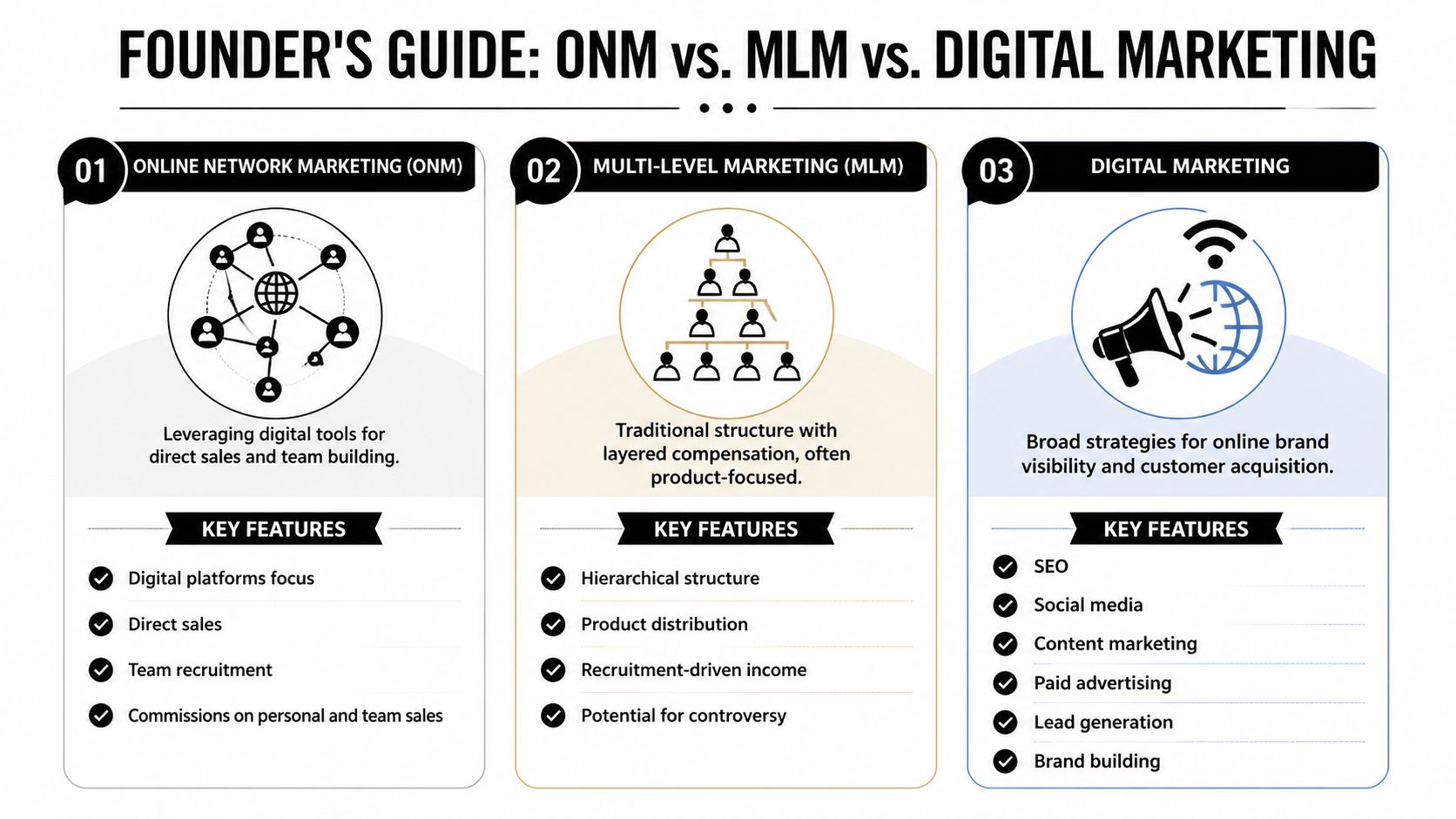
A founder should treat these two as cousins, not opposites.
MLM usually refers to a compensation structure with multiple levels of reward. Online network marketing describes how that structure is executed through digital channels. If someone says their model isn’t MLM because it happens on social media, that’s not a serious distinction.
The more useful question is this: Does the business remain attractive if nobody recruits anyone?
If the answer is no, the model is telling you what it really is.
Traditional digital marketing is less glamorous because it doesn’t promise compounding through social chains. But it gives you things startups need:
A founder weighing channels should also review broader marketing channels for UAE startups before treating online network marketing as a primary GTM move.
| Attribute | Online Network Marketing | Traditional Digital Marketing | Curated Founder Community |
|---|---|---|---|
| Primary mechanism | Distributed selling through individuals and recruited networks | Direct acquisition through owned and paid channels | Trust-based introductions and peer-driven opportunities |
| Brand control | Lower. Messaging can drift across sellers | Higher. Central team controls assets and campaigns | High in relationship context, but not a mass acquisition engine |
| Speed to launch | Can launch quickly if structure already exists | Fast for paid channels, slower for content and SEO | Slower to build, but stronger signal quality |
| Fit for B2B SaaS | Usually weak | Usually strong | Strong for intros, feedback, partnerships |
| Fit for repeat-purchase consumer products | Can work if product demand is genuine | Strong if margins support paid growth | Limited as a direct sales channel |
| Compliance burden | High if recruitment and incentives are layered | Moderate and more predictable | Low as a network model, separate from sales compliance |
| Learning quality | Mixed. Feedback can be distorted by incentives | Strong. Data comes from controlled campaigns | Strong. Feedback is candid and contextual |
| Reputational risk | High if sellers overclaim | Moderate and manageable | Low if curated well |
| Scalability pattern | Uneven. Can spike fast, then destabilise | More linear and measurable | High trust, lower volume |
| Best use case | Narrow set of simple offers with careful controls | Core GTM for most startups | Strategic support, intros, accountability |
Founders often compare only the cost side. That’s a mistake. The comparison is cost plus control plus consequence.
Consider the differences:
Founder lens: If your product needs education, onboarding, demos, compliance review, or nuanced positioning, uncontrolled person-to-person selling usually hurts more than it helps.
That’s why many startup teams end up landing on a lighter model, such as ambassadors, affiliates, referral partners, or customer advocates, instead of a full online network marketing structure. Those models preserve some word-of-mouth influence without importing the full downside of MLM-style incentives.
Most generic online network marketing advice becomes useless for a UAE founder. It talks about “building teams” and “social selling” but says almost nothing about local compliance, consumer protection, privacy, or reputational fallout.
That omission is expensive.

There was a 35% rise in consumer complaints about unregistered schemes in 2025, and local rules such as Federal Decree-Law No. 28/2021 can expose businesses to fines up to AED 1 million, according to this analysis of underserved compliance gaps in the UAE market.
A legal sales model and an illegal or non-compliant scheme can look similar in early conversations. The difference usually sits in the economics and the claims being made.
Watch for these red flags:
A founder’s job isn’t to ask whether these red flags are common. It’s to decide whether the business can survive if even a small number of them appear under your brand.
Federal Decree-Law No. 28/2021 matters because online network marketing often relies on persuasive personal selling. If those sellers misrepresent outcomes, hide terms, or create false expectations, the startup behind the programme may carry more risk than it expected.
Then there’s data handling. Distributor-led growth usually involves contact sharing, prospect lists, direct messaging, and follow-up outside your owned systems. If you’re collecting or processing personal data in the UAE, founders should get clear on practical privacy obligations early. A useful starting point is this guide on what founders need to know about the UAE PDPL.
You also need a clean answer on VAT treatment for digital sales and commissions before launch. Don’t leave that to your first finance hire or to a distributor WhatsApp group.
Compliance rule: If you can’t explain your compensation logic, sales claims, and data flow clearly on one page, you’re not ready to run this channel.
Before approving any online network marketing structure, ask your team and legal adviser:
A short explainer on the broader risk environment can help frame the issue before you formalise anything:
In the UAE, trust moves business. A founder can recover from a weak ad campaign. Recovering from a reputation as “one of those schemes” is much harder.
This is why online network marketing shouldn’t be reviewed only by growth. Founders should involve legal, finance, and whoever owns brand and community. If those functions don’t exist yet, that’s not a reason to move faster. It’s a reason to narrow the experiment or skip it entirely.
Most tech founders shouldn’t ask whether online network marketing is “good” or “bad”. They should ask whether it fits their product, buyer behaviour, and brand posture.
In the UAE and wider MENA market, 72% of consumers prefer halal-certified digital businesses, and trust issues contribute to network marketing adoption being 25% lower than global averages, according to LivePlan’s review of underserved market dynamics. That matters because channel choice is never just economic. It’s cultural and reputational too.
Use this before you spend a week designing incentives.
Online network marketing works better when the offer is easy to understand, easy to demonstrate, and easy to buy without a long sales cycle.
A repeat-purchase consumer product can sometimes fit. A complex B2B SaaS product usually doesn’t. If your product needs onboarding, API explanation, security review, procurement steps, or stakeholder buy-in, a distributor model creates confusion fast.
Some categories benefit from peer recommendation. Others don’t.
If your buyer is influenced by trusted personal recommendation and can decide quickly, there may be a case for a lightweight referral structure. If your buyer needs internal approval, product comparisons, and a business case, online network marketing is usually the wrong path.
Founders underestimate this point because they think training solves it. It doesn’t.
Ask yourself:
If the answer is no, you need a more controlled channel.
A premium or trust-sensitive brand should be very careful about any model that decentralises promises before the company has mature controls.
This isn’t abstract. In MENA, founders need to think about whether the incentive design feels aligned with local expectations around fairness, transparency, and financial ethics.
That includes questions such as:
This is also where many founders realise they don’t need online network marketing at all. They need something narrower and cleaner, such as referrals, ambassadors, or affiliate marketing for startups, where incentives can stay tied to actual customer acquisition rather than layered recruitment.
| If this sounds like you | Likely answer |
|---|---|
| You sell B2B software, fintech, healthtech, or complex services | Avoid online network marketing |
| You sell a simple consumer product with strong repeat behaviour | Maybe test a tightly controlled version |
| Your brand relies on precision, regulation, or premium trust | Avoid or use affiliate-only models |
| You don’t yet have legal, finance, and community moderation capacity | Don’t launch this channel |
| You mainly want more word of mouth | Build referral and customer advocate systems instead |
For most UAE startups, especially software companies, online network marketing is a poor primary GTM choice. It weakens message control, creates compliance drag, and attracts the wrong conversations inside the company. Teams start talking about recruitment mechanics when they should be improving product-market fit, retention, onboarding, and partnerships.
Where it can work is narrow. Usually simple offers. Usually consumer-facing. Usually with strict guardrails. If you have to argue hard to make the model fit, it probably doesn’t fit.
If you still want to test the channel, keep it lean. Don’t build a multi-level machine. Don’t create a “founding distributor” culture. Don’t ask the market to trust a structure you haven’t earned the right to run.
Run a pilot that behaves more like a controlled ambassador or affiliate programme.

The safest pilot is simple:
This isn’t because multi-level models can never function. It’s because startups need signal before scale.
A lean pilot needs a short written policy pack. Not a motivational deck. A rules pack.
Include:
A CRM like HubSpot can help track referred leads and conversion stages. Even a lightweight setup is better than managing this through spreadsheets and chat threads.
That’s a compliment. Boring is compliant.
When using social media, there’s clear evidence of its influence. 89% of top salespeople affirm social media’s critical role in closing deals, and strong social selling programmes can produce a 48% increase in deal size, according to ElectroIQ’s network marketing industry statistics.
That doesn’t mean your pilot should become a content free-for-all. It means you should guide people towards disciplined behaviour:
Test whether people can create qualified conversations, not just attention.
Founders often launch channel experiments without a stopping rule. That’s how messy pilots become expensive habits.
Define in advance what will end the test:
Complaint threshold
If you start getting brand or conduct complaints, pause.
Lead quality failure
If referred leads are consistently low-intent, stop rewarding volume and review fit.
Operational drag
If your team spends too much time correcting claims, this channel is costing more than it appears.
Weak economics
If direct referred customers don’t retain or convert well enough, close the pilot.
A strong pilot gives you one of two useful answers. Either this can be a controlled acquisition layer, or it can’t. Both outcomes are valuable if you keep the experiment tight.
Online network marketing chases reach. Founders usually need signal.
That’s the core mismatch. A startup rarely wins because it found more loosely connected sellers. It wins because it got better feedback, stronger introductions, sharper positioning, and more honest accountability. Those things come from trusted relationships, not from incentive ladders.
A curated founder network works differently. It helps a founder test decisions with peers who have context. It creates warm paths to collaborators, partners, and investors. It gives you people who will tell you your pricing is wrong, your onboarding is weak, or your channel assumptions don’t hold up. That’s worth more than a large group of semi-motivated distributors repeating a script.
This also matters for operators building advisory, education, or support layers around founders. Tools such as an all-in-one coaching platform can support structured guidance and accountability in a way that feels far more aligned with serious company building than hype-led recruitment systems.
If your real problem is isolation, unclear GTM choices, or weak access to relevant people, online network marketing won’t solve it. A stronger answer is usually intentional relationship-building through trusted circles, practical sessions, and curated introductions. That’s the model behind building a strong startup network in Dubai.
The founders who make durable progress in the UAE ecosystem usually do one thing well. They get into the right rooms, with the right people, for the right reasons.
If you want that kind of high-signal support, Founder Connects is built for it. It brings UAE and MENA founders into curated peer groups, practical conversations, and relevant introductions so you can make better decisions, move faster, and build with less isolation.


