

For founders in the UAE, the name Rocket Internet GmbH might feel like a relic from a different tech era. But writing it off is a mistake. The German venture builder was a masterclass in aggressive growth, leaving behind a powerful playbook of strategies to learn from—and critical mistakes to avoid.
This guide gives you clear, practical answers fast. We'll extract actionable frameworks from their journey that you can use to make better decisions for your own venture.
You should care because Rocket Internet literally wrote the manual on how to conquer new markets with ferocious speed. Understanding their model isn't a history lesson; it's a deep dive into a high-velocity system that shaped the e-commerce and startup world you operate in today, especially here in the MENA region.
Rocket Internet wasn't a typical VC. It was a "startup factory" or venture builder. They systematically found successful digital business models in places like the US and then cloned them at breakneck speed in untapped regions across the globe.
Founded in 2007 by the Samwer brothers, the company was built on a simple, ruthless belief: a great business idea is only 10% of the battle. The other 90% is pure execution.
This conviction was the engine behind their entire operation. They industrialized company creation, building centralized teams for marketing, engineering, and HR that could launch and support multiple startups simultaneously.
Their playbook was simple but brutal:
Founder Takeaway: The biggest lesson from Rocket Internet is their relentless focus on operational excellence. They proved that a well-oiled execution machine can be a far more powerful weapon than a completely original idea.
Next Action: As you read on, ask yourself: "Which of my startup's core processes could be turned into a system to move faster?" Start by mapping out one key function—like customer onboarding or content creation—and pinpoint the steps you can standardize right now.
The blistering speed of Rocket Internet wasn't magic. It was a brutally efficient, industrialized process for building companies from scratch. Think of their model not as an incubator but as a high-output startup factory.
A typical VC writes a check. An incubator offers mentorship. Rocket built the entire company. They provided everything from the initial idea and seed funding to the operational teams ready to execute.
This "venture builder" approach flipped the normal startup script. Rocket didn't wait for founders with a pitch deck. They identified a proven business model, assigned internal teams to clone it, and installed a management team to follow a very specific plan. At the heart of it all was a set of standardized playbooks for everything—marketing, HR, engineering, finance.
The most legendary piece of the Rocket machine was its 100-day launch plan. This was a rigid, day-by-day checklist that dictated every action needed to take a company from concept to a fully operational business.
The plan mapped out every detail:
This militant structure removed guesswork and forced an insane pace. The lesson for UAE founders isn't to copy this plan verbatim, but to understand the raw power of building systems. When you turn key operations into repeatable processes, you build a machine that can scale predictably. Building a strong network through structured programs can also be a game-changer; dig deeper into the value of accelerator networks beyond just funding.
This visual gets to the core of the three-step process behind the Rocket Internet model.
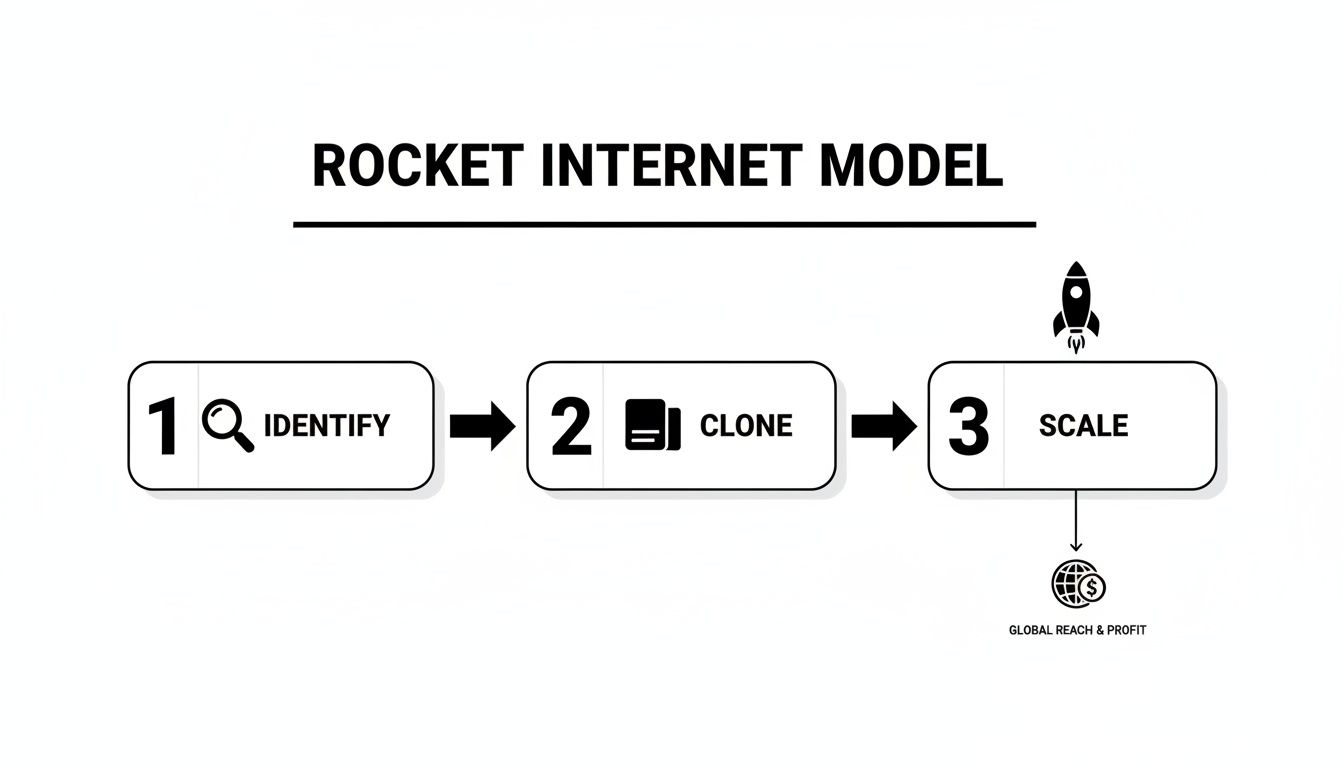
As the diagram shows, Rocket systematically de-risked company creation by focusing only on proven concepts and plugging them into a powerful, centralized engine built for scaling.
It’s crucial to grasp how different the venture builder model is. The level of hands-on involvement sets them apart.
"A VC gives you money and a board seat. An accelerator gives you a program and a network. A venture builder like Rocket Internet gives you a company."
Let's break it down:
Next Action: Turn one of your startup’s ad-hoc activities into a documented, repeatable process this week. This discipline is what separates a one-off project from a business that can scale.
The Rocket Internet story isn't just a global phenomenon; its impact was felt profoundly right here in the UAE and MENA. Their entry was a calculated, heavily funded invasion designed to dominate the region's nascent digital economy.

Understanding how they entered this market is a lesson in strategy, timing, and local adaptation. Their bold entry came with a massive €300 million commitment in 2014, partnering with South African telecom giant MTN. This birthed Middle East Internet Holding (MEIH), a turbo-charged incubator to clone and scale internet hits specifically for the Gulf. You can read more about Rocket Internet's strategic partnership with MTN.
Rocket’s decision to storm MENA was textbook strategic market selection. They saw a region on the cusp of a digital explosion. These signals are still relevant for spotting opportunities today.
This combination of a ready consumer base and a lack of sophisticated local competition created the perfect storm.
Under MEIH, Rocket launched and invested in several companies that are now household names. Their strategy was both building from scratch and acquiring promising local players.
Founder Takeaway: You don’t always need to build from zero. Acquiring a local champion can be a faster path to securing market leadership and integrating crucial local knowledge.
Two of their most significant ventures were Namshi and Talabat.
Namshi: Launched in 2011, Namshi was Rocket's answer to Zappos for the Middle East. It was a classic "clone and scale" play. By pouring resources into logistics, marketing, and a localized customer experience, they quickly built one of the region's premier online fashion destinations.
Talabat: While not a Rocket creation, their acquisition of Kuwait-based Talabat through their entity Delivery Hero in 2015 for $170 million was a masterstroke. They spotted the clear market leader in food delivery, bought it, and instantly became the dominant force.
These ventures fundamentally altered the competitive dynamics for any local entrepreneur. They raised the stakes, forcing everyone to move faster and think bigger. For insights on building a competitive business from the ground up, check our guide on key considerations for a Middle East startup.
The real lessons are in the big wins and the quiet shutdowns. For every celebrated exit in the Rocket Internet GmbH portfolio, there are dozens of cautionary tales. Digging into both gives us real-world patterns for building a resilient business in the MENA region.

These aren't just case studies; they're strategic blueprints. Let's look at one massive success and one notable flameout.
One of the most legendary successes tied to Rocket Internet in the Middle East is Delivery Hero. Rocket’s heavy backing was critical to its global expansion, which led to one of MENA's most iconic deals: the acquisition of Talabat.
In 2015, Delivery Hero acquired Kuwait-based Talabat for a staggering $170 million. This was a strategic masterstroke, cementing its dominance in the region's exploding food delivery market. It perfectly captures the Rocket playbook's dual strategy: build when you have to, but buy when it's faster.
Founder Takeaway: Market leadership is the only prize that matters. Whether you get there by building from scratch or by acquiring the front-runner is a tactical decision, not an emotional one.
The success of this deal came down to a few key factors:
Over eight years, Rocket and its partners poured nearly $1 billion into the food sector alone. This surgical focus paid off, especially as MENA e-commerce exploded to an $8.3 billion industry by 2017. You can find more on Rocket's multi-million dollar Middle East strategy.
On the other side is Wadi. Launched in 2015, Wadi was built to be a direct challenger to Souq.com (now Amazon.ae). With serious backing, Wadi had plenty of cash and a sky-high vision.
But despite raising over $67 million, Wadi couldn't carve out a sustainable market slice. It eventually pivoted before fading away. What went wrong?
Key Missteps and Founder Takeaways
The stories of Wadi and Talabat show two sides of the same coin. One successfully acquired its way to market leadership, while the other was crushed by it. The contrast offers a powerful lesson: knowing when to buy or partner can be as crucial as knowing how to compete. For another perspective on scaling in the region, read about Careem's journey to global markets.
No honest look at Rocket Internet GmbH is complete without digging into the controversies. The same aggression and speed that fueled its rise also cast a long shadow, holding heavy lessons for founders in the UAE and MENA today. This is about understanding the dangerous trade-offs of a "growth-at-all-costs" mindset.
The most persistent jab was the "clone factory" label. Rocket built its empire by systematically copying proven business models. While it worked financially, it drew fire for smothering genuine, local innovation. Critics argued the model was parasitic, creating a zero-sum game where a deep-pocketed clone could simply outspend and crush a smaller local startup.
The internal culture at Rocket was often described as a "pressure cooker," known for its punishing pace, impossibly high targets, and a brutal focus on hitting KPIs.
This aggressive culture had several knock-on effects:
Founder Takeaway: A company’s soul is defined by the trade-offs it’s willing to make. Chasing growth by sacrificing your team's well-being is a debt that eventually comes due.
The Rocket model put entrepreneurs in a tough spot. They were handed immense resources but at the cost of creative freedom and a huge slice of equity. They were founders by title, but often just executors in practice.
This brings up a core question for any founder today: What do you value more—control and vision, or speed and resources?
Next Action: Block out 30 minutes this week with your co-founder or a trusted mentor. The only agenda item: "What are our non-negotiables?" Define the cultural and ethical lines you will not cross, even if it means slower growth. Write them down. This simple act can give you clarity when you face your first high-pressure decision.
The Rocket Internet story is a playbook filled with strategies, warnings, and frameworks you can use right now. This is about adapting their core ideas—speed, systems, and strategic aggression—for a market that's far more mature and competitive today.
Rocket mastered the "fast-follow." For founders today, the lesson isn’t to just copy-paste, but to be smart about adaptation.
Next Action: Get your team together and ask: "If we were to 'fast-follow' a successful global company in our industry, what would be our unique 'MENA-specific' advantage?" Aim for three concrete things that would set you apart.
Rocket's superpower was its "startup factory." You can adopt their systematic mindset to build your own execution engine. This is about shifting from chaotic work to documented, scalable systems. For founders getting an idea off the ground, a structured guide on how to launch a SaaS product can be a game-changer.
Start small by creating simple playbooks for your core operations:
These don’t need to be long. They just need to be written down and shared.
Next Action: This week, pick one core process in your business. Spend two hours documenting it from start to finish. That's the first brick in your execution engine.
The dark side of the Rocket model offers important lessons. Their "growth-at-all-costs" approach led to burnout, shaky unit economics, and a reputation for chasing quick exits.
Founders in MENA can learn from these stumbles:
Ultimately, the biggest lesson from Rocket Internet GmbH is this: a great idea might get you started, but disciplined execution and a healthy culture build a company that lasts.
For any founder looking at venture builders, it's crucial to understand the trade-offs. This table breaks down what you gain and what you give up.
Deciding if this model is right for you comes down to what you value most. If your goal is rapid execution with a safety net, the trade-offs might be worth it. If you prioritize autonomy and long-term equity, building from the ground up might be the better path.
Blatant copy-pasting is a tough sell in today's smarter MENA ecosystem. But the core idea of 'fast-following' is absolutely viable. The lesson from Rocket Internet GmbH is to learn from what works globally, then adapt with a deep understanding of local nuances—culture, regulations, and consumer behavior. Superior execution on that localized model is what wins.
The power of systems and support. You can't replicate Rocket's machine, but you can steal the mindset. Create repeatable processes for sales, marketing, and onboarding. More importantly, build a solid support network. You need people for advice and operational leverage. Don't do everything from scratch.
They were methodical. They used a framework looking at market size, consumer purchasing power, and digital readiness. They started with the UAE as a dynamic, high-spending hub and Saudi Arabia for its massive scale. These were their beachheads. Once they had a foothold, they expanded to large population centers like Egypt. It was a smart, tiered approach.
At Founder Connects, we believe building a great company shouldn’t be a lonely journey. We provide UAE and MENA founders with curated peer groups, actionable support, and the meaningful connections you need to grow faster and make smarter decisions. Join a community built for real progress.


