

How to Start a Startup Company in the UAE: A Founder's Roadmap

Building in MENA? You don't have to do it alone.
Join 300+ founders in the Founder Connects Residency. Monthly squad calls, warm intros, $3M+ in perks, and much more. All for less than your monthly coffee budget.

Starting a company in the UAE is about more than a great idea—it's about execution. You need a launchpad, not a lecture. This is a practical, step-by-step guide to help you plug into the local ecosystem, navigate the rules, and make sharp, informed decisions fast.
Forget generic business advice. This is your playbook for building a startup in a region engineered for ambition.
Why the UAE Is a Startup Gold Rush Right Now
Let's be clear: deciding where to launch is one of your first big calls. The UAE isn't just a pin on the map; it has deliberately engineered an ecosystem to attract global talent and big ideas. For founders, this means tangible advantages that go beyond low taxes—it's about speed, access, and a government that wants you to win.
The hype is real. Starting a startup in the UAE has exploded, with over 5,600 new companies registered in Q2 2024 alone. This isn't just a number; it's a signal of a booming ecosystem where you can find the peer support and resources needed to navigate rapid growth.
This surge is no accident. It's the result of Dubai's mission to become a global innovation hub, powered by free zones designed to cut red tape. For you, this means getting a trade license approved in as little as 2-4 weeks, not months.
This infographic nails the core elements fuelling the UAE's momentum: growth, speed, and talent.
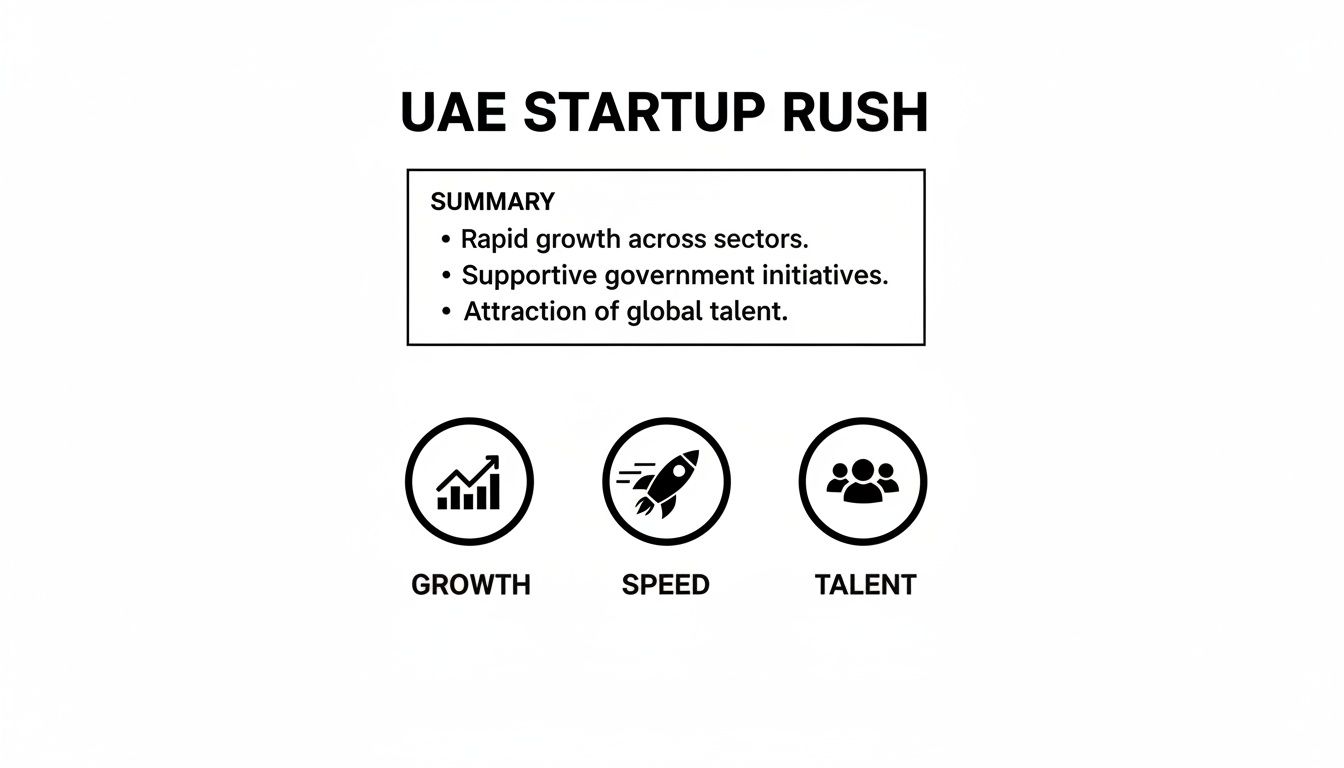
The takeaway is simple: the region's appeal is a potent mix of rapid expansion, efficient setup, and a truly international talent pool.
The Power of Proximity and Community
In a market moving this fast, who you know is as critical as what you're building. The concentration of founders, investors, and top talent in hubs like Dubai creates a unique advantage. A chance meeting at a coffee shop can lead to a game-changing partnership. An introduction can solve a problem that would otherwise take months to untangle.
But this density can be overwhelming. The key isn't just attending big networking events; it's about finding your inner circle—your trusted tribe.
For solo founders, the risk of isolation is real. A curated peer group provides the accountability and unfiltered feedback you need to make smart decisions under pressure, turning a challenging journey into a collaborative one.
Building these connections early is non-negotiable. This is where you find co-founders, your first key hires, and even your first customers. You can read more about how Dubai fosters this unique environment in our article on the rise of "Silicon Valley in Dubai".
Key Ingredients of the UAE's Startup Ecosystem
So, what makes the UAE so attractive? It boils down to a few key elements creating a founder-first environment.
- Government-Backed Ambition: Initiatives like the National Program for Coders and the Golden Visa aren't just policies; they are clear signals that the government is all-in on a knowledge-based economy and wants the best talent building here.
- Access to Global Talent: As a global crossroads, the UAE attracts professionals from around the world. This means a deep, diverse talent pool with international experience is right on your doorstep.
- A Culture of Speed: The business culture here values action. Processes that drag on for months elsewhere are often wrapped up in weeks. This lets you get from idea to launch incredibly fast—a massive competitive advantage.
Next Action: Ask yourself: "Which of these three advantages is most critical for my startup's success right now?" Your answer will help you decide where to focus your initial networking and setup efforts.
Validating Your Idea in the MENA Market
An idea is just a starting point. To successfully start a startup company, you must prove people in the MENA region actually want what you’re building. Forget abstract theories; the goal is to get real answers, fast.

Validation isn't a one-off task. It's a constant loop of learning, building, and tweaking to swap your assumptions for market realities before you pour in serious time and money.
Customer Discovery: A Practical MENA Approach
Your first job is to talk to potential customers. The key is to learn, not to sell. In the MENA region, this requires a thoughtful approach that respects cultural nuances. Direct, blunt questioning can be seen as aggressive. Frame your conversations around their current problems and behaviours instead.
Here’s a simple framework for your customer interviews:
- Look at Past Behaviour: Ask how they’ve tried to solve a specific problem before. People are more honest about what they have done than what they might do.
- Ask Open-Ended Questions: Instead of "Is this feature useful?", try "Tell me about the last time you tried to [achieve X outcome]." This uncovers pain points you haven't considered.
- Leverage 'Wasta': When appropriate, use your network for warm introductions. A referral from a mutual connection leads to a more open, honest conversation.
The goal of customer discovery isn't to hear people say they love your idea. It’s to find a problem so painful they are already trying—and failing—to solve it. That's your opening.
For a closer look, check our guide on how to define your target customers in the UAE.
Building a Lean and Local MVP
Once you have initial insights, build a Minimum Viable Product (MVP). An MVP isn't a stripped-down product; it's the smallest thing you can create to start learning from actual users.
With today's no-code tools, you don't need a massive technical team. Many successful MENA startups began with simple MVPs. For example, a new F&B delivery concept might start with a simple WhatsApp Business account and a Google Form for orders to test demand in a specific neighbourhood.
Next Action: Pinpoint the single most important action you want a user to take. Can you test that core function with a simple landing page, a Typeform survey, or a WhatsApp bot? Start there.
The feedback from this early version is gold. It helps you decide whether to pivot or push forward. For a deeper dive, learn how to validate a startup idea with a practical playbook.
The Unfiltered Feedback Loop
Friends and family will almost always tell you your idea is brilliant. Their feedback is useless. You need raw, objective input from people who have been in the trenches.
This is where a curated peer group becomes your most valuable asset. Other founders will:
- Poke Holes in Your Assumptions: They’ve made similar mistakes and will spot your blind spots.
- Give Honest Feedback: They aren't worried about hurting your feelings; their goal is to help you build a viable business.
- Keep You Accountable: Sharing your validation goals with peers creates accountability that pushes you to execute.
Validating your idea is about reducing risk. By systematically testing your assumptions with real people in the MENA market, you shift from a guess to an evidence-backed strategy.
The Operational Playbook: Legal, Banking, and Tech Setup
You've validated your idea. Now, turn it into a real, legal business. This is where momentum can stall, but it doesn’t have to.
Getting your company registration, corporate bank account, and compliance right from the start saves you from massive headaches later, especially when preparing for your first funding round.

A solid operational footing is critical. Dubai is home to over 3,500 active startups valued at more than $28 billion as of 2023, with the ecosystem projected to grow +32% by 2025. To thrive here, you need a strong foundation. For more context, this ecosystem overview explains how these hubs provide vital support.
Choosing Your Legal Structure: Free Zone vs. Mainland
First, where will you incorporate? The main choice is between a free zone and the mainland. For most tech startups, a free zone is the clear winner for several reasons.
Free zones offer 100% foreign ownership, zero personal and corporate income tax, and simpler import/export rules. But each zone has its own focus.
- Dubai Multi Commodities Centre (DMCC): A solid all-rounder with a well-respected regulatory framework that investors like.
- Dubai International Financial Centre (DIFC): The top choice for FinTech, operating under its own common-law jurisdiction—a massive plus for international investors.
- Abu Dhabi Global Market (ADGM): Another heavy-hitter with a common-law jurisdiction, becoming a major hub for tech and finance.
Pick the jurisdiction that fits what you're building today and where you plan to go tomorrow. A mismatch can limit your operations later.
Tackling the Corporate Bank Account
The UAE corporate bank account is a notorious bottleneck. Banks have strict Know Your Customer (KYC) and Anti-Money Laundering (AML) checks, and the process can drag on for weeks or even months.
Don't underestimate this step. Start the bank account application process the moment your trade license is issued. Delays here will impact everything.
Next Action: Create a "Bank Account Application" folder on your Google Drive and get these files in there now:
- Founder Documents: Passport copies, visa pages, and Emirates ID for all shareholders.
- Company Documents: Trade license, Certificate of Incorporation, Memorandum of Association, and your office lease agreement.
- A Clear Business Plan: A crisp, one-page summary. What do you do? Who are your customers? What is your projected cash flow?
Being over-prepared is your best weapon here. A complete, tidy submission massively increases your odds of a smooth approval.
Building Your Initial Tech Stack
With your legal and banking sorted, assemble your operational toolkit. Your first tech stack should be simple, efficient, and scalable. Stick with tools well-supported in the region.
- Payments: Stripe is the go-to in the UAE. It’s easy to integrate and reliable.
- Accounting: Zoho Books is a favourite among UAE startups as it's fully FTA-approved for VAT compliance. Xero is another great international choice.
- Communication: Slack and Google Workspace are the global standards.
By nailing these three pillars—legal structure, banking, and essential tools—you build the operational backbone needed for confident growth.
A Founder’s Guide to Early-Stage Funding
Landing your first cheque is a massive milestone. In the MENA region, it's not just about a killer idea. You need to understand a funding landscape with its own rules and know how to build the right relationships.
Forget the Silicon Valley playbook. What works there often falls flat here. Local VCs and angels weigh a founder's resilience, deep market knowledge, and a clear path to monetization in a diverse region.
The capital is here. Funding for UAE startups hit $704.3 million in Q3 2025 across 26 deals. This shows money is flowing into mature ecosystems like Dubai and Abu Dhabi. MENA funding had already reached $6.6 billion by Q3 2025, proving that if you know how to position yourself, investors are ready.
Crafting a Pitch Deck for a MENA Audience
Your pitch deck is your foot in the door. It must speak the local language. While the structure is standard—problem, solution, market, team—the story and data must be rooted in regional realities. Generic global stats won't work.
- Localise Your Problem: Explain why it's a particularly sharp pain point for customers here. Use local examples. For instance, instead of a generic e-commerce problem, frame it as a last-mile delivery challenge specific to Riyadh's sprawling layout.
- Show Real Traction: Vanity metrics are useless. Show tangible proof of demand—a pilot with a well-known local company, a strong waitlist, or early revenue. Every dirham counts.
- Highlight Your "Unfair Advantage": Why is your team the one to win in MENA? Is it your deep industry connections, previous on-the-ground experience, or unique insight into local consumer psychology? Spell it out.
MENA investors bet on the founder's ability to navigate the local landscape as much as the idea itself. Your deck must build confidence in both.
Identifying and Approaching the Right Investors
Raising capital is a matching game, not a numbers game. Blasting your deck to every VC is a rookie mistake. Use a surgical approach.
Next Action: Open a spreadsheet with these columns:
- Investor Name: (VC fund or angel group).
- Investment Stage: (Pre-seed, Seed, Series A).
- Sector Focus: (FinTech, SaaS, HealthTech).
- MENA Portfolio Examples: List 1-2 of their local investments to show you've done your homework.
- Potential Connection: Find a mutual contact for a warm introduction.
The cardinal rule of fundraising here: never cold email. Your goal is a warm introduction from a trusted connection. Other founders in your network are often the best source for these intros. For a deeper dive, our complete guide on fundraising for startups breaks this down.
Mastering the Pre-Fundraising Game
The best time to build relationships with investors is when you don’t need their money. This "pre-fundraising" phase is about getting on their radar and building credibility long before you ask.
Send short, periodic progress updates via email.
- Key Metric Growth: "Our user base grew 30% month-over-month."
- Product Milestones: "We just launched our beta and onboarded our first 100 users."
- Key Hires: "We brought on a new technical lead from Careem."
While VC funding is often the goal, it's not the only option. Securing a startup business loan in UAE can be a smart move, especially for businesses with a clear path to revenue.
Building Your Go-To-Market and Scaling Plan
You have money in the bank. Now the real work begins. Your focus shifts from raising capital to deploying it with precision. A go-to-market (GTM) strategy for the diverse MENA market is about building a machine for repeatable customer acquisition.
Forget generic advice. The MENA region is a mosaic of cultures and behaviours. A campaign that succeeds in Dubai may fail in Riyadh. Your plan needs nuance.

This means digging into cost-effective channels that thrive here, like community-led growth and hyper-targeted digital campaigns.
Nailing Your Initial Acquisition Channels
Your first 100 customers are the hardest to get but the most valuable. Instead of spreading your budget thin, go deep on one or two channels that fit your business and UAE audience.
A B2B SaaS company selling to enterprises in DIFC has a different playbook than a D2C brand targeting millennials in Jeddah.
Consider these starting points:
- Community-Led Growth: Build a genuine community around the problem you solve. This could be a lively WhatsApp group, local meetups, or a valuable content hub. It's a slow burn but builds loyalty.
- Hyper-Targeted Digital Campaigns: Ditch broad campaigns. Use LinkedIn to target specific job titles at ideal companies. For B2C, use Instagram and TikTok with content that speaks to local cultural trends.
- Strategic Partnerships: Team up with non-competing businesses that already have the trust of your target audience. A co-hosted webinar or a joint offer can provide instant credibility and reach.
Your initial GTM strategy is a series of experiments. The goal is to find a repeatable, scalable channel before you run out of cash.
Building a Team That Can Scale
As you get traction, your biggest challenge shifts from finding customers to finding talent. Hiring is competitive in the UAE, but government incentives can help.
The Golden Visa is a game-changer. Offering a 10-year residency visa to key hires with specialized skills is a massive differentiator when competing against larger companies.
Next Action: Identify the first three key roles for your GTM plan. For each, create a scorecard defining what success looks like in the first 90 days. This shifts your focus from a CV to a candidate's ability to deliver immediate impact.
Designing Processes for Regional Expansion
Scaling is about building processes that don't break as you expand. What works for a team of five in Dubai will fall apart with a team of 20 across three countries.
Start documenting your operational playbook early—from sales processes to customer onboarding. This ensures consistency and makes it easier to train new hires as you expand into markets like Saudi Arabia or Egypt.
Your Top Questions About Starting a UAE Startup, Answered
Jumping into the UAE startup scene brings questions. You need straight, practical answers. Let's tackle the big ones.
What's the Fastest Way to Get a Business License in Dubai?
For speed, free zones are your best bet. Zones like IFZA (International Free Zone Authority) or Meydan Free Zone are known for quick, straightforward processes. You can often get a trade license in a few days.
The secret to moving fast is having all your documents ready before you start. Delays almost always come from missing paperwork.
Actionable Checklist:
- Passport Copies: Clear, high-resolution scans for every shareholder.
- Proof of Address: A recent utility bill or bank statement.
- Business Plan Summary: A one-pager explaining what your business does.
Realistically, budget 4-6 weeks for the entire process, from license to visa and bank account.
How Much Cash Do I Really Need to Launch a Tech Startup Here?
For a lean tech startup in a cost-effective Dubai free zone, plan for a first-year setup budget between AED 25,000 and AED 45,000.
This typically covers:
- Trade License: Your main cost, varying by free zone and business activity.
- Establishment Card: Essential for sponsoring visas.
- One Residence Visa: For you, the founder.
- Office Solution: A flexi-desk or co-working space membership.
Warning: The biggest financial shock for new founders is the time it takes to open a corporate bank account. Delays cause cash flow headaches, so build a buffer into your financial plan.
This budget is just for setup. Have at least six months of operational runway in the bank from day one to cover software, marketing, and initial hires.
What Are the Biggest Mistakes Founders Make in the UAE?
Learn from the mistakes of others to save time and money. These three pitfalls are common but avoidable.
- Choosing the Wrong Legal Structure: Picking a mainland setup when a free zone is better (or vice versa) can create unnecessary costs and operational nightmares. Your legal structure must align with your long-term vision.
- Underestimating the Bank Account Timeline: This is a classic rookie error. It can take two months or more, not a week or two. Start the application the second you get your license.
- Trying to Build in a Bubble: Going it alone is a recipe for failure. The UAE ecosystem is built on relationships. Not investing time in building a genuine network of peers and mentors is the biggest missed opportunity for new founders.
Building a startup is a grind, but you don’t have to do it alone. Founder Connects is a private community built to give you the peer support, curated introductions, and accountability you need to cut through the noise and make real progress. Learn more and apply to join.

Building in MENA? You don't have to do it alone.
Join 300+ founders in the Founder Connects Residency. Monthly squad calls, warm intros, $3M+ in perks, and much more. All for less than your monthly coffee budget.
Popular posts





Founder Connects is a premium MENA tech founder community. Meetups in Dubai and across MENA, Residency Squads of 8–10, and 400+ vetted WhatsApp founders (apply and screened).