

Thinking about launching your business in Dubai? You need to move fast. This is a unique environment where a solid idea can become a fully operational company in about a week. This isn't just about fast paperwork; it's about plugging into a strategic ecosystem built for ambitious founders who value execution speed.
This guide gives you the clear, practical answers you need to make smart decisions and take the next step.

Dubai has sprinted past being just a regional player to become a top-tier global destination for entrepreneurs. This is the direct result of a deliberate strategy focused on removing friction and creating opportunity. For a busy founder, understanding these core advantages is the key to unlocking the city’s full potential.
The city’s reputation is built on hyper-efficient, digital-first governance. The tedious paperwork and bureaucratic delays that cripple progress in other hubs are almost non-existent here. This lets you focus on what actually matters: building your product, winning customers, and growing your team.
The biggest draw for many startups in Dubai is the ability to get up and running—fast. Think of it as a plug-and-play environment for your business.
This operational efficiency is a massive factor in Dubai's global standing. A recent report confirmed this momentum, ranking Dubai as the third most startup-friendly city worldwide—ahead of established centers like London and New York.
The city’s core promise to founders is simple: Spend less time on bureaucracy and more time building.
Beyond the easy setup, Dubai gives you the raw ingredients to scale a business. Its world-class physical and digital infrastructure means you have rock-solid connectivity and logistics from day one. That stability is a huge advantage, especially for tech startups that can’t afford downtime.
On top of that, the city's exceptional quality of life, safety, and cosmopolitan vibe act as a magnet for top international talent, making it easier to build a diverse, highly skilled team. While some debate whether the city can truly become the "Silicon Valley of the Middle East," its unique blend of talent, capital, and government support creates a powerful formula for success. For more on this, you can read a take on whether Dubai is becoming the Silicon Valley of the Middle East.
Next Action: Before you read on, ask yourself: "What is the biggest administrative bottleneck currently holding back my progress?" Write it down. As you go through this guide, you’ll discover how Dubai’s ecosystem is specifically designed to solve that exact problem.
If you're a founder in Dubai, the investment climate has changed. The days of getting by on a big idea and a slick pitch deck are over. Today’s investors dig deeper, looking for real substance: solid fundamentals, clear revenue paths, and bulletproof governance.
Capital is flowing. UAE startups, with Dubai leading the charge, pulled in over $1.2 billion in venture funding in 2023. The money is there, but it's smarter now. Investors are prioritizing businesses that can show a clear path to profitability and have their operational house in order. You can get a closer look at these trends in detailed reports on startup opportunities in Dubai.
This shift means you have to come to the table more prepared than ever. Your vision is still key, but it needs to be grounded in data, a firm grasp of your unit economics, and a go-to-market strategy that makes sense.
Dubai’s funding ecosystem is a mix of different players. Knowing who's who is the first step to finding the right capital for your stage and sector.
Before you start outreach, map out the financing paths available. You can find an excellent overview in this ultimate founder's guide to funding a startup to get your bearings.
Investor priorities have sharpened. The old mantra of 'growth at all costs' is dead. Now, it's all about sustainable execution.
Today’s investors in Dubai back substance over hype. They want to see a clear, defensible business model, a team that can execute flawlessly, and a deep understanding of governance and compliance from day one.
This means your startup needs clear answers for:
To help you align with the sectors drawing the most attention, here’s a snapshot of where the money is flowing.
This table summarizes the high-growth sectors in Dubai, giving you a sense of their market potential and what investors are looking for.
Investors are placing bets on sectors that align with Dubai's strategic vision. Positioning your startup within one of these verticals significantly improves your fundraising prospects. For a deeper dive into building your financial story, check out this guide on fundraising for startups.
Next Action: Start building your "target investor list." Don't just spray and pray. Research 5-10 VCs or angel investors whose investment thesis perfectly matches your sector, stage, and business model. Go beyond their websites—dig into their portfolio companies to see the kinds of founders and ideas they actually back. A targeted approach wins.
While you can build almost any business in Dubai, some sectors are experiencing explosive growth, fueled by serious government backing and investment. For founders, aligning with these industries is like catching a massive tailwind.
This is about tapping into the city's core strategy. Ambitious plans like the Dubai Economic Agenda (D33) and the National AI Strategy 2031 are treasure maps for entrepreneurs, showing you exactly where the government is committed to creating winners. When you position your startup in one of these key areas, you plug into a government-backed engine designed for scale.
Artificial Intelligence is the biggest force shaping Dubai's future economy. The government isn’t just encouraging AI; it’s bankrolling it. This top-down support has created an incredible opportunity for startups in Dubai building AI-powered solutions.
The numbers are staggering. Dubai's AI and tech boom is getting a huge boost from government investment, expected to add $96 billion to the UAE's GDP by 2030 and grow the local AI market to $1.5 billion by 2026. For founders, these numbers are a clear signal of massive market demand. You can learn more about the support available in this detailed Dubai no-code AI guide.
This opens up opportunities in key areas:
Dubai is the MENA region’s undisputed FinTech capital. Thanks to the tech-savvy DIFC FinTech Hive and a forward-thinking regulatory environment, the sector is booming. The opportunity is to solve specific financial pain points for consumers and businesses in a rapidly digitizing economy.
For FinTech founders, Dubai offers a unique combination of a sophisticated regulatory sandbox, access to a massive underbanked population in the wider region, and financial institutions eager to partner with agile startups.
The trick is to go beyond another generic payment app and focus on deeper needs like wealthtech, regulatory technology (RegTech), and blockchain-based finance. These niches solve more complex problems and have a higher barrier to entry, which makes them far more attractive to serious investors. If you're building in this space, our complete landscape analysis of top FinTech startups is a must-read.
With the UAE's Net Zero 2050 commitment in full swing, GreenTech has become another critical growth sector. Investors and government grants are actively looking for innovations in:
Next Action: Re-evaluate your startup idea against these three high-growth sectors. Can you frame your solution to align with AI, FinTech, or GreenTech? Write three sentences describing how your business helps push Dubai's goals forward in one of these areas. This simple exercise will be incredibly valuable for your next investor pitch.
Let's tackle one of the first big decisions you'll make as a founder in Dubai: your legal setup. It’s simpler than it looks and boils down to one question: where do you plan to do business?
You have two main paths: setting up on the Mainland or inside a Free Zone. A Mainland company gives you direct access to the entire local UAE market. A Free Zone is like a high-tech, members-only business park—it comes with fantastic perks but has rules about where you can operate.
This decision tree helps visualize which sectors are hitting their stride right now, pointing new ventures toward high-growth areas like FinTech, GreenTech, or Logistics.
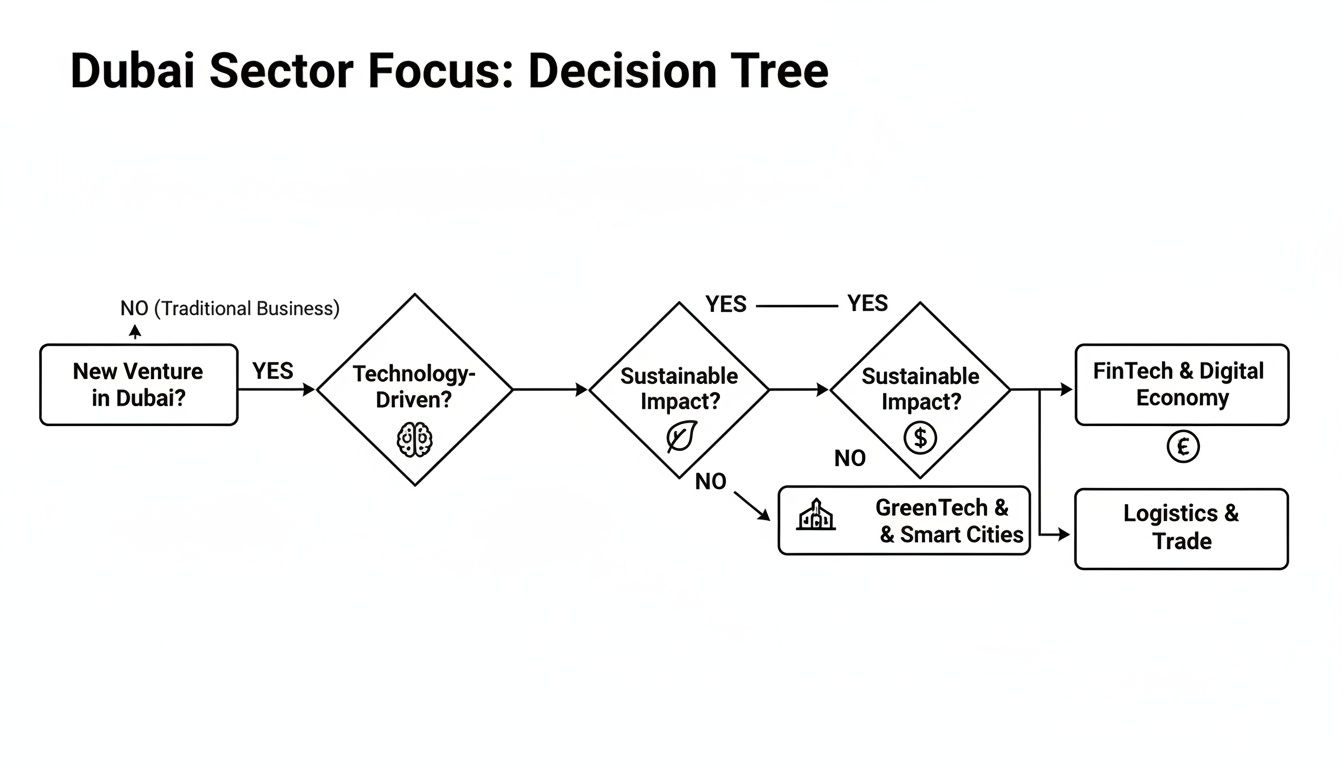
Dubai's ecosystem creates clear runways for different types of businesses. Whether you're building a compliant FinTech platform or an innovative GreenTech product, there’s a path designed to help you align with the city's bigger goals.
For most tech founders, the choice comes down to ownership, market access, and industry support.
Previously, a Mainland setup required a local Emirati partner to hold 51% of the company. That’s changed. Recent reforms now allow for 100% foreign ownership for most business activities, but it’s not a blanket rule. This is why Free Zones, which have always offered full foreign ownership, remain a simple and secure go-to for international founders.
The trade-off is market access. A Mainland license from the Department of Economy and Tourism (DET) lets you trade directly with anyone in the UAE and bid on government contracts. A Free Zone company is generally restricted to doing business within its zone or internationally. To sell on the Mainland, you usually need a local distributor.
Dubai has over 40 Free Zones, but a handful have become the undisputed hubs for tech companies.
The right Free Zone is more than just a license; it’s a support system. Choosing one that understands your industry gives you access to relevant events, partners, and a regulatory framework built for your needs.
This table breaks down the key differences to help you decide.
There's no single "best" option. There's only the best option for your business, right now.
Next Action: Before you decide, answer these three questions:
Answering these will point you toward the structure that will support your growth from day one.

Your idea is only as good as the people who build it. For startups in Dubai, this means tapping into a truly global talent pool. The city’s reputation as a safe, tax-free, and exciting place to live is a massive draw for skilled professionals worldwide.
But sourcing talent here is competitive. You need a smart, multi-channel approach.
To build a world-class team, you need to be where the talent is—both online and off.
Once you find the right person, you’ll need to handle the visa process and put together a compelling offer. The good news? If you're in a Free Zone, the visa process is surprisingly straightforward and usually handled as part of your company setup.
When it comes to salary, remember that Dubai has no personal income tax. What you offer is what your employee takes home—a massive selling point.
A common mistake is benchmarking salaries against Europe or the US without factoring in the tax-free advantage. A competitive package in Dubai should include health insurance and an annual flight ticket allowance to stand out.
As your team grows, look into the best HR software for startups to manage payroll, leave, and compliance. This lets you focus on building the business, not paperwork.
Building a team in Dubai almost guarantees you’ll manage a diverse, multicultural group. This isn't a challenge; it's one of the ecosystem’s biggest strengths. You get a rich mix of perspectives that can give you a serious competitive edge.
Be intentional about your company culture. Focus on crystal-clear communication and establish core values from the beginning. Create an environment where different viewpoints are actively encouraged. This cultural foundation is the secret to attracting and retaining top talent.
Next Action: Map out your hiring plan for the next six months. Pinpoint the single most critical role you need to fill. Now, instead of just posting it online, challenge yourself to find three potential candidates through other channels: one from a university, one from a community event, and one through a personal referral. You’ll be amazed at the difference in candidate quality.
Building a company is a lonely journey, but in Dubai, you’re not flying solo. The city is brimming with support systems. The challenge is navigating the options to find the right help for what your startup needs right now.
This network is a rich fabric of accelerators, incubators, coworking spaces, and industry hubs. Your job is to figure out which piece of this puzzle will give you the biggest advantage today.
For early-stage startups in Dubai, accelerators and incubators offer a fast-tracked path to growth. These 3-6 month programs combine mentorship, funding, and network access to help you sharpen your product, find product-market fit, and get investor-ready.
If a rigid program isn’t right for you, coworking spaces and industry-specific hubs offer a more flexible way to connect. They are curated communities where you can meet other founders, bounce around ideas, and find your next collaborator.
For example, the DIFC FinTech Hive is the epicenter for financial technology, giving you a direct line to the banks, regulators, and investors who get the space. It’s in these hubs that you find spontaneous, high-value connections.
The most powerful support often comes not from a formal program, but from curated communities of your peers. Meaningful peer support provides something accelerators can't: a continuous, trusted circle for honest feedback and real accountability.
Generic networking events are often a waste of time. The real breakthroughs happen in smaller, high-signal groups where every connection is intentional. This is where curated founder communities like Founder Connects fit in.
Instead of random mixers, these groups are about building deep, functional relationships. They use moderated sessions, peer-to-peer accountability, and warm introductions to help you solve real-world challenges. Whether you need an honest opinion on your pitch deck or an intro to a specific investor, a curated community offers a trusted, efficient way to get it done.
Next Action:
Take five minutes and write down your single biggest challenge right now. Is it fundraising, product-market fit, or accountability? Based on your answer, pick one specific type of support to investigate this week:
Getting a startup off the ground in Dubai brings up a ton of questions. Let's get straight to the practical answers you need to move forward.
Dubai has a reputation for being expensive, but you can absolutely bootstrap here if you're smart. Your two biggest costs will be rent and initial business setup.
A solo founder can live comfortably on AED 8,000-12,000 per month. The key is to skip prime real estate in the Marina or Downtown and look at more founder-friendly neighborhoods like JVC or Dubai Silicon Oasis.
The bigger financial hurdle is the upfront business setup. Budget AED 15,000 to AED 35,000 for a standard Free Zone license that includes your visa. It’s a significant one-time cost, but your annual renewal fees will be much lower.
It’s surprisingly straightforward, especially if you go the Free Zone route. Most of the process is handled online, and Free Zone authorities are incentivized to get you running quickly. They walk you through each step.
You'll need the basics: your passport copy, a simple business plan, and a few options for your company name.
The whole thing, from submitting your application to having your trade license and visa in hand, can take as little as one to three weeks. The system is built for speed.
The best advice? Get your documents organized before you start. Knowing exactly what business activity you'll be licensed for will make everything a breeze.
Absolutely. This is one of the biggest reasons founders choose Dubai. It's a launchpad for the entire MENA region, South Asia, and Africa.
Think of your Dubai entity as your operational headquarters for a market of billions, not just millions. It gives you instant credibility.
Don't try to figure this all out by yourself. Your first step should be to get out and connect with other founders.
Before you even think about registering your company, start building genuine relationships. Find a high-signal, industry-specific event or a curated founder meetup. The goal is to have real conversations with founders who are a few steps ahead of you. Ask them which Free Zones they used, which banks they hate, and which lawyers they trust. That peer-to-peer advice is gold and will save you a fortune in time and money.
Building a business is a marathon, not a sprint, and you shouldn't have to run it alone. Founder Connects offers curated peer groups, practical accountability, and introductions that matter, helping you make smarter decisions and accelerate your growth. Join a trusted community of your peers at https://www.founderconnects.com.


