
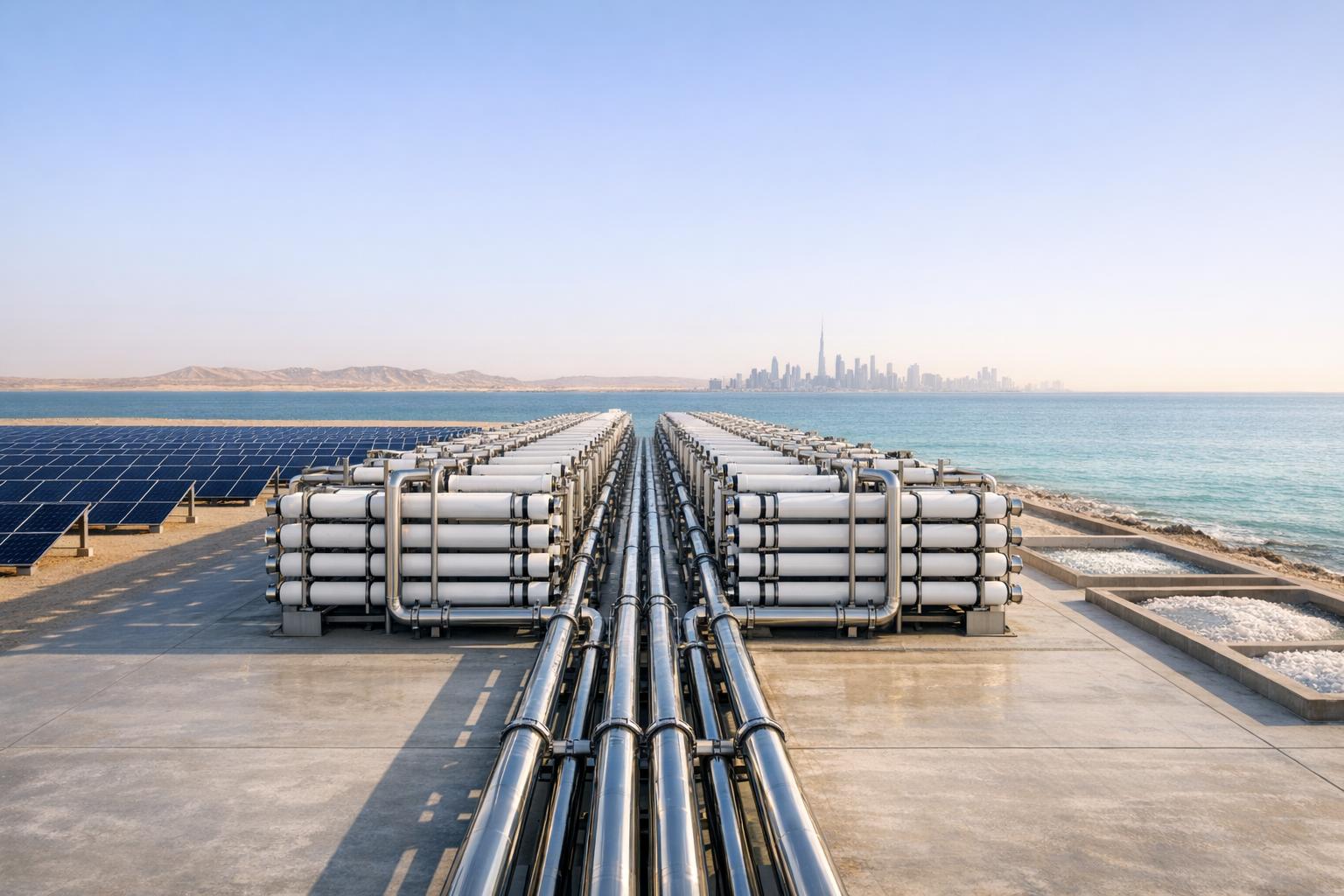
The UAE is tackling water scarcity with cutting-edge desalination technologies. With 42% of its water supply coming from desalination and contributing 14% of global output, the UAE is a leader in this field. However, challenges like high salinity in the Arabian Gulf and environmental concerns from brine discharge and CO2 emissions demand better solutions.
Startups and research centres in the UAE are driving progress by developing energy-efficient methods like Reverse Osmosis (RO), which uses 90% less energy than older thermal systems. Innovations include solar-powered systems, recycled plastic membranes, and brine mining to extract valuable minerals. Major plants like Taweelah and Hassyan are setting benchmarks for efficiency and renewable energy integration.
The UAE’s focus on advanced water technologies, supported by government initiatives and funding, is reshaping its approach to water security.
Startups in the UAE are pushing the boundaries of desalination technology, addressing the Gulf's high salinity levels with solutions that go beyond traditional reverse osmosis. The unique challenges of elevated salinity have inspired advancements in both membrane design and system architecture.
One standout innovation comes from Pure Hydro, whose system - based on research from Khalifa University - removes the need for moving parts or expensive, replaceable components. This design slashes maintenance and operational costs, making it a more efficient option for desalination plants[5].
Meanwhile, researchers at the NYU Abu Dhabi Water Research Center have incorporated nanotechnology into polymer membranes. By using recycled plastic bottles, they’ve created membranes that save 20–25% more energy compared to conventional ones[2]. These breakthroughs pave the way for integrating renewable energy sources into desalination processes, making them even more efficient.
The integration of solar power with advanced membrane and system designs is proving transformative. A prime example is the Taweelah RO plant in Abu Dhabi, which operates with record-low energy use - less than 3 kilowatt-hours per cubic metre of water produced. The plant also benefits from 50 megawatts of onsite solar capacity[4].
This setup not only minimises energy consumption but also reduces reliance on gas, especially during fluctuating seasonal demand[4]. By decoupling water production from traditional power generation, the plant sets a new standard for energy-efficient desalination.
Energy efficiency is just one part of the equation. Tackling brine waste is equally critical for making desalination more sustainable. UAE startups are leading the charge by developing methods to either eliminate brine waste entirely or extract valuable resources from it.
Manhat, a company founded in 2019 by Dr. Saeed Alhassan and Vishnu Vijayan Pillai, has created a technology that produces zero brine waste. Their floating, solar-powered devices replicate the natural water cycle by evaporating seawater and condensing the vapour. As Dr. Saeed Alhassan explains:
The technology developed at Manhat is meant to produce water sustainably from open water surfaces by trapping the evaporated water mimicking the natural water cycle with zero carbon footprint and zero brine rejection[1].
By 2026, Manhat had raised AED 734,600 (around US$200,000) in equity-free funding and secured patents across 18 countries.
At the same time, researchers at NYU Abu Dhabi are working on membranes that can selectively extract minerals like lithium, magnesium, and silver from brine waste[2]. Professor Nidal Hilal, Director of the Water Research Center, highlights the potential:
What used to be waste, we now believe are resources[2].
This dual-purpose approach allows desalination plants to not only produce fresh water but also recover valuable materials. These innovations play a key role in enhancing process efficiency and advancing the UAE's water security objectives.
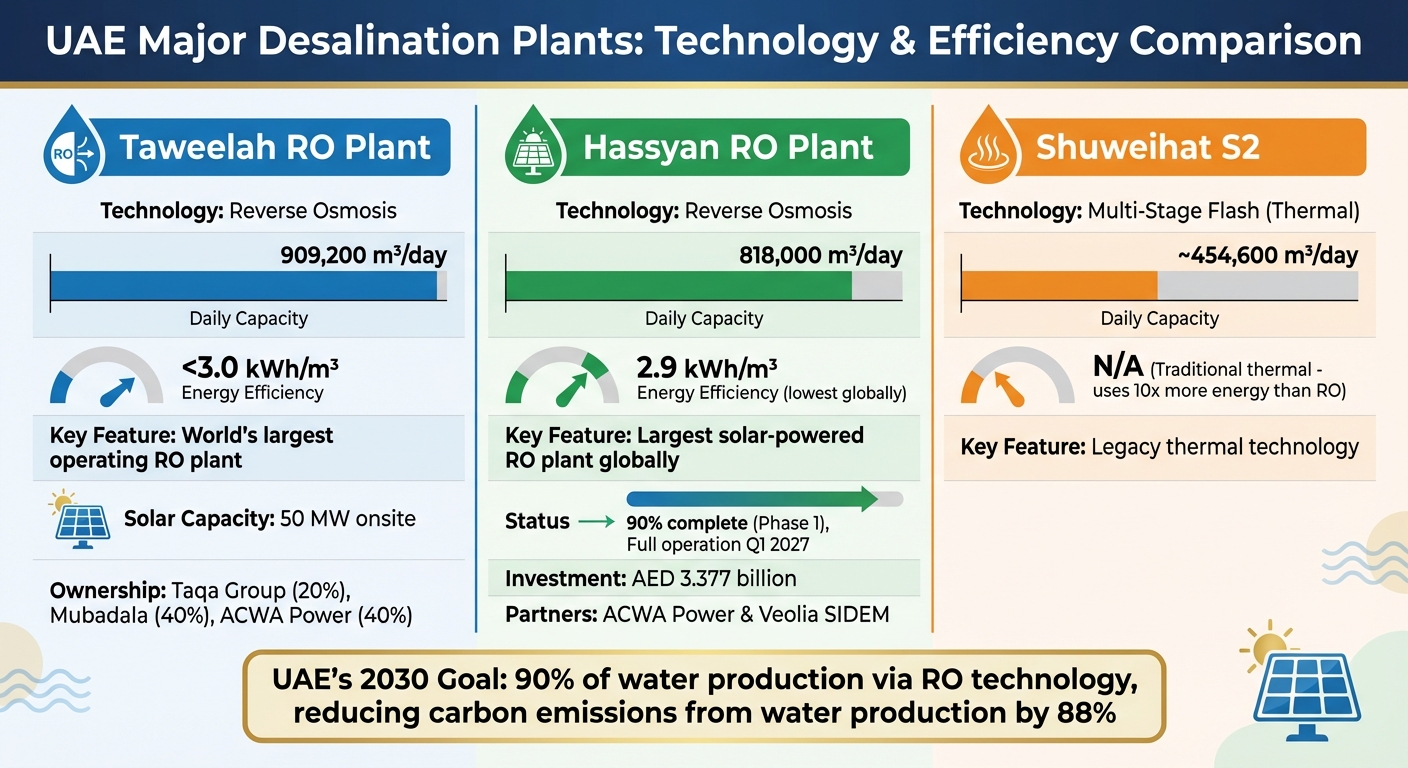
UAE Major Desalination Plants: Technology and Efficiency Comparison
The UAE is setting the bar high in desalination, with facilities like Taweelah and Hassyan leading the way in scaling reverse osmosis (RO) technology to meet national water needs. These plants highlight how advanced engineering and renewable energy integration are reshaping water production.
In Abu Dhabi, the Taweelah RO plant holds the title of the world's largest operational reverse osmosis facility, producing an impressive 909,200 cubic metres of water daily. This capacity outpaces previous global records by 44% [4][6]. The plant is owned by Taqa Group (20%), Mubadala (40%), and ACWA Power (40%) and incorporates 50 megawatts of solar power onsite, further boosting its sustainability credentials [4][6].
Meanwhile, Dubai's Hassyan desalination plant is on track to become the second-largest RO facility worldwide when fully operational by Q1 2027. Currently, its first phase is 90% complete, and the plant is designed to deliver 818,000 cubic metres of water per day [7][8]. The AED 3.377 billion project, developed in collaboration with ACWA Power and Veolia's SIDEM, will also hold the distinction of being the largest solar-powered desalination plant globally [7][8].
Older plants like Shuweihat S2 still rely on Multi-Stage Flash (MSF) thermal technology, producing approximately 454,600 cubic metres per day (100 million imperial gallons) [9]. However, the UAE is actively transitioning to RO technology, aiming for 90% of water production via RO by 2030. This shift is expected to cut carbon emissions from water production by 88% [6].
A closer look at the technologies used in these facilities reveals the efficiency gains achieved with modern RO systems compared to traditional methods.
The energy consumption of advanced RO plants is significantly lower than that of thermal desalination. For instance, Taweelah operates at under 3 kilowatt-hours per cubic metre, while Hassyan has pushed the efficiency even further to 2.9 kilowatt-hours per cubic metre [4][8]. As Veolia CEO Estelle Brachlianoff noted:
"Our efforts have made the impossible possible, reducing the energy consumption of large-scale desalination to 2.9 kWh/m³" [8].
| Plant Name | Technology | Capacity (m³/day) | Energy Efficiency (kWh/m³) | Key Feature |
|---|---|---|---|---|
| Taweelah RO | Reverse Osmosis | 909,200 | < 3.0 | World's largest operating RO plant |
| Hassyan RO | Reverse Osmosis | 818,000 | 2.9 | Largest solar-powered RO plant |
| Shuweihat S2 | Multi-Stage Flash | ~454,600 | N/A (Thermal) | Traditional thermal technology |
The UAE's startup ecosystem is shaping the future of desalination technology by combining innovation, funding opportunities, and collaborative frameworks.
Startups in the UAE have access to a well-established support system that includes accelerators, grants, and research partnerships. Initiatives like the MBRIF Innovation Accelerator are key players in connecting water tech startups with industry experts, mentors, and angel investors who understand the unique challenges of desalination [1].
Government-backed programmes also provide equity-free funding, allowing startups to scale without giving up ownership stakes. For example, Manhat secured US$200,000 in equity-free funding from organisations like the Abu Dhabi Department of Economic Development, Sharjah Entrepreneurship Centre (Sheraa), Ma'an Abu Dhabi, and the Expo Live Innovation Program [1]. On the research side, institutions like Khalifa University play a vital role in turning academic projects into commercial solutions. Pure Hydro is a great example - it started as a university research initiative and later developed a low-cost, sustainable desalination product with no moving parts [5].
This ecosystem is further bolstered by dedicated investment channels aimed at pushing the boundaries of water technology.
The Mohamed bin Zayed Water Initiative (MBZWI) stands out as a major funding body for water innovation in the UAE. Partnering with XPRIZE, MBZWI launched a US$119 million competition, supported by a total investment of US$150 million, to encourage breakthroughs in desalination technology [10]. By September 2025, 143 teams from 29 countries had advanced to the competition's second phase, vying for a US$40 million grand prize for system-level innovations and an additional US$8 million prize for advanced separation materials [10].
Investors in the region are particularly drawn to technologies that address key desalination challenges, such as energy efficiency, cost reduction, and environmental impact. As Aisha Al Ateegi, Executive Director of MBZWI, pointed out:
Desalination remains one of the most promising solutions to address water scarcity. However, many existing systems still consume large amounts of energy and face limitations related to efficiency, cost and sustainability [10].
Funding is increasingly directed towards reverse osmosis technologies that incorporate renewable energy and aim to mitigate harmful brine discharge.
In addition to funding, collaboration platforms are helping water tech startups thrive. The XPRIZE Water Scarcity competition acts as a global hub, bringing together innovators, researchers, and startups to tackle desalination challenges [10]. Vishnu Vijayan Pillai of Manhat highlighted the value of such platforms:
By providing access to a robust network of industry experts, mentors, angel investors and government‐backed resources, the MBRIF enhances the growth potential of innovative startups like ours [1].
For ongoing collaboration, Founder Connects (https://founderconnects.com) offers virtual masterminds, networking events, and curated access to investors. This platform enables water technology founders to connect with peers, access expert advice, and participate in live discussions - building a strong support network to navigate the complexities of desalination innovation.
The UAE is taking significant strides in integrating solar energy into desalination processes to reduce emissions and cut energy costs. A standout innovation comes from Manhat, whose solar-powered, natural water distillation technology produces fresh water without any carbon emissions or brine discharge. This system operates without electricity, making it especially suited for floating farms and coastal irrigation needs [1].
On a broader scale, the industry is transitioning from traditional thermal desalination methods to reverse osmosis (RO), a process that uses only about one-tenth of the energy required by thermal systems. By 2030, reverse osmosis is expected to dominate, accounting for nearly 90% of Abu Dhabi's water production - an impressive leap from 27% in 2022. The Al Taweelah RO plant, the largest of its kind globally, exemplifies this shift with its capacity to produce approximately 909,000 cubic metres of water daily [2].
The pace of innovation in desalination is accelerating, with exciting advancements on the horizon. Researchers at NYU Abu Dhabi have developed a method to turn recycled plastic bottles into functional filtration membranes, combining water security efforts with waste reduction initiatives [2].
Another promising development is brine mining. Instead of releasing concentrated salt waste into the sea, new technologies are extracting valuable minerals like lithium, magnesium, and silver from brine. Professor Nidal Hilal, Director of the NYUAD Water Research Centre, highlighted this shift:
What used to be waste, we now believe are resources. With global demand for battery materials such as lithium accelerating, desalination plants could one day serve as both water producers and sources of strategic minerals [2].
These advancements are laying the groundwork for a more sustainable and resource-efficient approach to desalination.
The UAE's long-term water security strategy focuses on cutting energy usage, eliminating harmful brine discharge, and expanding the use of renewable-powered systems. By embracing these innovations, the country aims to strengthen its water security while advancing technologies that address environmental challenges.
Startups are playing a key role in meeting these goals. For instance, Manhat’s technology is specifically designed to support floating farms, offering a sustainable irrigation solution that avoids harming marine ecosystems. Dr. Saeed Alhassan underscored the importance of such technologies in ensuring long-term water security and protecting marine life from the adverse effects of brine discharge [1].
The UAE is turning to advanced technology and collaborative efforts to address water scarcity. With much of its water already sourced from desalination and a prominent role in global production, the country stands to benefit greatly from pushing the boundaries of innovation [2].
Local startups are leading this charge. For instance, Manhat’s solar-powered distillation system operates with zero carbon emissions and no brine discharge. Meanwhile, researchers at NYU Abu Dhabi have developed the UAE’s first reverse osmosis membrane module, which delivers energy savings of 20% to 25% [1][2][3]. These advancements highlight the critical influence of the UAE’s startup ecosystem in driving change.
Government initiatives like the Mohammed Bin Rashid Innovation Fund are equipping UAE entrepreneurs with mentorship, funding opportunities, and essential resources. On an international scale, competitions such as the XPRIZE Water Scarcity challenge - with its impressive US$119 million prize pool and participation from 143 teams across 29 countries - further cement the UAE’s reputation as a leader in water innovation [10][11].
Looking to the future, reverse osmosis is expected to dominate Abu Dhabi’s water production, growing from 27% in 2022 to nearly 90% by 2030. Emerging technologies like brine mining and strategies rooted in the circular economy are reshaping how the region approaches water management. Platforms such as Founder Connects provide startups with the networking, expert advice, and investor access they need to thrive in this dynamic environment.
The UAE’s vision for water security rests on innovation, teamwork, and rethinking traditional practices. As Professor Nidal Hilal aptly said:
What used to be waste, we now believe are resources [2].
This mindset reflects the UAE’s commitment to building a future where water is managed sustainably and efficiently.
Desalination in the Arabian Gulf faces unique hurdles. The region's high salinity levels and extreme temperatures make the process more demanding. Additionally, the heavy reliance on energy-intensive methods, such as thermal desalination, further complicates operations. Overcoming these challenges requires cutting-edge technology and substantial resources to maintain efficiency.
Startups in the UAE are tackling energy challenges in reverse osmosis by developing membranes made from recycled plastic that significantly lower energy consumption. Using advanced technologies, they’ve managed to bring energy usage down to less than 3 kWh per cubic metre of water. Additionally, some desalination plants are incorporating renewable energy sources, like solar power, to boost efficiency even further.
Brine waste isn't just a byproduct to discard - it can be a source of minerals like magnesium, potassium, and calcium. With advanced technologies, these minerals can be extracted and repurposed, offering a way to minimise waste while reducing harm to the environment.


