

Top 7 Questions Investors Ask About Valuations

Building in MENA? You don't have to do it alone.
Join 300+ founders in the Founder Connects Residency. Monthly squad calls, warm intros, $3M+ in perks, and much more. All for less than your monthly coffee budget.

UAE's startup ecosystem is booming, with sectors like technology, AI, and fintech leading the charge. By 2024, the region secured AED 6.4 billion across 159 deals, making it a key venture capital hub in MENA. For founders, understanding valuations is critical for negotiating equity, securing funding, and staying competitive.
Investors focus heavily on traction, scalability, and sector-specific metrics. Common valuation methods include:
- Comparable Company Analysis: Benchmarks against similar startups using UAE-specific data.
- Discounted Cash Flow (DCF): Projects future cash flows for early-stage startups, accounting for UAE’s 9% corporate tax.
- Berkus Method: Suitable for pre-revenue startups, capped at AED 7.3–9.2 million.
Key investor questions include:
- How is your valuation calculated? Back numbers with local benchmarks.
- What metrics validate your valuation? Highlight ARR, CAC, LTV, and scalability.
- How will funding be used? Present a clear, milestone-driven plan.
- Are you ready for due diligence? Maintain clean financials, a solid cap table, and regulatory compliance.
Preparation, local market understanding, and strong relationships are essential for navigating UAE’s competitive funding landscape.
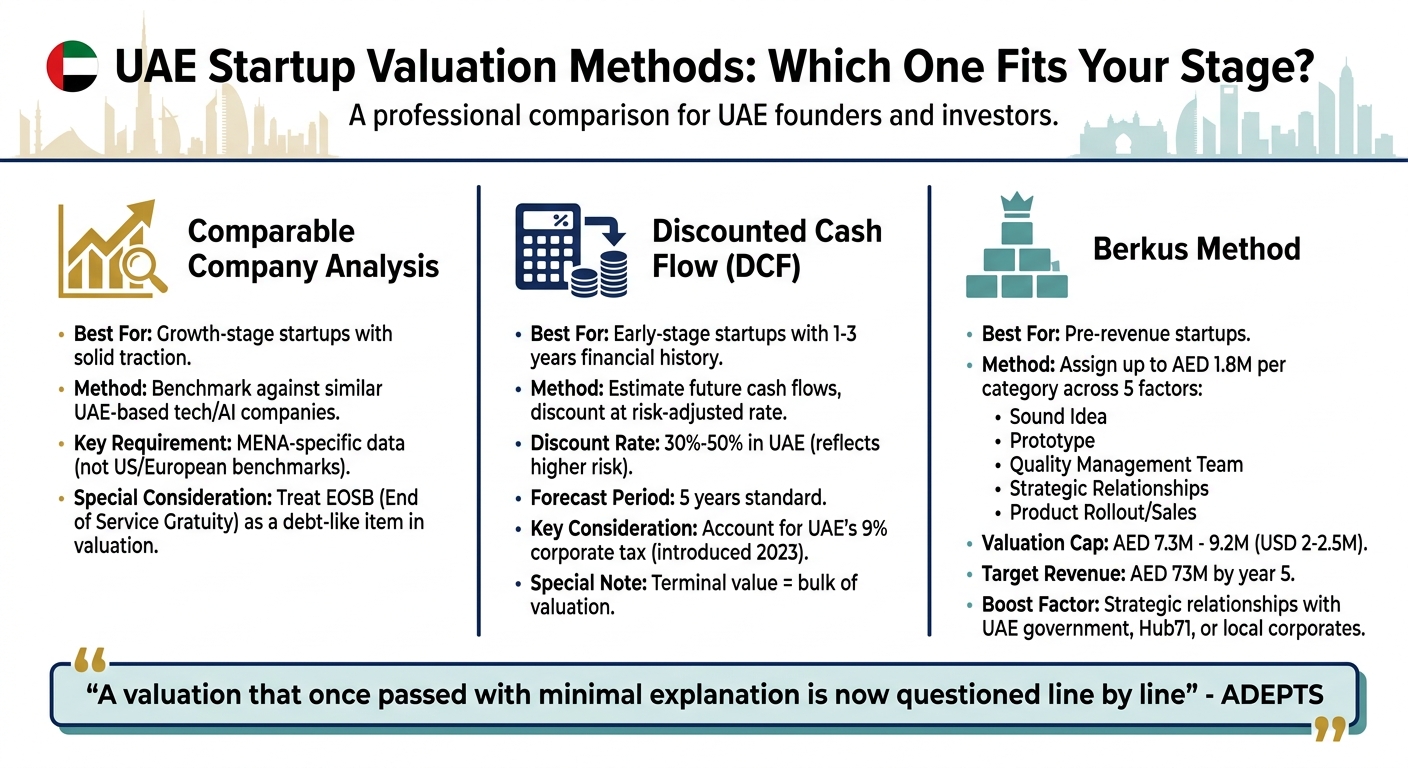
UAE Startup Valuation Methods Comparison: DCF vs Berkus vs Comparable Analysis
The Ultimate Guide to Startup Valuations for Founders
sbb-itb-f597d8f
1. How Do You Determine Your Startup's Valuation?
When investors ask how you arrived at your valuation, they’re not just curious - they’re testing your preparation. Throwing out a random figure won’t cut it in the UAE’s 2026 market, where investors dig deep into the assumptions behind your numbers [1]. The valuation method you choose depends on your startup’s stage, revenue, and sector. But whatever approach you take, it must be backed by credible, local data. Picking a method that aligns with your startup’s stage and the UAE market landscape is key.
Comparable Company Analysis is ideal for growth-stage startups with solid traction. This method involves benchmarking your business against similar UAE-based tech or AI companies, using relevant valuation multiples. Of course, finding a perfect match is rare, so you’ll need to adjust for differences in size, geography, and leverage instead of relying on headline figures alone [1]. Always prioritise MENA-specific data over US or European benchmarks, as regional market dynamics and exit opportunities differ significantly. For added credibility, consider End-of-Service Benefits (EOSB) as a debt-like item when transitioning from Enterprise Value to Equity Value [1].
Discounted Cash Flow (DCF) works well for early-stage startups with at least 1–3 years of financial history. This approach estimates future cash flows and discounts them at a risk-adjusted rate, which typically ranges from 30% to 50% in the UAE [1]. A five-year forecast is standard, but since terminal value often makes up the bulk of your valuation, it requires extra scrutiny [1]. Additionally, with the UAE’s 9% corporate tax introduced in 2023, your model must account for tax impacts - ignoring this could lead to overvaluation [1]. Keep currency consistent; if you’re working with USD cash flows, use a USD-based risk-free rate for accuracy [1].
The Berkus Method is tailored for pre-revenue startups. It assigns up to AED 1.8 million (around USD 500,000) per category across five key factors: Sound Idea, Prototype, Quality Management Team, Strategic Relationships, and Product Rollout or Sales [10, 11]. This method typically caps the pre-money valuation between AED 7.3 million and 9.2 million (roughly USD 2–2.5 million), adjusted for the UAE’s investment climate [11, 12]. To justify this approach, aim to show potential revenue of around AED 73 million by year five [11, 12]. Highlighting strategic relationships with UAE government entities, Hub71, or local corporates can also reduce perceived market risks and increase your valuation [12, 13].
"A valuation that once passed with minimal explanation is now questioned line by line, and the model is no longer judged by its output alone." - ADEPTS [1]
No matter which valuation method you choose, it’s essential to prepare for due diligence. A well-organised data room with detailed documentation - like your cap table and dilution breakdown - can make or break investor confidence. Platforms such as Founder Connects can also help by providing up-to-date UAE startup trends and funding data, offering valuable benchmarks to refine your comparable analysis.
2. What Metrics Do Investors Focus On?
Once you've decided on your valuation approach, the next step is to zero in on the metrics that validate it. Investors in the UAE pay close attention to the figures that back up your valuation - proof that your startup has the potential to scale, deliver returns, and succeed in the region’s unique funding environment. In 2024, Fintech led the way in UAE sector investments, pulling in AED 973 million (around US$265 million), followed closely by Web3, which attracted AED 947 million (approximately US$258 million). These numbers highlight that strong performance in high-growth industries draws investor attention [2]. Metrics like these provide concrete evidence of your startup's current success and future promise.
Traction Metrics: ARR, MRR, CAC, and LTV
For sectors like SaaS, Fintech, and AI, metrics such as Annual Recurring Revenue (ARR) and Monthly Recurring Revenue (MRR) are critical. AI-enabled Deeptech companies in the UAE typically enjoy revenue multiples between 15x and 20x, while their non-AI Deeptech counterparts see multiples in the range of 6x to 8x [2]. Additionally, Customer Acquisition Cost (CAC) and Lifetime Value (LTV) are crucial for assessing long-term profitability. Given that UAE startups take 52% longer than those in Silicon Valley to reach Series A, maintaining a solid LTV-to-CAC ratio (ideally 3:1 or higher) becomes even more important. This is particularly vital for overcoming the "middle stage" funding gap, where rounds requiring between AED 91.8 million and AED 110 million (roughly US$25 million to US$30 million) often face a scarcity of investors [2].
Gross Margins and Scalability
Healthy gross margins are a strong indicator that your business can scale without excessive cash burn. Investors in the UAE value capital efficiency, often referred to as "Bang for Buck", which measures how much progress is achieved per AED of funding. Early-stage investments (Seed and Series A) made up about 38% of total MENA tech funding in 2024. However, late-stage rounds dominated, accounting for AED 2.79 billion (US$760 million) out of AED 3.2 billion (US$872 million) raised in Q1 2025 [2]. Strong margins and scalability not only validate your valuation but also reassure investors about your startup’s growth trajectory.
Market Positioning and Competitive Advantage
Your startup’s positioning in the market and its competitive edge can significantly influence valuation multiples. Startups that align with the UAE National Strategy for AI 2031, which aims for AI to contribute 20% of the nation’s non-oil GDP by 2031, benefit from a supportive, investment-friendly environment. Corporate venture capital involvement in Deeptech has also surged, rising from 15% in 2019 to 35% in 2023 [2]. Being part of strategic sectors like AI infrastructure can lead to premium valuations. For example, in March 2024, the MGX platform debuted with AED 367 billion (around US$100 billion) in assets, including an AI infrastructure fund valued at AED 110 billion (about US$30 billion), supported by BlackRock and Microsoft [2].
Here’s a quick look at valuation multiples and investor perspectives for Deeptech sectors:
| Metric | AI-Enabled Deeptech | Non-AI Deeptech |
|---|---|---|
| Revenue Valuation Multiple | 15x – 20x | 6x – 8x |
| Investor Perception | Growth accelerant | Standard tech venture |
| Corporate VC Participation | High (35% in 2023) | Lower (15% in 2019) |
Source: [2]
3. How Will You Use the Funding?
When discussing valuation, it's equally important to present a clear, detailed plan for how the funding will be utilised. Investors today expect measurable, well-thought-out strategies for fund allocation. By 2026, the focus has shifted towards capital efficiency and achieving sustainable unit economics, moving away from unchecked, rapid expansion [5][8]. This means your funding plan should be milestone-driven and aligned with the UAE's evolving investment priorities.
Gone are the days of large, upfront funding rounds. Instead, investors now favour performance-based, staged funding [5]. For B2B startups - responsible for 70% of MENA funding in 2025 - this often translates into prioritising sales team expansion and adopting scalable growth tools [4]. Enterprise SaaS and application models, in particular, are focusing heavily on product development to meet the UAE's digital transformation goals across sectors like government and retail [4]. This staged funding model underscores the importance of detailed allocation and runway planning.
Breakdown of Investment Allocation
Your funding plan should demonstrate how every dirham contributes to investor-valued metrics, such as lowering Customer Acquisition Cost (CAC) or boosting Lifetime Value (LTV) [3]. Typically, funding is allocated across three core areas: product development (improving technology), marketing (expanding customer acquisition in the GCC), and operations (scaling the team) [3].
For example, in February 2026, TruDoc Healthcare raised AED 55.1 million (US$15 million) in a pre-Series B round. The funds were strategically allocated to enhance at-home and remote care services, including hospital-at-home critical care. CEO Ahmed Mansour explained:
"Healthcare systems everywhere are being asked to do more - serve more people, manage more chronic disease, and deliver better outcomes - without endlessly expanding physical infrastructure. TruDoc represents a fundamentally different approach: one that scales access and efficiency whilst maintaining clinical integrity" [7].
Late-stage UAE startups are also allocating capital to aggressively hire and strengthen vendor relationships to support rapid scaling [4]. The Enterprise SaaS sector alone secured AED 2.53 billion in Q1 2025, marking a 1,111% year-on-year growth [4]. This growth highlights how strategic investment in product and market expansion can significantly enhance valuation.
Runway and Milestone Planning
A strong funding strategy also includes robust runway and milestone planning. Calculate your burn rate to ensure an 18–24-month runway, giving you sufficient time to achieve your next valuation round [3]. Milestones should be quantifiable and focus on metrics like Annual Recurring Revenue (ARR), Monthly Recurring Revenue (MRR), and user acquisition [3].
Expanding into markets like Saudi Arabia or other MENA regions is another key milestone that UAE investors watch closely to evaluate future potential [3]. For example, in 2025, Property Finder, a UAE-based proptech company, raised AED 1.93 billion (US$525 million) in Private Equity funding, followed by an additional AED 918 million (US$250 million) in debt financing. These funds were used to strengthen its dominance in Dubai’s booming real estate market, which recorded AED 36.6 billion in weekly property transactions by early 2026 [6][5].
It’s also crucial to develop a detailed 12–18 month cash flow model to anticipate potential financial challenges and stress-test various scenarios [9]. In 2025, the average ticket size for UAE startup deals was AED 54 million (US$14.7 million), with a median deal size of AED 7.3 million (US$2 million) [6]. Aligning your funding request with these benchmarks shows market awareness and demonstrates a clear path from your current position to your next major milestone.
4. Are You Ready for Due Diligence?
Investors take a deep dive into every aspect of your business before committing their capital. In the UAE, where startup closures rose by 30% in 2025, and compliance issues contributed to 27% of those failures, being ready for due diligence is more important than ever [12]. With the process from a signed term sheet to receiving funds typically taking 45 to 60 days, any missing documents can throw a wrench in the works [11].
As investors focus more on capital efficiency, they’re asking tougher questions about unit economics, intellectual property (IP) ownership, and regulatory compliance. To stand out and close deals faster, you need to back your vision with data that resonates with decision-makers [12]. For UAE founders, this means having a well-organised data room, a clean cap table, and ensuring your pitch deck numbers align with your financial records.
Organising Financial Documents and a Data Room
Preparation is everything. Start by getting your documents in order and setting up a virtual data room. Investors expect well-organised files covering key areas like corporate/legal, financial, IP, HR, and sales [11]. For UAE startups, this also includes regulatory documents and permits specific to operating in free zones such as DIFC or ADGM.
Your financial records are critical. These should include historical financial statements, bank records, a detailed burn rate analysis, and a financial projection model covering three to five years [11]. Investors will look for performance metrics like Monthly Recurring Revenue (MRR), Annual Recurring Revenue (ARR), Gross Merchandise Value (GMV), and unit economics. It’s vital that your pitch deck numbers match your accounting records. As VC Beast puts it:
"Discrepancies between your pitch deck numbers and your books are relationship-ending red flags. Have clean financial records from day one" [11].
In the UAE, compliance adds another layer. Ensure beneficial owner identities are verified through UAE-Pass or the Federal Authority portal, and maintain records of transaction volumes if required [10].
Clear IP ownership is another non-negotiable:
"The most common legal issue that delays or kills deals is unclear IP assignment", warns VC Beast [11].
Make sure every founder, employee, and contractor has signed IP assignment agreements transferring all rights to the company. Using secure platforms like DocSend or Ansarada for your data room can also help track which documents investors are viewing, offering insights into their concerns.
Addressing Cap Table and Dilution Concerns
A well-maintained cap table is essential for a smooth transaction. Investors want to see clear ownership percentages, details on share classes, and information on any convertible notes or SAFEs. Many Series A deals in the region follow a 1x non-participating liquidation preference and broad-based weighted average anti-dilution structure [11]. Familiarising yourself with these benchmarks can help you craft terms that align with investor expectations.
Transparency is key. Translate your technical strengths into clear business value [12]. Investors are shifting their focus from hyper-growth to sustainable business models, so showing capital efficiency and a thoughtful approach to dilution can address their concerns early on [12]. Avoid exaggerating traction; instead, provide honest customer insights and actionable metrics. Be ready to answer tough questions about how your solution stands out in the UAE and MENA ecosystem. With only 30% of seed-funded companies successfully raising a Series A round, investors are more selective than ever [11]. Demonstrating a strong grasp of unit economics and compliance from the start can help you navigate this scrutiny [12].
Leveraging Founder Connects for Preparation

Once your financials and cap table are in order, consider seeking external support. Just as solid metrics are crucial for accurate valuations, thorough due diligence builds investor confidence. The UAE startup ecosystem offers resources like Founder Connects, which pairs founders in virtual masterminds to conduct mock due diligence sessions. These peer-review sessions can help identify documentation gaps before formal investor meetings.
Founder Connects also provides networking opportunities and expert advice on setting up data rooms, structuring cap tables, and meeting compliance requirements. The platform’s curated list of investors helps founders understand the specific priorities of UAE-based VCs and family offices. Additionally, live problem-solving sessions allow you to address potential deal-breakers in real time. Engaging with this community can also demonstrate your understanding of "local substance" - whether it's knowledge of office lease requirements or employment visa documentation - something UAE investors value during their reviews.
Conclusion
Securing investment in the UAE requires more than just a polished pitch deck. Investors in the region place a strong emphasis on tangible results, such as proven revenue or user engagement, rather than just promising ideas [13]. The UAE's investment ecosystem has seen rapid growth - large-ticket capital increased by 215% in the first half of 2025, while mergers and acquisitions activity rose by 183% compared to the previous year [13]. This growth has led to heightened selectivity among investors, who now demand clean financial records, alignment with strategic sectors, and thorough preparation for due diligence.
In addition to metrics, relationships play a pivotal role in the UAE. As Mena Botros explains:
"UAE/Dubai is a totally different culture to the US/Europe. People don't just invest in people they don't know" [13].
Establishing what experts call Minimum Viable Relationships (MVR) is key to reducing perceived operational risks and earning investor trust. In this high-context market, strategic networking with individuals who have a deep understanding of the local ecosystem is just as important as demonstrating strong metrics. These personal connections act as a vital complement to the financial and operational groundwork.
Beyond relationships and traction, aligning with external resources can also strengthen your position. Affiliating with key UAE hubs like DIFC or ADGM and targeting the appropriate investor tiers can enhance the credibility of your valuation. For example, angel investors are typically suited for the first AED 3.67 million (US$1 million), family offices for amounts between AED 3.67–18.35 million (US$1–5 million), and sovereign wealth funds for rounds exceeding AED 36.7 million (US$10 million) [13].
Founder Connects offers tools like virtual masterminds, networking introductions, and a curated list of UAE investors to help founders refine their valuation strategies. These resources are designed to help entrepreneurs understand the priorities of local investors and develop the relationships that are crucial in this dynamic market.
With fintech leading the funding landscape and investors increasingly focusing on capital efficiency, preparation is what sets successful funding rounds apart. Build meaningful relationships, organise your data room meticulously, and ensure alignment with UAE priorities. By combining strong metrics, strategic networking, and jurisdictional alignment, you can position yourself for success in the competitive UAE startup funding environment.
FAQs
What valuation range is realistic for my stage in the UAE?
When determining a realistic valuation range for your startup in the UAE, several factors come into play, such as your company's stage of development, the industry you're operating in, and its potential for growth. For early-stage startups in the UAE, valuations usually fall between AED 1 million and AED 10 million. Startups that are further along, with proven progress and solid market traction, often command higher valuations that reflect their achievements and position in the market.
How do UAE investors adjust valuation for 9% corporate tax?
Investors in the UAE are factoring in the 9% corporate tax by carefully analysing cash flow projections, tax implications, and underlying economic assumptions. This upcoming tax, set to take effect in 2026, places a stronger emphasis on reliable and transparent discounted cash flow (DCF) models. As businesses prepare for this change, accurate financial forecasting and strict compliance will play a central role in ensuring valuations align with the new tax framework.
What documents should be in my UAE due diligence data room?
When preparing a due diligence data room for UAE investors or partners, having the right documents is essential. Here’s what you’ll typically need to include:
- Incorporation documents and cap table files: These provide clarity on your company’s legal structure and ownership breakdown.
- Key agreements, contracts, and licenses: This includes any significant deals, partnerships, or regulatory approvals your business operates under.
- Financial statements and compliance reports: Accurate financial records and proof of regulatory adherence are critical for building trust.
- Ownership, intellectual property, and asset details: Clearly document who owns what, along with trademarks, patents, or other valuable assets.
Organising this information securely not only streamlines the process but also builds confidence in the UAE’s dynamic startup ecosystem.
Related Blog Posts

Building in MENA? You don't have to do it alone.
Join 300+ founders in the Founder Connects Residency. Monthly squad calls, warm intros, $3M+ in perks, and much more. All for less than your monthly coffee budget.
Popular posts





Founder Connects is a premium MENA tech founder community. Meetups in Dubai and across MENA, Residency Squads of 8–10, and 400+ vetted WhatsApp founders (apply and screened).