

You’ve probably seen this happen.
A founder has a sharp idea, a clean logo, a pitch deck, and a company name they already love. They say they’re “building a business”. But when you ask who pays, how they’ll reach buyers, what happens after the first sale, and what they’ll do when the first assumption breaks, the answers get vague.
That gap matters.
If you’re asking what is business, the practical answer isn’t “an idea that makes money”. A business is a system. It finds a problem, solves it for a specific customer, delivers that solution repeatedly, and gets paid in a way that leaves enough margin and control to keep going.
In the UAE and wider MENA ecosystem, first-time founders often underestimate the operational side because the region makes company formation accessible. That’s useful, but registration is the easy part. Building something people want, can buy, and will return to is essential work.
A lot of founders start in love with the idea. That’s normal. The trouble begins when the idea becomes a shield.
You avoid speaking to customers because you’re still “refining the concept”. You spend weeks on the deck because it feels productive. You tell yourself the business starts after the website, after the trade licence, after the app mock-up.
It doesn’t.
A business starts when you can connect four things without hand-waving. A customer. A problem. An offer. A path to getting paid.
In the UAE, there’s another layer that people rarely say out loud. Building can feel lonely. A 2025 Dubai Chamber report found that 68% of UAE early-stage founders cite loneliness as their top challenge, yet only 12% access structured peer groups (reported here). That matters because isolation distorts judgement. Founders overestimate demand, delay hard conversations, and stay too long in private theory.
A good idea feels exciting. A business feels testable.
When founders ask me what a business is on the ground, I usually answer like this. It’s not your idea. It’s the machine around your idea.
That machine includes how leads come in, how buyers decide, how delivery happens, how money is collected, how problems are handled, and how you learn fast enough to improve before cash or energy runs out.
Stop thinking like the “idea person”. Start thinking like a system builder.
That means asking:
If those pieces aren’t in place, you may have ambition, not a business yet.
A business works like a machine. If one part is missing, the rest strain to compensate.
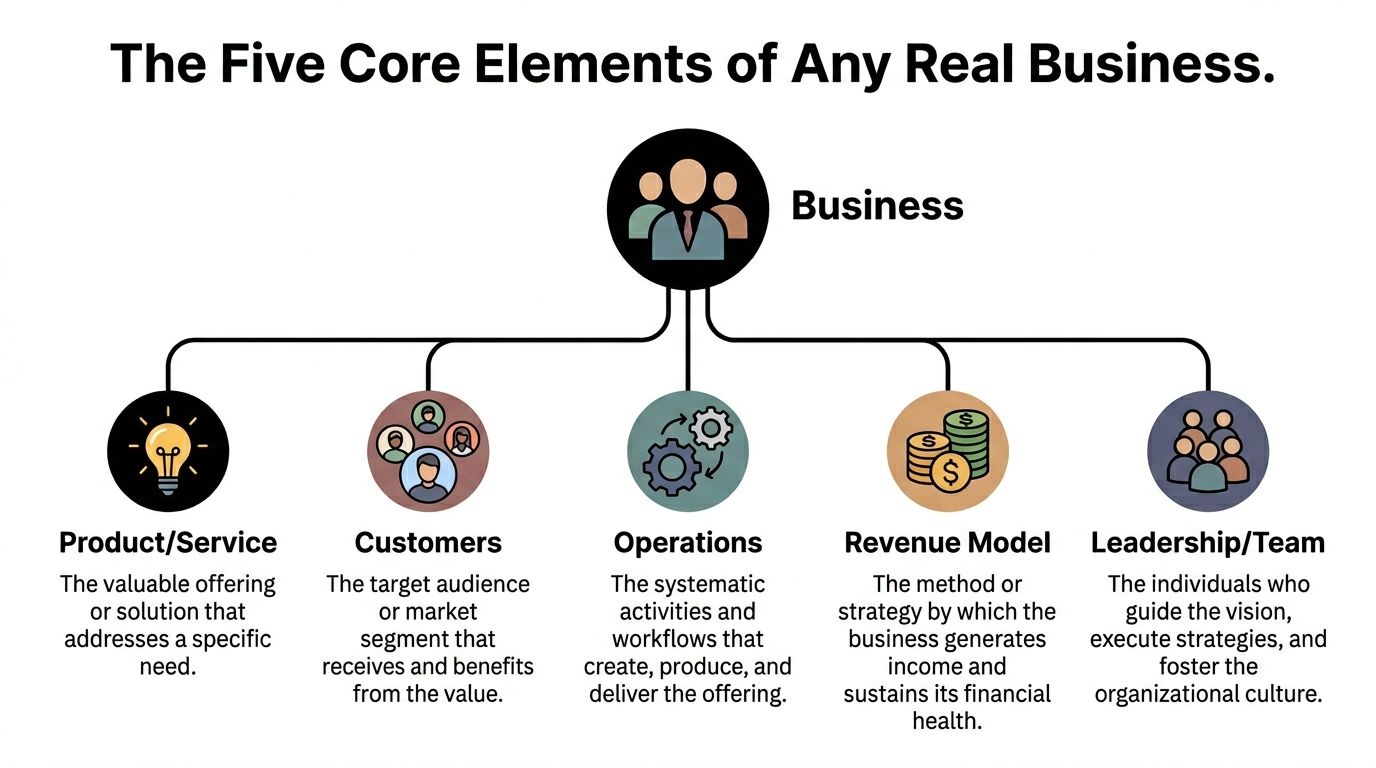
This is the heart of it. What painful job are you helping someone get done better, faster, cheaper, safer, or with less stress?
Most founders describe their product instead of the value. Buyers don’t care that you built an AI dashboard, marketplace, platform, or app. They care whether it removes friction from something they already need to do.
A weak value proposition sounds like this: “We connect brands and creators using smart technology.”
A stronger one sounds like this: “We help UAE ecommerce brands find vetted Arabic-speaking creators without spending weeks on manual outreach.”
Specific wins.
Many early businesses fail because they try to serve “everyone who might benefit”. That’s not focus. That’s avoidance.
Choose a narrow first customer segment. Not because the market is small, but because learning is easier when the buyer looks similar from one conversation to the next.
Useful filters include:
If you can’t name your first ten target customers, your market definition is still too broad.
A business isn’t just because users like it. You need a clear answer to how money enters the company.
There’s no single right model. Subscription, one-off projects, retainers, transaction fees, licensing, and training can all work. What matters is fit.
A few trade-offs matter early:
| Revenue option | Works well when | Common risk |
|---|---|---|
| Subscription | Customers get ongoing value | Churn if usage is weak |
| Project fee | Scope is clear and delivery is custom | Revenue becomes lumpy |
| Retainer | Problem is recurring | Clients expect extra work over time |
| Commission | You control or influence transactions | Cash flow depends on volume |
A bad revenue model can kill a good product. If delivery is heavy and pricing is light, you’ll stay busy and still struggle.
Channels are how customers discover you, trust you, and buy from you.
Founders often overinvest in broad visibility and underinvest in focused access. A polished Instagram page looks active, but it’s often less useful than ten direct customer conversations, a sharp landing page, and one credible partner referral source.
Start with a short channel stack:
Don’t try five channels at once. Pick one primary, one secondary, and learn.
Operations are what make the business repeatable. Leadership is what keeps it aligned.
Practical rule: If delivery depends on heroics every week, you don’t have a business system yet. You have founder effort.
Operations cover onboarding, fulfilment, communication, payment collection, support, and issue handling. Leadership covers priorities, hiring decisions, quality standards, and pace.
Many first-time founders lose money in this area. They sell something they can’t deliver cleanly, or they build a team before the process exists.
The simplest test is this. If a customer says yes tomorrow, do you know exactly what happens next?
A business and a startup aren’t the same thing, even though people use the terms as if they are.

A traditional business is like a well-built car. You want reliability, predictable profit, and controlled growth. A startup is more like a rocket. It’s built for rapid scale, usually with more uncertainty, more capital pressure, and more things that can go wrong on the way up.
Neither path is superior. The mistake is choosing one path and copying the tactics of the other.
A normal business usually wants:
Think of a consultancy, agency, clinic, café, training company, logistics operator, or niche software business with focused customers and disciplined growth.
The founder’s job is to make the machine dependable.
A startup usually wants something else:
That means startup founders tolerate more ambiguity. They may run ahead of profitability for a period if they believe speed and market position justify it.
If you’re still figuring this out for your own venture, this breakdown of what is a startup company is useful because it separates high-growth startup logic from ordinary small business logic.
In this region, founders often get pulled toward startup language because it sounds more ambitious. But many strong companies here are better built as disciplined businesses first.
That affects practical choices. How you hire. Whether you raise money. What kind of advisors you need. How aggressively you spend. What success looks like in year one.
Here’s a good gut check. If your business only works after significant external capital, multiple hires, and a large scale of demand, you’re probably on a startup path. If it can work with early customers, controlled costs, and gradual expansion, you’re probably building a business first.
This short explainer is worth watching if you want a simple mental model before choosing your path.
An idea becomes more than talk when a customer gives you time, attention, commitment, or money.
That’s why validation matters so much. In the UAE, SMEs make up 94% of all companies and contribute over 63% to non-oil GDP (reference). The lesson is simple. Sustainable businesses matter more than impressive pitch language.
The fastest way to waste months is to build first and test later.
You don’t need a full app, office, team, or brand system to validate. You need signs that a defined buyer has a painful problem and is willing to move.
Use a simple order of operations:
Write the assumption
Pick the cheapest test
Look for behaviour
If the only proof you have is compliments, you haven’t validated much.
Talk to the people you think you want to serve. Not friends. Not other founders unless they are the target customer.
Ask questions that uncover behaviour:
Don’t pitch too early. Listen for repeated pain, urgency, and language you can use later in sales copy.
Use Webflow, Framer, Carrd, or even a basic Notion page if needed. Keep it simple.
Include:
If you need a practical way to structure fast testing, this guide on how to validate product ideas fast is useful because it keeps the focus on learning, not polishing.
This is one of the best methods for first-time founders. Instead of building the system, you manually deliver the outcome.
If you want to build a hiring tool, start by matching candidates yourself. If you want to build a reporting dashboard, compile the report manually. If you want to sell lead generation, run the process in Airtable and email.
You’ll learn what buyers value before you invest in automation.
If your idea is still early, use a tight plan.
If you want a more detailed path from concept to revenue, this Founder Connects guide on moving from idea to first customer in the UAE pre-seed plan is a solid next read.
Many founders track activity because it’s available, not because it’s useful.
Likes, impressions, event attendance, page views, and follower growth can tell you something about attention. They rarely tell you whether the business is getting healthier.
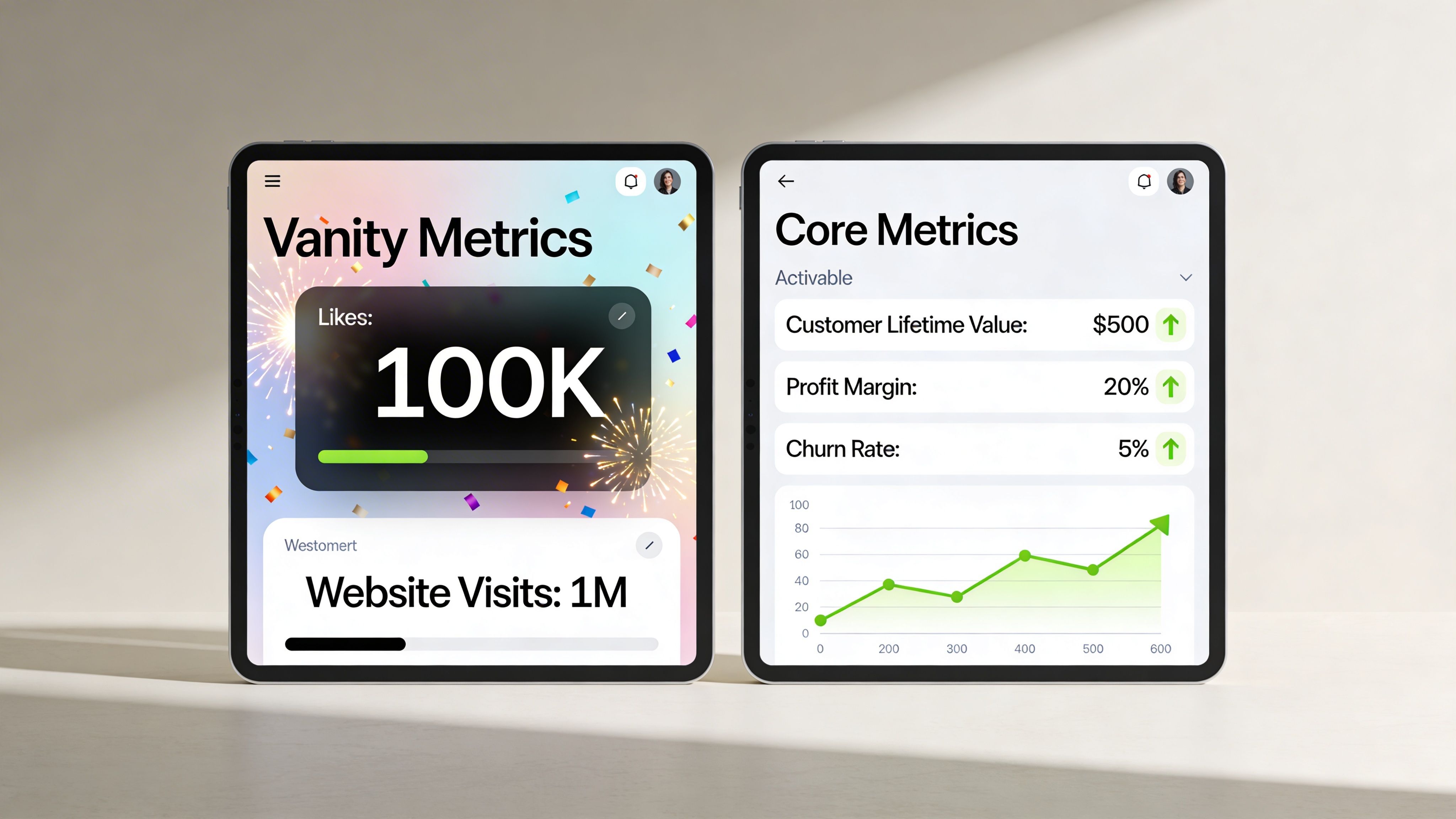
Start with a short operating scoreboard.
| Metric | What it tells you | Simple question |
|---|---|---|
| Customer Acquisition Cost | What you spend to win a customer | Is growth affordable? |
| Lifetime Value | What a customer is worth over time | Is the relationship valuable enough? |
| Churn Rate | How many customers leave | Is the product or service sticky? |
| Conversion Rate | How many prospects move to purchase | Is the offer clear and trusted? |
| Payback Period | How long it takes to recover acquisition cost | Is cash flow under control? |
You don’t need a finance team to begin. A spreadsheet is enough if the numbers are updated accurately.
Not all meaningful KPIs are financial.
A 2025 MENA benchmark for high-signal founder networks shows an annual member retention rate of 78%, driven by peer accountability, with 2.4x faster idea validation speed and a 41% higher probability of scaling (data cited here). That’s a useful reminder. Progress also depends on whether your operating rhythm helps you make better decisions consistently.
In practice, that means founders should track internal execution signals too:
Operator’s test: If your metrics don’t change what you do next week, they’re probably vanity metrics.
Keep it short. Five to seven numbers is enough for most early-stage teams.
A simple rhythm works:
If marketing is part of your growth motion and you want a cleaner way to think about proof rather than noise, this 7 metric framework for proving marketing impact is a useful reference.
A business isn’t fully operational until the legal and commercial structure matches what you’re trying to do.
The UAE gives founders advantages here. It ranks as the top destination for ease of doing business in MENA, Dubai issued over 59,000 new business licences in 2022, and the country has over 45 free zones hosting more than 100,000 companies (details here). That creates options, but options can confuse first-timers.
For most early founders, the first meaningful setup choice is between a mainland company and a free zone company.
Here’s the practical comparison.
UAE Business Setup Mainland vs Free Zone
| Factor | Mainland Company (DED) | Free Zone Company |
|---|---|---|
| Primary regulator | Department of Economy and Tourism or equivalent local authority | Specific free zone authority |
| Market access | Generally suited for operating directly in the local UAE market | Often preferred for founders who want an efficient setup environment |
| Activity flexibility | Depends on approved activity and local rules | Depends on the free zone and its permitted categories |
| Office expectations | Can vary by licence and activity | Often more packaged and startup-friendly |
| Ecosystem fit | Useful if your business relies on broader local commercial activity | Useful if you want a contained setup process and cluster benefits |
| Decision lens | Best when local operating scope matters most | Best when simplicity, sector fit, or free zone support matters most |
Don’t choose based on what a friend did. Choose based on operating reality.
Ask these questions first:
What works is aligning legal structure with business model.
What doesn’t work is registering quickly because the package looked easy, then discovering the activity, banking process, customer contracts, or operating scope don’t fit how you sell.
A practical sequence is better:
If you’re getting ready to build locally, this guide for becoming an entrepreneur in the UAE helps connect the setup decision with the founder journey, not just paperwork.
If you strip away the jargon, what is business comes down to this. It’s a repeatable system for creating value, delivering it well, and getting paid in a way that can last.
That sounds simple. It isn’t easy.
The founders who make progress don’t just chase inspiration. They validate before building too much. They choose a model that fits the customer. They track a few metrics. They set up the right legal base for how they’ll operate. Then they keep adjusting the machine.
There’s one more reality worth facing. Founders rarely win important trust-based opportunities alone. In MENA, founder-peer facilitated introductions boost deal success by 3x, while scaling startups face 45% longer funding cycles due to trust deficits (reported here). That’s why random networking often disappoints. Access improves when relationships are relevant, credible, and ongoing.
You don’t need more noise. You need better conversations, better feedback, and better introductions.
If you’re still in the idea stage, your next move is validation.
If you’ve validated, your next move is systems.
If you already have systems, your next move is tightening the circle around you so decisions improve faster and the right doors open sooner.
That’s what turns motion into traction.
If you want that kind of founder circle, Founder Connects is built for it. It’s a private UAE and MENA startup community for founders who want practical support, curated introductions, accountable peer groups, and conversations that lead to progress instead of surface-level networking.


