

What Is Marketing Sales? A Founder’s Guide To Growth In The UAE

Building in MENA? You don't have to do it alone.
Join 300+ founders in the Founder Connects Residency. Monthly squad calls, warm intros, $3M+ in perks, and much more. All for less than your monthly coffee budget.

For a busy founder in the UAE, the line between marketing and sales can feel blurry. Let's clear that up fast. Marketing is the engine that creates awareness and sparks interest. Sales is the team that converts that interest into actual, paying customers.
Marketing And Sales: What Founders Need To Know Fast
Think of it this way: Marketing is like casting a wide, intelligent net to attract the right kind of fish. Sales is the art of expertly reeling them in, one by one.
One team finds potential customers; the other turns them into actual customers. They're distinct jobs, but they are completely codependent. A startup simply cannot scale if these two aren't working in perfect harmony.

This simple understanding is critical in the competitive UAE and MENA startup ecosystem, where every dirham and every lead counts. Get this relationship right from day one, and you'll prevent a world of wasted resources and missed opportunities.
Their Distinct Roles
To get how they work together, you must first understand their separate missions.
- Marketing’s Mission (One-to-Many): Marketing speaks to a broad audience. Its job is to build brand recognition, educate the market about the problem you solve, and generate a steady stream of interested, qualified leads. This is your content, your social media, your SEO, and your ad campaigns in action.
- Sales’s Mission (One-to-One): Sales takes the baton from marketing. The goal here is to build personal relationships with those qualified leads, dig into their specific needs, and guide them toward a purchase. This means product demos, writing proposals, negotiation, and, ultimately, closing deals.
To the customer, the process should feel seamless. Marketing warms up the conversation so that by the time your sales team reaches out, the prospect already knows who you are and what you do.
Marketing vs Sales At a Glance
Here’s a simple table breaking down their core differences.
AspectMarketingSalesPrimary GoalGenerate awareness & qualified leadsConvert leads into paying customersFocusOne-to-many communicationOne-to-one relationshipsKey MetricsWebsite Traffic, MQLs, Cost Per Lead (CPL)Conversion Rate, Monthly Recurring Revenue (MRR), Customer Lifetime Value (CLV)Time HorizonLong-term (brand building)Short-term (quarterly targets)
This distinction is your first diagnostic tool. It helps you pinpoint where your customer acquisition process is breaking down.
Not getting enough attention in the market? That’s a marketing problem. Getting plenty of attention but failing to convert it into revenue? That’s a sales problem. Answering that question is your first step to fixing the real issue.
Why Team Alignment Is Your Startup’s Superpower
While it's standard to have separate marketing and sales teams, real growth kicks in when they act as a single, unified force. When these two teams operate in their own silos, the fallout is immediate and expensive—especially in a competitive market like the UAE. You'll see wasted ad spend, frustrated colleagues, and leads that fizzle out.
Picture a rowing team. If one side rows harder or in a different direction, the boat just spins in circles. Get them in sync, and the boat cuts through the water with incredible speed. That synchronisation is what turns a good startup into a great one.
The High Cost of Misalignment
When marketing and sales aren't on the same page, the friction ripples through the entire business. Marketing might be proud of generating hundreds of leads, but sales complains they're all low-quality. Meanwhile, the sales team is gathering priceless customer insights, but that feedback never makes it back to shape the next marketing campaign.
This disconnect creates a predictable set of problems:
- Wasted Resources: Marketing burns cash attracting people who will never become customers. Sales wastes time chasing prospects who aren't a good fit.
- Inconsistent Messaging: A potential customer sees one message in an ad and hears something completely different on a sales call. Trust evaporates.
- Internal Friction: Teams start pointing fingers at each other for missed targets, breeding a toxic culture that kills collaboration.
A study found that this disconnect between sales and marketing costs businesses a staggering $1 trillion every year in lost productivity and wasted marketing efforts. For a UAE startup, even a tiny slice of that waste can be fatal.
The Power of a Unified Growth Engine
On the flip side, when your teams are aligned, they create a powerful feedback loop. Marketing delivers high-quality leads that the sales team is excited to follow up on because they actually convert. In return, sales provides real-world intel on which messages are hitting the mark, allowing marketing to constantly fine-tune its strategy.
This synergy builds a growth engine that delivers tangible results. For a deeper dive into how leaders can tackle this, exploring frameworks on fixing internal alignment for leadership clarity can offer great starting points.
The benefits are clear and measurable:
- Higher Conversion Rates: When leads are better qualified from the start, they’re easier to close.
- Shorter Sales Cycles: Prospects move through your funnel faster because the journey is seamless.
- Increased Customer Lifetime Value (CLV): A consistent, trustworthy experience leads to happier customers who stick around longer.
Your Next Action: Ask your marketing and sales leads this one question: “How do we currently define a ‘good’ lead?” Even if you're wearing both hats, answer it from each perspective. If you get two different answers, you've just found your starting point for alignment.
Building Your Growth Engine From Day One
For an early-stage founder, the "growth engine" is usually just you. You're the head of marketing, the only salesperson, and the entire customer support team. This is a necessary part of the grind.
But how do you go from a one-person show to a functioning team without burning through capital? The journey happens in three clear stages, moving from chaos to aligned, collaborative growth.
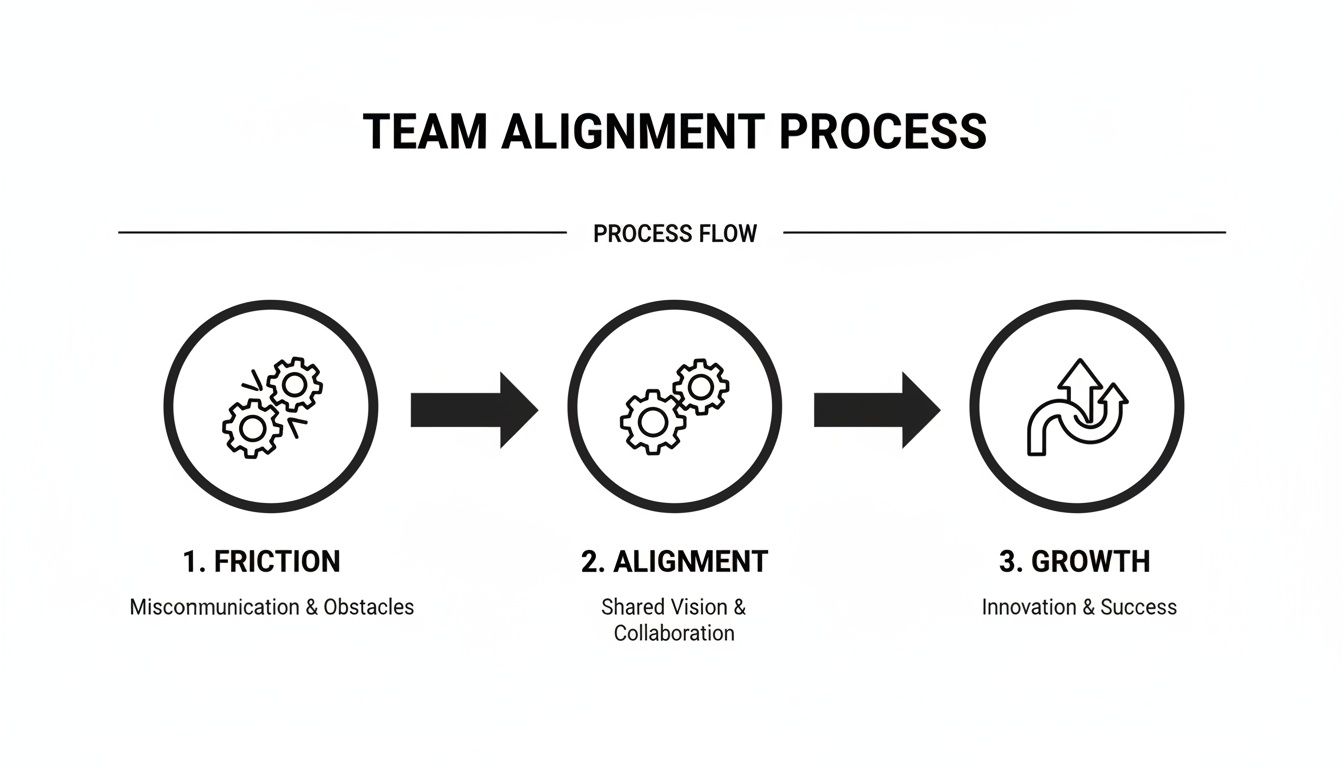
This process is the only real path to sustainable growth. It’s about transforming internal chaos into a well-oiled machine.
Stage 1: The Founder-Led Era
In the beginning, your main job is to learn. You're the one hitting up your network for leads and personally closing those first few crucial customers. Forget fancy funnels for now.
Your mission is simple. Focus on these priorities:
- Customer Interviews: Talk to everyone. Your goal isn't just to sell; it's to get inside your customers' heads, validate your idea, and understand their pain points.
- Manual Outreach: Lean on your personal and professional networks. In the UAE, a warm introduction is worth its weight in gold.
- Tracking: A simple spreadsheet or a free CRM is all you need. The only KPI that matters right now is the number of meaningful customer conversations per week.
Stage 2: Your First Specialist Hire
You've found product-market fit. You have a repeatable (though manual) way to bring in customers. The problem now is you—you've become the bottleneck.
It's time for your first specialist hire. But do you go for marketing or sales?
If you have a decent flow of inbound interest but can't find the time to follow up and close deals, you need a salesperson. If your product is solid but no one knows you exist and your lead pipeline is dry, you need a marketer. Getting this first hire right is critical. For more on this, check out our guide on choosing the best marketing channels for UAE startups.
Stage 3: Building The Team
With your first specialist killing it, it's time to build a small, dedicated team. This is where you formalise the scrappy processes you developed earlier, turning manual efforts into scalable systems.
Now you face another big decision: hire in-house or bring in an agency?
This is a key question in the UAE's fierce market. The startup scene here has grown by 32% in recent years, and Dubai alone is home to over 3,500 active startups. That competition means you have to be smart about how you grow.
Here’s a simple framework to decide:
- Hire In-House When: You need deep product knowledge and someone who will live and breathe your company culture. This is for core, strategic roles that define your business.
- Outsource to an Agency When: You need specialised expertise for a project—like a big SEO push or a performance marketing campaign—without the overhead of a full-time salary. It’s worth understanding different models like CAaaS vs. MAaS to see what fits your stage.
Actionable Steps To Unify Your Teams Today
All the theory in the world is useless if you can't put it into practice. For founders juggling a dozen priorities, unifying marketing and sales comes down to simple, repeatable actions that build momentum.
This isn’t about a massive reorganisation. It’s about building small, consistent habits that force your teams to speak the same language and share accountability.
Create a Simple Service Level Agreement
The single biggest source of friction is the definition of a "good lead." Marketing hits its target of 100 leads and celebrates, while sales grumbles that 95 of them were duds. Sound familiar?
The fix is a Service Level Agreement (SLA). It's a simple contract between marketing and sales that answers one critical question: What criteria must a lead meet before marketing hands it over to sales?
This forces a crucial conversation and gets both teams to agree on a concrete definition of a Marketing-Qualified Lead (MQL).
Your SLA could include criteria like:
- Demographics: The lead must be from a specific industry, company size, or location (e.g., based in the DIFC or KSA).
- Firmographics: They need to have a certain job title, like 'Head of Operations' or 'CTO'.
- Behavioural Data: They must have taken specific actions—downloading a whitepaper, joining a webinar, or requesting a demo.
Run a Weekly Smarketing Meeting
Alignment needs constant, open communication. Get a recurring 30-minute "Smarketing" (Sales + Marketing) meeting in the calendar and make the agenda non-negotiable.
The point isn't to point fingers. It's to review the pipeline, share what's working (and what's not), and solve problems as one team.
The purpose of a Smarketing meeting is simple: ensure insights from the front line (sales) directly fuel the strategy at the top of the funnel (marketing). This builds a learning-obsessed growth engine.
Your agenda should hit three key points every week:
- Pipeline Review: Look at last week’s MQLs. Which converted to Sales-Qualified Leads (SQLs)? Which fell flat, and why?
- Feedback Loop: What is sales hearing on calls right now? New objections? Common questions? Competitor mentions? This is pure gold for marketing content.
- Upcoming Campaigns: What's marketing planning? Sales can give immediate feedback to ensure the messaging will land with the target audience. Learn how to power these efforts with our guide to AI tools for lead nurturing in UAE startups.
Use Your CRM for MENA-Specific Networking
In the MENA region, business gets done through relationships. Generic advice to "use your CRM" misses this crucial local nuance.
Instead of only tracking deals, get your team to meticulously log the key relationships for every contact. Who do they know? Who introduced them? Which industry events do they frequent?
Over time, your CRM transforms from a sales pipeline tool into a powerful relationship map of your ecosystem. It becomes your secret weapon for finding that next warm intro.
Your Next Action: Block 30 minutes in your calendar this week. Invite your marketing and sales leads (or just yourself) to your first Smarketing meeting. Use the three-point agenda above to kick off the conversation.
The MENA Advantage: Leveraging Relationships For Growth
If you're a founder in the UAE, you can throw most Western sales playbooks out the window. The cold outreach and automated funnels that work in North America often fall flat here. In the MENA region, business moves at the speed of trust.
Understanding this isn't just a tip—it's the core of any successful growth strategy.

Here, cold emails are almost always ignored. Aggressive, transaction-first sales tactics can damage your reputation before you even get a foot in the door. The single biggest driver of high-value deals and critical partnerships is the warm introduction.
Your network isn’t just a part of your strategy. It is the strategy.
This relationship-first culture is becoming even more pronounced. For the first time, the number of active investors in the MENA region has surpassed the number of new startups. This signals a huge shift: investors are now actively hunting for high-potential ventures, making a referral from a trusted contact the most powerful asset a founder can have.
Building Your Network The Right Way
In the MENA region, your entire marketing and sales effort must prioritise genuine connection over transactional volume. It’s about showing up, listening, and adding value long before you ever ask for something in return.
Your focus should boil down to two key activities:
- Attending High-Signal Events: Forget sprawling, anonymous trade shows. Spend your time at curated meetups and industry-specific gatherings where you can have real conversations. The goal isn't collecting business cards; it's building genuine rapport.
- Activating Warm Introductions: Systematically map your network. Use your CRM not just to track deals, but to understand who knows who. A referral from a trusted contact bypasses gatekeepers and instantly establishes credibility.
In the UAE, a five-minute coffee meeting set up through a mutual connection is infinitely more valuable than a hundred cold emails. Trust is the currency, and relationships are the transaction.
Growth Tactics: Cold Outreach vs. Warm Introductions
The difference in effectiveness between a cold approach and a relationship-based one in this market is stark. Founders who adapt their methods to the local culture will always have a massive advantage.
For anyone looking to master this, our guide on how to build a strong startup network in Dubai offers practical, step-by-step advice.
Here's how outreach strategies really stack up for founders in the region.
TacticEffectiveness in MENATypical ROIBest ForWarm IntroductionExtremely HighVery HighSecuring high-value clients, key partnerships, and investor meetings.Networking EventsHighHighBuilding initial rapport, lead generation, and market intelligence.LinkedIn OutreachLow to ModerateLowVery targeted outreach, but only effective if a mutual connection exists.Cold Email/CallingExtremely LowVery Low / NegativeRarely effective; often ignored and can damage your brand's reputation.
As you can see, the path to meaningful growth in the MENA region doesn't run through mass email campaigns. It’s paved with handshakes, coffee meetings, and mutual trust.
Your Next Action: Go through your network and identify one person who could introduce you to a potential key client or partner. Draft a short, clear email making it incredibly easy for them to make that introduction for you. Don't ask for a sale—just ask for a conversation.
Common Questions We Hear About Marketing And Sales
Even with the best strategy, aligning marketing and sales stirs up tricky questions. Here are straight-up answers to the most common questions from founders in the UAE and MENA.
"As A Solo Founder, Am I Doing Marketing Or Sales?"
You're doing both, sometimes in the same five-minute window. Think of it less as two separate jobs and more as a fluid dance between two roles.
When you post on LinkedIn about a problem your startup solves, that's marketing—you're building awareness. The second someone comments with interest and you slide into their DMs to chat about their specific needs, you’ve switched hats. That’s sales—a one-on-one conversation aimed at a deal.
The key isn't to get bogged down in titles but to recognise which hat you’re wearing. Early on, your main goal is to learn. Marketing helps you find people to talk to, and sales conversations give you the raw feedback you need to sharpen your message and product.
Your Next Action: For one week, track your activities. At the end of each day, split your growth-related tasks into two columns: 'Marketing' (one-to-many) and 'Sales' (one-to-one). This simple exercise will show you exactly where your time is going and help you see the natural rhythm between the two.
"What’s The Single Most Important Metric For Team Alignment?"
If you want to know if your teams are truly on the same page, look no further than the Marketing-Qualified Lead (MQL) to Sales-Qualified Lead (SQL) Conversion Rate.
This number tells you what percentage of leads from marketing are accepted by sales as real, workable opportunities. It's the ultimate litmus test.
A low MQL-to-SQL rate is a massive red flag. It means one of two things:
- Marketing is talking to the wrong people or using the wrong message.
- Sales has a different (and maybe unwritten) definition of a good prospect.
Fixing this one metric forces both teams to agree on a shared definition of a "qualified lead." That conversation is the bedrock of an efficient growth engine.
"Should I Hire A Sales Or Marketing Person First?"
There's no single right answer, but there's a simple way to figure it out.
Ask yourself this question: "What is holding back our growth right now—a lack of leads, or a lack of time to close them?"
- Hire a sales person first if: You already have a trickle of inbound interest. Maybe your personal network brings in referrals or your content generates enquiries. If you are the bottleneck in following up, doing demos, and closing deals, you need a sales hire to convert the demand you already have.
- Hire a marketing person first if: Your product is solid, but your pipeline is bone dry. If you have no consistent flow of potential customers and you're struggling to get in front of new audiences, you need a marketing hire to build the top of your funnel and create that initial spark.
A common mistake in the UAE is hiring a salesperson too early, expecting them to magically create demand in a market that runs on relationships. Without any marketing fuel to get started, even the best salesperson will spin their wheels.
At Founder Connects, we help you navigate these critical growth decisions by connecting you with a curated community of fellow founders. Get the peer support, accountability, and warm introductions you need to build your business smarter, not harder.
Learn more and apply to join at https://www.founderconnects.com.

Building in MENA? You don't have to do it alone.
Join 300+ founders in the Founder Connects Residency. Monthly squad calls, warm intros, $3M+ in perks, and much more. All for less than your monthly coffee budget.
Popular posts





Founder Connects is a premium MENA tech founder community. Meetups in Dubai and across MENA, Residency Squads of 8–10, and 400+ vetted WhatsApp founders (apply and screened).