

A lot of UAE founders reach the same point at roughly the same time. The company is stable, cash flow is less fragile, and idle capital starts to feel like a missed opportunity. Dubai property looks expensive, public markets feel crowded, and someone in your network says Pakistan real estate still has room to run. Then one platform keeps appearing in every conversation. Zameen.
That's usually where the confusion starts, not where it ends.
Most guides treat Zameen as a search portal. That's too shallow for a cross-border investor. If you're based in Dubai, Abu Dhabi, or Riyadh, you don't need help clicking filters. You need a way to judge whether a listing is investable, whether pricing is grounded in reality, and whether the risk sits in the asset, the seller, the paperwork, or the market itself.
The useful way to think about Zameen real estate is this. It's not just a marketplace. It's a signal layer for Pakistan's property market. Used well, it helps you build a view on pricing, liquidity, and local demand. Used badly, it turns into a feed of attractive photos, stale asks, and false confidence.
A familiar scenario. A founder in Dubai has already bought exposure to the UAE through salary, customers, rent, and personal property decisions. That concentration works until it doesn't. So the next move often becomes regional diversification, usually into a market that feels understandable enough to access through trusted contacts.
Pakistan often enters the shortlist for exactly that reason. The cultural and business overlap with the Gulf is real, and family networks or operating relationships often make the market feel one step closer than it is. But “familiar” can be dangerous. Cross-border property investing punishes assumptions.
Zameen is often the first serious stop because it gives you market visibility fast. You can scan cities, asset types, and societies in one sitting. Beyond that, you can start spotting patterns in what gets marketed aggressively versus what appears truly liquid. That distinction matters if you're thinking about capital preservation, rental demand, or an eventual resale.
A founder should approach this like any other capital allocation decision. Start with portfolio logic, not listing logic. If you're already thinking about expanding your rental property portfolio, the same principle applies here. Diversification only helps if the new asset has a different risk profile, a different demand base, or a different upside driver. Buying a hard-to-exit property in another country isn't diversification. It's just complexity.
Practical rule: Don't open Zameen and ask, “What looks cheap?” Ask, “What kind of exposure am I trying to buy?”
That question changes everything. It tells you whether to focus on completed homes, land-like exposure through plots, or purely speculative inventory that might look exciting online but behaves badly when sentiment turns. The platform becomes much more useful once you stop browsing like a buyer and start screening like an operator.
Zameen.com has been around since 2006 and is widely described as Pakistan's No. 1 property portal, with coverage across major cities including Lahore, Karachi, Islamabad, Rawalpindi, Multan, Faisalabad, and Peshawar, according to its App Store listing for Zameen. For a UAE-based founder, that matters because long operating history and city breadth usually tell you the platform is embedded in day-to-day market behaviour, not just in digital marketing.
Its own market framing also highlights overseas Pakistanis as a key demand driver in the property market, which is especially relevant if you're investing from the Gulf and want to understand who else is buying and why.
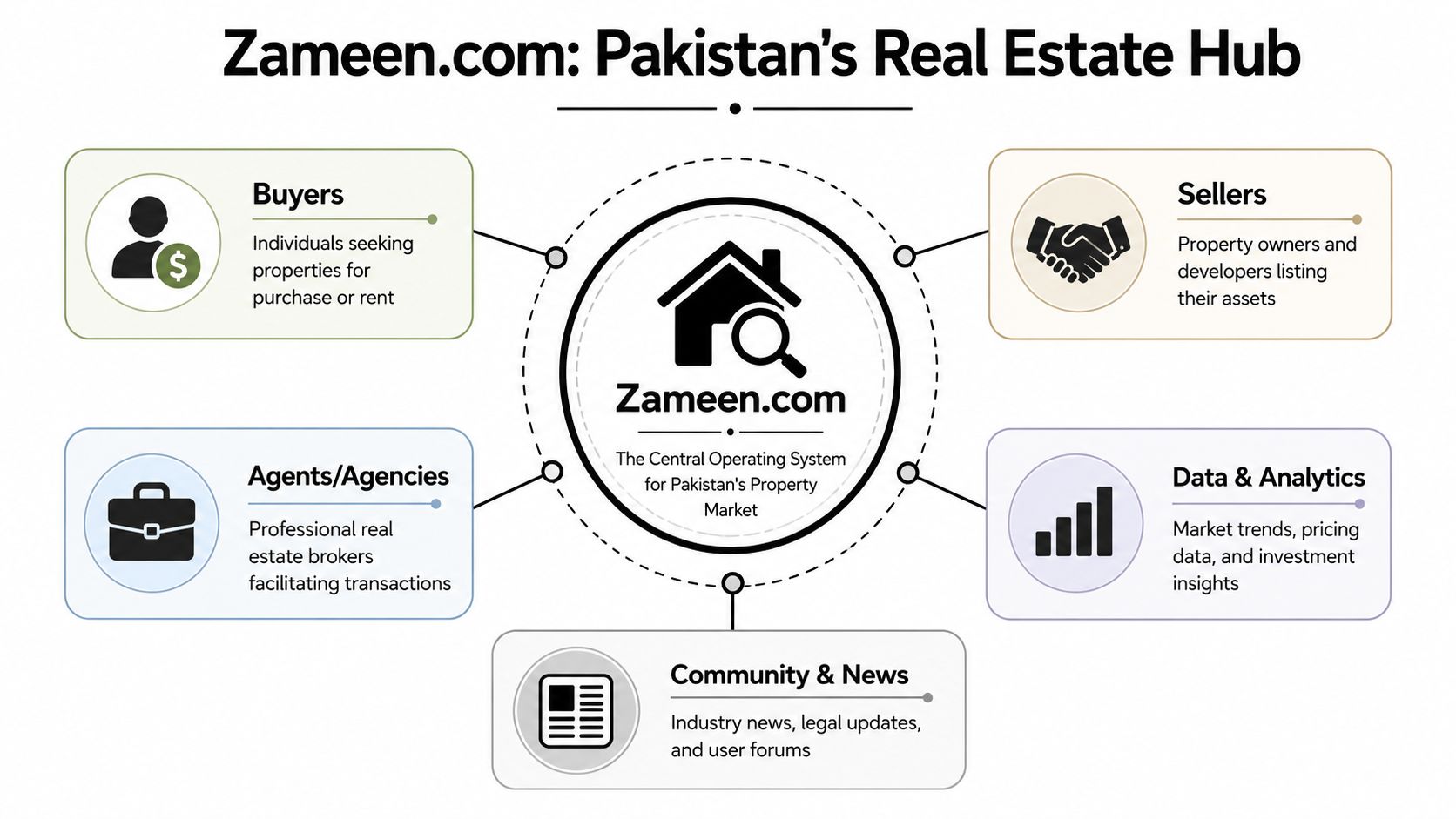
The easiest mistake is treating Zameen as neutral market infrastructure. It isn't. It's a commercial platform sitting between buyers, sellers, agents, and developers. That doesn't make it unhelpful. It means you should read it the way you'd review any marketplace business.
A practical lens:
| Layer | What it gives you | What to watch for |
|---|---|---|
| Listings | Fast market visibility | Asking prices aren't the same as cleared prices |
| Agents and agencies | Local access | Incentives may favour volume over precision |
| Developer exposure | Early access to projects | Marketing can overpower sober underwriting |
| Data and index signals | Directional pricing intelligence | Index snapshots still need local validation |
| News and content | Regulatory and sentiment context | Platform content may reflect ecosystem incentives |
If you spend time in proptech, the structure will feel familiar. Marketplaces become influential because they aggregate demand, then they accumulate data, then they shape behaviour. That's part of why platforms like Zameen matter in markets where offline information is fragmented. For a useful comparison of how real-estate technology businesses create defensibility, this overview of proptech companies driving real estate innovation is worth skimming.
Zameen is most useful when you treat it as an ecosystem, not a truth machine.
If you're not fluent in Pakistan's property vocabulary, pause and fix that first. Terms that seem ordinary can carry different implications by market. This guide to real estate investing vocabulary is a quick refresher before you start comparing listings across jurisdictions.
The platform can tell you where attention is flowing. It can't replace independent judgement on price, title quality, or exit risk.
That's the right stance. Zameen helps you locate the market. It doesn't remove the need to interrogate it.
You are in Dubai, a broker sends three Pakistan listings on WhatsApp, and each one looks cheap relative to UAE prices. That is usually where a bad process starts. Cross-border investors do better when they read demand, pricing, and liquidity before they read any single listing.
Zameen is useful at this stage because it lets you study market behavior by city, society, and property type before you spend time with agents. That matters in Pakistan, where two assets in the same city can behave like completely different markets once you account for location quality, infrastructure delivery, buyer mix, and resale depth.
On its market-facing materials, the platform has been associated with different price movements across houses, plots, and residential property categories, as discussed in Data Darbar's analysis of Zameen's growth. The practical takeaway is simple. Stop treating Pakistan property as one market with one trendline.

A city-level view is too broad for underwriting. In Pakistan, societies often function as distinct micro-markets with their own price bands, buyer profiles, infrastructure risk, and exit conditions.
Zameen's index data, noted earlier, regularly shows that even well-known communities such as DHA Defence and Bahria Town can move differently across segments. That difference matters more to a UAE-based founder than headline city appreciation. You are not buying “Lahore” or “Karachi.” You are buying exposure to a specific pocket of demand, with a specific resale audience, under a specific legal and operational setup.
I use three screens before I form any view on value:
Founders often have an edge. They already know that top-line activity can mislead if the underlying user quality is weak. The same discipline behind understanding real-estate tech needs through product-market fit applies here. Demand quality matters more than surface volume.
Pakistan property cycles are shaped by taxes, filer status rules, and documentation friction. A change in transaction costs can pull sidelined buyers back into the market quickly, especially in segments already favored by domestic capital or overseas remittances.
Zameen's market commentary has highlighted examples such as changes affecting non-filer participation and withholding tax. For an operator used to watching CAC, regulation, and conversion friction, the logic is familiar. Lower transaction friction can temporarily lift activity without fixing the underlying asset quality.
That creates a useful filter. If policy gets friendlier and a society still shows weak movement, slower absorption, or stale asking prices, I treat that as a warning sign. It often points to a deeper issue such as oversupply, poor location economics, weak title confidence, or limited end-user demand.
Working heuristic: A property segment that stays soft during a supportive policy window deserves stricter diligence.
Price benchmarking on Zameen works best when the comparison group is tight. Do not compare a file in an outer development area with a completed house in an established society and call it a valuation exercise. That is category error.
Use a narrow frame:
For UAE-based investors, this step does two jobs at once. It helps estimate fair value, and it exposes whether the asset depends on local narrative rather than actual demand. If one society consistently lists at a premium, ask why. Better utilities, stronger security, cleaner title history, and easier resale are valid reasons. Pure branding is less durable.
Agent conversations are more productive once you already know the spread between comparable societies, the usual asking range for the asset type, and the policy backdrop affecting demand. Without that base, you are borrowing someone else's framing.
A short one-page market memo is enough. Define the society, target buyer, likely rental or resale path, reasons prices may be justified, and the specific conditions that would make you walk away. That habit saves time, especially when you are evaluating Pakistan from the UAE and cannot inspect market claims in person the same week.
When you finally start using the platform at listing level, your job is screening, not shopping. The question isn't whether a property looks appealing. It's whether it survives enough pressure tests to earn deeper diligence.
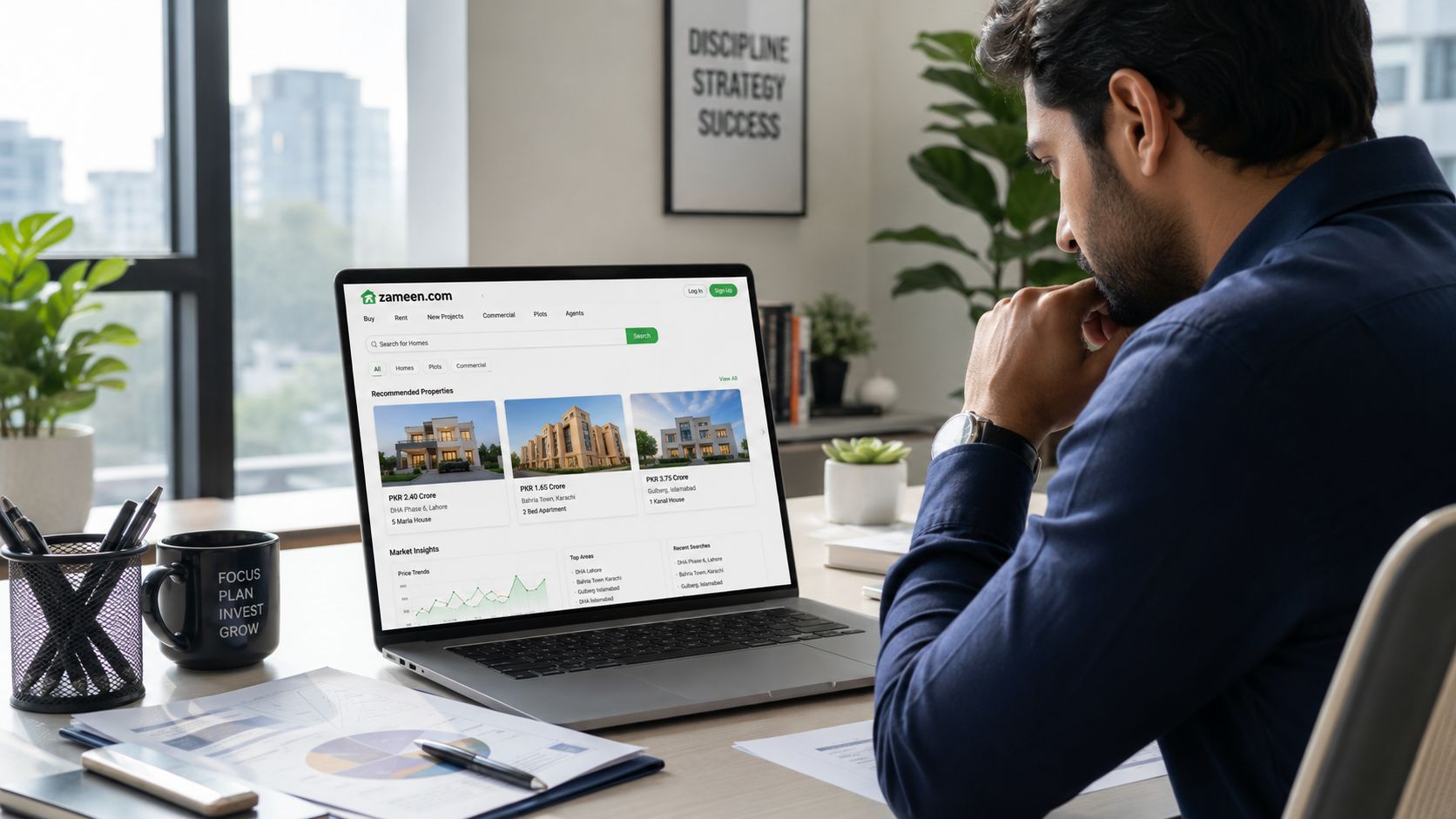
The first filter isn't budget. It's instrument type.
In Pakistan property listings, terms can hide very different risk profiles. Houses and completed apartments are easier for most UAE-based investors to reason about because you can underwrite occupancy, condition, and neighbourhood quality more directly. Plots can work, but they introduce a different bet. You're often relying more on future area development, utility delivery, and buyer sentiment than on current income.
Then there's inventory that behaves more like paper exposure than straightforward property ownership in practical terms. If the structure of the deal isn't obvious from the listing, slow down. Cross-border investors lose money when they think they're buying one type of exposure but are buying another.
A simple shortlist framework:
| Asset type | Usually suits | Main watchout |
|---|---|---|
| Completed home | Buyers who want clearer use-case and comparables | Renovation or upkeep surprises |
| Apartment | Investors focused on managed occupancy potential | Service quality and building execution |
| Plot | Investors comfortable with development-led upside | Long holding periods and sentiment risk |
Most users treat filters as convenience tools. Investors should treat them as a way to strip out weak leads.
Focus on combinations, not individual checkboxes:
If you've used UAE portals before, the workflow will feel familiar. But the discipline has to be stricter. A useful contrast point is how buyers assess Bayut properties in Dubai. In the UAE, buyers often have more formalised benchmarks and clearer transaction visibility. On Zameen, you need to create more of that structure yourself.
What works is boring. Shortlists. Repeatable filters. Manual note-taking. Comparing similar stock inside a small geography. Calling fewer agents, but asking sharper questions.
What doesn't work is also predictable. Chasing “urgent sale” language. Falling for polished images. Treating premium society branding as proof of good entry price. Assuming a developer-led push means demand is broad-based.
Buy the listing only after you understand the micro-market. Never the other way round.
A founder's advantage here is process discipline. Use it. Build a watchlist, score each listing against your thesis, and reject anything you can't explain in one clean sentence.
The biggest mistake UAE-based investors make with Zameen real estate is assuming a listed discount equals value. It often doesn't. It may mean the seller is motivated. It may also mean the listing is stale, the asset is awkward, the paperwork is messy, or the market has already moved on.
That's why verification matters more than discovery.
For context, a separate UAE-focused discussion on undervalued property notes that Dubai residential prices rose by about 20% year-on-year in Q1 2025, and argues that market-specific benchmarking matters because pricing dynamics differ sharply by location, as outlined in this piece on how to find undervalued properties. The practical takeaway is simple. You can't import a Dubai “deal” heuristic into Pakistan and expect it to work.

A founder in Dubai usually has an instinct for checking transaction reality against portal pricing. Bring that habit with you.
Your benchmark stack should include:
The key is not to ask, “Is this cheaper than Dubai?” That's an unhelpful question. Ask, “Is this correctly priced for its exact submarket, given local liquidity and execution risk?”
Some issues are annoying. Others are disqualifying.
Watch for these first:
Non-negotiable: If the property can't survive document verification and independent inspection, the online listing is irrelevant.
You don't need to fly in for every opportunity. You do need a sequence.
The practical challenge in cross-border investing isn't just fraud. It's asymmetry. The other side knows which compromises are normal in that local market. You don't. Your protection comes from insisting on a process that narrows that information gap before money moves.
A UAE founder looking at Pakistan usually does not have a listing problem. The problem is deciding which signals deserve capital and which ones deserve a pass. Zameen is useful for price discovery and market scanning, but it is only one input in an investment process that should include local verification, comparable analysis, and a clear exit view.
The better approach is triangulation. Use Zameen to benchmark asking prices, then compare that with what local brokers say is clearing, what recent development activity suggests about supply, and whether the location solves a real demand problem for end users. In cross-border investing, the gap between advertised value and tradable value is where mistakes happen.
Macro context still matters. In the UAE, investor demand has been shaped in part by population growth. Dubai's population reached about 3.8 million in 2024, according to the Dubai Statistics Center population data. The useful lesson for Pakistan is not that both markets behave the same way. They do not. The lesson is that property performance usually follows utility first. Areas gain pricing power when transport improves, commercial activity deepens, schools and hospitals become more accessible, and buyers can explain why the next purchaser or tenant will also want that location.
Keep the process narrow enough to manage properly.
One practical point matters more than founders expect. Zameen can help you spot pricing patterns, but it cannot tell you whether a quoted price is financeable, transferable, or likely to clear in a real sale. That part still depends on local truth.
Move when the asset is plain enough to explain to another buyer in 30 seconds, the documentation is clean, the location has a visible demand base, and your local counsel can verify the transfer path without caveats.
Wait when the thesis depends on stacked assumptions. A future road, future possession, future regulation clarity, and future buyer demand can each be acceptable on their own. Put them into one deal and you are no longer investing against evidence. You are investing against hope.
A busy founder does not need more listings. You need a tighter filter, a pricing benchmark you trust, and the discipline to keep cash unallocated until the risk-adjusted case is clear.
If you're a UAE founder making cross-border decisions and want sharper judgement from people who've built, invested, and operated in the region, Founder Connects is built for exactly that kind of high-signal conversation. It's a private founder community centred on practical support, curated introductions, and honest peer input, so you can test decisions like this with people who understand both capital allocation and regional nuance.


