

You've probably seen allianz marketing management llc dubai in a proposal, a vendor list, a LinkedIn message, or an intro from someone in your network. That's usually when the founder brain splits in two. One side wants to move fast because pipeline, launches, and runway don't wait. The other side knows one weak agency decision can burn months.
My default position with any UAE marketing partner is simple. Verify first. Test second. Commit last. That keeps emotion out of the process and stops a polished sales deck from doing the heavy lifting.
With Allianz Marketing Management LLC, there are enough public signals to start proper due diligence, but not enough to skip it. That makes it a useful case study for founders, especially if you're hiring external help for validation, lead generation, market entry, or outsourced execution in Dubai.
A founder gets a proposal on Tuesday, takes the call on Wednesday, and by Friday the team is already discussing campaigns. That is usually where avoidable mistakes start. The right first move is slower and simpler. Check whether the business you are evaluating looks like the kind of partner you need.
Publicly, Allianz Marketing Management LLC is associated with Clover Bay Tower, Business Bay, Office 1212, 33 Marasi Drive. That is a real commercial location in a part of Dubai where many service firms operate. On its own, that does not prove delivery quality. It does tell you you are likely looking at a structured B2B services firm rather than a freelance setup hiding behind a broad trade name.
For founders, that distinction changes the evaluation. A structured firm may bring process, account management, and broader execution capacity. It may also bring higher retainers, slower turnarounds, and more layers between your team and the people doing the work. Early-stage companies often underestimate that trade-off.
I would reduce the first screen to four checks before any serious conversation:
That last point gets ignored too often. A weak marketing partner rarely fails in one dramatic moment. The more common failure mode is slow drift. Missed deadlines. Generic messaging. Reporting that looks busy but does not help a founder decide what to do next.
A useful evaluation looks at operating evidence, not presentation quality. Ask what team will handle the account, what work stays in-house, how results are reported, and what happens if scope changes mid-engagement. If the answers stay high-level, treat that as a risk signal.
Company names can also mislead founders in the UAE. “Marketing management” is broad language. It can cover coordination, campaign execution, consulting, partner management, or outsourced marketing operations. This signals a different type of partner than a pure creative agency, and your diligence should reflect that.
If you need a benchmark for checking whether a UAE business has the kind of formal presence expected of an established services firm, the DIFC public register verification process is a useful reference point, even when the company you are reviewing is not a DIFC entity.
The goal here is not to prove Allianz Marketing Management LLC is good or bad. The goal is to decide whether the engagement can be tested safely, with clear scope, clear accountability, and limited downside.
A founder gets the proposal on Tuesday, the sales call goes well on Wednesday, and procurement asks a simple question on Thursday: is this company properly set up to sell what it is offering? That is the point where a fast verification process saves time, money, and awkward backtracking.

For any UAE vendor, including Allianz Marketing Management LLC Dubai, I check legal existence before I discuss strategy, pricing, or case studies. Founders can do most of this themselves in a short session.
Use this order:
This part matters because a polished pitch can hide basic operational problems. If the licence activity looks narrow but the company is selling a broad outsourced marketing function, ask why. If the address changes across documents, pause the process and request the current trade licence copy.
The useful test is consistency. A real operating company should leave the same basic trail across its licence, invoices, email signatures, proposal deck, and public listings.
For Allianz Marketing Management LLC, one practical check is whether the Business Bay office details used in public-facing material line up with current licence records and billing paperwork. You do not need perfect branding consistency. You do need the legal identity, address, and contracting entity to match cleanly enough that your finance team can verify who it is paying.
A structured registry check is easier to understand if you have a reference point. This guide to the DIFC public register verification process shows the level of clarity founders should look for, even when the company being reviewed is not a DIFC entity.
A mismatch does not automatically mean fraud. It can mean outdated admin, a recent office move, or weak internal controls. For an early-stage company hiring an external partner, that still creates avoidable risk.
Do this on the first serious call, not after verbal alignment:
The trade-off is simple. Serious firms usually share these quickly because they have gone through procurement before. Weak operators often delay, deflect, or send incomplete paperwork.
That response pattern tells you a lot.
If they are slow on basic verification, expect more friction later when approvals, reporting, or scope changes start to matter.
A founder signs a marketing retainer expecting leads in 30 days. Two weeks later, the vendor is sending survey drafts, market maps, and audience notes instead of campaign assets. The work may still be useful, but the mismatch burns time and cash.
That is the right lens for assessing allianz marketing management llc dubai. Start with what the public footprint suggests, then pressure-test whether that matches the outcome your company needs.
One public description points to market research and feasibility studies in the UAE, with work connected to local data analysis for GCC clients, according to this business listing reference. If that description is accurate, founders should treat them less like a creative shop and more like a research-led commercial support partner.
That changes the buying conversation.
A research-led firm can be useful for startups that need clearer market entry decisions before they spend on full execution. In practice, that usually means work such as:
I usually see founders get value from this type of partner in three cases. The first is UAE market entry, where the team needs evidence before building an in-house function. The second is a narrow lead generation push, where local knowledge matters more than broad creative output. The third is pre-expansion validation, where management needs a realistic read on segment demand, pricing tolerance, and buying friction.
The upside is clear. Local context often improves campaign performance because buyer behaviour in Dubai changes by language, sector, trust signal, and approval chain. A playbook imported from another market can miss badly here.
The trade-off is just as clear.
If you need sharp positioning, category storytelling, product marketing, or senior growth architecture, a research-heavy operator may not be the right first hire. Founders often buy the label "marketing management" and assume it covers strategy, creative, paid media, CRM, and sales enablement. It rarely does.
A better approach is to force service clarity early. Ask, "What do you do better than other agencies in Dubai?" Then ask, "What do you not do?" Good partners answer both without hedging.
If you want a comparison point for how broad this category can be, this review of Vibrant Marketing Management Dubai service positioning is useful because it shows how similar naming can hide very different delivery models.
Use this filter before you scope a trial project:
| Need | Better fit |
|---|---|
| Early market validation | Research and feasibility partner |
| Outbound lead generation support | Sales and campaign execution partner |
| Messaging and category creation | Brand or product marketing specialist |
| Paid acquisition at scale | Performance agency with channel depth |
The practical question is simple. Are you hiring for answers, execution, or both?
If the firm cannot define its strongest service in one sentence, or keeps shifting between research, lead generation, branding, and consulting depending on what you ask, treat that as a scope risk. Founders do not need a broad pitch. They need a partner whose delivery model matches the job.
You shortlist a firm, the pitch sounds polished, and the proposal arrives fast. The fundamental question starts after that. What kind of operator are you about to let into your pipeline, budget, and customer data?
For Allianz Marketing Management LLC Dubai, I would separate reputation checks into two buckets. First, how the company appears to run internally. Second, whether there is enough outside proof that clients received useful outcomes. Founders need both.
One public employee review describes a high-pressure sales environment with aggressive targets, including 120%+ attainment expectations, 50+ weekly leads, and conversion targets in the 18 to 22% range, based on this employee review page.

I do not read that as an automatic negative. In Dubai, a sales-led culture often means follow-up happens, managers track activity, and commercial teams know their numbers.
It also creates a familiar risk.
A team trained to hit targets hard can be excellent at speed and weak at restraint. That shows up in oversold scope, vague delivery promises, and retainers signed before success metrics are pinned down. If you have dealt with other trading and services firms in the UAE, the pattern is similar to what founders often uncover during broader vendor checks such as this review of BSS Trading LLC due diligence signals.
Employee commentary is useful for judging operating tempo. It is weak evidence of client success.
Use it to test for four things:
Good sales management helps. It does not replace proof of execution.
The harder issue here is limited public evidence of recent client outcomes. I could find employee-facing commentary more easily than verified case studies, named references, or clear before-and-after performance examples.
That should raise your proof threshold.
In the UAE, outsourced marketing is crowded, presentations are polished, and service labels overlap. Founders need a filter for separating visible activity from reliable delivery. If you want an outside benchmark for that screening process, this guide on how to find the right marketing agency is a useful cross-check.
A quiet public profile is not disqualifying. Some firms do solid work without publishing much. But a low-transparency firm does shift more verification work onto the buyer.
Do not reject the company on reputation signals alone. Tighten the evidence standard before you sign.
Ask for:
The quality of the answer matters as much as the answer itself. Clear, specific responses lower risk. Vague replies, changing stories, or reluctance to connect you with actual clients usually point to a sales-first operation that still has not earned trust.
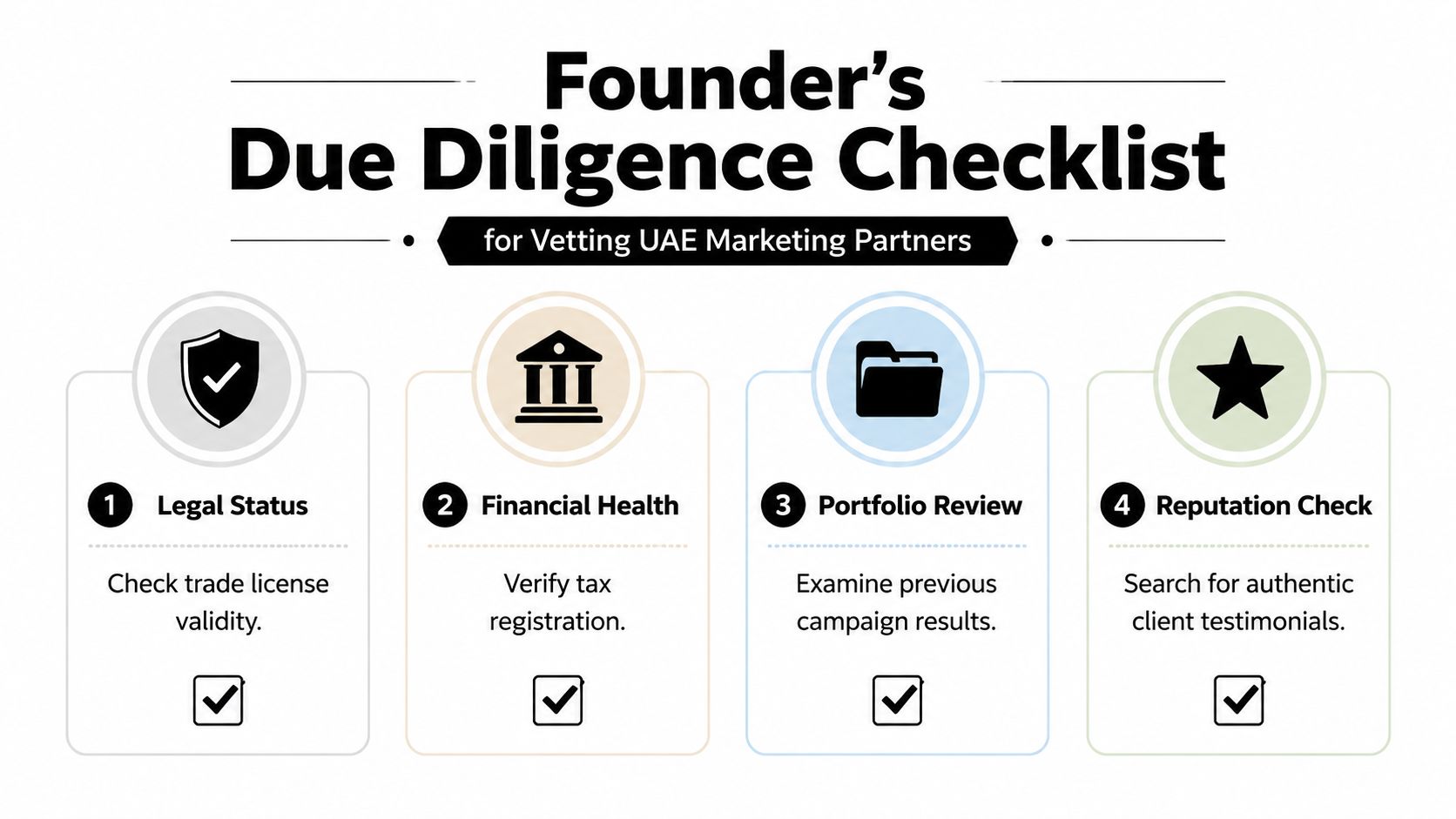
You get the proposal on Thursday. The deck looks polished, the pricing feels manageable, and the salesperson wants a quick yes so they can “start next week.” This is the point where founders get exposed.
A good due diligence process does not need to be heavy. It needs to be repeatable, fast, and strict enough to catch the obvious ways a marketing engagement can go wrong. I use the same screen for Allianz Marketing Management LLC Dubai that I would use for any small or mid-sized agency in the UAE.
This filter is built for founder-led buying decisions. It focuses on what reduces risk before signature.
Start with the entity, not the pitch. In Dubai, small mismatches in paperwork often point to bigger problems later, especially when invoices, contracts, and account ownership do not line up.
This is not an audit. It is a sanity check on whether the commercial setup makes sense for a startup that needs control over cash and accountability.
Many founder decisions break down at this stage. A vendor can sound credible and still fail the evidence test.
For Allianz Marketing Management LLC Dubai, the practical question is simple. Can they show work that is relevant to your stage, budget, and growth problem? If public proof is thin, ask for private proof under NDA and judge the quality of that material, not the confidence of the sales call.
A legally valid vendor can still be a poor operating fit. This matters more than many founders admit.
For a broader outside view on how to find the right marketing agency, this guide from Gilkes Media is a useful companion because it lines up well with an evidence-first buying process.
| Area | Check | Status (Done/Pending) |
|---|---|---|
| Legal Status | Trade licence verified | Pending |
| Legal Status | Registered activity matches proposed service | Pending |
| Financial Health | Invoice and tax details confirmed | Pending |
| Financial Health | Payment schedule tied to milestones | Pending |
| Portfolio Review | Relevant case examples requested | Pending |
| Portfolio Review | Client references requested | Pending |
| Reputation Check | Delivery model and communication quality reviewed | Pending |
| Reputation Check | Delivery team and account lead confirmed | Pending |
If you want another founder due diligence example where an ordinary company profile raises practical questions once you examine operations more closely, this review of BSS Trading LLC is worth reading.
A key principle: Don't sign a retainer until the checklist is complete enough that you could defend the decision to your co-founder, board, or next investor.
If a vendor clears your due diligence threshold, the next risk sits in the contract. Within these agreements, many founders yield their advantage.
For most startups, the safest first move is a paid, time-boxed pilot. Not a six-month commitment. Not a vague monthly retainer with “ongoing optimisation” as the main deliverable.
A pilot does three things:
Good pilot formats include a short feasibility sprint, a defined lead generation experiment, a messaging test, or a market-entry research brief. The key is that the output must be observable.

Founders get trapped by promising language. Contracts should describe deliverables, not aspirations.
At minimum, define:
If they promise strategy, ask what the actual artefacts are. A strategy could mean a workshop, a deck, a market map, channel priorities, buyer personas, or all of them. If it isn't listed, it probably won't be delivered.
Every founder-friendly service agreement needs a clean exit path.
Use plain terms around:
The best contract is the one that stays calm when the relationship doesn't.
Avoid large upfront payments unless there's a compelling reason and a strong trust basis. Link payments to milestones, outputs, or review points. That keeps both sides aligned.
This isn't about being adversarial. It's about making accountability normal from day one.
At this point, the answer usually falls into one of three buckets.
Choose this if the legal details are unclear, the contracting entity doesn't match the pitch, or the team avoids basic verification questions. Also choose no if the service being sold is still fuzzy after a real conversation.
This is the likely category for many founders assessing allianz marketing management llc dubai. There are enough public signals to justify a conversation. There is also a meaningful lack of public client proof, which means you shouldn't jump straight into a broad retainer.
A pilot makes sense if:
This only makes sense if your private diligence closes the proof gap. That means you've seen enough to believe they can execute in your category, at your stage, with your budget.
A simple founder decision filter helps:
| Your situation | Best move |
|---|---|
| Pre-seed, validating demand | Short research or feasibility pilot |
| Early revenue, need pipeline support | Small outbound or campaign pilot |
| Scaling, need broad strategic partner | Proceed only with strong proof and clear governance |
The important point isn't whether this specific firm is good or bad. It's whether you can reach a decision based on evidence instead of momentum. Founders in the UAE don't need more vendor noise. They need tighter filters, faster checks, and cleaner ways to reduce downside.
Use this process once, and it becomes reusable for every future agency, consultant, growth shop, or outsourced partner you evaluate.
If you want a better way to sanity-check vendor decisions with people who understand the UAE startup reality, Founder Connects is built for that. It brings founders into curated peer groups, practical conversations, and high-signal introductions so you can pressure-test choices, compare notes, and move faster with less guesswork.


