

For founders across MENA, regional expansion is usually a story of high costs and confusing red tape. But setting up a business in Bahrain offers a completely different experience. Think of it as a practical, cost-effective launchpad into the rest of the GCC—a strategic, low-friction gateway to scale your startup.

If you’re a founder based in the UAE or anywhere in the region, you know the drill: juggling different legal systems, ownership restrictions, and sky-high setup fees can burn through your time and capital fast. This is exactly where Bahrain stands out, serving not just as another market, but as a strategic hub for your next growth phase.
Bahrain’s approach is refreshingly straightforward, designed to cut through the usual friction founders face. The Kingdom provides a clear, welcoming framework for international entrepreneurs, making it the perfect place to test a new product, set up a secondary operational hub, or establish a strategic base to tap into the massive Saudi Arabian market next door.
Bahrain's appeal to startups boils down to core benefits that solve common founder headaches. The government has intentionally built an environment to make getting a business off the ground as simple as possible. This gives you a real edge, especially if you’re an early-stage company that needs to stay lean and move fast. Here’s the practical breakdown:
One of the biggest wins for founders is Bahrain's digital-first approach. Forget running around to different ministries; the Sijilat portal is an integrated online system connecting you to over 60 government entities. You can handle most of your registration and licensing from one place, which is a massive time-saver.
It’s also worth noting that a new 15% minimum tax for large multinationals is set to begin in January 2025, but this is designed specifically to leave SMEs and startups untouched, reinforcing the country’s focus on supporting growing ventures.
Next Action: Before you dive into the details, ask your founding team this question: "Could a low-cost, 100% foreign-owned entity in Bahrain help us test the Saudi market faster than setting up there directly?" Your answer will shape how you approach the rest of this guide. You can also explore our broader perspective on the Middle East startup ecosystem to see how Bahrain fits into the regional picture.
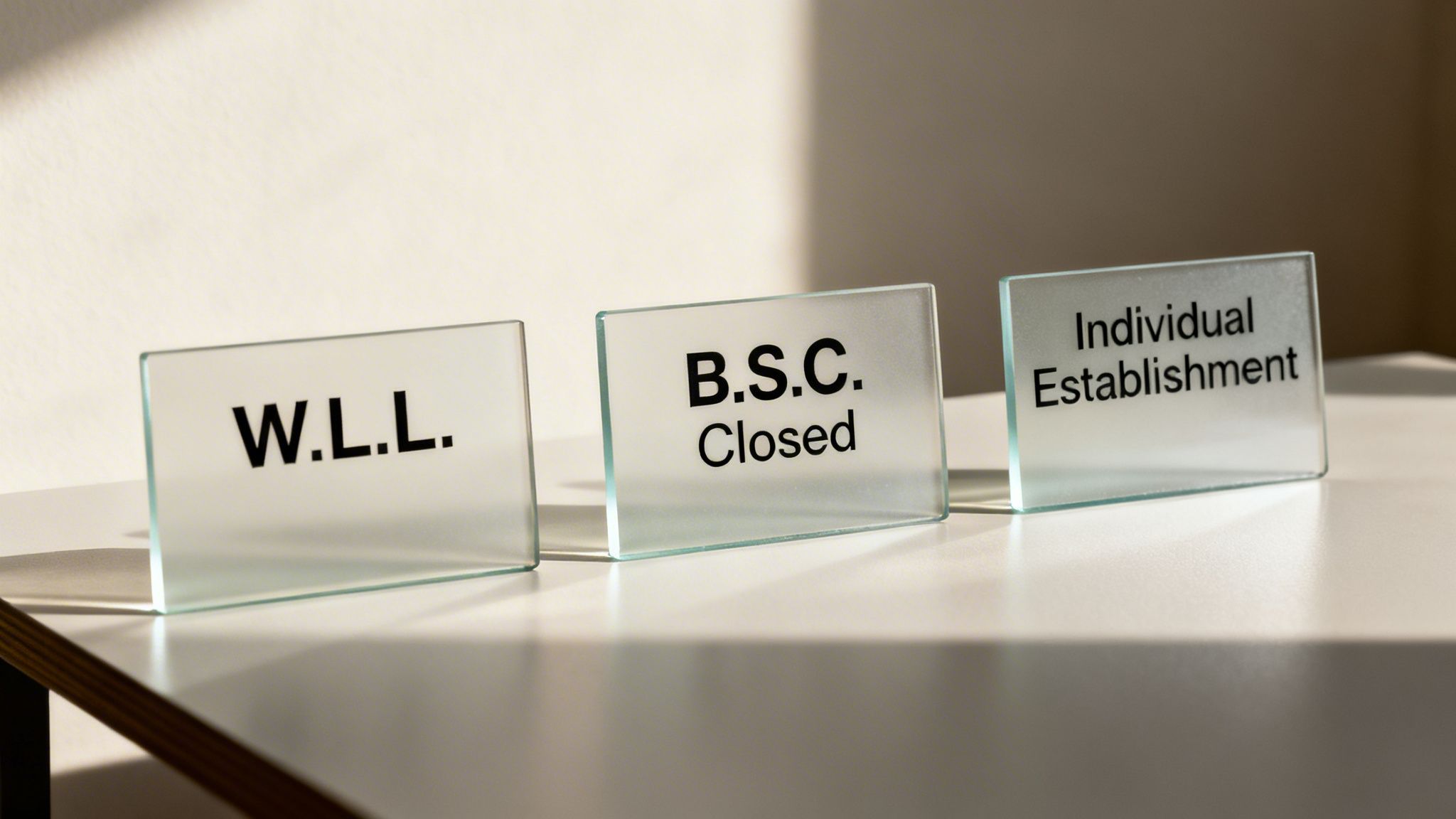
Picking a legal structure for your startup feels like a massive, irreversible decision, but it's a strategic one that shapes your ability to raise capital, protect your personal assets, and manage operations. For founders setting up in Bahrain, the options are refreshingly straightforward.
The best way to approach this is by asking one simple question: “What’s the most important thing for my business to accomplish in the next 18-24 months?” Are you just testing an MVP? Planning to hire a team? Or getting ready to raise a seed round? Your answer will point you directly to the right entity.
The three most common structures for founders are the With Limited Liability (W.L.L.), the Bahraini Shareholding Company (B.S.C.) Closed, and the Individual Establishment.
Your company's structure should be tailored to your roadmap. Use these scenarios to see where your ambitions fit.
Scenario 1: You're a solo founder or small team testing an MVP.
Your focus is speed and low costs. You need to validate your idea without putting personal savings at risk. Fundraising isn't on the immediate horizon.
Scenario 2: You plan to raise venture capital within two years.
Investors need a clean, scalable structure that allows them to easily buy into your company. You need a setup that can handle co-founder equity splits, employee stock options (ESOPs), and multiple funding rounds.
Founder Insight: It’s tempting to start with a W.L.L. for its simplicity, but if you have a clear path to a priced funding round, consider a B.S.C. Closed from day one. Converting a W.L.L. later involves legal fees and paperwork that can slow down a deal. Starting as a B.S.C. Closed signals to investors that you're built for scale.
Here’s a quick-scan table breaking down how each entity stacks up against what founders actually care about.
| Feature | W.L.L. (With Limited Liability) | B.S.C. Closed (Shareholding Co.) | Individual Establishment |
|---|---|---|---|
| Liability | Limited: Personal assets are protected. | Limited: Liability is restricted to capital invested. | Unlimited: You are personally liable for all business debts. |
| Best for | Service businesses, small teams, pre-funding startups. | Startups planning to raise VC funding or implement an ESOP. | Solo founders, freelancers, consultants testing a concept. |
| Fundraising | Possible, but complex. Often requires conversion to a B.S.C. | Ideal. Designed for issuing shares to investors. | Not suitable for institutional investment. |
| Partners | Requires at least one partner (but can be a 99/1 split). | Requires a minimum of two shareholders. | Only one owner. No partners allowed. |
Getting this right from the start saves you major headaches and sets your startup on a solid foundation. For a deeper dive into the first steps, take a look at our guide on how to get your startup off the ground.
Once you’ve locked in the right legal structure, your next stop is Sijilat. This is the government’s all-in-one online portal for business registration. Think of it as your digital command center for getting your company legally off the ground.
For any founder who has dealt with tangled bureaucracy, Sijilat is a huge improvement. It brings together more than 60 government entities, meaning most of your registration and licensing happens in one spot. But while the portal is efficient, getting it right depends on having all your information ready.
This is your practical playbook for using Sijilat to make your business setup in Bahrain as smooth as possible.
The most important work happens before you log in. The top reason founders hit roadblocks is a lack of preparation. Get your documents and key details sorted before you start the application to save weeks of frustrating back-and-forth.
Here’s a checklist of what you need on hand:
The portal guides you, but knowing the main phases helps you stay ahead. It’s not a single form submission; it’s a sequence of approvals.
Founder Insight: The step everyone underestimates is opening the corporate bank account. It can easily take longer than the entire CR process. Start talking to banks the moment you get your initial CR approval. Ask around in the Founder Connects community for recommendations on startup-friendly banks.
Getting your business set up in Bahrain quickly comes down to avoiding simple errors. Here’s how to stay out of trouble:
Getting your Commercial Registration (CR) is a huge win, but don't celebrate just yet. The race isn't over; it has shifted from setup to operations. Think of the CR as your ticket to the game—now you have to actually play. Getting these next steps right is what separates businesses that thrive from those that stumble.
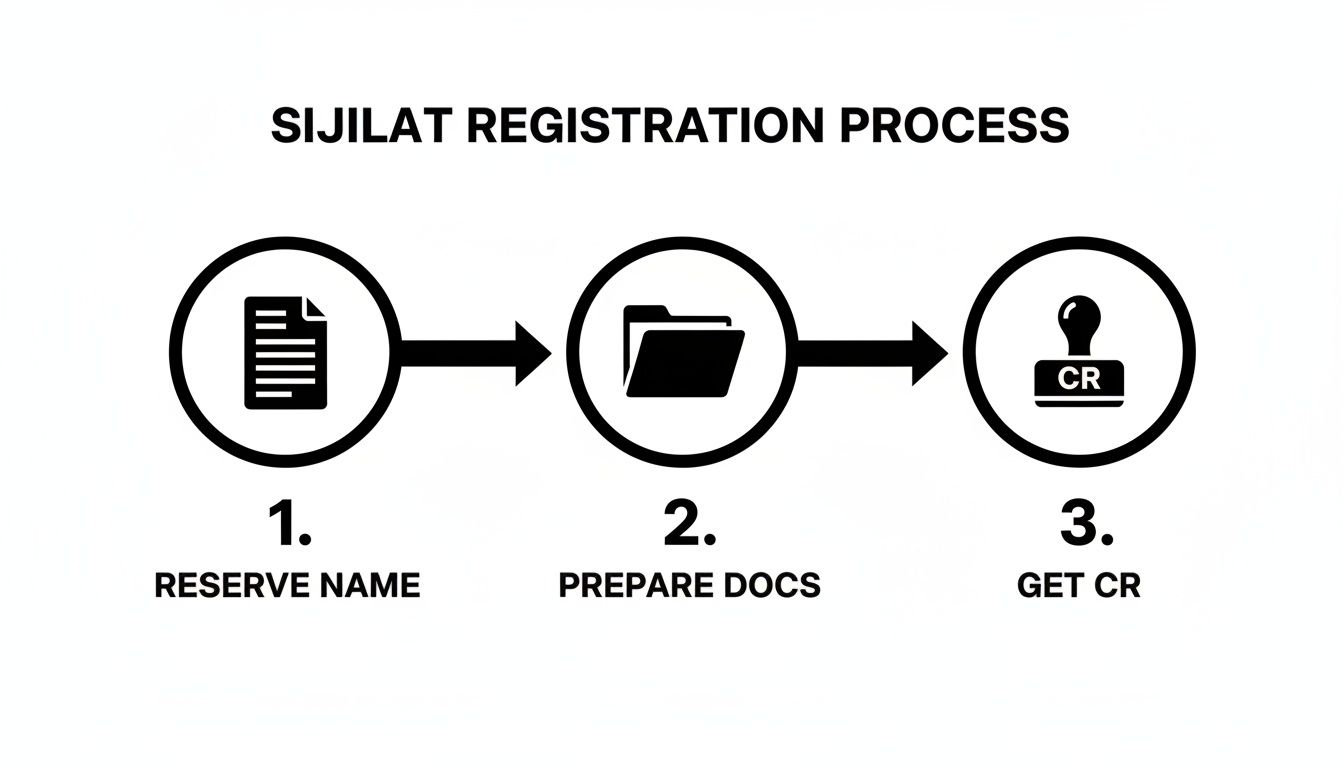
As you can see, securing your CR is just the beginning. The most time-consuming operational hurdles often come after you have that piece of paper.
This is your absolute top priority. You can't manage revenue, pay suppliers, or run payroll without a corporate bank account. This single step can take longer than the entire CR process, so start immediately. Not all banks are created equal, especially for startups.
Tips for a Smoother Banking Setup:
Bahrain’s tax-friendly environment is a massive perk, but "low tax" is not "no compliance." Getting a handle on your financial obligations from day one will save you headaches and penalties.
A Founder's Reality Check: That 0% corporate income tax is amazing, but don't mistake it for a free ride. VAT and other mandatory fees are real costs. Build these into your financial model from the start, or your projections will be toast.
Here’s what you absolutely need to know:
The Labour Market Regulatory Authority (LMRA) is the gatekeeper for all private-sector employment in Bahrain. The moment your CR is active, your next stop should be registering your company with the LMRA. This registration is non-negotiable. Without it, you can't hire anyone—local or expat—or issue a single work visa. It's the key that unlocks your ability to build a team and requires managing the necessary legal documents for your employees.
Next Action: Start the corporate bank account process this week. Get the application forms and document checklists from at least two recommended banks. This single action will set the pace for getting your business running.

Once your business is registered, your next big move is building the team. A company is nothing without its people, which means navigating visas for yourself and key hires while tapping into Bahrain's impressive local talent pool. Everything related to employment runs through the Labour Market Regulatory Authority (LMRA). Getting registered and staying compliant is non-negotiable.
As soon as your Commercial Registration (CR) is issued and your company is registered with the LMRA, you can start the visa process. For founders, the key is securing the Self-Sponsorship Residence Permit, tied to your business ownership.
For your expatriate staff, you'll be applying for individual work permits and residence visas. The LMRA’s online system is efficient, but you should still plan for a 2 to 4-week turnaround from application to final approval—assuming all your paperwork is perfect.
Like its GCC neighbors, Bahrain has a "Bahrainisation" policy that encourages hiring local citizens. Many founders see this as just a compliance box to tick, but that’s a missed opportunity. Treat it as a strategic advantage. The professional talent here is remarkable, especially in fields like tech and finance. Hiring locals gives you an instant injection of market knowledge and helps build a more sustainable culture.
Founder Insight: Don't put off your Bahrainisation strategy. Weave local hiring into your growth plan from day one. Your first local team member can be a game-changer, helping you navigate cultural nuances and open doors an all-expat team could never access.
To land the best local professionals, a competitive salary is just the starting point. Ambitious Bahraini talent wants growth opportunities, a vibrant company culture, and the chance to make a real impact. If you need to Hire Developers or other technical specialists, you'll be competing for top-tier candidates.
Here’s what actually works:
Bahrain’s highly skilled, bilingual workforce makes scaling your team much easier. It’s a popular secondary hub for UAE-based founders and a perfect launchpad into the $2.37 trillion GCC market, especially with its close economic ties to Saudi Arabia. As a founder, you may also qualify for special government programs. We put together a guide on these opportunities here: expatriate founder programs and special government funding paths.
Even with a perfect plan, you're going to have questions. Here are clear answers to the most common ones we hear from founders.
Official portals often highlight best-case scenarios, but a realistic timeline accounts for real-world administrative hurdles. Plan for a 4 to 8-week window from start to finish. This gives you a buffer for inevitable delays.
Here’s a typical breakdown:
Founder Takeaway: The biggest variable is opening the corporate bank account. Don't wait. Start conversations with banks the moment you get your initial CR approval.
Learning from others' mistakes is the fastest way to get ahead. Sidestep these recurring—and completely avoidable—issues.
1. Mismatched Business Activities
Don't pick a general category on Sijilat. Be incredibly specific about every activity your business will perform. The wrong code can trigger surprise license requirements or get your application rejected.
2. Incomplete or Poor-Quality Documents
This is the number one cause of delays. A blurry passport scan or missing signature will get your application bounced back. Before you upload a single file, double-check that every document is crystal clear and complete.
3. Underestimating the Commercial Address Requirement
You can't get your final CR without a physical address in Bahrain. A P.O. box is not allowed for most activities. Secure your lease agreement early, as you'll need it for multiple approval stages.
The initial registration fees are just the start. To build a sustainable financial forecast, account for the recurring costs of operating in Bahrain.
Here’s a clear breakdown of the main ongoing costs to budget for:
By anticipating these timelines, sidestepping common mistakes, and building a realistic budget with all ongoing costs, your path to launching a successful business in Bahrain will be much smoother.
Navigating a new ecosystem is a challenge, but you don't have to do it alone. At Founder Connects, we believe in the power of peer support. Our curated community connects you with other founders in the MENA region who have been exactly where you are, offering a trusted space for real-world advice, meaningful introductions, and the accountability you need to grow.


