

Exits vs. Acquisitions: UAE Startup Trends

Building in MENA? You don't have to do it alone.
Join 300+ founders in the Founder Connects Residency. Monthly squad calls, warm intros, $3M+ in perks, and much more. All for less than your monthly coffee budget.

The UAE startup ecosystem is shifting focus to exits and acquisitions as key liquidity strategies. While IPOs remain rare, mergers and acquisitions (M&A) dominate, with the UAE leading the Middle East in M&A activity in 2025. Founders and investors are prioritising businesses with solid fundamentals, clear growth paths, and scalable operations.
Key Points:
- M&A Dominance: In 2025, the UAE recorded 17 M&A deals, contributing 92% of MENA’s inbound M&A value.
- IPO Rarity: Only five VC-backed IPOs occurred in MENA between 2015 and mid-2025.
- Sector Highlights: Fintech, SaaS, and PropTech lead investment and exit activity, with rising interest in AI startups.
- Preparation for Exits: Founders should focus on financial clarity, compliance with UAE regulations, and operational independence.
Quick Comparison:
| Aspect | Mergers & Acquisitions (M&A) | Initial Public Offerings (IPOs) |
|---|---|---|
| Timeline | 3–9 months | 12–24 months |
| Complexity | Less regulatory burden | Extensive compliance and disclosures |
| Valuation | Negotiated with buyer | Market-driven |
| Frequency | Common in UAE | Rare in UAE |
To succeed, UAE startups should plan exits 12–36 months in advance, ensure financial transparency, and leverage resources like Dubai SME and MBRIF. M&A remains the most practical route for founders seeking liquidity and long-term growth opportunities.
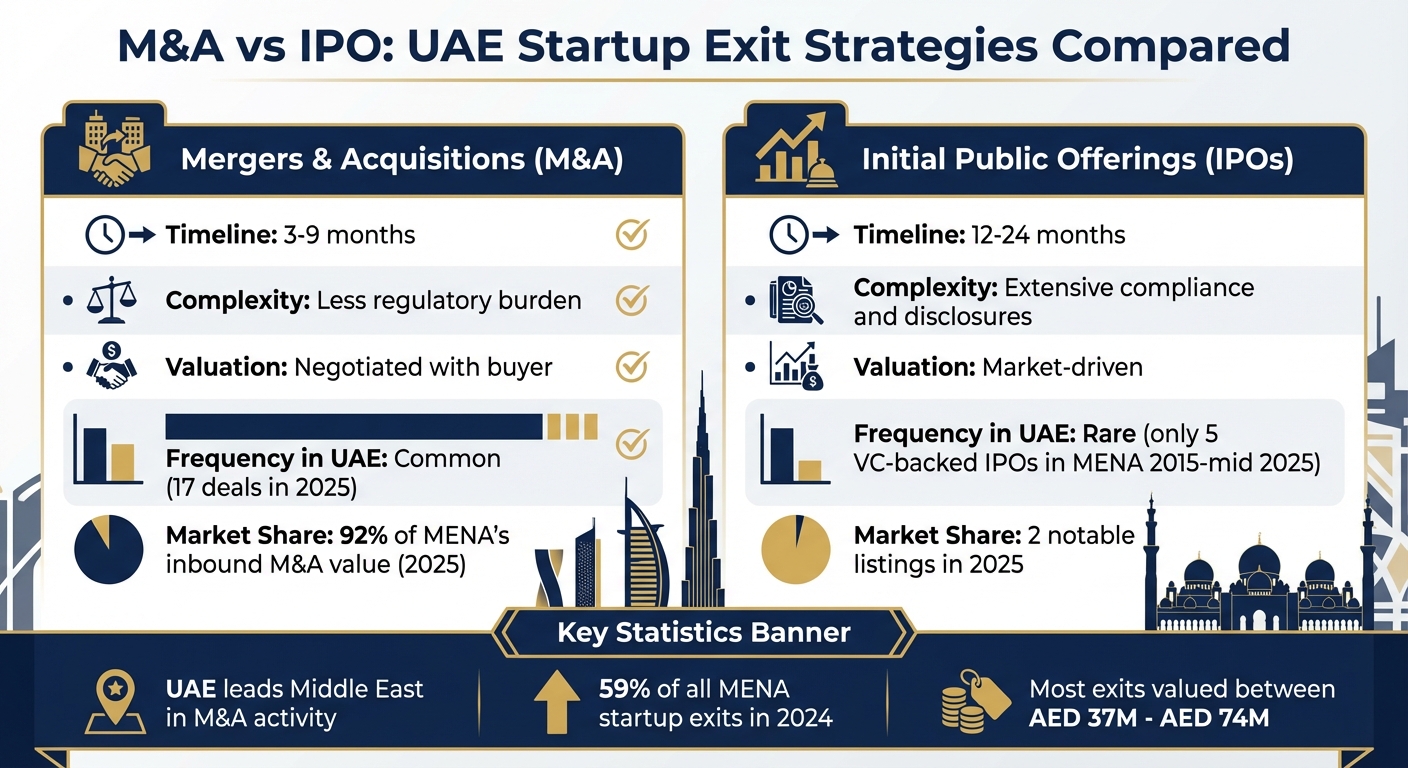
M&A vs IPO Exit Strategies for UAE Startups: Timeline, Complexity and Frequency Comparison
What Exits and Acquisitions Mean
What Are Startup Exits?
An exit is the process through which founders and investors convert their equity in a company into financial returns. This allows them to "cash out" after contributing to the growth and development of the business [2]. In the UAE, the most common exit strategies include Initial Public Offerings (IPOs), Mergers and Acquisitions (M&A), and secondary market transactions, where current shareholders sell their stakes to new investors [2].
While IPOs are relatively uncommon in the UAE, M&A and secondary transactions dominate the landscape [2][7]. A notable example of a secondary transaction is MEVP’s impressive 52× return on its investment in Fresha through a secondary share sale [2]. These transactions create opportunities for early investors to realise returns by selling their shares to later-stage investors.
Although exits can take various forms, acquisitions stand out as a more direct, transaction-focused method. Understanding these pathways is essential to grasp their significance in the UAE's growing startup ecosystem.
What Are Acquisitions?
Acquisitions, a specific type of exit, occur when one company purchases another [2]. In the UAE, acquisitions are the leading way for founders and investors to achieve liquidity. During the first nine months of 2025, the UAE tech sector saw several notable acquisitions, such as Xeneta acquiring eeSea, IHC purchasing Funder.ai, and Nawy acquiring Smart Crowd [7].
The preference for acquisitions often stems from their practicality. Larger companies increasingly opt to acquire existing tech capabilities rather than develop them in-house [4]. For instance, in Q1 2025, Dubai-based startup Cartlow was acquired by Basatne, marking the highest-valued acquisition of the quarter [9]. Abdullah Mutwai, Partner at TaylorWessing, highlights this trend:
"A recent rise in activity points to a more mature ecosystem and a desire to acquire tech capabilities rather than build them internally" [4].
This trend is evident in the numbers. In 2025, the UAE recorded 17 mergers and acquisitions, leading the Middle East in this category [1]. Additionally, in the first nine months of 2024, the UAE accounted for 59% of all startup exits in the MENA region [8]. For many UAE-based founders, acquisitions represent the most achievable route to liquidity, offering a practical way to deliver returns to investors. These insights underline the dominant role acquisitions play in shaping the UAE's startup landscape.
sbb-itb-f597d8f
How Exits and Acquisitions Compare in the UAE
Following our look at exit strategies, let’s dive into how timelines and valuations vary within the UAE’s startup ecosystem.
Timeline and Complexity
Acquisitions tend to wrap up much faster than IPOs in the UAE. A trade sale typically takes around 3 to 9 months to complete. IPOs, on the other hand, come with a longer timeline of 12–24 months due to the rigorous compliance required by the SCA (Securities and Commodities Authority) and exchange mandates. This includes detailed audited financial disclosures [10][11]. The extended timeline reflects the stricter regulations tied to public offerings.
For instance, in October 2022, Burjeel Holdings raised nearly AED 1.1 billion through an IPO on the ADX. However, this milestone was only possible after substantial internal restructuring to evolve from a family-owned business into a public company [11].
Acquisitions, meanwhile, offer more flexibility and privacy. Due diligence in a trade sale is usually tailored to the buyer's focus areas - like financial performance, contracts, or customer base. Confidentiality is often ensured through non-disclosure agreements [11]. That said, regulatory changes such as Ministerial Decree No. 3 have introduced stricter Ministry of Economy reviews for large mergers and acquisitions (M&A) that exceed certain revenue thresholds [10]. As ADEPTS observes:
"Deals that once took 3 months may now take 6 or more [due to regulatory reviews]... It gives time for better due diligence, sharper negotiation, and tighter integration plans" [10].
These differences in timing are just one part of the picture. Valuation methods and deal structures also set these exit routes apart.
Valuation and Deal Structure
Valuation strategies vary significantly between IPOs and acquisitions. Public offerings rely on market demand to establish a company’s value [11]. In contrast, acquisition valuations are negotiated directly between the buyer and seller, often using EBITDA multiples based on recent transactions in the same industry [13].
In the UAE, around 35% of startup exits fall within the AED 37 million to AED 74 million range, while 62% of disclosed M&A deals are valued below AED 184 million [12]. A standout example occurred in 2024 when e& acquired a majority stake in the Careem Super App, valuing the company at over AED 1.1 billion. This deal also allowed the founders to transition into advisory roles [10].
Acquisitions often provide additional options for founders, such as earnouts, retention packages, or advisory roles - opportunities that are typically unavailable in IPOs. Philip Bahoshy, Founder of MAGNiTT, highlights:
"The time to exit of those startups that successfully sold their companies is in line with international benchmarks at 7 years from founding to acquisition" [12].
This timeline serves as a helpful reference point for founders planning their exit strategies.
Which Sectors Lead UAE Exits and Acquisitions
Spotting the sectors driving acquisitions can give startups an edge in shaping their strategies. In the UAE, certain industries consistently dominate the scene, both in terms of investment and liquidity events.
Top Performing Sectors
Fintech stands out as a leader in both investments and exits. In 2025, the sector attracted AED 3.82 billion (around US$1.04 billion) in funding, marking a substantial 164% increase from the previous year [1]. This growth is fuelled by widespread digital adoption and supportive regulatory policies.
Enterprise Applications (SaaS) also played a key role, securing AED 4.77 billion (approximately US$1.3 billion) in funding during the first nine months of 2025. Although this represents a 30% drop from 2024, the sector remains active in mergers and acquisitions, as companies prefer acquiring proven technologies over building them from scratch [7][4].
Real Estate and Construction Tech emerged as a surprising star in 2025. Funding in this sector skyrocketed to AED 2.24 billion (roughly US$612 million) in the first nine months of the year, a dramatic leap from AED 180 million (around US$49 million) in 2024 - an astonishing 937% increase [6][7]. Notable examples include Property Finder's AED 1.93 billion (approximately US$525 million) private equity round and Nawy's acquisition of Smart Crowd to expand its footprint [7].
E-commerce continued its steady performance, raising AED 1.81 billion (about US$494 million) in 2025 [4]. Its maturity and established market presence make it a dependable sector for strategic acquisitions. As Philip Bahoshy, Founder and CEO of MAGNiTT, notes:
"The UAE's importance lay less in headline growth and more in ecosystem depth. The country remained the leading market for exits, recording 17 mergers and acquisitions in 2025" [1].
While these sectors remain dominant, artificial intelligence (AI) is quickly gaining traction as a transformative force in the UAE's startup ecosystem.
Growth in AI Startups
Building on the momentum in fintech and enterprise applications, AI is now drawing significant acquisition interest. Regional AI-related funding surged by 204% year-on-year to reach AED 3 billion (approximately US$817 million) in 2025 [1][4]. Government initiatives have positioned the UAE as the MENA region's leading market for AI funding.
A prime example of this trend is International Holding Company's (IHC) acquisition of Funder.ai in 2025, demonstrating how large conglomerates are integrating AI-driven financial tools [7]. Additionally, XPANCEO, a UAE-based deep-tech firm, raised AED 918.25 million (around US$250 million) in a Series A round, making it one of the year's largest transactions in emerging venture markets [4].
Anil Menon, Head of M&A and Equity Capital Markets at EY-Parthenon MENA, remarked:
"2025 was a remarkable show of Mena M&A market resilience... in spite of regional political unrest, significant global trade policy uncertainties and a once-in-a-generation tech transformation led by AI" [3].
Moreover, technology and diversified industrial products accounted for 38% of the total M&A deal volume in the MENA region during 2025 [3]. This positions AI and advanced tech startups as prime targets for high-value acquisitions, reflecting the growing maturity of these sectors. These trends highlight the diverse opportunities available to UAE startups seeking strategic exits.
How to Prepare Your Startup for Acquisition
Building a Strong Foundation
When planning for an acquisition in the UAE, early preparation is key. Ideally, you should begin laying the groundwork 12 to 36 months before your desired exit date [11]. This timeline gives you enough room to address compliance issues, refine your corporate structure, and showcase operational stability.
Setting up your business in DIFC or ADGM can be a strategic move. These jurisdictions offer a reliable common law framework, enforceable shareholder protections like drag-along and tag-along rights, and ensure your intellectual property (IP) is safeguarded through registered trademarks, patents, and well-drafted co-founder agreements [16][11]. Such measures not only protect your business but also make it more appealing to potential buyers.
Financial clarity is another cornerstone of acquisition readiness. Ensure you have at least three years of audited financial statements that align with IFRS standards [15]. Clean up your financial records by eliminating one-off expenses and personal costs to present a sustainable EBITDA. With the UAE's corporate tax now set at 9% (0% for businesses earning under AED 3 million annually), it's essential to stay compliant with Corporate Tax regulations, as well as UBO, ESR, and AML requirements [15].
To reduce dependency on any single individual, including yourself, focus on building systems that operate independently. Standardise processes like contracts, billing, and client onboarding. Additionally, consider forming a professional board of directors or advisors to provide governance and open doors to strategic buyers [14]. As Dubai Future District Fund aptly puts it:
"Founders have two sets of customers… the customers they sell their product/services to, and their investors. Have your exit plan ready for investors so you can pitch what their return scenarios look like" [14].
Using UAE Startup Resources
The UAE offers a wealth of resources to help startups prepare for acquisition. Platforms like Founder Connects enable you to join virtual mastermind groups, where you can learn from other founders who have successfully navigated exits. These platforms also provide curated investor lists and host live talks with experts familiar with the local M&A landscape.
For more structured guidance, programmes like the Scale Up MENA! masterclass by Dubai Future District Fund allow you to practice exit scenarios, analyse term sheets, and connect with a wide network of investors [14]. Government-backed initiatives such as Dubai SME and MBRIF can also be invaluable, offering mentorship and seed funding ranging from AED 500,000 to AED 2 million to help scale your business and make it more attractive to acquirers [15].
Treat fundraising like a sales process. Use a CRM to track your investor pipeline, targeting at least 100 vetted investors per round to ensure you have viable options for choosing the right partners [14]. From the outset, map out potential corporate acquirers and understand their motivations - whether they aim to enter the MENA market, diversify revenue streams, or acquire specific technologies [14]. These proactive steps will align your startup with the strategic goals of UAE-based acquirers.
Conclusion: Choosing the Right Strategy for Your UAE Startup
When deciding on the right strategy for your startup, it’s crucial to align your approach with your industry, growth phase, and long-term goals. In the UAE, mergers and acquisitions (M&A) continue to dominate as the preferred exit strategy, with 17 deals reported in 2025 [1]. On the other hand, initial public offerings (IPOs) remain rare, with only two notable listings that year - Optasia and Micropolis [6]. For most founders in the UAE, acquisitions are often the more realistic and effective route.
If your startup operates in thriving sectors like AI, FinTech, or PropTech, you’re in a favourable position. These industries have attracted substantial late-stage investments, making them appealing for strategic acquisitions [5][6]. However, regardless of the sector, disciplined financial planning is key. The market now prioritises strong fundamentals, scalability, and clear paths to liquidity. This means financial transparency, solid governance, and operational autonomy are more important than ever for startups aiming to grow and attract attention.
Start preparing for a potential exit 12–36 months in advance. This includes ensuring your financial records comply with IFRS standards, maintaining a clean corporate structure, and fostering operational independence. Such preparation enhances your startup’s appeal to investors and acquirers.
The UAE startup ecosystem provides plenty of support to guide you through this process. Platforms like Founder Connects offer valuable resources, including virtual mastermind groups, curated investor lists, and expert advice. These tools can make the journey towards a strategic exit much smoother.
Ultimately, the formula for success remains consistent: build a scalable business, prioritise financial discipline, and take full advantage of the resources available in the UAE’s growing ecosystem. As the region evolves from a startup hub to a hotspot for exits, founders who prepare thoughtfully will be well-positioned to seize the opportunities this shift brings [4].
FAQs
When should I start preparing my UAE startup for an acquisition?
Preparing your UAE startup for an acquisition should begin as early as possible - ideally during the growth stage. Starting early allows you to align your financials, operations, and scalability with what potential buyers are looking for. In the UAE, this often means focusing on building a strong market presence, showcasing financial stability, and ensuring compliance with local regulations. By planning ahead, you increase the chances of maximising your valuation and making the exit process much smoother when the right opportunity comes along.
What makes buyers value a UAE startup more in an M&A deal?
Startups in the UAE attract higher valuations in mergers and acquisitions (M&A) when they showcase exceptional growth potential, strong market positioning, and alignment with thriving sectors such as AI, fintech, and technology. The UAE's vibrant startup ecosystem, coupled with active funding channels and rapidly expanding industries, makes these businesses especially appealing to buyers.
What sets certain startups apart is their ability to present solid performance metrics, relevance to key industries, and a well-thought-out market strategy. Additionally, the UAE's standing as a regional liquidity hub adds another layer of appeal, often resulting in valuation premiums for businesses that meet these criteria.
Do I need to be set up in DIFC or ADGM to sell my company?
No, you don’t need to establish your business in DIFC or ADGM to sell your company in the UAE. Many exit strategies, including trade sales and IPOs, can be executed using other legal frameworks. That said, certain rules and compliance standards must be followed, especially if you're planning an IPO on the DFM or ADX.
Related Blog Posts

Building in MENA? You don't have to do it alone.
Join 300+ founders in the Founder Connects Residency. Monthly squad calls, warm intros, $3M+ in perks, and much more. All for less than your monthly coffee budget.
Popular posts





The premier community for tech founders, investors, and builders. Connect, collaborate, and grow together.