

உத்தி (Uththi) is the clearest Tamil word for strategy meaning in tamil. It means a plan of action to achieve a goal, and for founders it's the difference between saying “we have an idea” and showing exactly how that idea will win in the market.
If you're building in the UAE, this matters more than most founders admit. You pitch in English, think in two or three languages, and often need to align a mixed team fast. A small shift in the word you use can change how people hear your plan. “Plan” sounds broad. “உத்தி” sounds deliberate. “வியூகம்” sounds bigger and longer-term. “தந்திரம்” can sound clever, but also too tactical if you use it in the wrong room.
That nuance matters in investor meetings, co-founder debates, hiring conversations, and weekly reviews. The founder who can separate vision, strategy, and tactics usually explains the business more clearly. Clearer language creates clearer decisions.
A common UAE founder problem isn't lack of ambition. It's fuzzy alignment. One co-founder says “growth strategy” and means market entry. Another means paid acquisition. A third means fundraising timing. When the core word means different things to different people, the team moves, but not in the same direction.
Tamil gives you a sharper vocabulary for this. That's useful when you're speaking with Tamil-speaking team members, family investors, operators, or peers across the region. It's also useful for your own thinking. The right word narrows the idea.
This isn't just a translation exercise. The term உத்தி has deep roots in trade across the Arabian Emirates region. Ancient trade networks linked Tamil merchants from South India with UAE ports such as Julfar, now Ras Al Khaimah, dating back to 1000 BCE, and archaeological evidence from Ed-Dur includes over 1,200 Tamil-Brahmi inscribed pottery shards, representing 15% of total ceramics, tied to strategic maritime trade planning, as noted by Multibhashi's explanation of strategy in Tamil.
That history matters because it places Tamil strategic thinking in the same geography where many founders are now building companies.
Clear words create operational clarity. If your team uses one word for every kind of plan, confusion starts early.
When a founder says “our உத்தி,” I expect a focused route to an outcome. I expect choices, not just ambition. I expect trade-offs.
That's why the phrase strategy meaning in tamil isn't academic for a UAE founder. It affects how you:
If you're exploring how founder identity and language shape business thinking, this piece on entrepreneur meaning in Tamil adds useful context.
உத்தி is the first word most founders should learn.
Pronunciation: Uth-thi.
Meaning: a purposeful, thought-through way to achieve something. In business terms, it's usually closer to a chosen course of action than a generic plan.
Your company may have a broad plan for the year. That's not automatically உத்தி. Your உத்தி is the part that answers: how exactly are we going to get there, given our constraints?
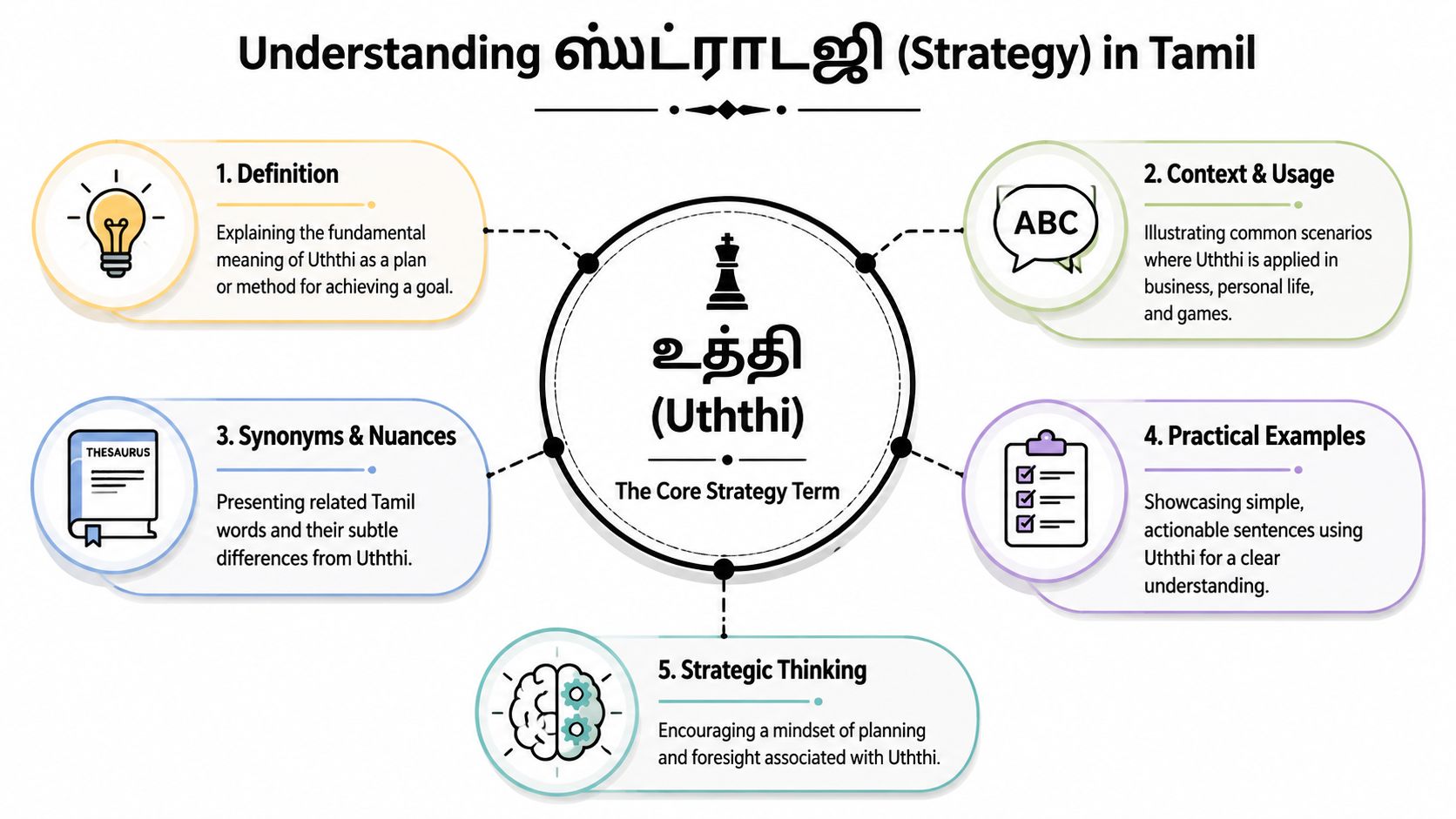
Definition to remember: உத்தி is a practical strategy. It's the deliberate way you move towards a goal, especially when resources, timing, or competition force you to choose carefully.
A lot of founders confuse strategy with activity. Launching ads isn't strategy. Hiring sales reps isn't strategy. Rebuilding the deck isn't strategy. Those may support the strategy, but they aren't the strategy themselves.
This distinction helps:
If your annual operating document says “enter Saudi and Abu Dhabi enterprise accounts,” that's a plan. If you decide to enter through channel partners first because direct sales cycles are too slow, that's your உத்தி.
Use உத்தி when you mean:
Don't use it when you mean a task list only.
A quick founder test helps. Ask: “If I remove this, do we still have a way to win?” If the answer is no, you're probably talking about strategy. If the answer is yes, it may just be a tactic or workstream.
One Tamil word won't cover every founder conversation. That's where nuance matters. If you use உத்தி for everything, you flatten useful distinctions.
A board discussion needs a different word from a performance marketing review. A hiring plan needs a different word from a product moat discussion.
The broad idea is simple. Strategy has layers. If you want a good English breakdown of how strategy differs from tactics, The OKR Hub's strategy insights are worth reading alongside the Tamil terms below.
| Term (Script) | Pronunciation | Core Meaning | Best Used For (Founder Context) |
|---|---|---|---|
| உத்தி | Uththi | Strategic plan of action | Go-to-market choices, pricing approach, fundraising path |
| வியூகம் | Viyoogam | Grand strategy, broad formation | Long-term company direction, expansion logic, multi-market positioning |
| தந்திரம் | Thanthiram | Tactic, manoeuvre, clever move | Campaign-level execution, negotiation move, short-term tactical play |
| அணுகுமுறை | Anugumurai | Approach, method | Team process, customer handling style, problem-solving method |
| செயல்திட்டம் | Seyalthittam | Action plan | Execution roadmap, team delivery sequence, operational follow-through |
Use வியூகம் when the conversation is about the shape of the business over time. If you're deciding whether to become a regional software platform or stay a specialised UAE-first operator, that's not just உத்தி. That's வியூகம்.
Use தந்திரம் carefully. It can be useful, but in some contexts it sounds like a trick rather than a durable business move. Good for campaign discussions. Less ideal for investor positioning unless you mean a very specific execution move.
Use அணுகுமுறை when strategy isn't the point, but method is. For example, “Our customer success அணுகுமுறை is hands-on for enterprise accounts and self-serve for smaller teams.”
A founder sounds more credible when the word matches the scale of the decision.
If you enjoy connecting business language with founder growth, this piece on thrive meaning in Tamil is a useful companion.
The fastest way to understand strategy meaning in tamil is to hear how these words sound in real founder situations.

You're speaking to an investor in DIFC. Don't say everything is “strategy.” Separate the layers.
Sample line:
“எங்கள் வியூகம் UAE enterprise segment-ல் trust-led expansion build பண்ணுவது. அதற்கான உத்தி, existing distribution partners மூலம் first 20 accounts close பண்ணுவது.”
In plain English, that means your grand strategy is trust-led enterprise expansion, and your strategy of action is to win the first set of customers through partners.
That lands better than a vague claim like “we'll grow through partnerships.”
Team meetings need operational clarity. Use அணுகுமுறை and செயல்திட்டம் more often here than வியூகம்.
Try this:
The benefit is simple. Your team hears what is stable, what is changing, and what needs action now.
In critical situations, use வியூக பகுப்பாய்வு. It signals that you're not reacting randomly. You're reviewing the business with structure.
For founders in Abu Dhabi's ADGM free zone, which hosts 650+ fintech startups, applying வியூக பகுப்பாய்வு in bi-weekly check-ins helps target an 18-month breakeven, versus a global average of 24 months. The same source notes that peer-vetted strategies help UAE founders reach 2.5x month-over-month growth versus solo founders, according to Shabdkosh's strategy meaning in Tamil page.
That gives you a useful founder habit:
A founder who separates those three usually wastes less energy.
You don't need literary Tamil to sound clear. You need a few phrases you can use naturally.
In a pitch, investors want to hear that your strategy is stable, your plan is actionable, and your tactics are adaptable.
Use this sequence when you need to explain your business crisply.
Start with வியூகம்
Explain the long-term position you want to own. This is your market-level logic.
Move to உத்தி
Explain the path you've chosen to get there first, which involves showing focus and trade-offs.
End with தந்திரம்
Show one or two specific moves that prove you can execute now.
A sample version:
If you're also refining pipeline language, this guide to leads meaning in Tamil can help clean up the rest of your pitch vocabulary.
Founders often think strategy problems are decision problems. Many are, in fact, language problems first. If your words are loose, your team interprets them loosely. Then execution drifts.
This is why precise Tamil terms help. உத்தி sharpens the path. வியூகம் frames the long game. செயல்திட்டம் forces execution. The right word makes the discussion easier.
Rigid போர்த்தந்திரம் often fails in the current UAE startup environment. A more collaborative செயல்திட்டம் fits better, especially when fast learning matters. One cited source also notes that AI-integrated strategies are boosting MENA founder success by 42%, and 65% of early-stage founders are seeking peer strategies for investor warmups via communities, according to Wordhippo's Tamil strategy reference.
That tracks with what good founders already do. They don't just ask, “What's our strategy?” They ask, “What's our shared way of making decisions?”
For culture and team language, a founder can also borrow ideas from this HR guide to culture strategy. Not for slogans, but for a practical reminder that team behaviour follows the language leaders repeat.
Ask this in your next meeting:
“நம்ம வியூகம் என்ன, அதற்கான உத்தி என்ன, இந்த வார தந்திரம் என்ன?”
In English: What is our long-term strategy, what is our chosen path, and what is this week's tactic?
If your team gives three different answers, that's useful. You've found the alignment problem.
If you want a place to pressure-test your உத்தி, refine your pitch language, and get sharper founder feedback from people building in the same UAE and MENA context, join Founder Connects. It's built for founders who want practical conversations, curated peer support, and clearer progress than generic networking usually delivers.


