

Angel Syndicate UAE: How It Works for Founders

Building in MENA? You don't have to do it alone.
Join 300+ founders in the Founder Connects Residency. Monthly squad calls, warm intros, $3M+ in perks, and much more. All for less than your monthly coffee budget.

You've had the first promising call. One angel likes the business, asks for the deck, and says they may write a cheque. Then the conversation expands. Five other investors want to participate, but nobody has agreed who will lead diligence, sign documents, hold the shares, or answer the questions that arrive before closing.
That's the point where an angel syndicate in the UAE becomes more than a group chat and a collection of introductions. The capital can be useful, but only if the structure is clear and your company is ready for scrutiny. This guide starts with the question founders usually leave too late: what must be in place before a syndicate wires money?
What a UAE Angel Syndicate Looks Like in Practice
A founder is halfway through a seed round. One angel has reviewed the deck, understands the customer problem, and is willing to commit. The investor then brings in several other backers who want exposure to the same company but prefer to invest a smaller amount.
The founder now sees several cheques instead of one. That sounds like progress, and it is, but the round has also acquired moving parts. Someone must coordinate diligence, agree the terms, collect commitments, manage signatures, and determine whether the investors subscribe directly or through a special-purpose vehicle.
The practical distinction is simple. A solo angel makes an individual decision and deals with the company directly. A syndicate organises several individual investors around one investment, usually with a lead angel coordinating the process and other backers following that lead.
UAE startups closed 134 funding deals in the first nine months of 2024, up 12% year on year, while seed and pre-Series A transactions represented 42% of all deals in that period, according to MAGNiTT's UAE venture investment report. That activity creates room for organised early-stage capital, but it also means founders need to understand how a round gets closed, not merely how to reach an investor.
This isn't a directory of names. It's a working guide to the decisions that follow investor interest:
- Who leads: Identify the person responsible for diligence and terms.
- What gets checked: Prepare the company records before questions arrive.
- How the money moves: Confirm the investment vehicle, signatories, and cap-table treatment.
- What happens next: Turn a promising conversation into a documented process.
The best first move isn't sending your deck to every angel you can find. It's making sure the company can survive the next question.
The Basic Anatomy of a Syndicate
A UAE founder can have investor interest and still lose momentum at closing if nobody can explain who approves the deal, who signs, or where the funds come from. An angel syndicate is an organised group of individual investors that coordinates deal sourcing, due diligence, and capital deployment into early-stage companies. Some UAE member-led groups report more than 100 active investors, as described in this overview of active Middle East angel networks.
In practice, the lead angel coordinates diligence, terms, and timing while backers follow that lead, similar to a site manager coordinating trades. The lead reviews the company, manages questions, negotiates the commercial terms, and keeps the round on schedule. Backers add capital and may bring sector knowledge, customers, hiring support, or regional relationships. The company receives the investment through either direct subscription or an investment vehicle, depending on the agreed structure.
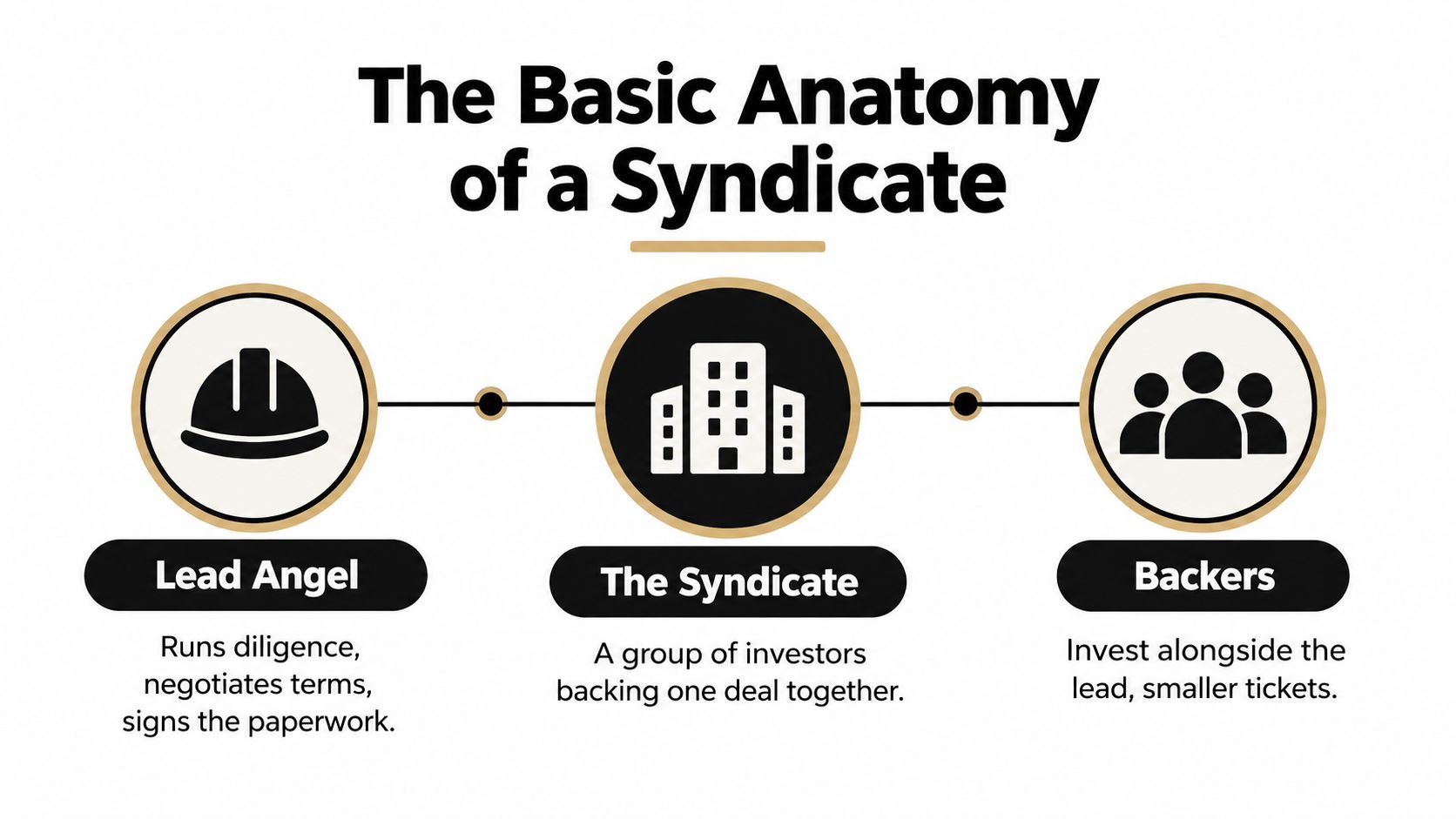
The lead angel
The lead usually owns the first serious review. That work can cover the product, customer evidence, financial model, legal records, founder ownership, and proposed terms. The lead may negotiate the term sheet and serve as the main investor contact, but the founder should confirm that role rather than assume it.
A lead does not automatically have authority to speak for every backer. Confirm whether the lead can bind the group, whether each investor signs separately, and whether the group invests through an SPV.
The backers
Backers invest alongside the lead, often with smaller tickets. Depending on the documents, they may receive information rights or pro-rata rights. Their practical involvement varies. Some offer active support, while others remain financially interested but operationally quiet.
Ask these questions on the first call:
- Decision owner: Who reviews the opportunity and gives final approval?
- Diligence lead: Who sends document requests and consolidates findings?
- Investment route: Do backers invest directly or through a special-purpose vehicle?
- Signing authority: Who signs for the syndicate?
- Founder access: Which investor remains available after closing?
Practical rule: “The syndicate likes it” is incomplete. Ask who has authority to approve, sign, and transfer funds.
Put the structure on one page: the lead at the top, backers below, and the company and vehicle beside them. If nobody can explain that diagram clearly, the group is not ready to close. Prepare this map before the next investor call.
How UAE Structures Shape a Syndicate
The UAE structure matters because investors aren't only assessing your product. They're assessing the legal route through which they'll own, convert, or receive rights in the business.
DIFC and ADGM operate as independent financial jurisdictions with English-common-law frameworks, separate courts, and dedicated regulators. They offer 100% foreign ownership and a 0% corporate tax regime for qualifying activities, while typical UAE angel cheques sit at roughly $50,000 to $500,000 and syndicates can aggregate $500,000 to $2 million, according to UAE investor market guidance from DataPile.

Why the jurisdiction enters the conversation
A company incorporated in mainland UAE, another free zone, DIFC, or ADGM may present different documents, signing requirements, shareholder mechanics, and regulatory considerations. That doesn't make one jurisdiction universally correct. It means the structure should match the company's activity, investor expectations, and future financing plans.
An SPV, or special-purpose vehicle, is a separate investment entity created to hold the syndicate's interest in the startup. Instead of every backer appearing individually on the startup's cap table, the company may have one SPV as a shareholder, with the backers holding interests in that vehicle. The exact arrangement requires legal advice, but the operational benefit is straightforward: one coordinated investor relationship can be easier to administer than a fragmented register.
Questions for your counsel
Before agreeing to terms, ask counsel to clarify:
- Issuing entity: Which company is issuing the shares or convertible instrument?
- Investor vehicle: Will the syndicate invest directly or through an SPV?
- Ownership record: How will the vehicle or individual backers appear on the cap table?
- Authority: Which documents prove that the person signing can commit the investor group?
- Future rights: How will information, conversion, liquidation, and pro-rata rights operate?
- Regulatory exposure: Does the business activity require licensing, a regulated partner, or additional review?
Don't incorporate in DIFC or ADGM just because investors mention them. First understand why they prefer that route and whether it fits your operations. Jurisdiction should follow the financing and operating requirements, not become a badge that substitutes for a coherent structure.
The Closing Readiness Checklist Founders Miss
A syndicate can be enthusiastic about your business and still stop before wiring money. The final review often becomes less about the quality of the pitch and more about whether the company's records agree with one another.
UAE-focused diligence guidance identifies the legal entity, share register, memorandum of association, cap table, corporate bank account, financial model, and beneficial-ownership information as core documents commonly scrutinised before closing, as outlined in UAE startup funding guidance.
Build a closing folder
Create one controlled folder with the current version of each item:
- Legal entity: Incorporation certificate and constitutional documents must identify the same legal company.
- Trade licence: The licence should be valid and consistent with the activity you conduct.
- MOA and articles: Check share rights, transfer provisions, approvals, and signing requirements.
- Shareholder register: Reconcile every holder against the company's formal records.
- Cap table: Include issued shares, options, prior instruments, and any promised ownership.
- Corporate bank account: Make sure the account belongs to the issuing entity and supports the proposed payment route.
- Financial model: Show assumptions, revenue logic, costs, runway, and the milestones the round funds.
- Beneficial ownership: Identify the individuals who ultimately own or control relevant interests.
The most damaging gaps are usually mundane. A founder's percentage in the pitch deck doesn't match the register. Intellectual property sits in a founder's personal name. A previous convertible instrument isn't reflected in the financing model. Nobody can explain who has authority to sign.
Use a structured due diligence steps guide to turn the review into a sequence rather than a last-minute scramble. For UAE-specific considerations around investor review, keep this Abu Dhabi angel investment diligence guide alongside your counsel's checklist.
Closing test: If a backer challenged any ownership number in your deck today, could you prove the answer from a signed company record?
This week, run a document cross-check. Compare the legal name, ownership, bank evidence, revenue claims, founder biographies, and funding history across every file. Fix contradictions before outreach. Investor interest is useful, but clean records are what convert it into a completed round.
Signals and Criteria UAE Syndicates Actually Screen For
Syndicates don't assess every UAE startup against the same template. A fintech company may face licensing and compliance questions that a consumer marketplace won't. A B2B software company may need to prove repeatable sales evidence before a lead is comfortable asking backers to join.
The 2024 UAE market gives founders a useful calibration point. $1 million to $5 million rounds accounted for 50% of UAE deals, the UAE represented 33% of total MENA funding, fintech attracted $179 million, and enterprise-software seed deals grew 175% year on year, according to MAGNiTT's 2024 UAE venture investment report.
| Signal | 2024 UAE Data | Founder Action |
|---|---|---|
| Round size | $1 million to $5 million represented 50% of UAE deals | Show exactly which milestones the round will finance |
| Regional weight | The UAE represented 33% of total MENA funding | Explain why the UAE is a strategic base for customers, capital, or expansion |
| Sector attention | Fintech attracted $179 million in UAE funding | Prepare licensing, AML, data governance, and regulated-partner answers |
| B2B momentum | Enterprise-software seed deals grew 175% year on year | Demonstrate customer pain, sales evidence, retention logic, and implementation repeatability |
What the numbers mean for your raise
A round should have a job. “Grow the team” is too vague. State the product, commercial, regulatory, or distribution milestone the capital will achieve, then connect that milestone to measurable operating evidence.
For fintech founders, product-market fit isn't enough. Investors may examine licensing exposure, anti-money-laundering controls, data governance, outsourcing dependencies, and whether a regulated institution must participate. Put those answers in the diligence folder rather than waiting for a specialist backer to expose the gap.
For enterprise software, present the sales motion in a way a lead can test. Explain who buys, why they buy, how long deployment takes, what the contract includes, and which evidence suggests the process can repeat. Avoid dressing early interest up as predictable revenue.
The strongest syndicates behave like specialised diligence networks. Their value isn't only pooled capital. It's the combined judgement of investors who understand the sector, the UAE operating environment, and the next financing hurdle.
Running the First Conversation with a Syndicate
Targeting matters more than volume. Identify investors by type, sector, stage, and geography, then send a concise summary covering the business, problem, solution, business model, management team, and top-line financial projections, as recommended in UAE fundraising guidance.

Your opening note should answer five things quickly:
- Company: What do you sell, and to whom?
- Evidence: What customer, revenue, product, or usage evidence supports the thesis?
- Round: How much are you raising, through which instrument, and on what basis?
- Use of funds: Which milestones will the capital fund?
- Reason for fit: Why does this particular investor group understand the company?
Don't end with “Will you invest?” That invites a vague response. Ask whether the mandate fits, whether a lead is available, which diligence materials are required, how the group makes decisions, and what timeline applies.
Use the first call to expose the process
A productive call should clarify the operating mechanics:
- Who owns the next step?
- Who leads commercial and legal diligence?
- Does the group invest directly or through a vehicle?
- Which terms are standard for the group?
- What information rights and pro-rata rights will investors expect?
- What must be complete before funds are transferred?
After the call, send a one-page investor brief and a clearly organised diligence folder. Request one concrete next action, such as a lead-investor call or a written list of required documents. Record the answer and the owner beside it.
For a stronger rehearsal, use this guide to pitching UAE angel investors before you speak to a lead. The aim isn't to perform a polished pitch. It's to demonstrate that you can run an efficient financing process.
You can also use this video as a prompt for reviewing your pitch flow and delivery:
Benefits and Trade-offs for Founders
A syndicate can be the right partner for a UAE seed round, but only if the benefits exceed the administrative cost. Think about a founder raising between $1 million and $2 million, where several investors may contribute to a meaningful part of the round while leaving room for future institutional participation.
| Benefits | Trade-offs |
|---|---|
| Larger commitment: Several smaller cheques can become a substantial round contribution. | More administration: Direct backers can create more signing, reporting, and cap-table work. |
| Broader networks: Investors may bring customers, hiring leads, market knowledge, and sector expertise. | Slower decisions: A group may need internal agreement before acting. |
| Lead support: One experienced investor can coordinate diligence and negotiate terms. | Rights to negotiate: Information and pro-rata rights can affect future fundraising flexibility. |
| Institutional preparation: A disciplined syndicate process can expose gaps before a later institutional round. | Closing burden: Every ownership, approval, and signing detail must be clean. |
| Shared risk: Backers can participate without one angel funding the entire round. | Relationship complexity: You need to know who is genuinely available after closing. |
The central question is not whether syndicates are good or bad. Ask whether this group accelerates a milestone your company cannot reach alone. If its investors can shorten a regulated partnership, secure credible enterprise customers, or help recruit a critical operator, the structure may justify the extra work.
Push back on unclear authority. Ask for a clear explanation of the lead's role, the vehicle, information rights, pro-rata rights, conversion or liquidation mechanics, and reporting expectations. Don't accept “that's standard” as a substitute for reading the documents.
A founder should also protect future flexibility. A syndicate that creates a clean investor relationship can make the next round easier. A fragmented arrangement with unclear rights can make institutional diligence slower, even when the original capital was helpful.
Where to Meet Syndicates Across the MENA Ecosystem
Founders often enter the wrong room first. An angel network is designed around investment activity. A startup hub may provide programmes, workspace, or ecosystem support. A founder community is useful for peer feedback, accountability, and rehearsal. These channels overlap, but they solve different problems.
Use them in sequence:
- Market calibration: Speak with founders who have recently raised and ask what documents and terms slowed their process.
- Pitch practice: Test whether a non-specialist can understand the problem, customer, traction, and use of funds.
- Investor preparation: Find the people who can challenge your assumptions on sector, stage, geography, and round construction.
- Formal outreach: Approach relevant angels with a focused brief and a specific request.
Moderated Pitch Night Meetups can help you pressure-test the round before a serious investor conversation. The value is not a promise of introductions or a guarantee that investors will participate. It's the chance to hear where your explanation breaks, whether the ask is clear, and which questions other founders raise immediately.
Founder Connects has live chapters in Dubai, Abu Dhabi, Nairobi, Beirut, and Cairo, alongside virtual founder activity. More than 1,000+ founders attended Meetups in the last few months, and the community reports 300+ Residents. Its WhatsApp community includes 500+ vetted founders who apply and are screened, with a 23.3% acceptance rate. The Residency includes Squads of 8 to 10 and costs $582 for 6 months.
Before you contact a syndicate, practise the raise with a Residency Squad or at a Pitch Night Meetup. Ask peers to challenge three points: the milestone funded by the round, the reason the UAE syndicate is a fit, and the document that would make them hesitate. For broader market research, use the UAE angel investor directory to understand investor focus and potential fit, then verify each investor's current mandate independently.
Book a Meetup through the Founder Connects Meetups page or the community's booking page, bring a one-page brief, and leave with the next document you need to fix.
Founder Connects gives UAE and MENA founders moderated Meetups, Pitch Night practice, and peer support through Residency Squads, so you can pressure-test your round before syndicate diligence begins. Visit Founder Connects to choose the next session or explore the Residency.

Building in MENA? You don't have to do it alone.
Join 300+ founders in the Founder Connects Residency. Monthly squad calls, warm intros, $3M+ in perks, and much more. All for less than your monthly coffee budget.
Popular posts





Founder Connects is a premium MENA tech founder community. Meetups in Dubai and across MENA, Residency Squads of 8–10, and 400+ vetted WhatsApp founders (apply and screened).