

BNI vs Founder Community: What Is Better

Building in MENA? You don't have to do it alone.
Join 300+ founders in the Founder Connects Residency. Monthly squad calls, warm intros, $3M+ in perks, and much more. All for less than your monthly coffee budget.

Everyone keeps asking the wrong question about BNI vs founder community what is better. The mistake is treating them like two versions of the same thing. They're not. One is a referral engine, the other is a decision-support system, and if you choose the wrong room for your stage, you'll spend months being busy without moving the business.
For UAE founders, that difference matters more than the brand name on the door. BNI is built for structured referrals, category exclusivity, and repeatable local business generation. Founder communities are built for honest peer feedback, strategic intros, and accountability. If your bottleneck is leads for a service business, BNI can be useful. If your bottleneck is clarity, product direction, or fundraising judgement, you need a different room.
| Criterion | BNI | Founder Community |
|---|---|---|
| Primary job | Structured referrals and local business generation | Peer learning, accountability, and strategic support |
| Meeting style | Weekly chapter rhythm | Curated peer groups and moderated sessions |
| Best for | Repeatable service offerings | Founders needing signal, feedback, and introductions |
| Category structure | One member per profession in a chapter | More flexible, curated by relevance |
| Main return | Measurable referral throughput | Higher-quality decisions and relevant connections |
What Founders Should Actually Ask Instead of Which Is Better
The wrong question is, “Which one is better?” Better for what, exactly? A founder in Dubai trying to validate a product, a consultancy owner in Abu Dhabi chasing local leads, and a first-time raiser preparing investor meetings are solving different problems. If you ask the wrong room to do the wrong job, you will blame the network when the issue is fit.
A better question is, “What job do I need this room to do?” If you need a steady referral engine, choose the format built for introductions and repeatable business flow. If you need sharper judgement, faster learning, and honest pressure-testing, choose the format built for peer support. What BNI actually is matters here because it shows why the structure is so different from a founder room.
For a solo consultant, a category-based referral network can be useful if the offer is easy to refer and the buyer is local. For a SaaS founder, or any business that needs product feedback, market signal, or investor-ready thinking, that same room can feel noisy and slow. I have seen founders show up every week and get activity without progress because they were in a room built for business generation, not decision quality.
A founder community works for a different bottleneck. It is the right call when your real problem is not lead volume but judgment, pricing clarity, hiring choices, or whether to push, pause, or pivot. In the UAE, that matters because the cost of the wrong room is not just wasted time, it is missed momentum.
Practical rule: if your main problem is getting more local opportunities, a referral-heavy network can help. If your main problem is making better decisions, you need a founder room.
Use that rule against your own stage, business model, and time budget. A founder who can commit to weekly follow-ups and sells a service with a clear referral path may get real value from BNI. A founder running a complex product business, or someone who only has a few hours a month to invest, usually gets more from a curated peer group than from a chapter that rewards repetition and attendance.
How BNI and Founder Communities Operate Differently
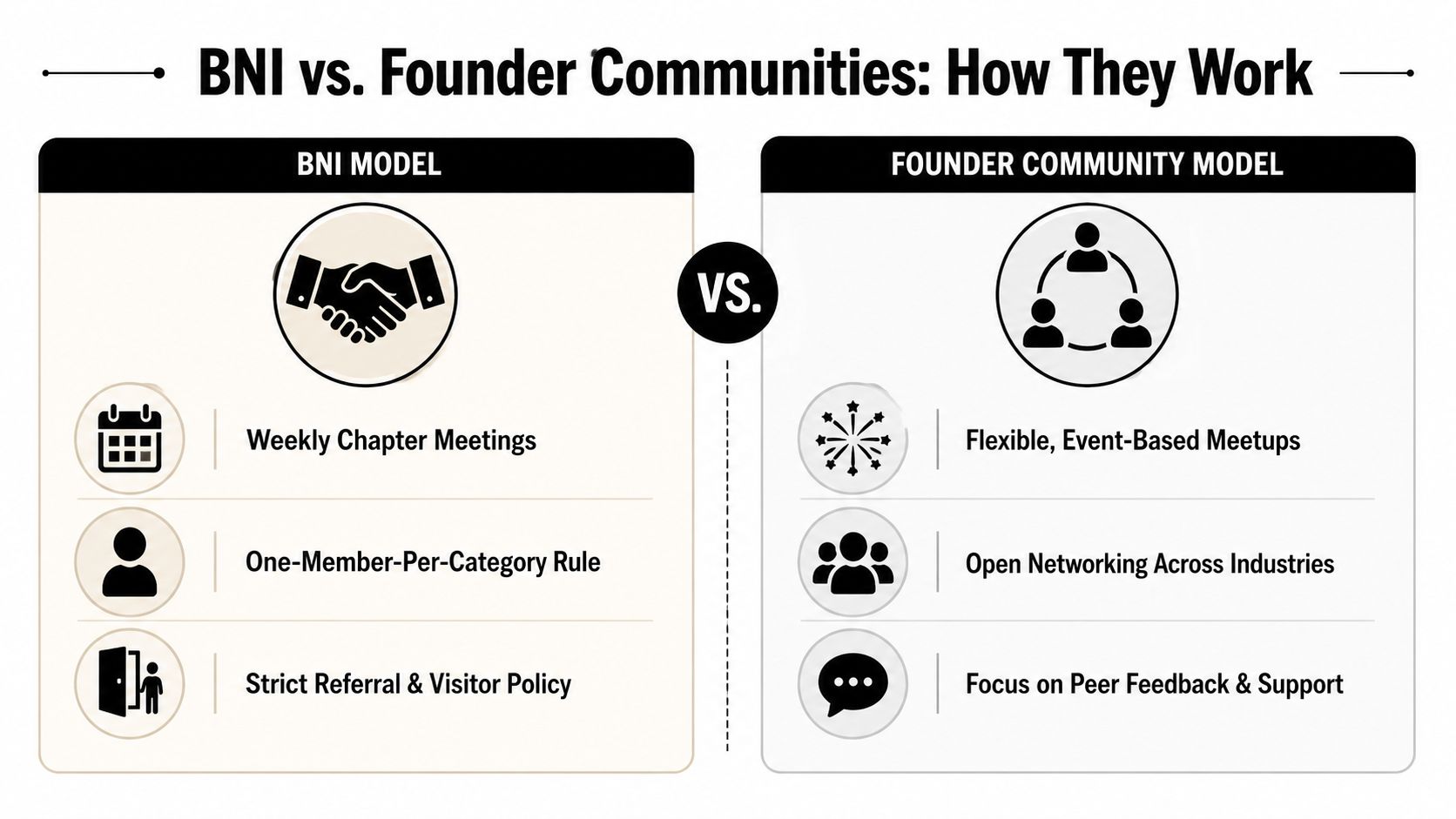
A BNI chapter is built for repetition. The model is structured around fixed meetings, referral tracking, and one member per profession inside the chapter, which is why it feels orderly from the first session. That category exclusivity reduces direct competition in the room and gives each member a clearer lane. BNI India's public about page shows the scale of that system, with figures such as 72,958 members, 1,527 chapters, and INR 56,277 crores in closed business from 4,921,300 referrals in 2026, while another regional stats page reported 71,802 members and INR 52,610 crores from 4,863,973 referrals (BNI India about page).
Founder communities run on a different logic. They are curated around peer fit, not profession lock, and the point is to put founders in smaller rooms where the conversation is useful fast. In practical terms, what BNI is in practical terms helps explain why the chapter model feels so different from a founder peer group. In Founder Connects, for example, the experience is built around curated founder sessions, smaller peer groups, one-to-one introductions, spotlight events, and access to practical tools and partner perks. The goal is relevance, not crowd size.
The time commitment tells you a lot about the model. BNI expects you to keep showing up, follow the structure, and build trust through repeated contact. Founder communities ask for sharper participation in conversations that deal with hiring, pricing, product decisions, fundraising, and the messier side of building a company.
A BNI room is good at creating routine. A founder room is good at improving judgement.
That difference matters because the value is not interchangeable. A founder can get useful introductions from both, but the shape of the return is different, and treating them as the same thing leads to bad decisions about where to spend time.
In the UAE, the split is easy to see. BNI tends to produce a predictable referral habit and a pipeline mindset. Founder communities tend to produce better operating conversations and more thoughtful decisions. If you are clear about which problem you are solving, the choice stops being abstract.
Side-by-Side Comparison on Founder-Relevant Criteria
The cleanest way to judge BNI vs founder community what is better is to compare them on the things founders feel in daily life, not the things networks like to market. Time, signal quality, accountability, category exclusivity, stage fit, and return on effort are the filters that matter.
| Criterion | BNI | Founder Community |
|---|---|---|
| Time commitment | Weekly rhythm, usually in-person and structured | Often lighter, with moderated sessions and curated intros |
| Intro quality | Strong for local referral flow, especially within a profession-based chapter | Stronger for relevance, context, and strategic fit |
| Accountability | Referral tracking and attendance discipline | Peer accountability and problem-solving |
| Category exclusivity | One member per profession in a chapter | Usually curated by founder need, not profession lock |
| Stage fit | Better for mature service businesses and repeatable offers | Better for validation, scaling, and fundraising support |
| Outcome style | Volume and repeatability | Depth and decision quality |
BNI is strongest when the business model can be explained, referred, and closed repeatedly. That's why it makes sense for accountants, consultants, agencies, and other service-led operators. Founder communities are stronger when the founder needs sharper thinking, warmer and more relevant introductions, and a room that will challenge assumptions instead of just passing along leads.
A useful test is simple. If you are measuring success mainly by introduced business, BNI makes sense. If you are measuring success by better decisions, stronger founder discipline, and introductions that change your options, a founder community is the more useful tool.
This comparison with BNI's business-builder style helps if you're evaluating how referral-led your current network really is.
My rule of thumb: if a meeting can be judged by how many warm leads came out of it, it's a referral network. If it can be judged by how much clearer you are after it, it's a founder room.
That's the part many founders miss. You don't join a network just to be around smart people. You join to solve a specific problem faster. Once you frame it that way, the better option becomes much easier to spot.
Why Founders Specifically Need a Different Kind of Room
BNI is not bad. It's just built for a different buyer. Its architecture rewards repeatable offerings, local business development, and category clarity. That's exactly why it works so well for service businesses with a predictable sales motion. For founders, though, that same structure can become a constraint.
A startup founder's biggest bottleneck is often not lead flow. It's clarity. You need to know whether the product is right, whether the positioning is working, whether the next hire is a mistake, or whether the fundraise story holds up in a real conversation. A chapter built around referral handoff is not optimised for that. It can keep you active without moving you forward.
The one-member-per-category rule is a good example. In BNI, it sharpens focus and reduces internal competition. For founders, especially in early stages, that can feel oddly limiting because your business is still evolving. Your role, your offer, and even your market may shift fast. You do not need a room that freezes you into a narrow category before the business has settled.
That's why a curated founder community usually fits better for validation and early scaling. It's designed around honest feedback, accountability, and strategic introductions. If you're working through product-market fit, a fundraising path, or a messy go-to-market decision, the quality of the conversation matters more than the quantity of referrals.
A practical resource worth having alongside that process is the launch checklist for SaaS founders. If you're still shaping the product and need a tighter operating cadence, that kind of checklist is more aligned with founder needs than a referral-only room.
Founder communities also give you more room to be candid. You can say the product is confusing, the messaging is weak, or the raise isn't landing, and the room is built to respond to that. That's different from a chapter whose centre of gravity is business exchange.
BNI can absolutely help a founder with a service business who wants local visibility and introductions. But if the main challenge is strategic progress, founders usually need a room that treats ambiguity as normal and addresses it directly.
Which Format Fits Your Founder Profile
A solo founder in Dubai, pre-revenue and trying to validate an idea, usually does better in a curated founder community. They need honest feedback, a sense of accountability, and people who can tell them quickly when they're solving the wrong problem. A referral chapter may give them activity. It won't necessarily give them the truth.
A scaling founder with a defined B2B service offering is a different case. If the product is stable, the sales motion is repeatable, and warm local leads matter more than deep strategic debate, BNI can compound well. The chapter format rewards consistency, and that suits businesses that can convert introductions into revenue. For this profile, the referral engine is the point.
A first-time founder preparing to raise is usually better served by a curated founder room. Investor warmups, practical feedback on the story, and introductions that are chosen for fit matter more than a broad pipeline. That is where a founder community can outperform a sales-oriented chapter, because the room is built to help founders think, not just circulate contacts.

A useful comparison point for anyone looking at curated founder spaces in the UAE is the best founder community in Dubai 2026 conversation, because it forces the question, which room helps you make better decisions, not just meet more people.
The quick self-check is simple:
- Choose BNI if your offer is clear, your market is local, and you want structured referrals.
- Choose a founder community if your business is still being shaped and you need strategic feedback.
- Choose a founder community again if fundraising, hiring, or positioning is the current bottleneck.
That's the honest split. One room helps you sell the thing you already know how to sell. The other helps you figure out what to build, how to sharpen it, and who can help you move faster.
Questions to Ask Before You Commit
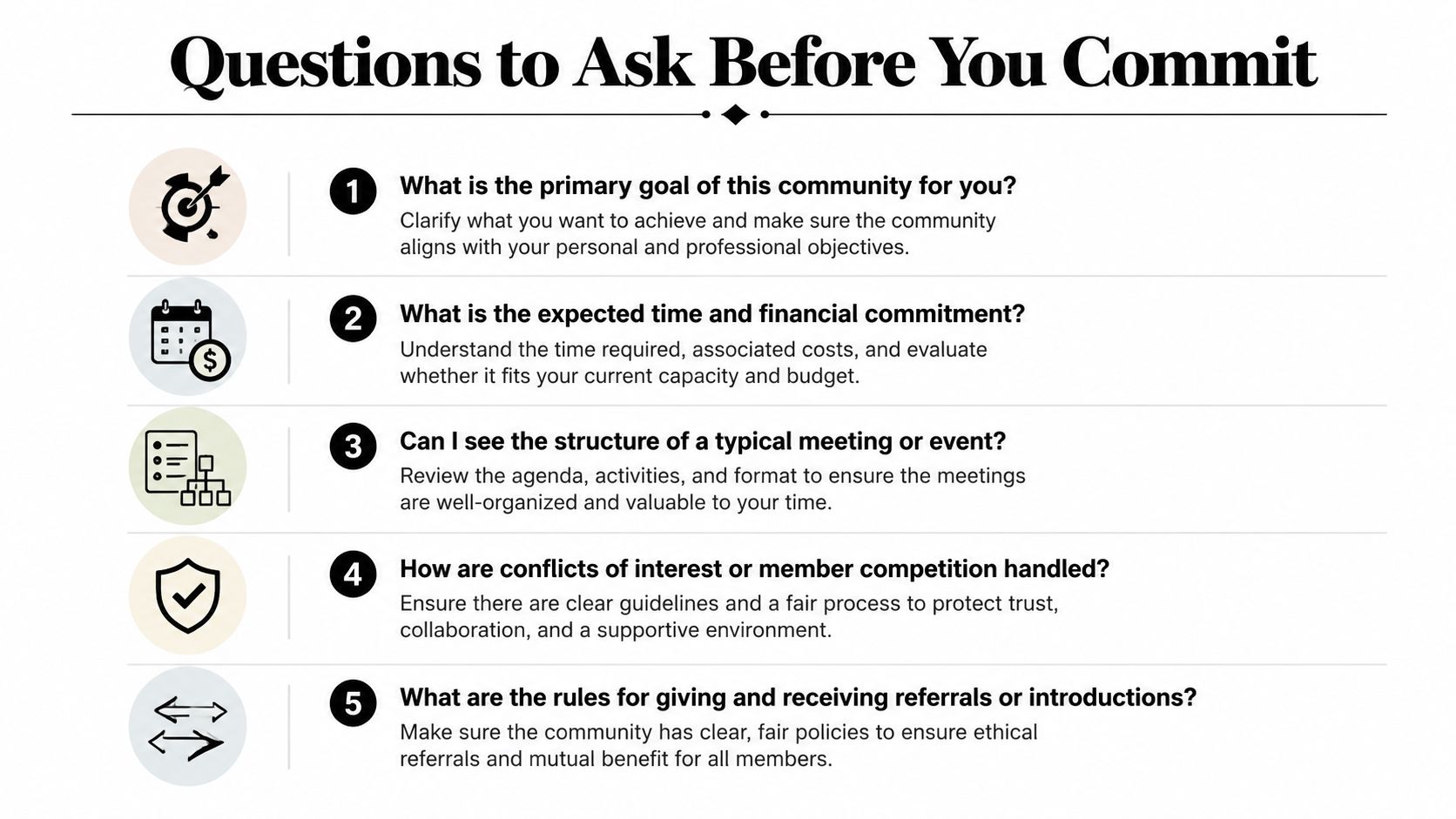
Before you join anything, ask questions that expose the operating model. The marketing will always sound polished. Your job is to find out whether the room solves your problem.
What is the primary goal of this community for me? A good answer sounds specific, like referrals, founder accountability, or strategic introductions. A weak answer sounds vague, like “connections” or “growth” without a mechanism.
What is the actual time and financial commitment? Good operators answer plainly and don't minimise the overhead. Red flags show up when costs are fuzzy or the attendance expectation is hidden until later.
How is a typical meeting structured? You want a clear agenda, not a generic “networking event” label. If no one can explain the format, expect low consistency.
How are conflicts of interest handled? In BNI, category exclusivity is part of the model. In founder communities, the answer should focus on curation and fit. If the explanation is defensive, the room probably has internal friction.
How are introductions made and measured? Strong communities can explain who makes intros, how relevance is checked, and what success looks like. Weak ones celebrate volume without showing any path to outcomes.
A useful way to evaluate the answer is to listen for precision. Good communities know who they serve, how they meet, what they expect, and how they track value. Bad ones rely on energy and good branding.
That's why the discovery call matters. You're not buying access to a logo. You're buying a system of interactions. If the system isn't clear in the first conversation, it won't get better after you pay.
Time Cost Versus Outcome Quality
The hidden variable in every networking decision is not money. It's time. A network can look cheap on paper and still be expensive once you count the commute, the follow-up, the prep, and the mental energy it takes to stay consistent.
BNI usually asks for weekly attendance, plus the work of referral tracking and relationship building around the chapter. For many founders, that means a real monthly time commitment that can become hard to defend if the business is cross-city or cross-border. Founder communities usually compress the calendar into fewer, higher-signal sessions and curated one-to-one intros, which is often easier to fit around real operating work.
That difference matters in the UAE because many founders move between Dubai, Abu Dhabi, and wider MENA markets. A weekly in-person referral rhythm can be fine if your business depends on local, repeatable business development. It becomes less efficient if your main need is strategic insight and you're already stretched thin.
A simple mental model helps here. BNI is about volume. Founder communities are about strategic advantage. Volume can be useful when you need steady introductions. Strategic advantage is better when one good conversation can save you weeks of wrong effort.
If you only have a few hours a month, judge the network by decision quality per hour, not by how active it feels.
That's the contrarian point most founders ignore. Activity is not the same as progress. A room full of movement can still leave you stuck if the people around you aren't solving the problems you have.
Your Decision Framework and Next Step
Use three questions. What is my current bottleneck. What stage am I at. How many hours a month can I realistically invest. If the answer is “I need warm local referrals and I already have a repeatable offer,” BNI is a sensible choice. If the answer is “I need better decisions, sharper feedback, and relevant introductions,” a curated founder community is the better fit.
For most UAE and MENA founders at validation or early scaling stage, a curated founder community will usually give higher value per hour. BNI still makes sense for established service businesses that want local referral flow and can sustain the weekly rhythm. If you're trying to decide between building a network through a referral chapter or through a more selective peer room, the same logic applies as when founders compare deciding between design agency and in-house. The right answer depends on the job you need done, not which option sounds stronger in theory.
This week, write down your bottleneck in one sentence, then audit your last month of networking hours against the outcome you got. If the time went into activity but not into better decisions or better leads, you already have your answer.
Founder Connects is built for founders who want a smaller, more intentional room than a broad referral chapter. It combines curated peer groups, moderated conversations, and relevant introductions so UAE and MENA founders can get feedback, accountability, and strategic connections without wasting time in generic networking. If that's the kind of advantage you need, visit Founder Connects and see how a founder-first network changes the quality of your next conversation.

Building in MENA? You don't have to do it alone.
Join 300+ founders in the Founder Connects Residency. Monthly squad calls, warm intros, $3M+ in perks, and much more. All for less than your monthly coffee budget.
Popular posts





The premier community for tech founders, investors, and builders. Connect, collaborate, and grow together.