

Your Daraz Online Store: A Founder's Guide for 2026

Building in MENA? You don't have to do it alone.
Join 300+ founders in the Founder Connects Residency. Monthly squad calls, warm intros, $3M+ in perks, and much more. All for less than your monthly coffee budget.

Your products are moving. A few customers are coming back. Someone on your team says it's time to get onto marketplaces and scale faster.
That's usually the moment founders split into two camps. One camp treats marketplace expansion like admin work. Open account, upload catalogue, wait for orders. The other treats it like channel strategy. Which platform fits the customer, the margin structure, the logistics reality, and the attention the team is able to give it.
If you're weighing a Daraz online store, that second view matters more. Daraz isn't just another generic marketplace. It was founded in 2012 and acquired by Alibaba in 2018 as part of its South Asia strategy, which tells you a lot about where it sits and why it matters in the region's commerce map, as outlined in this Daraz background summary.
For UAE and wider MENA founders, the question isn't “Can we open a Daraz store?” It's “Should Daraz be one of our next channels at all?” That's a different decision. It affects your stock planning, customer support model, team workflows, and whether you need systems for integrating with online marketplaces before catalogue sprawl turns into operational mess.
Launching Your Brand on a Marketplace
Founders usually reach for marketplaces when direct-to-consumer growth starts feeling expensive or inconsistent. That instinct is reasonable. Marketplaces can compress discovery, trust, payments, and fulfilment into one channel. But they also compress your mistakes.
A marketplace launch works when you're clear on one thing first. Are you buying reach, or are you building a repeatable sales channel? If you only want quick volume, you'll chase discounts and burn margin. If you want a durable channel, you'll build around assortment discipline, stock accuracy, and service quality.
What changes when you move from your own store to a marketplace
On your own site, you control the narrative. On a marketplace, buyers compare you against competing listings in seconds. They don't care about your brand deck. They care about price credibility, delivery confidence, product clarity, and whether returns will become a headache.
That's why a Daraz online store should be approached as an operating model, not a storefront.
- Product selection matters more than total catalogue size. Start with items that photograph well, ship cleanly, and have low ambiguity.
- Customer service gets tested earlier. Buyers are less forgiving when the seller is one tile among many.
- Ops debt shows up fast. Bad inventory sync, weak packaging, and vague listing copy hurt faster on marketplaces than on your own site.
Practical rule: Launch your best-behaved SKUs first. Not your full range.
The real founder decision
For MENA brands, Daraz sits in a specific place. It's relevant. It has regional importance. But it isn't the default answer for every UAE-focused brand. If your core market is still the Gulf, you need to compare Daraz against platforms that already have stronger local buyer habits, stronger local expectations, and different competitive pressure.
That's the lens for the rest of this guide. Not “how to click through seller onboarding”, but how to decide whether Daraz deserves your team's time, and if it does, how to launch without creating a new operational problem.
Is a Daraz Store a Strategic Fit for Your MENA Brand
A UAE founder usually hits this decision after the first few months of marketplace interest. Sales on the home market start to stabilize, someone on the team suggests opening a Daraz store, and the idea sounds efficient. More reach. Another channel. New customers. In practice, the question is narrower. Does Daraz match your expansion plan, your margin structure, and your operating capacity better than the regional alternatives you could back first?
For MENA brands, that is the true filter.
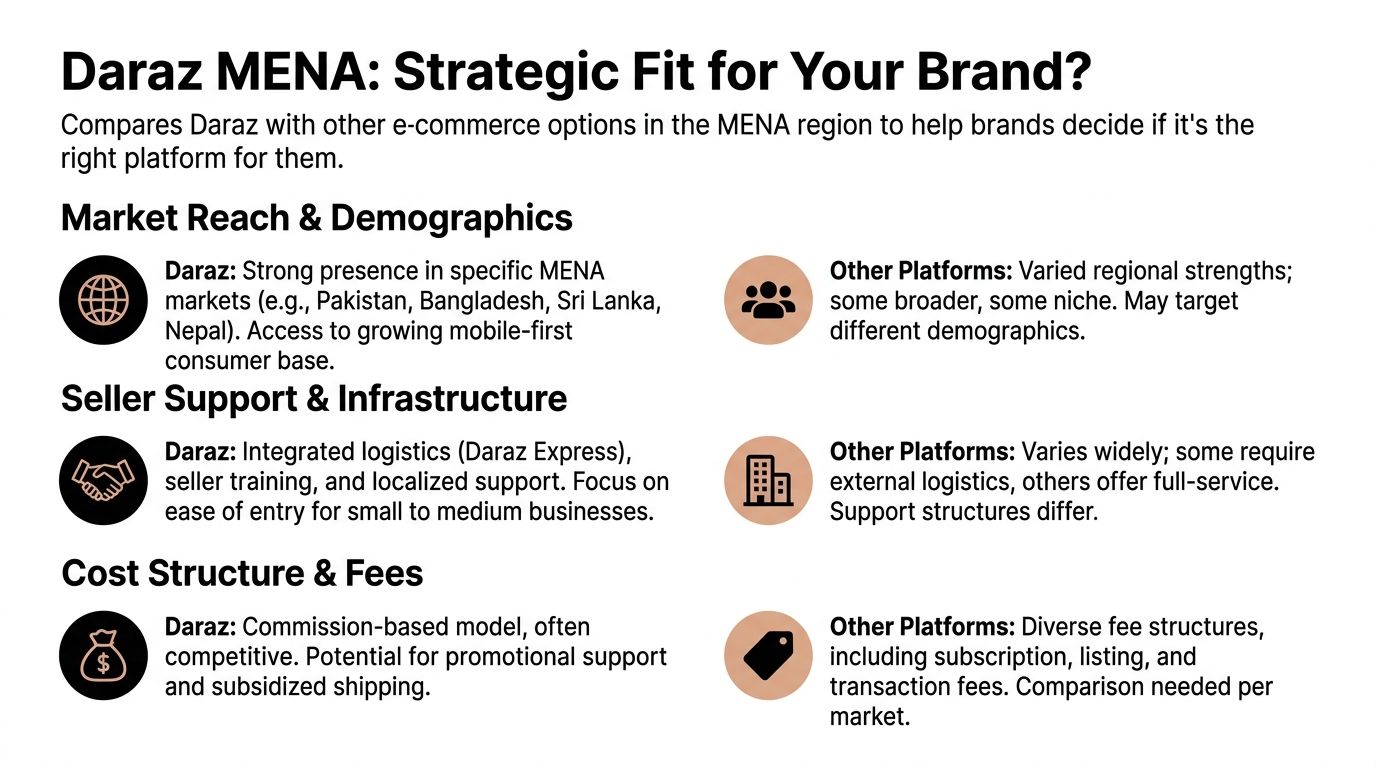
Daraz is not a default Gulf channel. It is more useful as a route into South Asian demand and cross-border marketplace exposure. If your brand is built around UAE delivery speed, Arabic-first support, and a customer base that already shops heavily on Noon or Amazon, Daraz may sit lower on the priority list. If you sell products with broad appeal, clear value, and low education overhead, it can earn its place faster.
When Daraz is a smart move
Daraz tends to work best for founders making a deliberate geography play, not just opening another seller account because the option exists.
It fits well when:
- You want access to demand beyond the Gulf. Daraz makes more sense if expansion into South Asian markets is already part of the plan.
- Your hero SKUs are easy to understand and compare. Functional beauty, personal care, home items, accessories, and giftable products usually travel better than products that need heavy brand storytelling.
- Your pricing can survive marketplace pressure. If the offer only works at premium price points with minimal discounting, channel economics can tighten fast.
- Your team can handle localized operations. Returns, customer messaging, promotions, and fulfillment expectations all need market-specific handling.
I would treat Daraz as a strong candidate for portable, repeat-purchase products with straightforward benefits. I would not treat it as the first bet for a brand that wins mainly on local brand affinity or high-touch service.
Where MENA founders misjudge the trade-off
The common mistake is comparing Daraz to your own site instead of comparing it to the other marketplaces competing for your attention.
For a UAE-led brand, Noon often has the more natural local logic. Buyer behavior is closer to your home market. Delivery expectations are shaped by Gulf standards. Competitive pressure looks different too. Daraz can still be the right move, but usually for expansion, channel diversification, or selected SKU testing, not because it is automatically the strongest regional marketplace for every MENA seller.
That trade-off matters at the operating level. A channel that brings orders but adds support complexity, weak returns control, and unstable margins can look good in a dashboard and still be a poor founder decision.
When Daraz is the wrong first channel
Some brands should wait.
Hold off if your catalogue still has stock sync issues, your margins only work with direct-to-consumer pricing, or your team is already stretched by current fulfillment and customer support. Daraz will expose those weaknesses early. It also tends to punish vague positioning. If the product value is unclear in one listing tile and a few product images, conversion gets expensive.
Another weak fit is the UAE brand that still has not tested local marketplace demand properly. In that case, compare your options first through a shortlist of e-commerce platforms for online retail startups in the UAE, then decide where your first marketplace effort has the highest odds of producing clean learnings.
A practical decision filter
Before opening a Daraz online store, answer these five questions with specifics, not optimism:
What problem is this channel solving?
Entering Daraz to reach a new geography is a strategy. Entering because a competitor is there is not.Which SKUs belong on it?
Pick products that are simple to explain, easy to ship, and resilient on returns.Can the margin hold after full channel costs?
Count fees, promotions, packaging, customer support time, and refund leakage, not just unit margin.Can the team support another operating rhythm?
Marketplace orders create more process discipline than many founders expect.Is this a better first move than Noon or another local platform?
If your buyer is still concentrated in the Gulf, that comparison should be explicit.
If those answers are strong, Daraz can be a strategic growth channel. If they are vague, it becomes another account to manage and another source of operational drag.
The Launchpad Account Setup and Verification
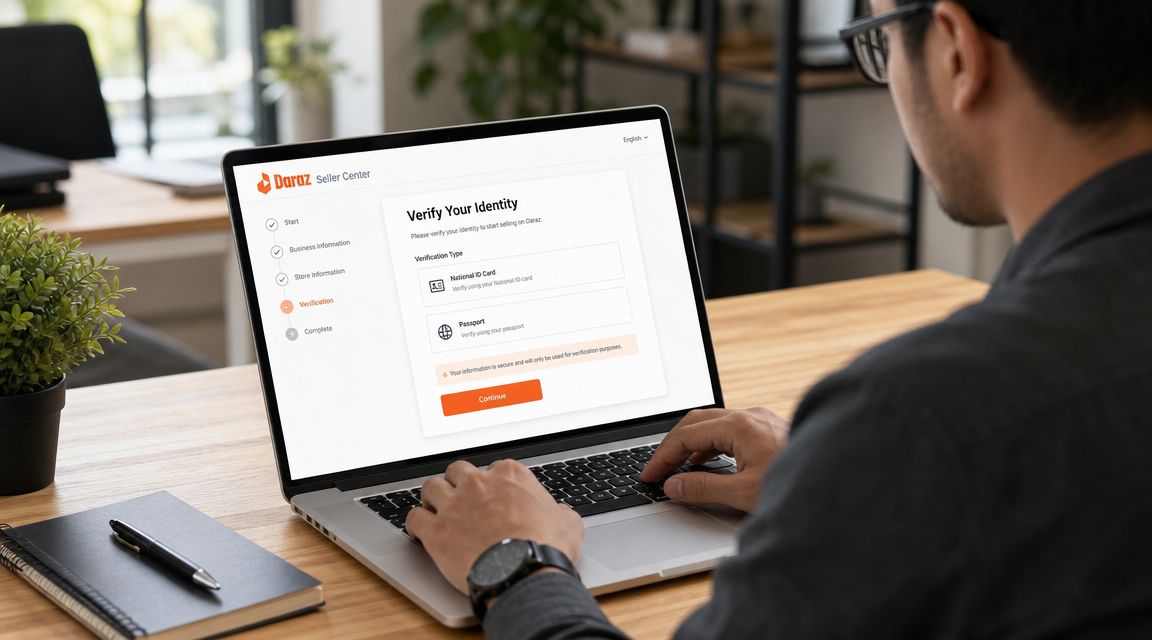
Once you've decided Daraz is worth testing, speed matters. Most founders lose time in onboarding because they treat verification like a formality. It isn't. In practice, the cleanest launches come from preparing every business document before anyone touches the registration flow.
Prepare your seller file first
If you're operating from the UAE, build a single folder with your core company records and identity documents. Keep naming consistent and make sure details match across records.
Use a simple checklist:
- Trade licence copy that's valid and easy to read
- Corporate bank details that match the legal entity you're using
- Owner or authorised signatory ID such as Emirates ID or passport copy
- Business contact details that your team actively monitors
- Brand assets including logo files and plain-language company description
Mismatch is what usually slows things down. If the legal name on the bank account and the business documents don't line up cleanly, expect friction.
Don't overcomplicate the first account
Your first goal isn't to build a perfect storefront. It's to get a verified seller account live and usable.
That means:
- Use one legal entity only. Don't mix side brands, alternate names, and informal trading identities in the opening setup.
- Set role ownership early. One person should own registration. Another should review submitted information before it goes live.
- Choose a working support email. Not a dormant inbox that no one checks.
Founders often delegate this to an intern or junior ops hire. That's fine if a senior owner reviews everything. Bad setup decisions echo later through payments, listing ownership, and account recovery.
What the dashboard work actually looks like
Once access is approved, most of the useful work begins in the seller dashboard. Expect to spend time on store profile basics, fulfilment settings, payment preferences, and listing structure. Don't rush those because you're eager to upload product pages.
A better sequence is:
- Complete identity and business verification.
- Set shipping and returns settings with your real operating constraints.
- Upload a very small initial product set.
- Test the store like a customer would.
This walkthrough helps if your team wants a visual sense of the process before assigning ownership:
Common delays to avoid
Watch for this: the slowest part of onboarding is rarely the form. It's the back-and-forth created by incomplete documents and unclear ownership.
A few practical fixes save time:
- Use current files only. Outdated trade documents create preventable review loops.
- Match spellings exactly. Even small inconsistencies in company names can trigger checks.
- Keep one source of truth. Don't let finance, operations, and marketing all send different versions of the same company details.
If you handle setup like compliance work rather than a quick sign-up, your Daraz launch starts cleaner and stays easier to manage.
Creating Product Listings That Actually Convert
A founder uploads 80 SKUs in week one, runs a few discounts, and gets traffic but weak sales. That pattern is common on marketplaces. The issue usually is not demand. It is listing quality, offer clarity, and whether the product is right for this channel in the first place.
On Daraz, your product page has to do the selling without help from your retail staff, your site experience, or your full brand story. For MENA brands, that matters because the customer benchmark is set by stronger local operators with cleaner merchandising and faster trust signals. If your listing feels incomplete, buyers compare you to Noon-level presentation and move on.
Start with products that survive marketplace economics
Uploading the full catalogue is usually a mistake. I would rather launch a small set of SKUs that can win on search, fulfilment, and margin than fill the store with products that create support tickets.
Use a first batch that fits these conditions:
- Low explanation burden. The item should make sense in a few seconds.
- Low return risk. Avoid complex sizing, shade matching, or fragile bundles at the start.
- Stable replenishment. Stock-outs kill momentum and distort your read on demand.
- Enough margin for marketplace reality. Commissions, packaging, returns, and customer service eat more than many first-time sellers expect.
This is also the point where Daraz stops being a generic sales channel and becomes a strategic filter. If a product only converts when your own site can educate the buyer with richer content, bundles, or subscription logic, keep it on your own store first. If it wins on clear utility, price transparency, and straightforward delivery, it is a better marketplace SKU.
Write titles for search intent first
Your title needs to match how buyers search, not how your brand team names products internally.
A practical structure is:
Brand + product type + core attribute + size or variant
That format gives you relevance and clarity without stuffing the title with repeated terms. A buyer scanning search results wants immediate confirmation that the item matches their need. Clever phrasing does not help much here.
If your team wants a useful reference for title structure, bullets, and conversion logic across marketplaces, this amazon listing optimization guide is worth reviewing.
Descriptions should remove friction, not recite features
Many listings read like supplier sheets copied into a text box. That hurts conversion because buyers are trying to reduce uncertainty, not admire your spec list.
Write the description around the decision a buyer is making:
- What exactly arrives
- Who the product is for
- The main use case
- The material, fit, scent, size, or compatibility details that affect satisfaction
- Any limits or exclusions that could otherwise trigger a complaint
For MENA founders, regional context holds importance. If heat, humidity, gifting, voltage, language, or packaging expectations affect the experience, say so clearly. Good marketplace copy does the same job as a sales associate. It answers the question before the buyer asks it.
Strong listings also connect to the wider customer experience journey across pre- and post-purchase touchpoints, because a misleading product page creates problems that operations and support cannot fix cheaply.
Images do more conversion work than brand copy

The first image should confirm the product instantly. The rest should answer objections, clarify scale, and set expectations accurately.
A useful image stack usually includes:
- Main product image on a clean background
- Detail shot showing finish, texture, or key feature
- Scale cue so the buyer understands dimensions
- In-use image if context explains the value better
- Packaging image when presentation matters for gifting or trust
Do not over-edit. If the delivered item looks different from the photos, return requests rise fast. That is expensive on any marketplace, and it gets worse in categories where buyers already have trust concerns.
Price to support conversion and retention
Low pricing can get clicks. It can also bring in the wrong buyer, especially if the rest of the listing does not support a bargain-positioned offer.
Set price using actual operating maths:
- Landed product cost
- Marketplace fees and handling cost
- Return and support risk
- Discount room for campaigns and price pressure
Then compare competing listings manually. Check photos, review quality, seller credibility, and delivery promise. In many cases the better move is not to be cheapest. It is to look safer to buy from.
That trade-off matters for MENA brands deciding where to focus. On Noon or your own site, stronger brand equity can support tighter pricing discipline. On Daraz, the listing often has to earn trust faster and with less context. Build pages that reduce hesitation, and your paid traffic, promotions, and fulfilment effort will have a fair chance to work.
Mastering Fulfillment and the Customer Experience
A MENA founder can do everything right up to launch, then lose repeat purchase on the boring part. The order ships late. The package arrives looking repacked. A refund request sits unanswered for three days. On a marketplace, that is not a minor ops issue. It is the point where margin, ratings, and future conversion start slipping together.
Daraz can work for brands that treat fulfilment as a commercial decision, not a back-office task. That matters even more if you also sell on Noon or your own site. Gulf customers are used to tighter delivery windows and faster support. If your Daraz operation feels slower or less controlled, the customer does not care which system caused it. They judge the brand.
The main question is simple. Which fulfilment model lets you protect service levels without choking cash flow or burying a small team in operational noise?
Choose your fulfilment model deliberately
Your two practical options are Fulfilled by Daraz (FBD) or Fulfilled by Seller, often managed as self-ship. Neither is automatically better. The right choice depends on SKU velocity, packaging risk, stock accuracy, and how much control you need over the last mile of the brand experience.
| Factor | Fulfilled by Daraz (FBD) | Fulfilled by Seller (Self-Ship) |
|---|---|---|
| Inventory handling | Daraz manages warehouse-side handling after stock is received | Your team keeps direct control over stock and dispatch |
| Delivery consistency | Easier to standardise once inventory is checked in and moving steadily | Depends on your own picking, packing, courier handoff, and cutoff discipline |
| Operational control | Less control after stock is lodged | Higher control over packaging, inserts, dispatch timing, and stock access |
| Complexity for a lean team | Reduces internal fulfilment load if processes are already stable | Can overload a small team during campaign spikes |
| Best fit | Repeatable SKUs with steady movement and low handling drama | Early testing, fragile items, mixed bundles, or products that need close oversight |
For early-stage brands, self-ship usually gives better learning. You see the weak points fast. Wrong picks, poor packaging, courier misses, inventory mismatches, and support gaps all show up in plain sight.
That visibility is useful.
FBD starts to make more sense once a product line is stable and demand is predictable enough to justify sending stock into the platform. At that stage, the trade-off changes. You give up some control, but you get time back and more consistency if your own operation is becoming the bottleneck.
A practical rule: if your inventory counts are still unreliable, do not send that confusion into FBD. Fix the stock discipline first.
Customer experience is decided after payment
Marketplace teams often over-focus on conversion and underinvest in what happens after checkout. That is a mistake in MENA, where WhatsApp habits, fast expectations, and low patience for vague service all shape review behavior.
The post-order experience needs clear rules your team can apply every day:
- Dispatch communication that sets a believable expectation
- Delay handling with specific updates, not generic apologies
- Refund and replacement criteria that support agents can follow without escalation every time
- Issue ownership so the buyer is not passed between seller, courier, and platform support
The experience of selling on Daraz can differ from running your own site. On your site, you can shape the full service flow. On a marketplace, parts of that experience sit with the platform and courier network, while the customer still blames your brand. Good operators plan for that gap instead of arguing with it.
Packaging matters more than many founders expect. It affects breakage, returns, giftability, and the buyer's sense that the seller is serious. For categories like beauty, electronics accessories, homeware, and gifting, poor packaging creates support volume that has nothing to do with product quality.
Cash flow shapes fulfilment quality too. If delayed payouts or import timing keep forcing you into stockouts, late dispatch, or partial order decisions, solve that at the finance layer as well. This article on supply chain financing UAE is a useful reference for founders trying to protect service levels while inventory cash is tied up.
One habit helps more than most software stacks. Map the full post-purchase flow from order placed to issue resolved, then review where trust drops, where handoffs fail, and where your team creates avoidable delay. This breakdown of the client experience journey after purchase is a strong framework for that exercise.
The brands that last on marketplaces do not win on discounts alone. They build a fulfilment system that keeps promises under pressure.
Driving Growth Marketing Analytics and Common Pitfalls
Most marketplace sellers don't fail because they lacked promotional tools. They fail because they confuse activity with traction.
Once your Daraz online store is live, you'll have plenty of levers to pull. Seller vouchers, platform campaigns, paid visibility, assortment expansion, bundled offers. The trap is obvious. It's easy to spend time and margin before proving the basics.
A more useful benchmark comes from marketplace thinking itself. The key is liquidity. Buyers should reliably find relevant products, and sellers should make regular sales. If that isn't happening, piling on more features or more catalogue usually makes the problem harder to diagnose, as explained in this marketplace liquidity and validation framework.
Focus on the metrics that change decisions
You don't need a huge dashboard at the start. You need a few numbers and patterns that tell you what to fix.
Watch these closely:
Sales velocity
Which SKUs move steadily, and which ones only move when discounted?Listing conversion behaviour
If traffic lands but doesn't convert, the issue is usually price position, listing clarity, or trust signals.Customer review themes
Don't just track star levels. Categorise complaints into product mismatch, delivery issue, packaging issue, or support issue.Stock reliability
If demand spikes and you can't fulfil, your marketing work backfires.Support friction
Repeated pre-purchase questions usually mean your listing is weak. Repeated post-purchase complaints usually mean ops is weak.
Use promotions carefully
Campaign participation can work, but only when the product is ready for the traffic. Don't push spend into listings that still have unresolved conversion problems.
A practical order of operations looks like this:
- Fix the listing
- Stabilise stock
- Confirm fulfilment consistency
- Then test vouchers, ads, or campaign placement
That sequence sounds simple. It isn't common. Many sellers do the reverse.
Operator's note: Promotion amplifies the current state of the listing. If the page is weak, paid traffic simply exposes the weakness faster.
Common pitfalls that waste founder time
The most expensive mistakes are usually boring ones.
Uploading too many products too early
More SKUs create more confusion if you haven't learned what converts.Ignoring funnel bottlenecks
If buyers click but don't buy, don't immediately blame traffic quality. Review the page and price first.Treating negative feedback as noise
Review patterns are operational data. They tell you where your process breaks.Scaling before demand is validated
Founders often invest in extra tooling, more content, or more ad spend before they've proven repeatable sales.Running Daraz in isolation
Marketplace data should inform your wider channel strategy, not sit in a silo.
The right growth question
The point isn't whether Daraz can produce orders. It's whether it can become a channel that beats your alternatives on enough dimensions to deserve ongoing attention.
That comparison should be explicit. Hold Daraz against Noon, Amazon.ae, and your own DTC store on:
- operational burden
- margin quality
- repeatability
- support load
- stock pressure
- brand control
If your team needs a sharper framework for deciding where to place effort next, this guide to marketing channels for UAE startups is useful for comparing channels based on fit, not hype.
A good founder review cadence is simple. Every few weeks, ask:
- Are our top marketplace SKUs still profitable after support and fulfilment effort?
- Are customers complaining about the same thing repeatedly?
- Is Daraz adding incremental demand, or just shifting sales from another channel?
- Would the next hour of team time be better spent improving this channel or backing a stronger one?
That's how you keep Daraz strategic. Not by treating it as a vanity presence, but by making it earn its place in the stack.
If you want a stronger way to pressure-test channel decisions like this with other operators in the region, Founder Connects gives UAE and MENA founders a practical peer group for honest feedback, sharper trade-off discussions, and real next steps.

Building in MENA? You don't have to do it alone.
Join 300+ founders in the Founder Connects Residency. Monthly squad calls, warm intros, $3M+ in perks, and much more. All for less than your monthly coffee budget.
Popular posts





Founder Connects is a premium MENA tech founder community. Meetups in Dubai and across MENA, Residency Squads of 8–10, and 400+ vetted WhatsApp founders (apply and screened).