

Direct Information System: A Founder's Guide

Building in MENA? You don't have to do it alone.
Join 300+ founders in the Founder Connects Residency. Monthly squad calls, warm intros, $3M+ in perks, and much more. All for less than your monthly coffee budget.

You're trying to answer a simple business question: which licence applies, whether a market is large enough, or what an investor will challenge in your next meeting. Instead, you're moving between ministry websites, old PDFs, directory listings, dashboards, and vendor brochures. The information exists, but finding the authoritative version takes longer than making the decision.
That friction is the practical problem a direct information system solves. It gives users a structured, self-service route to authoritative data, services, and answers without forcing them to rely on an intermediary for every step. For UAE and MENA founders, the concept matters because government information is increasingly delivered through unified portals, open-data platforms, real-time statistics, and integrated service channels. The private sector still often treats those systems as separate websites rather than as part of a decision-making layer.
The useful question isn't, “Do we need another IT platform?” It's, “Can our team reach verified information quickly, understand its source and freshness, and turn it into an action?” That distinction affects licensing, market validation, compliance, procurement, and investor readiness.
Why Founders Need a Direct Information System
A founder validating a healthcare product in Dubai might begin with a market question, then discover that the answer depends on regulatory classification, licensing authority, customer segment, and available public data. One browser tab points to a federal service, another to a Dubai entity, and a third contains a PDF that doesn't clearly show whether it remains current. A vendor may offer to “handle everything”, but the founder still lacks a reliable way to verify what was checked.
A direct information system changes the workflow. Instead of asking a consultant to interpret every source, the founder reaches an organised information layer, searches the relevant service or dataset, checks the authority behind it, and records the result. The system might be public, private, or connected to both. Its defining feature is direct, governed access, not the presence of a complex interface.
Practical rule: If a platform gives you an answer but hides the source, date, ownership, or next action, treat it as a convenience layer, not a dependable information system.
The UAE is a useful environment for this model because the country has built digital government infrastructure around unified access and service delivery. The official UAE digital-government factsheet recorded 19 million visitors to U.ae, followed by a record 30 million visits in 2022, while 221 government entities were connected to deliver 2,630 digital services. Those figures describe more than website traffic. They show a structural move from isolated information pages towards a shared entry point for information, transactions, and public services.
For a founder, the benefit is reduced search friction. A direct information system can help you:
- Validate demand: Use official demographic, economic, or social data before building a market-size slide.
- Check obligations: Find the relevant government service or approval route before committing to a launch plan.
- Prepare for diligence: Show investors where your assumptions came from and how you tested them.
- Create repeatable operations: Store the source, interpretation, owner, and review date for information your team uses regularly.
The system doesn't remove judgement. It gives judgement better inputs. That's the difference between making a decision because a supplier sounded confident and making one because your team can trace the underlying information.
Core Components of a Direct Information System
A static website can publish information. A direct information system lets people find, interpret, use, and sometimes exchange information through a controlled workflow. Evaluate the platform by looking for the components below, not by counting menu items or admiring a dashboard.
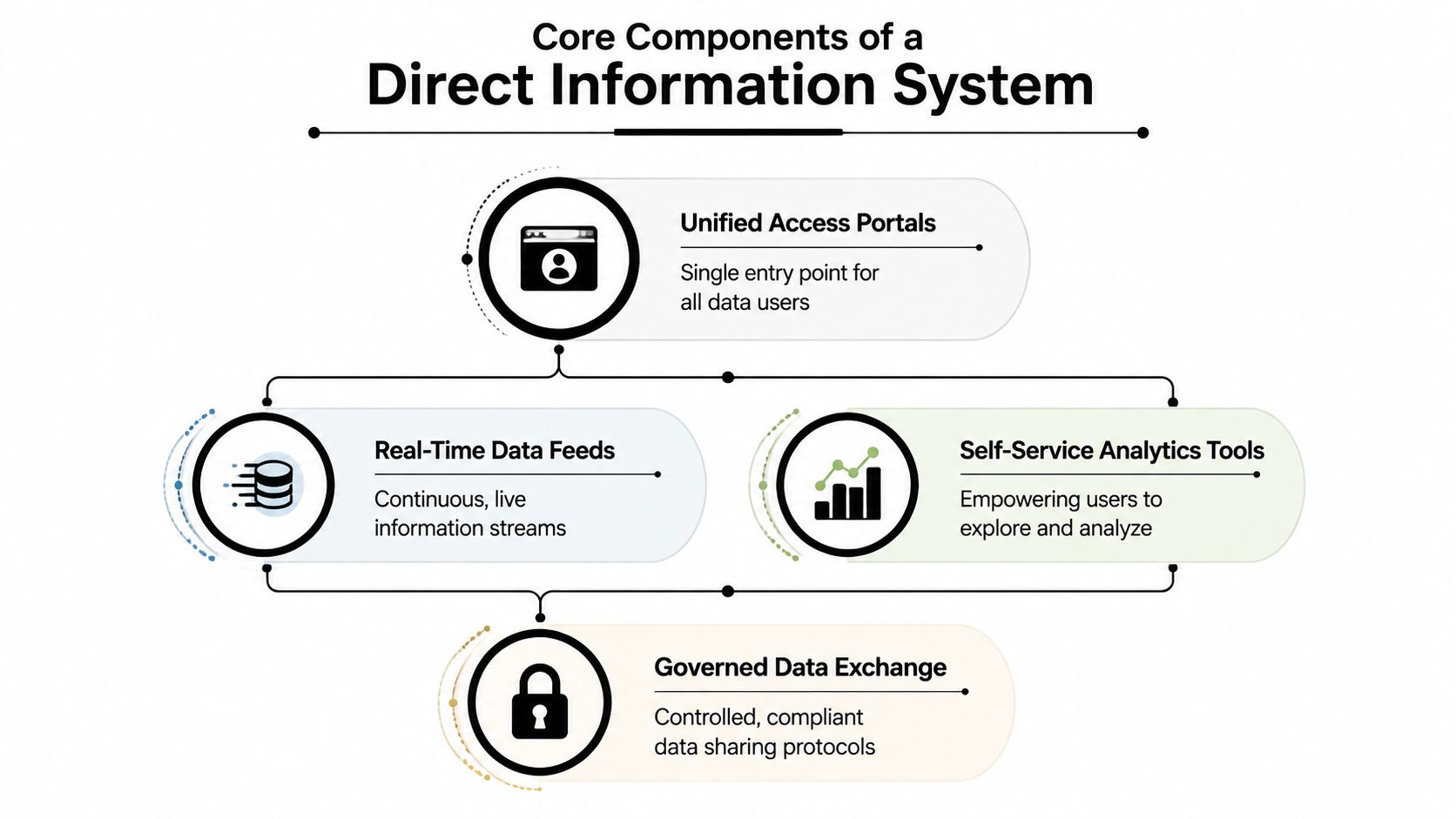
Unified access portals
Think of a unified portal as one operating desk instead of ten browser tabs. It should help a user locate a service, understand eligibility, submit information where required, and track the next step. The UAE Government describes U.ae as a unified channel and one-stop shop for government services, serving residents, businesses, and investors through a trusted interface.
For a private company, the same pattern might combine licensing guidance, internal policies, supplier records, customer data, and approval workflows. The value lies in the common route. Users shouldn't need to remember which department owns each piece of information before they can begin.
Real-time or regularly refreshed feeds
Data loses operational value when nobody can tell whether it has changed. A useful feed shows its origin, update status, coverage, and any limitations. “Live” shouldn't be accepted as a marketing adjective. Ask what refreshes, how exceptions are handled, and whether the platform preserves a record of previous versions.
This matters for founders tracking regulations, sector indicators, or operational events. A feed can support alerts and recurring reviews, but it still needs an accountable owner who decides what the information means for the business.
Self-service analytics tools
A search box returns a result. Self-service analytics helps you form a question. Users should be able to filter, compare, visualise, and export relevant information without submitting a manual request for every variation.
Dubai Statistics Center's e-Statistics System illustrates this principle through direct access to databases covering economic, demographic, and social surveys and censuses. It also enables users to build statistical reports with smart tools and retrieve updated data from the centre's website.
Governed data exchange
The final component is the least visible and often the most important. Governance defines who may access information, which systems can exchange it, what purpose applies, and how the organisation handles errors or withdrawal. Identity integration and role-based permissions turn a collection of data sources into an accountable service.
Founders building connected workflows can use this guide to integrated automation to think about how information moves between systems rather than treating each tool as an isolated purchase. The evaluation question is straightforward: can the platform connect authoritative data to a real business action while preserving ownership and access controls?
How the UAE Built a National Direct Information System
A founder checking a licence activity, testing a market hypothesis, or preparing an investor data room can lose hours moving between authority websites. The UAE's digital-government model addresses that problem by making direct access part of national infrastructure, rather than leaving users to assemble information from disconnected pages. U.ae as the government's unified platform gives residents, businesses, and investors a common starting point for official information and services.
The important development is integration. A single service count matters less than what it reveals about the operating model: different government entities can remain responsible for their own information while contributing to a shared access layer. For founders, that reduces the need to understand administrative boundaries before finding the service or requirement that affects a business decision.
The model combines four practical functions:
- Discovery: Users search for guidance, requirements, and services through a central channel.
- Transaction: Relevant information can lead into an application or government action.
- Integration: Multiple entities contribute to one public-service journey.
- Trust: An official entry point helps users distinguish authoritative records from vendor summaries or outdated advice.
The UAE also connects central access with more specialised data services. Dubai's statistics infrastructure lets a founder examine available datasets and shape an output around a specific question, rather than relying only on a prewritten report. That distinction matters for market sizing. The founder still has to define the customer, geography, sector, and period, then check whether the dataset matches those boundaries.
A practical example is a licensing review. A founder starts with the proposed activity, checks the relevant government guidance, records the required approvals, and saves the source used for each decision. If the business involves a regulated financial or property activity, an official record such as the DIFC public register can support verification of an entity or commercial detail. The record confirms what it contains. It does not replace legal review, commercial diligence, or the founder's interpretation.
Accessibility still has limits. A unified interface does not guarantee that every dataset uses the same definition, update cycle, geographic coverage, or level of detail. Founders should record those conditions before placing an official figure in a pitch deck or operating model. Government data publication and exchange rules, including reference to Dubai Law No. 26 of 2015, also show why permissions, ownership, and responsible use must accompany access.
The UAE example makes the direct information system practical. It is a decision layer connecting official guidance, public data, and business actions. The value comes from the workflow around the source: identify the question, verify the record, document the interpretation, and link it to a decision.
Practical Use Cases for Startup Founders and Community Operators
The strongest use of a direct information system is not passive research. It is a repeatable decision workflow where a founder knows the question, the source, the interpretation, and the next action.

Market validation
Start with a narrow question rather than “How big is the UAE market?” For example, define the customer type, location, sector, and time period you need. Use Dubai's official statistics infrastructure to identify what the data measures, then record the dataset name, source, update information, and assumptions behind your estimate.
Your next action is to create a one-page validation sheet with four fields: question, official source, interpretation, and decision. If the data doesn't answer the question directly, write down the gap instead of filling it with an unsupported assumption. A useful UAE startup data and personalisation reference can support your thinking about how verified information should shape founder-facing decisions.
Licensing and regulatory checks
Before launching, map the product to the relevant government service, authority, activity description, and required documents. U.ae can serve as the starting point for finding services, but don't stop at a general page. Confirm which entity owns the requirement and whether your exact activity, location, and business model fit the published route.
Ask your team: What would make this answer invalid? The answer may be a change in activity classification, a different emirate, a regulated customer segment, or a new approval requirement. Put that trigger into a review calendar.
Investor readiness
Investors don't need a slide full of links. They need a clear chain from evidence to conclusion. Use official datasets and government records to support market context, then separate sourced facts from your forecasts, assumptions, and interpretation.
A practical pitch note can label each important statement as one of three types:
- Verified: Directly supported by an authoritative source.
- Derived: Calculated or interpreted from verified information.
- Proposed: Your forecast, target, or operating assumption.
Community operations
Community operators can improve the quality of founder decisions by curating reliable sources, hosting practical sessions on government platforms, and matching founders with people who have completed similar workflows. The role isn't to replace official systems. It is to help members reach them, understand their limits, and avoid repeating preventable mistakes.
That is where a curated founder network can add operational value. Founder Connects uses peer groups, intentional introductions, events, practical tools, and ecosystem insights to help founders exchange experience rather than rely on generic networking. For a founder facing an unfamiliar licensing or data question, the right peer conversation can reveal which source to check and which assumption to challenge.
Implementation Considerations and Best Practices
Building a direct information capability doesn't require buying an oversized platform on day one. Start with the decisions your team repeats, identify the source each decision depends on, and design a controlled route from source to action.
Use a procurement test that exposes weak platforms
Ask vendors to demonstrate a real workflow using your business question. Don't accept a tour of preselected dashboards. Give them a scenario involving a source lookup, a user permission, an update, an exception, and an export.
Assess the platform against these criteria:
| Criterion | What to verify | Warning sign |
|---|---|---|
| Data freshness | Update timing, review ownership, and change history | “Real-time” with no refresh definition |
| Source authority | Original publisher, citation trail, and record ownership | Data copied from unnamed directories |
| Integration capability | Available connectors, exchange method, and error handling | Manual re-entry presented as integration |
| Access control | Roles, permissions, and user accountability | One shared login for the whole team |
| Language coverage | Whether important workflows work for your users in the required languages | Translated marketing pages but untranslated service content |
Design for governance from the beginning
The UAE's official information environment supports access and sharing, while also pointing to governed publication and exchange. Dubai Law No. 26 of 2015 is specifically referenced in the official framework on data publication and exchange, so founders should treat governance as part of system design rather than a compliance document added after implementation.
Create a simple register for every critical information source. Record the owner, purpose, access group, review date, permitted use, and escalation route when the source changes. For personal data, connect the register to your privacy controls and document why the team needs each field.
A practical resource such as SMS Activate compliance documentation can help teams think through the evidence required for controlled processes, but it shouldn't replace UAE-specific legal advice or your own review of applicable obligations.
Make the workflow useful on an ordinary Tuesday
Set alerts for regulatory updates where the source supports them, use official interfaces or APIs where available, and maintain a curated internal knowledge base with links to original records. Every internal note should include a plain-language interpretation and the action it supports.
The UAE PDPL guide for founders is a useful starting point for privacy questions, but the operational standard is simple: your team should know what information it uses, why it uses it, who can access it, and when someone must review it again.
Common Pitfalls and Misconceptions to Avoid
The phrase “direct information system” attracts a predictable mistake. Founders search for a company with that name, find inconsistent directory listings, and assume the first profile or vendor brochure explains the service. Public coverage of Direct Information System in Dubai, including listings associated with Bur Dubai and Al Raffa, is fragmented on naming, category, and scope. A directory can help locate a business, but it isn't a substitute for a verified explanation of capability, ownership, or support.
The second mistake is confusing an attractive interface with direct access. A vendor may repackage public information into a polished dashboard while adding little authority, freshness, or integration. Ask to see the underlying source, update process, permissions model, escalation route, and evidence that the system connects to the workflows you need.
A useful test: Ask, “What happens when the source changes, the user lacks permission, or the data is wrong?” A credible provider should answer with a process, not another feature list.
What buyers should challenge
- Directory dependence: Use business listings for discovery, then verify the service through official records and direct vendor questions.
- Brochure language: Replace “end-to-end” with a request to demonstrate a specific workflow.
- Interoperability assumptions: Confirm whether systems exchange structured information or whether staff copy and paste.
- Missing performance evidence: Ask about uptime commitments, support coverage, incident handling, and integration boundaries.
- Governance afterthoughts: Confirm access controls, retention practices, audit records, and responsibility for data errors before signing.
The UAE market is asking for something more practical than a generic IT category. Buyers need a region-specific framework connecting information access with government platforms, compliance, and service delivery. Until vendors publish clearer evidence on support models, integration, and operational performance, founders should make verification part of procurement.
Your Next Steps as a UAE Founder
Take three actions this week.
First, audit the information behind one important decision. Record the source, authority, update status, owner, and action it supports. Second, choose one official UAE platform and use it to answer a specific market, licensing, or compliance question rather than browsing without a defined outcome. Third, discuss the result with a curated peer group and ask what you may have missed.
Founder Connects is built around moderated peer groups, intentional introductions, practical tools, and founder conversations focused on progress. That kind of peer review can help you challenge assumptions without replacing official sources or professional advice.
You don't need perfect information before acting. You need a traceable answer, a clear limitation, and a next step you can test.
Founder Connects gives UAE and MENA founders access to curated peer groups, relevant introductions, practical ecosystem resources, and accountability focused on execution. Visit Founder Connects to find a higher-signal way to compare information, test decisions, and keep moving with the right founder circle.

Building in MENA? You don't have to do it alone.
Join 300+ founders in the Founder Connects Residency. Monthly squad calls, warm intros, $3M+ in perks, and much more. All for less than your monthly coffee budget.
Popular posts





Founder Connects is a premium MENA tech founder community. Meetups in Dubai and across MENA, Residency Squads of 8–10, and 400+ vetted WhatsApp founders (apply and screened).