

How to Improve Communication Skills: Founder's Playbook 2026

Building in MENA? You don't have to do it alone.
Join 300+ founders in the Founder Connects Residency. Monthly squad calls, warm intros, $3M+ in perks, and much more. All for less than your monthly coffee budget.

You walk out of an investor meeting feeling that it went fine, then realise later that the investor asked three versions of the same question and never got a direct answer. Or you leave a team stand-up thinking everyone is aligned, then spend the afternoon untangling Slack threads, voice notes, and a missed handoff that should have been obvious.
That's the founder version of a communication problem. It rarely looks dramatic in the moment. It looks like slower decisions, vague ownership, strained hiring conversations, and follow-up messages that shouldn't have been necessary.
If you're trying to figure out how to improve communication skills, start by dropping the idea that this is mainly about sounding polished. For founders in the UAE and wider MENA region, communication is an operating skill. You need it in board updates, customer calls, hiring loops, WhatsApp exchanges, and partnership discussions where one unclear sentence can create days of drag.
Why Communication Is Your Most Underrated Growth Lever
Founders often treat communication as a presentation skill. It's much closer to execution infrastructure.
A weak message creates expensive confusion. A vague brief leads to rework. An overly soft performance conversation lets a problem continue. A rambling pitch makes traction sound smaller than it is. None of that shows up neatly in your P&L, but you feel it in speed, morale, and burn.
There's also a direct business case. Global workplace research estimates poor communication costs between $9,284 and more than $30,000 per employee per year according to Pumble's communication statistics roundup. For a founder, that reframes the issue fast. Clarity is not etiquette. It's cost control.
Where founders usually misdiagnose the problem
Most communication breakdowns are not caused by a lack of confidence. They come from one of three failures:
- Unclear objective. You entered the conversation without deciding what the other person needed to understand, decide, or do.
- Over-explaining. You kept adding context instead of landing one clear point.
- False alignment. You assumed silence meant understanding.
In UAE and MENA startup environments, this gets sharper because teams are often multicultural, multilingual, and fast-moving. A sentence that feels obvious to you may land very differently with a co-founder, operator, investor, or external partner.
Practical rule: If a conversation matters, define the outcome before you define the wording.
Communication also shapes opportunity flow. Founders who are deliberate about investor updates, hiring conversations, and enhancing professional network communication tend to make better use of the rooms they're already in.
A better way to think about it
Treat communication like product management for meaning.
You have:
- A user. Investor, candidate, customer, team member, partner.
- A job to be done. Inform, align, persuade, decide, de-risk.
- A success condition. The other person can restate the point and act on it correctly.
That shift matters. Once you stop seeing communication as “speaking well” and start seeing it as “driving accurate action”, your standards change.
The quickest next step is simple. Write down the single most costly communication breakdown your company has had in the last quarter. Then ask: was the failure in clarity, listening, adaptation, or follow-through?
The Three Pillars of Effective Founder Communication
Most founders don't need more tips. They need a simple model they can use under pressure.
The framework I've seen work best is this. Intentional clarity, structured listening, and audience resonance. If one pillar is weak, the whole conversation gets weaker.
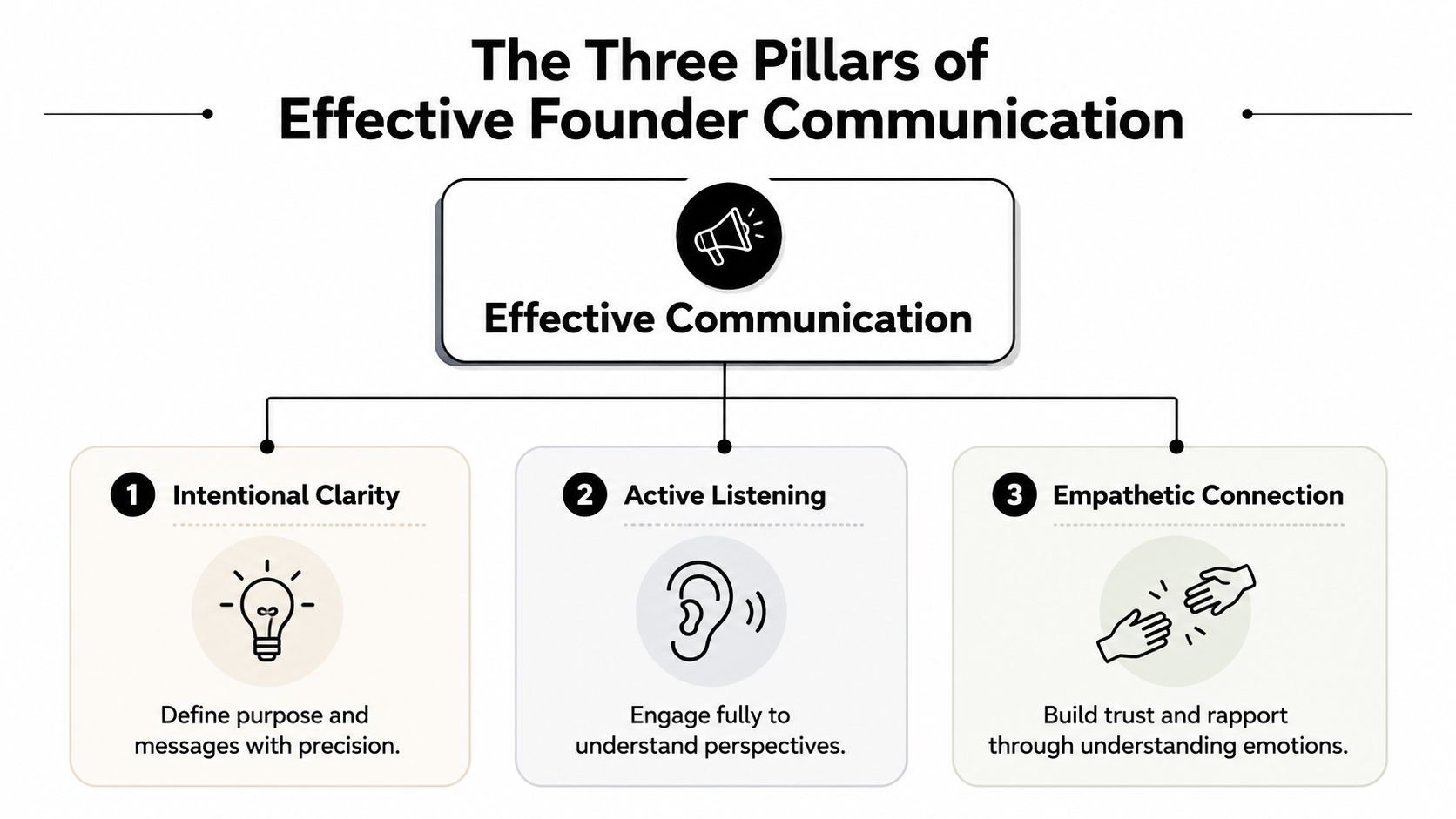
Intentional Clarity
Before you speak, decide the point.
Not the topic. Not the background. The point.
If you're sending a board update, the message might be: “Revenue quality is improving, but hiring in one function is now the bottleneck.” If you're talking to a candidate, the point might be: “This role has high ownership and ambiguity, and that's either attractive to you or it isn't.”
A useful founder habit is to prepare one sentence that answers this question:
- What do I need this person to leave with?
If you can't answer that in one line, you're not ready yet.
Structured Listening
Founders often think listening means being patient while the other person talks. It doesn't. It means actively working to understand what they mean, not just what they said.
A foundational communication principle is active listening, which includes removing distractions, maintaining eye contact, avoiding interruptions, and reflecting back what was said, as discussed in this professional communication review. That matters even more in UAE and MENA settings, where norms around age, hierarchy, gender, and culture can shape how directly people speak and how they use nonverbal signals.
A manager says, “The team is a bit stretched.” In one culture, that may be a mild comment. In practice, it may mean “we are overloaded and this deadline is unrealistic.”
If you want better information, make it easier for people to tell you the truth.
Try this in one-to-ones:
- Ask open questions. “What's harder than it should be right now?”
- Reflect back. “So the issue isn't effort. It's decision latency from my side.”
- Leave space. Don't rush to solve in the first minute.
If you want to strengthen this further, Founder Connects has a relevant piece on emotional intelligence tips for UAE founders that overlaps strongly with listening and response quality.
Audience Resonance
The same company should sound different to different audiences.
An investor wants evidence of momentum and decision quality. A customer wants confidence that you understand their problem. A senior hire wants to know whether the mission is real and the chaos is survivable.
Here's the mistake. Founders often repeat the same explanation everywhere and call that consistency. Real communication skill is adaptation without distortion.
A quick way to pressure-test resonance:
| Audience | What they care about first | What to cut |
|---|---|---|
| Investor | Progress, risk, judgement | Product detail that doesn't affect the investment case |
| Team member | Priorities, ownership, timing | Abstract vision without operational relevance |
| Partner | Shared value and clear next step | Long company history |
| Candidate | Scope, support, upside, reality | Overly polished language |
Pick one pillar and over-practice it for a week. Most founders improve fastest when they focus narrowly instead of trying to fix everything at once.
Your Daily Communication Workout Routine
Communication improves the same way fitness does. Not through one intense effort. Through repeatable reps.
Founders usually fail here because they wait for a major pitch, difficult conversation, or offsite presentation before they practise. That's too late. You need small drills inside normal work.
Start with this visual checklist.
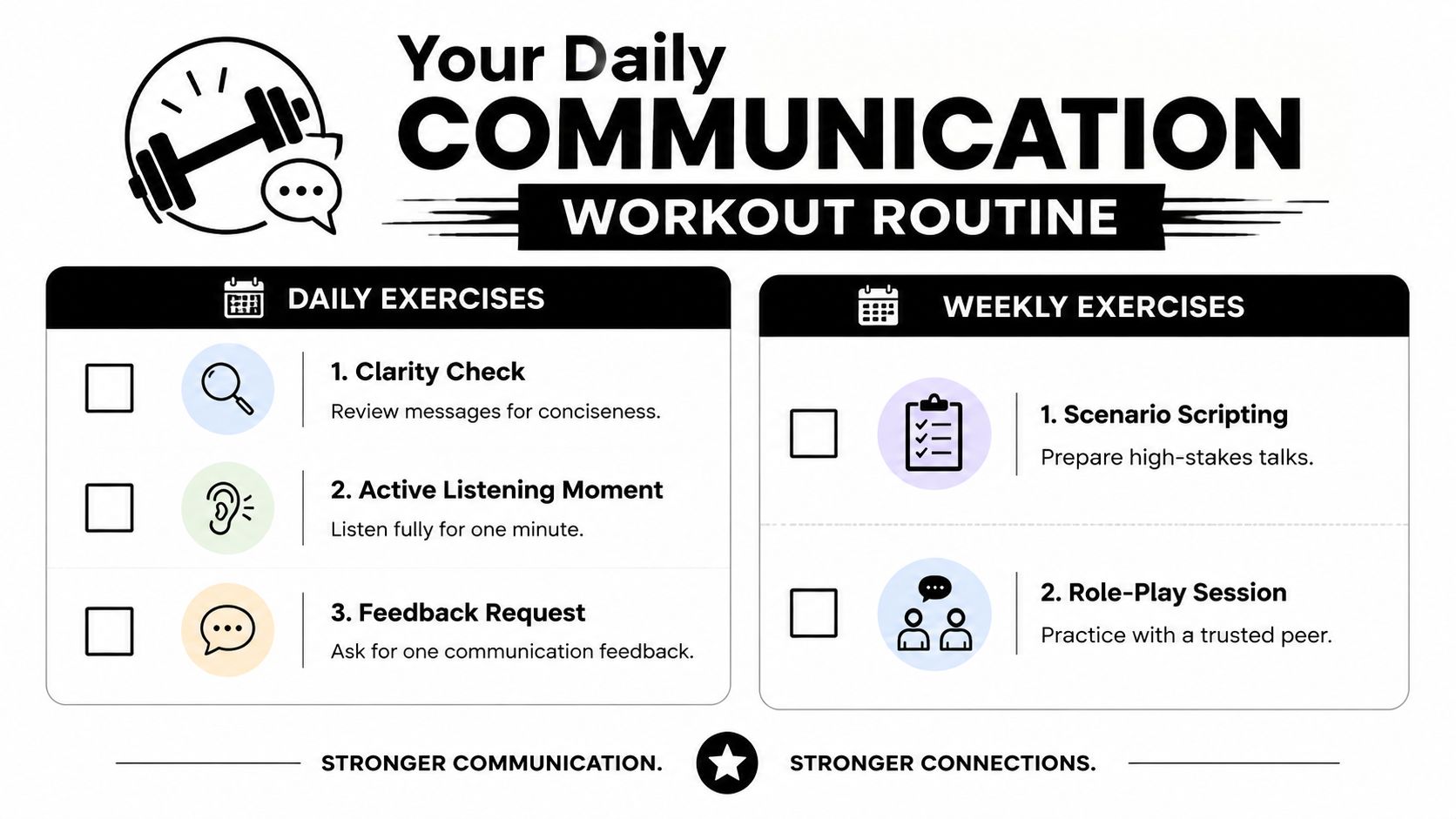
Daily reps that actually help
Use these in ordinary meetings, calls, emails, and voice notes.
The three-minute pre-meeting reset
Before any important conversation, write down:- The outcome you need
- The one point that must land
- The next step you want agreed
This cuts rambling immediately.
The one-paragraph rule for written messages
If an email or WhatsApp message needs multiple paragraphs to explain a simple request, rewrite it. Busy teams don't struggle because messages are short. They struggle because messages are unclear.The one-sentence close
At the end of a call, say: “The takeaway is X, and the next step is Y.”
This sounds basic. It prevents a lot of drift.The channel check
Don't force every issue into writing. If tone, ambiguity, or disagreement is growing, switch formats. Some decisions need a call, not a long thread.- Delegating work
- Explaining a strategic shift
- Clarifying priorities after a tense meeting
- Coordinating remotely across functions
- “Can you play back how you're interpreting that?”
- “What are you taking away as the priority?”
- “What would you tell the team after this call?”
- Monday. Script one high-stakes conversation you've been avoiding.
- Midweek. Practise saying it out loud once.
- Friday. Review one communication miss from the week and ask what failed.
- What changed
- Why it matters
- What happens next
- Name the pattern
- Ask for their read
- Check for missing context
- Agree what changes now
- “What part of this is within your control?”
- “Where am I or the system making this harder?”
- “What would better look like next week?”
- Clarity. Did I land one point or five half-points?
- Pacing. Did I rush key parts?
- Tone. Did I sound defensive, vague, or overly polished?
- Body language. Did my posture and facial expression match the message?
- Listener impact. Would the other person know exactly what to do next?
- One trusted peer who can tell you when your story is muddy
- One team member who can flag when your instructions are unclear
- One regular review slot where you test a message before a high-stakes conversation
- “What do I often explain too late?”
- “Where do my messages create extra work?”
- “In meetings, when do I become less clear?”
- “What would make my instructions easier to act on?”
- Every important conversation has a defined outcome
- Every key message is reduced to one point
- Every high-stakes audience gets a specific version
- Every week includes practice and review
- Use teach-back in your next delegation conversation
- Rewrite your next investor note around one core message
- Record one practice answer before a difficult meeting
- Ask one team member where your communication creates drag
A good communication habit is choosing the right channel before the misunderstanding compounds.
Here's a useful companion resource if your communication often matters after events, intros, and follow-ups: a post-networking follow-up checklist for founders.
Later in the week, it helps to watch someone model a few of these habits in action:
The teach-back drill
One of the most useful methods for founders is the closed-loop or teach-back approach. The process is simple: make one clear point, then ask the other person to paraphrase it before moving on. As explained by EW Solutions' guidance on communication success, communication is complete only after the receiver can accurately restate the message.
This is especially useful when:
Instead of asking, “Does that make sense?”, ask:
That's not patronising if your tone is right. It's operational discipline.
Weekly drills for high-stakes conversations
You don't need a formal training calendar. You need one weekly slot.
Try this rhythm:
A lightweight review table helps:
| Situation | What I meant | What they heard | What to change |
|---|---|---|---|
| Team delegation | Urgent, but not chaotic | Drop everything now | State priority level more clearly |
| Investor update | We're focused | We're slow | Lead with decision logic and momentum |
| Partner message | Explore fit | Hard sell | Reduce company background and sharpen ask |
If you want to know how to improve communication skills quickly, this is the answer often avoided because it's repetitive. Repetition is the point.
High-Stakes Scenarios Role-Specific Scripts for Founders
General advice breaks down when the stakes rise. Founders need language they can use in conversations where ambiguity is expensive.
The key skill is message adaptation. Founders have to translate one core company story into different narratives for investors, customers, hires, and partners. That's the practical implication behind Edalex's communication playbook, which highlights the need to connect skills and narrative to audience expectations.

The investor update
Most investor updates are too chronological. They describe activity instead of meaning.
A stronger three-part structure:
A practical script:
“Since the last update, the most important change is that we've learned where demand is strongest and where our sales cycle slows. That matters because it changes how we allocate founder time and hiring attention. Our next step is to concentrate effort on the segment showing the clearest pull and remove friction in the handoff that's slowing conversion.”
That sounds sharper than a list of meetings, hires, and product tasks.
If you need help tightening the short version of your story, this UAE elevator pitch builder for founders is relevant.
The difficult team one-to-one
Founders often make one of two mistakes here. They either become too vague to avoid discomfort, or too blunt too early and trigger defensiveness.
Use this sequence instead:
Mini-script:
“I want to discuss a pattern I've noticed. A few key handoffs have lacked clarity, and it's creating confusion downstream. I want your view first. What do you think is behind that?”
Then keep going:
This keeps accountability in the room without turning the conversation into a verdict.
The partner outreach message
Cold outreach fails when it's too long, too vague, or too self-focused.
Use a four-line structure:
| Line | Purpose |
|---|---|
| Opening | Show relevance, not flattery |
| Value link | Connect your work to their priorities |
| Specific ask | Suggest one next step |
| Friction reducer | Make replying easy |
Example:
“Hi [Name], I'm reaching out because we work with a similar customer profile and may have a useful overlap. We're seeing a recurring need around [problem], and I think there may be a practical partnership angle for both sides. Would you be open to a short call to explore whether there's a fit? If useful, I can send a two-line summary first.”
That works because it respects time and lowers commitment.
Speak to the decision the other person needs to make, not the biography of your company.
The best scripts aren't memorised word for word. They give you structure when the pressure rises.
Building Your Feedback and Accountability System
Most founders plateau because they only judge communication by outcome. Did I get the meeting? Did the candidate accept? Did the team seem aligned?
That's too blunt. You need a feedback system that catches weaker patterns before they become expensive habits.
One of the strongest methods is recording and review. For presentations, interviews, and difficult conversations, record your delivery, then critique pacing, clarity, tone, and nonverbal signals before trying again. That self-correction loop is the core recommendation in this communication practice guidance on YouTube.
What to review when you watch yourself
When reviewing a recording, the focus tends to be on whether one appears confident. That's not enough.
Review with a short scorecard:
Recordings are useful because they show the gap between what you intended to say and what you actually sounded like.
Build external accountability, not just self-awareness
Self-review helps, but founders also need informed feedback from other people. That can come from a peer group, a trusted operator, a mentor, or someone you specifically hire as an accountability coach if you know consistency is your bottleneck.
A practical setup looks like this:
Structured founder communities can be useful. Founder Connects runs moderated small-group sessions and curated introductions, which can give founders a place to test messaging, hear how they come across, and get practical feedback from peers in similar stages.

What to ask your team
If you ask, “How am I communicating?”, you'll get polite nonsense.
Ask narrower questions:
You also need a few simple indicators. Keep them practical:
| Signal | What it tells you |
|---|---|
| Repeat clarification requests | Your original message wasn't specific enough |
| Meetings that end without owners | You explained the issue, not the action |
| Long message threads after a decision | The decision wasn't framed clearly |
| Team hesitation in one-to-ones | Your listening may not feel safe or open |
You don't need a formal dashboard. You need attention and a loop.
A good first step is to record a one-minute explanation of your company, send it to one trusted person, and ask two questions only: “What's unclear?” and “What do you think I'm selling?”
Conclusion Installing Your Communication Operating System
The founders who communicate well under pressure usually aren't naturally gifted. They've built a system.
That system has four parts. Clarity before the conversation. Listening during it. Adaptation for the audience. Feedback after it. Once those four habits work together, communication stops feeling random. It becomes repeatable.
That matters more in the UAE and wider MENA ecosystem because many founders operate across languages, cultures, and stakeholder types in the same week. You might move from a government-facing conversation to an investor call, then to a team one-to-one and a partnership outreach message before the day ends. Generic advice about “speaking confidently” won't carry that load.
A better standard is this:
If you want a simple way to start, don't overhaul everything. Install one behaviour now.
Choose one:
That's how communication gets better in real companies. Not through theory. Through operating rhythm.
If you've been wondering how to improve communication skills, the answer is less glamorous than most articles make it sound. Prepare more. Say less. Check understanding. Adapt your message. Review your misses. Repeat until it becomes part of how you lead.
Founder communication improves fastest when it isn't done alone. If you want a trusted place to test your message, pressure-check decisions, and get honest feedback from other builders in the region, explore Founder Connects.

Building in MENA? You don't have to do it alone.
Join 300+ founders in the Founder Connects Residency. Monthly squad calls, warm intros, $3M+ in perks, and much more. All for less than your monthly coffee budget.
Popular posts





Founder Connects is a premium MENA tech founder community. Meetups in Dubai and across MENA, Residency Squads of 8–10, and 400+ vetted WhatsApp founders (apply and screened).