

How to Price Your SaaS Product MENA: A Founder's 2026 Guide

Building in MENA? You don't have to do it alone.
Join 300+ founders in the Founder Connects Residency. Monthly squad calls, warm intros, $3M+ in perks, and much more. All for less than your monthly coffee budget.

You're probably in one of two situations right now.
Either you've got a SaaS product selling reasonably well elsewhere and you're trying to figure out what to charge in the UAE, Saudi Arabia, or the wider region without looking overpriced or unserious. Or you're already talking to MENA prospects, and every pricing call turns into the same messy debate about budget, procurement, local payment methods, annual contracts, and “can you do something special for us?”
Generic startup advice often falls short. A lot of pricing playbooks assume buyers move fast, trust software by default, and compare vendors mostly on features. In MENA, pricing is tied to trust, proof, and how confidently you handle the commercial conversation. If you get that wrong, even a strong product feels risky.
If you want a practical answer to how to price your SaaS product in MENA, start with this rule. Price for proof first, then for scale. The founders who win here don't just pick a number. They build a commercial structure that fits how buyers in the region make decisions.
Understanding the MENA SaaS Pricing Mindset
MENA buyers usually aren't asking one question. They're asking three at once.
Can your team be trusted? Will this product work in our environment? And if it does, will the commercial relationship stay sensible after we sign? If your pricing only answers the third question, you'll lose deals that had nothing to do with the number on the proposal.
Trust comes before price acceptance
A founder in San Francisco might launch with a self-serve page, monthly billing, and a neatly tiered package. In the UAE or KSA, that same approach often feels thin. Buyers want context. They want responsiveness. They want to know who else in the region has already bought from you and whether your team understands local expectations.
That doesn't mean buyers in MENA only care about relationships. It means relationships reduce perceived risk.
When founders misread this, they call the region “price sensitive”. Often it's more accurate to say the buyer is proof sensitive. A weakly positioned product gets pushed into discount mode because the vendor hasn't yet earned pricing power.
Buyers rarely reward a SaaS vendor for being cheap. They reward a vendor for making the decision feel safe.
That's also why “we're successful in the US” or “we work with global brands” often lands weaker than founders expect. Regional buyers usually want regional evidence. They want to see that someone like them has already used the product, gone through onboarding, and got value from it.
Value is judged commercially, not abstractly
In many MENA sales cycles, “innovation” doesn't close the deal. Commercial logic does. If your pitch sounds like a product demo, procurement and finance will drag you back into a budget discussion. If your pitch sounds like an operating improvement with a clear business case, the price conversation changes.
A useful mental shift:
- Don't sell software access. Sell a business outcome.
- Don't defend your price with features. Defend it with operational or revenue impact.
- Don't treat negotiation as resistance. Treat it as part of commercial validation.
There's also a social layer many outside founders underestimate. Introductions matter. Reputation matters. The local equivalent of trust capital often moves a deal faster than a polished pricing page. A founder with strong references, warm intros, and a clear implementation plan can hold price more confidently than a founder with a better feature set but no local validation.
What works and what fails
Here's the pattern I've seen repeatedly.
| Approach | What happens in MENA |
|---|---|
| Generic global pricing page | Buyers ask for custom terms almost immediately |
| Low price to “get in the door” | Product looks disposable or underpowered |
| High price with weak proof | Sales cycle stalls |
| Consultative pricing tied to ROI | Buyers engage more seriously |
If your current pricing conversations feel harder than they should, the problem usually isn't the number alone. It's that the pricing hasn't been framed inside a relationship-first, ROI-driven sales motion.
Building Your Value-Based Pricing Core
The cleanest pricing decisions in MENA come from one discipline. Quantify value before you quote price.
A strong regional rule of thumb is simple. Your subscription fee should represent 10–25% of the total quantified value delivered to the customer according to 23 Hub Lab's MENA SaaS pricing analysis. That value can come from hours saved, revenue created, or cost avoided.
Here's the visual model I use when pressure-testing pricing logic.
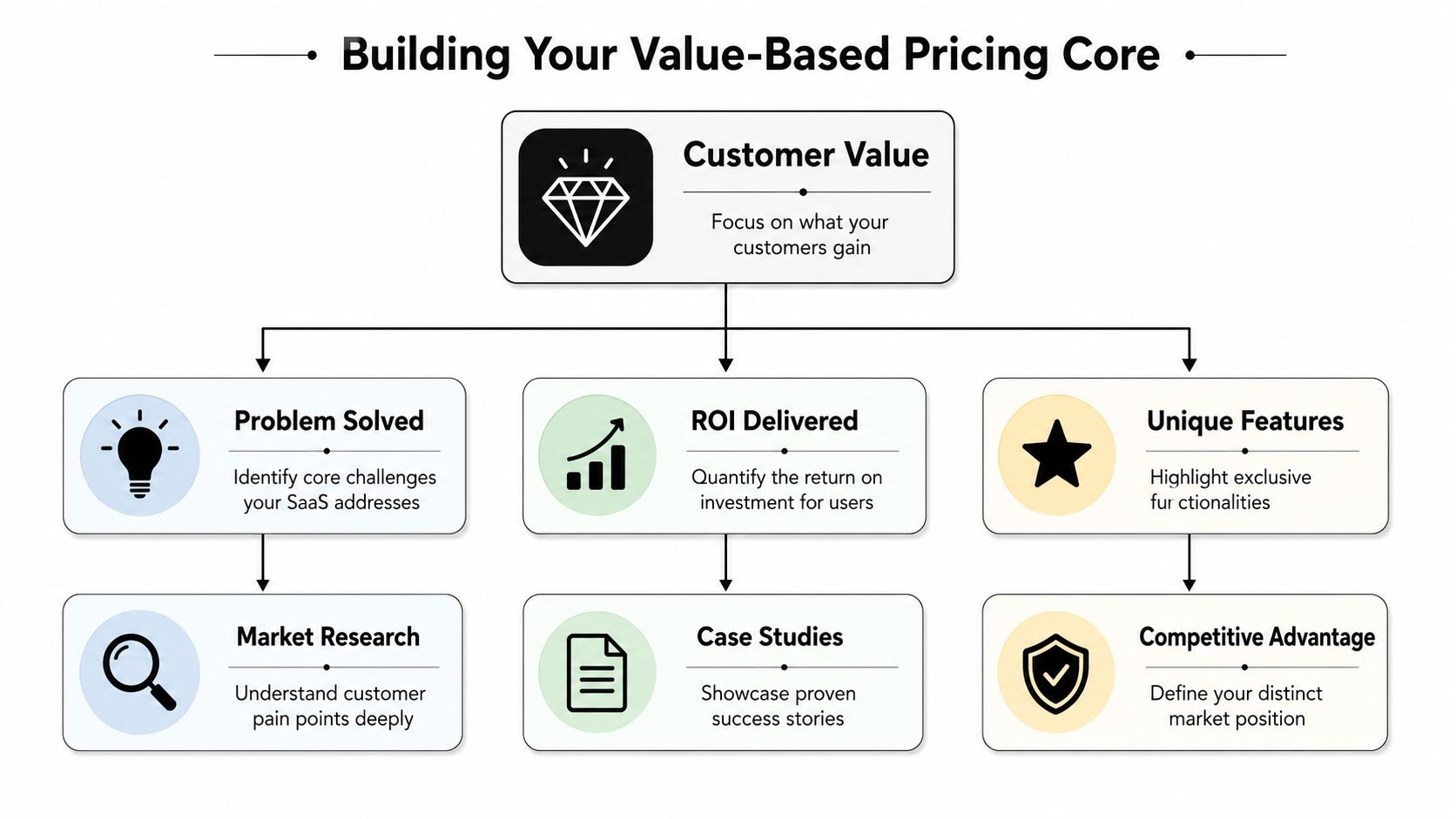
Start with an economic value worksheet
You don't need a complex spreadsheet. You need a repeatable discovery process.
Ask questions like:
- Time saved: How many hours does the team currently spend on this process each week?
- Revenue impact: Does faster execution help close more deals, retain more customers, or improve conversion?
- Cost avoided: What mistakes, delays, or manual effort disappear if your product is adopted?
- Risk reduction: What compliance or operational exposure becomes easier to manage?
The example from the same MENA pricing guidance is useful because it forces discipline. If a tool saves a UAE team 40 hours weekly with an average employee cost of $50/hour, the annual value is $104,000, which implies a pricing range of $10,400 to $26,000 annually when you apply the 10–25% rule in that source. Don't copy that example blindly. Use it as a way to train your team to think commercially.
Practical rule: If you can't explain your annual fee as a modest fraction of clear business value, your prospect will compare you to cheaper alternatives and you'll struggle to hold the line.
Build pricing from discovery, not from competitors
Founders often ask what competitors charge first. That's understandable, but it's a weak starting point in this region. Competitor pricing doesn't tell you how much value your product creates for a logistics company in Riyadh versus a healthcare group in Dubai. It only tells you what another vendor chose to publish.
Use a simple sequence instead:
- Measure the current pain
- Estimate the annual business impact
- Apply the value share
- Test whether the buyer agrees with the assumptions
- Only then package the offer
If you want a broader framework for sharpening that logic, Market Edge's guide to value pricing is worth reviewing alongside your own sales notes.
Segment customers by value magnitude
Not every customer should sit in the same pricing band. The right segmentation question isn't “How big is the company?” It's “How big is the value this company gets?”
A smaller team with a painful workflow may justify a stronger fee than a larger organisation using only basic functionality. That's one reason product-market fit and pricing can't really be separated. If you haven't nailed the use case tightly enough, pricing stays fuzzy. This is also why founders working through early traction should revisit their assumptions about value before locking a pricing page, especially if they're still refining product-market fit in the UAE startup context.
A simple founder template
Use this with your team before the next pricing call:
| Input | What to capture |
|---|---|
| Workflow pain | Where time, money, or errors are currently lost |
| Value driver | Hours saved, revenue gain, or cost avoided |
| Annual impact | Buyer-approved estimate of yearly value |
| Price range | Fee anchored to the value share logic |
| Packaging note | What support or scope is needed to land the deal |
That gives you a pricing core grounded in customer economics, not guesswork.
Designing Tiers and Packaging for Regional Success
A lot of SaaS pricing in MENA gets messy because founders try to solve every objection with another tier. That usually makes selling harder, not easier.
The better route is to choose one primary value metric and let the package expand as the customer gets more value. Per user can work. Per location can work. Per project, per active record, or per managed asset can work. What matters is that the metric is easy to explain and feels fair.
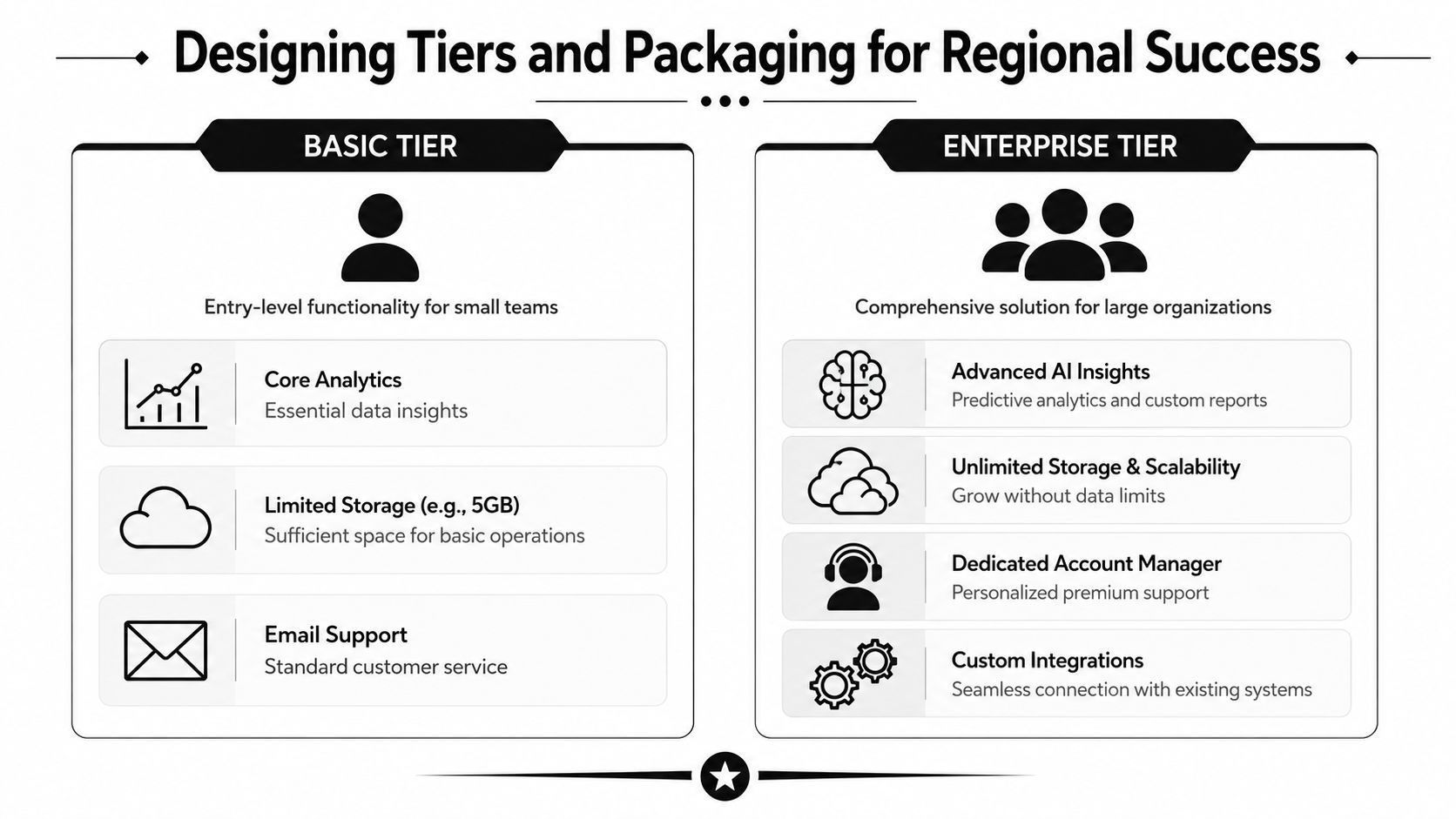
Use one value metric, not a feature maze
When your pricing page is built around feature gates, every sales call becomes a negotiation about exceptions. The buyer asks for one advanced feature from the top plan, one support promise from the middle plan, and one price from the lowest plan. Your team ends up custom-building packages anyway.
A single value metric keeps the conversation cleaner because it aligns your revenue with customer growth.
For example:
- Per user works when collaboration scales with headcount
- Per branch or location works when each site gets clear operational value
- Per volume unit works when usage tracks directly to business output
If you're still deciding whether recurring subscription or variable usage is the better fit, this breakdown of pay-per-use vs subscription models is a helpful lens.
Enterprise and SMB should feel different commercially
Most founders make one of two mistakes. They either give enterprise customers the same package with a higher price, or they overbuild a giant enterprise plan before demand exists.
Enterprise packaging in MENA usually wins when it includes commercial and operational assurances, not just more features.
| Segment | What they usually care about most |
|---|---|
| SMB | Speed, clarity, low-friction onboarding |
| Mid-market | Business case, team adoption, manageable rollout |
| Enterprise | Procurement comfort, support model, integration confidence |
That means your enterprise plan should usually emphasise:
- Support structure
- Implementation help
- Security or procurement documentation
- Custom integrations where needed
- Commercial flexibility on invoicing and contracting
Regional packaging needs judgement, not fake precision
One reality founders need to accept is that there is a lack of region-specific price sensitivity data for tier-2 MENA markets such as Lebanon and Jordan compared to the UAE and KSA, while Africa-focused guides may discuss 20-30% ARPU drops for Ghana versus Nigeria with no equivalent MENA benchmark, as noted by Launchpad's analysis of SaaS pricing tiers. In practice, that leaves founders choosing between overpricing lower-income markets or underpricing the Gulf.
So don't pretend you have a scientific regional discount model if you don't. What works better is to keep your core pricing logic intact and adjust packaging, support intensity, contract structure, or rollout scope by market.
A regional strategy doesn't need a different price list for every country. It needs a clear reason for every commercial difference you offer.
Handling Currency, Payments, and Taxes in MENA
Currency confusion kills momentum late in the sales process. The proposal is accepted in principle, then the buyer asks for local invoicing or a different settlement method, finance gets involved, and the deal slows down for reasons that had nothing to do with product fit.
The default answer is straightforward. Successful MENA SaaS companies should price in USD, display in USD, and accept USD, AED, and SAR payments according to Voxire's MENA go-to-market guidance. That hybrid model preserves value signalling while reducing payment friction for buyers using local rails.
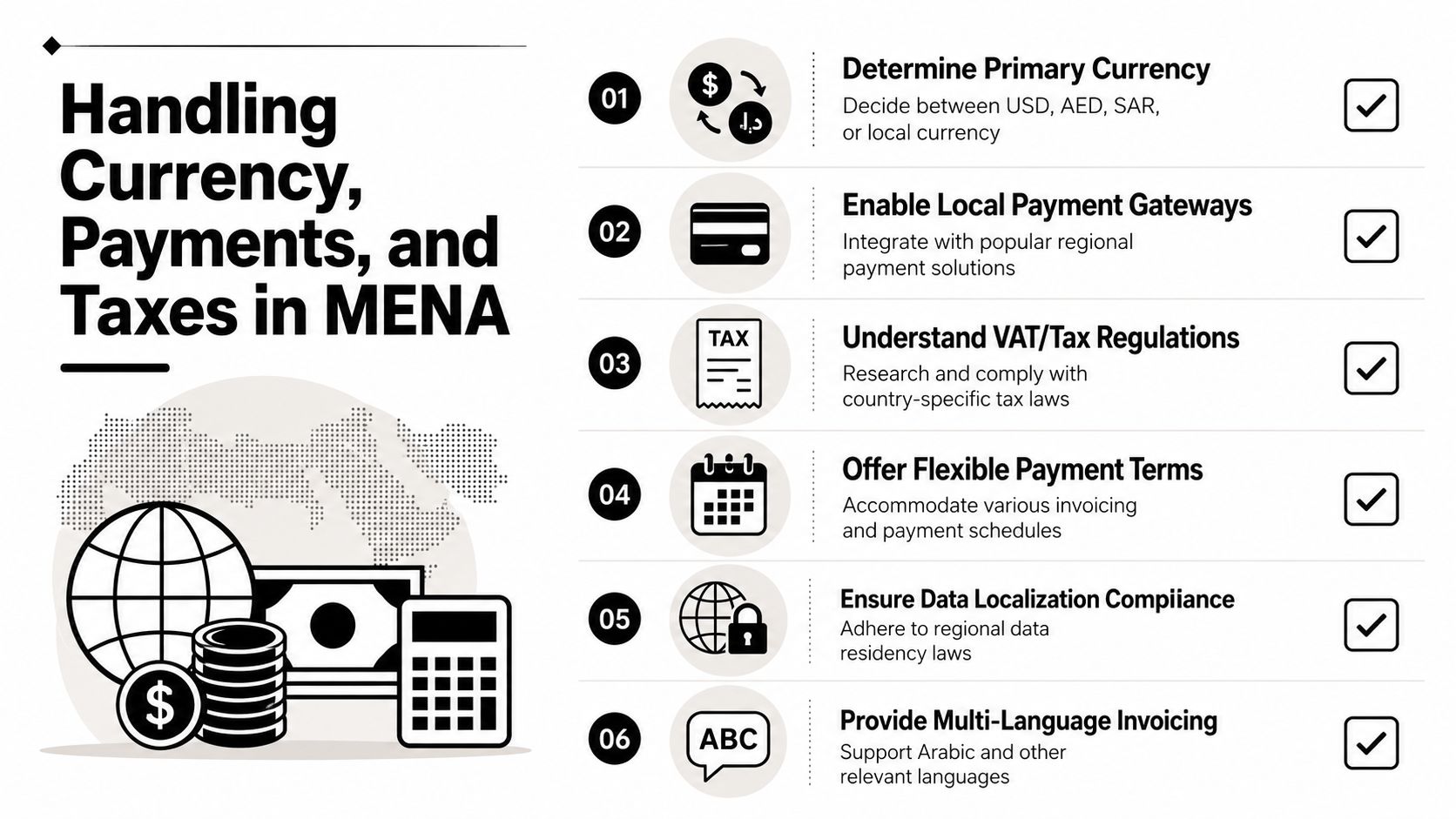
Use USD for pricing logic
USD gives you a stable commercial anchor. It also helps when you're selling across multiple MENA markets and don't want your core value proposition distorted by local display choices.
In practice, this means:
- Quote in USD: Keep proposals and pricing logic anchored to one benchmark currency
- Display in USD: Avoid sending mixed signals about product positioning
- Accept local settlement options: Let the buyer pay in AED or SAR if that reduces friction
This setup is especially useful when buyers are comfortable evaluating enterprise software in USD but operational teams still need familiar local payment routes.
Reduce friction at checkout and invoicing
Global payment tools can work well, but don't assume they solve everything neatly in the region. Your payment stack needs to match how your customer pays, not how your billing tool prefers to collect.
The practical checklist usually looks like this:
- Payment gateway fit: Compare global processors with regional options based on customer profile
- Invoice format: Make sure invoices are usable by local finance teams
- Tax handling: Confirm the tax treatment before the first large contract lands
- Approval flow: Expect some enterprise buyers to prefer bank transfer and invoice-based workflows over card payments
If you're evaluating local collection options, this guide on Network International payment solutions gives useful context for founders selling in the region. For a broader operational view on local payment methods, Tagada on optimizing global payments is also a practical reference.
Don't leave tax and compliance until after launch
Tax, invoicing language, and local commercial paperwork don't feel urgent at the beginning. Then your first serious customer asks for them and your team scrambles.
Use a simple internal checklist:
| Area | What to decide early |
|---|---|
| Currency policy | What you quote in and what you collect in |
| Payment methods | Card, transfer, invoice, local rails |
| Tax process | How invoices reflect applicable tax treatment |
| Contracting | Entity, payment terms, and signatory flow |
The fastest way to look unprepared in an enterprise deal is to sound confident on product and vague on invoicing.
Mastering Discounts and Enterprise Contracts
In MENA, discounting can be smart or destructive. The difference is whether you're buying proof or just giving away margin.
The strongest use of discounting is early. For SaaS companies entering the region, a critical first-year milestone is securing 2–4 regional pilot customers, often with 50% off standard pricing or even a free first year in exchange for case study and reference rights, according to Maven's guidance on selling SaaS in MENA. That isn't weakness. It's market entry strategy.

The right discount tells a story
I've advised founders who tried to hold full global pricing before they had any credible local reference. They usually got trapped in long conversations with interested prospects who never quite moved. The product wasn't the issue. The missing piece was local proof.
A better move is to say something like this:
We're opening the region deliberately. For a small number of pilot partners, we'll structure commercial terms more aggressively if we get meaningful implementation access, feedback, and reference rights if the deployment succeeds.
That changes the tone. The discount is no longer a sign that the list price is fake. It's a strategic trade.
What you should ask for in return
Never give a meaningful concession without a matching concession from the customer.
For pilot or enterprise discounting, get specific:
- Reference rights: Can you use their name, logo, or approved success story?
- Decision access: Will the team give direct access to operational stakeholders?
- Timeline commitment: Is there a target rollout window?
- Renewal clarity: What happens after the pilot period ends?
- Scope discipline: What is and isn't included during the discounted term?
A discounted contract with vague scope is often worse than no contract. Teams over-serve, build extras, and then struggle to move the account to normal commercial terms.
The discounting traps founders walk into
Some discount patterns look harmless at the time but create long-term pain.
| Trap | Better move |
|---|---|
| Open-ended “special price” | Time-bound pilot terms with renewal language |
| Discount for verbal interest | Discount only for concrete strategic value |
| Matching every procurement push | Trade every concession for something useful |
| Giving enterprise support for SMB pricing | Define support and scope in the contract |
One pricing experiment taught me this very clearly. We once presented the same core offer to similar prospects in two ways. One version led with a lower monthly fee. The other led with a stronger annual commercial structure tied to onboarding support and executive access. The lower monthly option attracted more discussion but weaker commitment. The annual structure drew fewer casual conversations but more serious buying behaviour. The lesson wasn't that annual always wins. It was that buyers often take the offer more seriously when the contract feels like a business initiative, not a low-risk software trial.
What belongs in the contract
Enterprise contracts in MENA don't need to be bloated, but they do need to be explicit.
Make sure yours covers:
- Payment terms
- Support scope
- Implementation responsibilities
- Renewal mechanics
- Any price review or uplift logic
- What happens if extra integration work is requested
If the commercial boundaries are fuzzy, the customer will often assume flexibility. Your team will feel that later.
Your Pricing Experiment and Iteration Roadmap
Your first price is a hypothesis. Treat it that way and you'll learn faster.
Founders often overcomplicate pricing tests. You don't need a full pricing overhaul to get useful signal. You need one clear question, one controlled change, and a disciplined way to collect feedback from sales calls.
Start with one live experiment
The easiest low-risk tests are usually about presentation, not about changing every number at once.
Try one of these:
- Annual prominence: Put the annual option first in proposals and see whether buyer conversations change
- Packaging language: Replace feature-heavy descriptions with outcome-heavy ones
- Commercial framing: Lead with implementation and support in enterprise proposals rather than product access alone
- Qualification questions: Ask value questions earlier and see if pricing objections become easier to handle
What surprised me in one experiment was how strongly perception shifted when the team stopped leading with the cheapest available entry point. We assumed a lower-friction opener would make buyers more comfortable. Instead, it often attracted less committed prospects and pulled the conversation toward price haggling. When we led with the version that made the business case clearer, buyers pushed harder on implementation questions and less on whether the product should cost less.
The experiment didn't change the product. It changed who took the offer seriously.
Use a simple review rhythm
Pricing reviews shouldn't happen only when deals stall. Put them on a recurring operating cadence.
Use this lightweight review list:
- Review recent deals and mark where price was the primary blocker versus where trust, scope, or timing killed the deal.
- Compare segments and identify which customer profile accepts your logic fastest.
- Listen to calls and note the exact language buyers use when they hesitate.
- Update one thing only. Packaging, billing cadence, proposal framing, or discount policy.
- Run the change long enough to gather pattern-level feedback.
Questions worth asking customers
Ask these directly after demos or in late-stage conversations:
- What part of this price feels hardest to justify internally?
- Which business outcome matters most if you approve this?
- Would a different contract structure make this easier to buy?
- What would finance or procurement ask us to clarify?
If you're wondering how to price your SaaS product in MENA, this is where the answer gets sharper. Not in theory. In repeated commercial conversations where you test assumptions and tighten the offer.
Frequently Asked Pricing Questions for MENA Founders
Some pricing questions don't need a long debate. They need a firm operating answer.
Common MENA pricing questions
| Question | Short Answer | Key Consideration |
|---|---|---|
| Should we charge monthly or annually? | Default to annual for serious B2B deals, while keeping monthly only where it clearly helps adoption. | Annual contracts usually create stronger commitment and cleaner onboarding. |
| Should UAE and KSA have different pricing? | Keep the core logic consistent unless the value delivered is materially different. | Change scope or support before changing the pricing philosophy. |
| Should we publish prices publicly? | Publish if your product is relatively standard. Keep enterprise pricing custom if implementation varies a lot. | Hidden pricing slows smaller buyers, but forced public pricing can weaken enterprise flexibility. |
| Should we discount every first deal in a new market? | No. Discount selectively when the customer gives strategic value back. | Reference rights and pilot learning matter more than logo vanity. |
| Should enterprise plans include more features? | Sometimes, but support and commercial terms usually matter more. | Many enterprise deals are won on confidence, not feature volume alone. |
| Should we localise pricing by currency? | Keep pricing logic anchored, but make payment easy. | Buyers want convenience without losing clarity on value. |
Non-negotiable advice
A few calls founders should make decisively:
- Don't let procurement define your pricing strategy. Procurement is part of the process, not the author of your model.
- Don't copy US SaaS pages and assume they'll work locally. The commercial context is different.
- Don't launch too many tiers. If your own team can't explain them quickly, buyers won't trust them.
- Don't separate pricing from sales behaviour. A weak discovery call creates weak pricing power.
If your pricing still feels uncertain, narrow the problem. Pick one customer segment, one value metric, one contract structure, and one pilot strategy. Clarity compounds faster than complexity.
If you want sharper feedback on your pricing, packaging, or go-to-market decisions from founders building in the same region, Founder Connects gives you a high-signal way to do it. It's built for UAE and MENA founders who want practical conversations, trusted peer input, and introductions that help move the business forward.

Building in MENA? You don't have to do it alone.
Join 300+ founders in the Founder Connects Residency. Monthly squad calls, warm intros, $3M+ in perks, and much more. All for less than your monthly coffee budget.
Popular posts





Founder Connects is a premium MENA tech founder community. Meetups in Dubai and across MENA, Residency Squads of 8–10, and 400+ vetted WhatsApp founders (apply and screened).