

Hub71 Abu Dhabi Accelerator Review: 2026 Guide

Building in MENA? You don't have to do it alone.
Join 300+ founders in the Founder Connects Residency. Monthly squad calls, warm intros, $3M+ in perks, and much more. All for less than your monthly coffee budget.

Over 190 startups in Hub71 have collectively raised about AED 5.4 billion, according to the Abu Dhabi Media Office. That figure changes the usual question founders ask.
The primary question isn't whether Hub71 is visible. It is. The better question is whether its model fits your company's stage, capital plan, and willingness to relocate.
Most founders searching for a Hub71 Abu Dhabi accelerator review want a shortcut to the practical answer. Is the funding real? What does the equity structure look like? Are the perks meaningful or just marketing? And what are the trade-offs that don't show up on application pages?
Hub71 stands out because it combines sovereign-backed support, a structured programme, and operational benefits that can remove real friction for an early-stage team. But it also asks for two commitments many founders underestimate: equity via a SAFE note and long-term relocation to Abu Dhabi.
If your startup wants a UAE base, investor access, and a structured path from validation to scale, Hub71 deserves serious attention. If your team is remote-first, market-agnostic, or highly protective of cap table simplicity, the answer may be different.
Introduction to Hub71 Accelerator
Hub71 sits in a category that many MENA accelerators aspire to, but few fully occupy. It is not just a coworking brand, and it is not just a demo-day operator. It is a startup platform designed to make Abu Dhabi a serious base for technology companies with regional and global ambitions.
For founders in the UAE and wider MENA market, that matters because the region doesn't reward vague ecosystem participation. Founders need capital, company setup support, investor access, and a regulatory home that can support growth. Hub71's appeal is that it tries to bundle those pieces into one system.
This Hub71 Abu Dhabi accelerator review comes down to five decision areas:
- Programme structure. How long it runs, how disciplined it is, and what that means for execution.
- Equity terms. What you receive, what you likely give up, and how to think about the SAFE note.
- Perks that affect burn. Office space, housing, healthcare, and practical operating support.
- Founder fit. Which companies are likely to benefit most from the platform.
- Hidden costs. Relocation, local buildout, and the missing public data around exits and post-programme performance.
Practical rule: Don't treat Hub71 like a generic accelerator application. Treat it like a location and financing decision at the same time.
If you're evaluating whether to apply, the fastest way to decide is simple. Look at your stage, your cap table tolerance, and whether one founder is committed to building in Abu Dhabi for the long term.
Understanding Hub71 Mission and Impact
AED 5.4 billion in startup funding is the headline figure cited earlier. The more useful question is what that number says about Hub71's role in Abu Dhabi's startup strategy.
Hub71 is best understood as an economic platform first and an accelerator second. Its mission is to help Abu Dhabi attract venture-backed companies, keep more of them operating locally, and connect them to state-linked institutions, investors, and corporate buyers. That design sets it apart from founder communities that mainly offer events, intros, and shared office space.

Why that mission matters to founders
For a founder, sovereign backing matters only if it changes execution. In Hub71's case, it often does. Abu Dhabi is trying to reduce the usual friction around relocation, company setup, talent visas, and access to decision-makers. A platform tied closely to that agenda can shorten the time it takes to establish a real operating base.
That does not mean every startup should apply. It means Hub71 is solving a specific problem. It is most useful for companies that want regional headquarters support, market access in the UAE, and a credible base from which to raise or sell. Founders who only want a short accelerator cycle may find the model heavier than expected.
The often-missed point is that mission and founder obligations are linked. Hub71's support makes more sense once you factor in the likely trade-offs around equity, SAFE mechanics, and residency commitment. Founders evaluating any programme with this kind of support stack should also understand how accelerator equity changes the real cost of participation.
The part many reviews miss
Hub71 is not just trying to increase startup count. It is trying to increase startup permanence in Abu Dhabi. That has two consequences.
First, the platform tends to matter more for relocating or cross-border startups than for founders who already have a strong UAE setup. If you need help getting established, the value can be meaningful. If you already have local investors, office arrangements, and hiring channels, Hub71's marginal benefit drops.
Second, Hub71 should be compared with MENA alternatives on outcomes that affect burn and operating speed, not on brand alone. Programmes in Dubai, Riyadh, or Cairo may offer network density or sector access. Hub71's angle is different. It combines capital pathways, in-kind support, and residency-related infrastructure in one package. For some teams, that is stronger than a mentor-heavy accelerator. For others, it creates commitments they do not need.
What separates Hub71 from lighter-touch ecosystems
Many regional programmes are designed to help founders get exposure. Hub71 is designed to help selected startups establish presence. That is a bigger promise, but it also demands a clearer founder decision.
Three practical implications follow:
- Institutional access: Startups enter a platform built to connect them with investors, government-linked entities, and corporate partners.
- Set-up support: The value is not limited to workshops. It extends to the operational work of building in Abu Dhabi.
- Residency logic: The model works best if at least one founder is ready to spend real time in-market rather than treat Abu Dhabi as an occasional meeting point.
The strategic takeaway is straightforward. Hub71 fits founders who want Abu Dhabi to be part of their company's operating map, not just their fundraising map. That is why the mission matters. It explains both the upside and the hidden requirements that weaker reviews tend to gloss over.
Breaking Down the Program Structure and Equity Terms
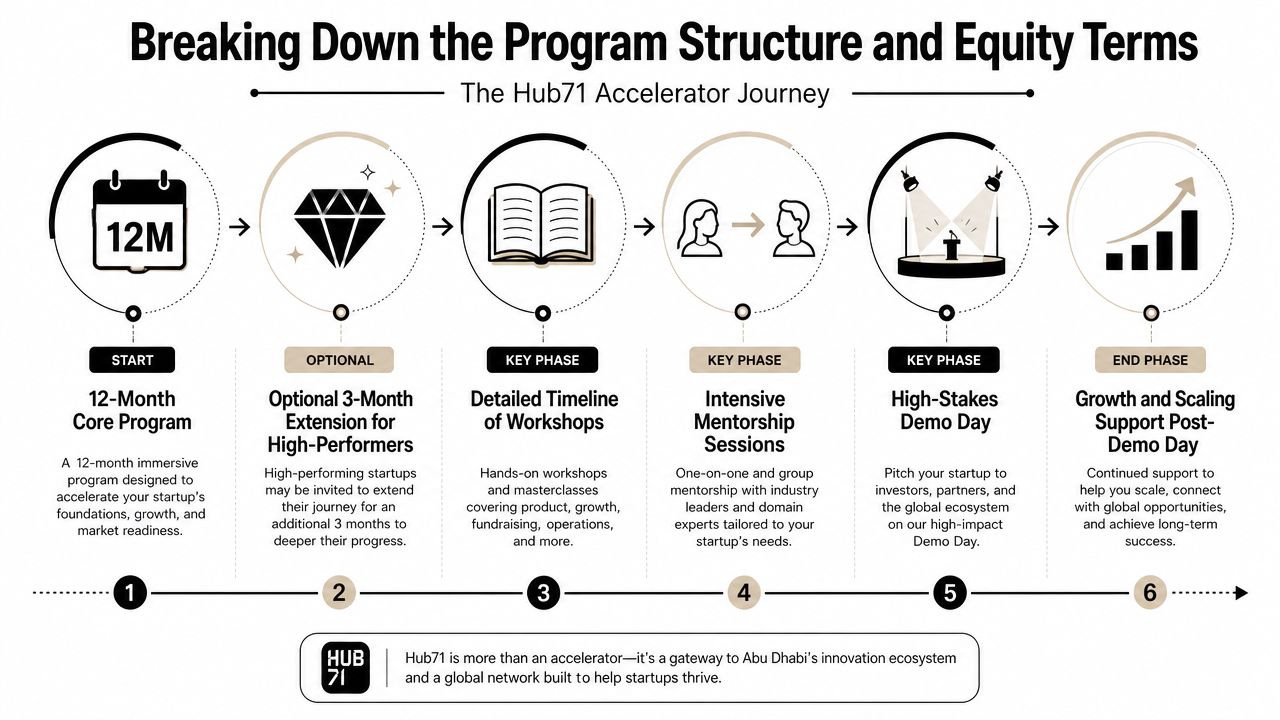
A 12-month programme is unusually long for a regional accelerator. That matters because duration changes what founders are really buying. Based on the public programme summary cited earlier, Hub71 is structured as a year-long programme, with a possible 3-month extension for stronger performers.
How founders should read the structure
A longer programme usually signals that the operator expects real company-building activity, not a short mentorship cycle. In Hub71's case, that reading is more plausible because the model is tied to establishing presence in Abu Dhabi, building local relationships, and using institutional access over time. A founder who only wants warm investor intros may find the timeline heavy. A founder planning to build sales, hiring, or partnerships in the UAE may see the opposite.
The possible extension also deserves attention. It implies some portfolio triage inside the programme. Selected startups may get more time and support, while others receive the standard term only. Founders should treat that extension as upside, not part of the base offer.
A simple test helps here. If your next 12 months already include GCC expansion, government or enterprise BD, or a relocation decision, Hub71's structure may fit. If your company mainly needs a faster fundraising sprint, a shorter MENA accelerator can be the cleaner option.
The equity terms matter more than the headline package
Hub71 is often discussed as a support platform, but the founder decision is partly a financing decision. Public materials describe a package made up of cash through a SAFE note for equity and additional in-kind support. As noted in the programme summary mentioned earlier, some startups may also be considered for an additional top-up if they perform well.
That mix is attractive on paper. It can also be misunderstood.
The in-kind portion is only valuable if it offsets costs you would have paid anyway. The SAFE note is only attractive if the implied future dilution makes sense relative to the practical support, market access, and time commitment involved. Founders who focus on the total package number without modelling conversion scenarios are skipping the hard part of the analysis.
For a clearer framework, see this breakdown of accelerator equity cost and programme trade-offs.
What to verify before accepting terms
Regional founders often compare accelerators by headline grant size or brand visibility. A better comparison is net value after dilution, relocation costs, and execution burden.
Before signing, review these points closely:
- SAFE conversion terms. Confirm what financing events trigger conversion and whether any discount, cap, or other pricing mechanics apply.
- Real dilution exposure. Model what the SAFE could mean after your next priced round, not just at signing.
- Top-up criteria. Ask how performance is assessed and who decides whether extra support is awarded.
- Usefulness of in-kind benefits. Check whether the credits and services match your actual spend profile in Abu Dhabi.
- Residency-linked economics. Factor in founder relocation and local build-out costs when judging whether the package is worth the equity.
This last point is easy to miss. Compared with lighter-touch MENA programmes, Hub71 can offer more tangible operational support, but it also tends to pull founders into a bigger commitment. The right benchmark is not “Do I get cash and perks?” It is “After equity, time, and relocation costs, is Abu Dhabi important enough to justify the trade?”
That is the overlooked trade-off in Hub71's structure. The programme can be stronger than mentor-led alternatives for startups that want to build in-market. For companies that only want optional regional exposure, the same structure can be expensive in both equity and founder attention.
Meeting Eligibility and Navigating Application Steps
The most important eligibility rule is also the one many founders underestimate. At least one founder must commit to long-term relocation to Abu Dhabi and build a team locally, and that requirement is mandatory according to the Hub71 Access Programme application page.
That single condition will eliminate a large share of otherwise qualified startups.
The requirement that changes the whole decision
Some accelerators can sit on top of your existing operating model. Hub71 often requires you to reshape that model. It is not built for founders who want to remain loosely connected to the UAE while keeping the company fully elsewhere.
If your startup applies, you should assume Hub71 wants local substance, not symbolic presence. That means founder time, entity setup, and local team building need to be part of your plan from the start.
The practical implication is simple. Don't apply first and solve relocation later. Decide internally whether your company is willing to build in Abu Dhabi.
Application preparation that actually matters
Public guidance indicates the programme is designed for startups from Pre-Seed to Series A, and the package is tied to those stages in the public materials already cited earlier. Beyond stage fit, your application should show that the business is ready for structured support, not just idea-stage enthusiasm.
Focus your prep on these areas:
- Relocation readiness. Name the founder who can move, how long they can commit, and what operational responsibilities they'll own on the ground.
- Local entity plan. Be clear about when and how you'll establish the Abu Dhabi operating presence required for onboarding.
- Pitch deck quality. Keep the narrative disciplined. Problem, solution, traction, team, and why Abu Dhabi matters to your growth.
- Market logic. Show why UAE or regional expansion is connected to your roadmap rather than bolted on for the application.
For a founder-focused walkthrough of sequencing and timing, this guide on the Hub71 application timeline and what to expect is a useful practical companion.
If you can't explain why Abu Dhabi should be part of your operating strategy, your application will likely feel opportunistic.
A strong application doesn't just say the startup is good. It shows that the startup and the platform fit each other.
Tangible Benefits and Alumni Success Stories
AED 500,000 in stated support is the figure that gets attention. The harder question is how much of that package changes execution once a founder lands in Abu Dhabi.

As noted earlier, Hub71 publicly frames its offer as a mix of cash and in-kind support. For founders assessing real value, the split matters more than the headline number. Cash helps with runway. The in-kind portion, which earlier public materials associate with office space, housing, and health insurance, lowers the cost and friction of establishing a base in Abu Dhabi.
That distinction is often missed in accelerator reviews across MENA. A programme can advertise a large package, but if the support does not offset relocation and company setup costs, the headline figure overstates the benefit. Hub71 is more credible than many regional alternatives on this point because part of the offer appears designed around the practical burden of moving a founder, not just promoting ecosystem access.
What the perks actually change
The non-cash support has a direct operational effect. It reduces time spent on housing, workspace, and basic admin during the first months in market. For a founder entering the UAE for the first time, that can mean faster customer meetings and fewer distractions. For a small team, it can also preserve cash that would otherwise be absorbed by setup costs.
This matters most for three founder types:
- International founders who need residency-linked stability to operate locally
- Lean teams that cannot afford a long relocation period with high burn
- Startups selling into regulated, enterprise, or government-adjacent markets where local presence improves credibility
The residency angle deserves more attention than it usually gets. Hub71's benefits are strongest if a founder is prepared to relocate and build from Abu Dhabi. If your company wants regional optics without a real operating presence, a large part of the package loses practical value.
What can be said about alumni outcomes
Public information on Hub71 alumni is still thinner than many founders would prefer. There is no widely available cohort-level dataset showing consistent exit rates, revenue growth, or follow-on funding by batch. That limits how far any serious review should go with success claims.
Still, the structure of the package points to where outcomes are more plausible. Startups that benefit most are usually those for which Abu Dhabi is part of the company plan, not an opportunistic add-on.
One example is an early-stage B2B software company using the UAE as a GCC entry point. In that case, subsidised living and office support can shorten the gap between arrival and first serious commercial conversations. The advantage is not abstract. It is more founder time spent on pilots, partnerships, and hiring instead of logistics.
A second example is a deep-tech or infrastructure startup that needs institutional credibility as much as cash. Here, Hub71's value is partly signaling. Being embedded in a recognised Abu Dhabi platform can help open conversations that would be slower to start from outside the market.
Here's a closer look at the founder experience in motion:
The right way to benchmark Hub71 against MENA alternatives
The useful comparison is not whether Hub71 offers perks. Many MENA accelerators do. The better question is whether those benefits materially reduce the cost of relocation, residency, and early operating setup.
On that benchmark, Hub71 stands out. Some regional programmes provide mentorship, introductions, or light office access but leave founders to absorb most relocation and living costs themselves. Hub71 appears stronger where the founder is making a genuine move and needs support that affects daily execution.
Founder lens: These benefits matter only if they change how your team operates. If they do not reduce setup burden, cash burn, or market-entry friction, they are branding, not a real advantage.
That is why the package is most compelling for founders prepared to establish a real Abu Dhabi presence and accept the trade-off that comes with it. The support is tangible. The value depends on whether your company is structured to use it.
Pros and Cons and Ideal Founder Profiles
A balanced Hub71 Abu Dhabi accelerator review has to acknowledge two things at once. First, Hub71 offers unusually tangible support for the region. Second, some of the most important outcome data founders want still isn't publicly transparent.
Public analysis notes that people searching for Hub71 reviews rarely find transparent data on actual exit success rate or post-accelerator revenue growth, creating a meaningful decision gap for founders, as discussed in this review of public Hub71 information and transparency gaps.

Where Hub71 is strongest
| Advantage | Why it matters |
|---|---|
| Structured support | The programme appears built for sustained execution rather than surface-level exposure. |
| Meaningful financial package | Cash plus in-kind support can reduce early operating strain if you use both well. |
| Abu Dhabi ecosystem access | Founders seeking a UAE base may gain faster institutional credibility and local traction pathways. |
Where the trade-offs are real
| Constraint | Why founders should care |
|---|---|
| Mandatory relocation | This isn't a side condition. It changes hiring, founder bandwidth, and company geography. |
| Equity via SAFE note | The funding package has cap table implications that some teams won't want at their stage. |
| Limited public outcome transparency | Missing public data on exits and post-programme revenue makes benchmarking harder. |
Who should apply
Hub71 is likely strongest for a founder who fits most of these conditions:
- You want Abu Dhabi to become a real operating base, not just a market to visit.
- You're comfortable trading some future dilution for immediate support and ecosystem entry.
- Your company benefits from structured engagement over a longer period, rather than a short cohort.
- You can place a founder on the ground for the long term and build locally.
Who should probably skip it
The fit weakens if any of these are true:
- Your team is fully remote and doesn't want location-dependent obligations.
- Your cap table is already sensitive and you want to avoid additional complexity.
- Your target market has little connection to the UAE or broader MENA region.
- You mainly want branding, community, or occasional investor access without operational relocation.
The biggest mistake founders make is treating Hub71 like a no-brainer upside. It's only high-value when the programme model matches the company model.
That is the key trade-off. Hub71 offers more substance than many alternatives. It also asks for more commitment.
Comparing Hub71 to Other MENA Accelerators
Hub71 isn't operating in a vacuum. For UAE founders, the practical comparison is not “Is Hub71 good?” It is “Is Hub71 better for my company than another regional platform with a different cost and structure?”
The most useful comparison is qualitative unless public figures are clearly available. Hub71's edge is strong tangible support plus ecosystem depth. Competing programmes may beat it on flexibility, sector specificity, or lighter founder obligations.
A founder decision table
| Programme type | Best for | Main upside | Main trade-off |
|---|---|---|---|
| Hub71 | Founders willing to build from Abu Dhabi | Strong operating support, structured programme, ecosystem depth | Equity and relocation commitment |
| Sector-focused accelerator in Dubai | Founders in a niche vertical such as fintech | More targeted mentors and partners | Narrower scope, may offer less broad support |
| Informal innovation platform | Founders who want visibility and soft connections | Lower commitment, easier participation | Less structure, less tangible founder support |
How Hub71 compares in practice
If you're choosing between Hub71 and another MENA accelerator, use three filters.
First, compare commitment level. Hub71 asks for more from the founder. That can be good if you want a full ecosystem landing pad. It is bad if you want optionality.
Second, compare support type. Some accelerators specialise in warm introductions and niche expertise. Hub71's value is broader. It wraps capital, in-kind support, and operating relocation into one package.
Third, compare your actual objective. A founder trying to sell into UAE institutions may value Abu Dhabi presence far more than a founder who wants a short, high-signal programme.
For a broader UAE comparison across early-stage options, this guide to Hub71 versus DIFC versus Area 2071 for pre-seed founders is worth reviewing.
The overlooked comparison point
Most founders compare accelerators on headline funding. That's too narrow.
The more useful comparison is this: which programme changes your execution speed the most without distorting your company strategy? Hub71 wins when Abu Dhabi fits the strategy. It loses when founders force the fit just to access the package.
That's why Hub71 often compares well against lighter regional options on tangible support, but not always on flexibility. The right choice depends less on prestige than on whether the programme asks your company to become something it already wants to be.
Final Thoughts and Application Checklist
Hub71 earns attention because it combines real support with institutional seriousness. The strongest parts of the offer are clear: a structured programme, meaningful founder benefits, and a credible Abu Dhabi base for startups that want to grow from the UAE.
The biggest caveat is also clear. This isn't a low-commitment accelerator. It asks for equity and long-term relocation. Founders who ignore those two points usually misread the programme.
Use this quick checklist before you apply:
- Stage fit. Are you within the programme's target stage and ready for structured execution?
- Relocation decision. Which founder can move to Abu Dhabi and lead local buildout?
- Cap table review. Have you modelled how the SAFE note could affect future dilution?
- Use of perks. Will office, housing, and healthcare support reduce real operating friction for your team?
- Regional logic. Can you explain why the UAE and Abu Dhabi matter to your roadmap?
- Application quality. Is your pitch deck sharp, evidence-led, and aligned with your actual strategy?
If most of those answers are strong, Hub71 is worth serious time. If several are hesitant, you likely need a different accelerator, not a better application.
If you want a sharper decision before you apply, Founder Connects helps UAE and MENA founders pressure-test accelerator choices, compare trade-offs with peers, and get practical feedback from builders who've faced the same questions. It's a strong next step if you want honest founder input before committing your time, equity, and relocation plan.

Building in MENA? You don't have to do it alone.
Join 300+ founders in the Founder Connects Residency. Monthly squad calls, warm intros, $3M+ in perks, and much more. All for less than your monthly coffee budget.
Popular posts





Founder Connects is a premium MENA tech founder community. Meetups in Dubai and across MENA, Residency Squads of 8–10, and 400+ vetted WhatsApp founders (apply and screened).