

Find Your International Marketing Group Dubai: Guide 2026

Building in MENA? You don't have to do it alone.
Join 300+ founders in the Founder Connects Residency. Monthly squad calls, warm intros, $3M+ in perks, and much more. All for less than your monthly coffee budget.

For an international marketing group in Dubai, you probably aren't looking for a company name. You're looking for traction. You want better market access, sharper feedback, warmer introductions, and fewer dead-end networking events.
That distinction matters.
In Dubai, the phrase can point to very different things: a registered marketing company, a WhatsApp group full of service pitches, a business council, a founder breakfast, or a curated peer network where people help each other move. Most founders lose time because they treat all of those as interchangeable. They aren't.
The useful question isn't “Which international marketing group should I join?” It's “What support system do I need for my next stage of growth in the UAE and wider MENA region?” Once you ask it that way, the search gets much clearer.
Beyond the Search Bar Finding Your Network
Most founders start the same way. They search Google, scan LinkedIn, RSVP to a few events, and hope one room will solve multiple problems at once. It rarely works like that in Dubai.
The local ecosystem is broad, active, and fragmented. Some spaces are good for visibility. Others are good for partnerships. A smaller number are useful for honest founder-level problem solving. If you lump them together, you'll say yes to too much and get very little back.
Start with the job your network needs to do
Before you join anything, define the job:
- Validation: You need blunt feedback on your offer, pricing, or target segment.
- Market entry: You need local partners, distribution insight, or operational guidance for the UAE or GCC.
- Demand generation: You need marketers, growth operators, or channel specialists who understand regional buyer behaviour.
- Accountability: You need recurring conversations with founders who will challenge your decisions.
- Credibility: You need association, visibility, and trusted introductions.
A founder at idea stage shouldn't build the same network as a founder expanding across the GCC. One needs signal on the problem. The other needs effectiveness in execution.
Practical rule: Pick one primary networking objective for the next quarter. If every invitation looks equally relevant, your filter is too weak.
Look for places where real conversations happen
High-signal groups usually share three traits. They have recurring participation, a clear member profile, and some form of curation. Low-signal groups are broad, noisy, and dominated by self-promotion.
A good starting point is a practical resource like this Social media marketing community list, not because every group on it will fit a UAE founder, but because it helps you see the range of formats and spot what kind of community you want.
For a more local lens on building useful relationships in the city, this guide on how to build a strong startup network in Dubai is worth reading before you commit to anything.
Build a short list, not a giant one
You don't need ten communities. You usually need one or two that fit your stage well.
Make a shortlist with only these buckets:
- Where founders talk openly
- Where operators share practical market insight
- Where introductions are intentional rather than random
That alone will save you from spending months in rooms that feel active but produce nothing useful.
Identifying Potential Marketing Groups in Dubai
Discovery works better when you stop hunting for “the best group” and start categorising what you find. Dubai has plenty of activity. The challenge is sorting signal from format.
Search for people, not logos
Most founders search company pages and event banners. That's the wrong layer. Search the organisers, moderators, repeat attendees, and members who seem to know each other well.
On LinkedIn, look for patterns such as:
- Recurring hosts: The same person convenes relevant conversations repeatedly.
- Member overlap: Strong founders and operators keep appearing in the same circles.
- Comment quality: People ask specific questions and get specific replies.
- Offline proof: Event photos show discussion, not only stage shots and sponsor walls.
Eventbrite and Meetup can help too, but use them carefully. One-off mixers often produce weak follow-through. Recurring topic-led gatherings tend to be more valuable because they create continuity.
Categorise before you engage
The fastest way to clean up your list is to label each group by function.
| Group Type | Best For | Typical Format | Potential Red Flag |
|---|---|---|---|
| Formal Industry Associations | Policy access, sector visibility, institutional introductions | Panels, breakfasts, member briefings, council events | Prestige is high, peer interaction is low |
| Informal and Social Networks | Casual relationship building, broad exposure, local familiarity | Meetups, coffees, dinners, WhatsApp groups | Friendly atmosphere, little accountability |
| Curated Peer Communities | Honest feedback, accountability, targeted introductions | Small groups, moderated sessions, founder matching | Over-curation with unclear member fit |
That table sounds simple, but it prevents a common mistake. Founders often expect peer support from a chamber-style network, or strategic introductions from a social meetup. Wrong expectation, wrong result.
A practical discovery process
Use a lightweight workflow for two weeks:
Search by niche plus geography
Try combinations tied to your actual business. SaaS founders, B2B marketers, D2C operators, fintech founders, healthtech leaders, and cross-border growth communities all produce better results than generic startup terms.Track repeat mentions
If the same organiser, venue, or member names keep appearing, that's useful.Review the last few gatherings
Look for discussion topics, attendee mix, and whether members seem to know each other beyond the event itself.Ask one trusted contact
The best question is simple: “Which group has helped someone you know make a real decision or useful introduction?”
A busy calendar is not evidence of a useful network. Relevance, repeat interaction, and trust matter more.
What to put on your target list
A good target list is short and deliberate. For each group, note:
- Who it's really for
- What members seem to get from it
- How often people return
- Whether you'd be a contributor or just an attendee
If you can't answer those four points, you haven't researched the group well enough yet.
Vetting Groups and Avoiding Time Wasters
Once you've found a few options, slow down. Here, most founders waste time.
The phrase International Marketing Group Dubai can refer to a specific company as well as a broader category. There is a Dubai-based company called International Marketing Group with a registered office in Deira City, Dubai, which matters operationally because local physical presence can matter in UAE market execution and partner coordination, as noted on the company's about page. But a registered office doesn't tell you whether a founder community, network, or marketing group will help you make better decisions.

What a useful group actually does
A useful group reduces uncertainty. It helps you test positioning, get context on the market, meet relevant people, and avoid obvious mistakes. A weak group gives you visibility without clarity.
That difference becomes sharper in the UAE. Teams that perform well internationally usually don't rely on direct translation and generic campaign cloning. They localise, read the market with cultural context, and avoid trusting superficial lifts that may come from the wrong audience. That same logic applies to communities. A room that looks active can still be strategically useless if the people in it can't help with your actual market.
Ask these questions before you commit
Send these to the organiser, or ask a current member privately:
- Recent collaboration: Can you share an example of members helping each other recently?
- Member profile: Are most members founders, operators, advisors, or service providers?
- Session design: Is the format structured, or is it mostly open networking?
- Accountability: Is there any follow-up between meetings?
- Commercial boundaries: How do you handle pitching, prospecting, and self-promotion?
- Relevance filter: How do you decide who gets in?
Their answers tell you a lot. So does the speed and specificity of the response.
Red flags founders should notice early
Some warning signs show up fast:
- Everything is for everyone: If a group claims to serve founders, agencies, coaches, recruiters, investors, and freelancers equally, focus is probably weak.
- The organiser talks more than members: That usually means the community exists to support a personal brand or sales funnel.
- No clear norms: If nobody can explain how the group works, members won't know how to contribute.
- A heavy pitch culture: Founders stop sharing real problems when every conversation turns into prospecting.
- No evidence of continuity: If people attend once and disappear, the value loop is broken.
You're not assessing whether a group looks impressive. You're assessing whether it changes decisions, opens doors, or improves execution.
A simple scoring method
Use a plain yes-or-no screen. If a group fails more than one line, move on.
- Is the mission clear?
- Are members relevant to my current stage?
- Would I trust people here with a real business problem?
- Is there structure beyond event photos and social posts?
- Can I see how value moves between members?
A founder's network should lower noise, not add to it.
How to Join and Make a Strong First Impression
Most founders make first contact too vaguely. They say they'd love to connect, join, explore, or learn more. That language sounds polite, but it gives the organiser nothing to work with.
A strong approach is brief, specific, and easy to route.

A clean outreach message
Use something like this:
Hi [Name], I'm building [company] in [space]. We're currently focused on [specific challenge or market move]. I've been looking for a Dubai-based group where founders and operators have practical conversations, not just general networking. Your community looks relevant because of [specific reason]. If it makes sense, I'd appreciate guidance on whether it's a fit, or an introduction to the right person.
That works because it does three things well. It shows you've done your homework, it states your current context, and it doesn't feel like a sales message.
Prepare before the first meeting
Don't arrive with a generic intro and hope the room pulls value out of you. Do the work first.
Bring these three things:
A tight founder story
State the problem, who it affects, and what you're building. Keep it clear enough that someone can repeat it accurately after one conversation.One real challenge
Not a polished talking point. A live issue. Market entry, hiring, pricing, partnerships, distribution, or campaign localisation are all fair topics if you can explain the context.One useful give
Share a lesson, make a relevant introduction, offer a tool recommendation, or point someone to a partner. People remember useful founders.
For founders who need to tighten how they introduce themselves, this UAE elevator pitch builder is a practical prep tool.
What people notice quickly
Founders in good communities pay attention to a few signals:
- Clarity: Can you explain what you do without jargon?
- Coachability: Can you hear direct feedback without getting defensive?
- Specificity: Do you ask real questions or broad ones?
- Reciprocity: Do you contribute, or only extract?
A strong first impression isn't about sounding polished. It's about being useful, grounded, and easy to help.
Here's a short clip that captures the kind of professional presence that helps in founder rooms:
What to avoid in the room
Skip the long pitch. Skip the “we're disrupting everything” language. Skip vague asks like “I'm open to meeting anyone helpful.”
Instead, say what you're testing, where you're stuck, and what kind of conversation would help. That's how you move from being another attendee to someone worth remembering.
Engaging for Maximum Value Post-Acceptance
Joining the group is the easy part. Most of the value comes later, and only if you participate with intent.
Passive attendance is the main reason founders walk away saying a network wasn't useful. They showed up, met a few people, and waited for momentum to happen on its own. In Dubai, where everyone seems connected to everyone, that approach creates a long contact list and very little trust.
Depth beats volume
At any event or session, aim for two or three good conversations, not ten light ones.
A good conversation usually includes one of these:
- A current business problem
- A relevant introduction idea
- A comparison of how each founder is handling a similar challenge
- A clear next step after the meeting
If none of those happened, the interaction was probably pleasant but low-value.
The founders who get the most from communities don't work the room. They work the follow-through.
Build a follow-up system you'll actually use
You don't need a complicated CRM for this. A simple note-taking system is enough if you keep it current.
Track:
- Who they are
- What they're focused on
- What they asked for
- What you can offer
- When to follow up
For a practical post-event routine, this checklist for post-networking follow-up success is useful.
Use the double opt-in introduction
This is one of the cleanest habits you can build. Don't throw people into a shared thread without checking first.
The process is simple:
- Ask each side if the introduction would be useful.
- Explain why you think there's a fit.
- Only connect them after both agree.
That protects trust. It also increases the odds that your introductions lead somewhere.
Why curated environments usually outperform open mixers
Open networking has its place. It's good for exposure, light discovery, and spotting who's active in the ecosystem. But if you need accountability, better judgment, or regular founder-level support, curation matters.
One option in this category is Founder Connects, which operates as a private startup community in the UAE and MENA with small peer groups, moderated sessions, and intentional introductions. That format is different from a standard mixer because it's built around repeated interaction rather than random attendance.
How to contribute without forcing it
Useful engagement is rarely flashy. It looks like this:
- Send the article, contact, or tool you mentioned
- Reply when you said you would
- Introduce people only when there's a clear reason
- Return with an update after trying the advice
- Share what didn't work, not just what did
That's how a community becomes a trusted circle instead of another room on your calendar.
Integrating Group Learnings into Your Growth Strategy
A founder network only matters if it improves operating decisions. If insights stay in your notebook or DMs, the community becomes a social outlet, not a growth asset.
The cleanest way to avoid that is to treat peer input like a decision-support layer. Bring specific questions into the group, test what you learn, and review the commercial result inside your business.
Bring sharp questions, not broad topics
“Any advice on marketing in the GCC?” won't produce much. Better prompts sound like this:
- We're getting interest from the UAE, but our conversion quality feels weak. What would you check first?
- We translated our campaign, but the response feels off. Which part would you localise first?
- We're seeing different lead quality across Dubai, Abu Dhabi, and Riyadh. How would you structure the comparison?
Specific questions create useful answers because people can respond from experience, not theory.
Protect your measurement logic
When you test ideas across markets, don't let reporting drift.
For AE-region international marketing programmes, RWS recommends separating vanity metrics from business outcomes, keeping KPI definitions comparable across countries, and interpreting performance with in-market cultural context rather than channel-only data in its guidance on measuring international campaign success. The practical benchmark is metric parity. If Dubai, Abu Dhabi, and Riyadh are measured with different conversion windows or lead-scoring rules, your cross-market optimisation is no longer like-for-like.
That matters more than most founders realise. A peer group may surface a strong campaign idea, but if your measurement setup changes by market, you can scale the wrong logic for the wrong reason.
Separate what looks busy from what moves the business. Then keep the definitions consistent across markets.
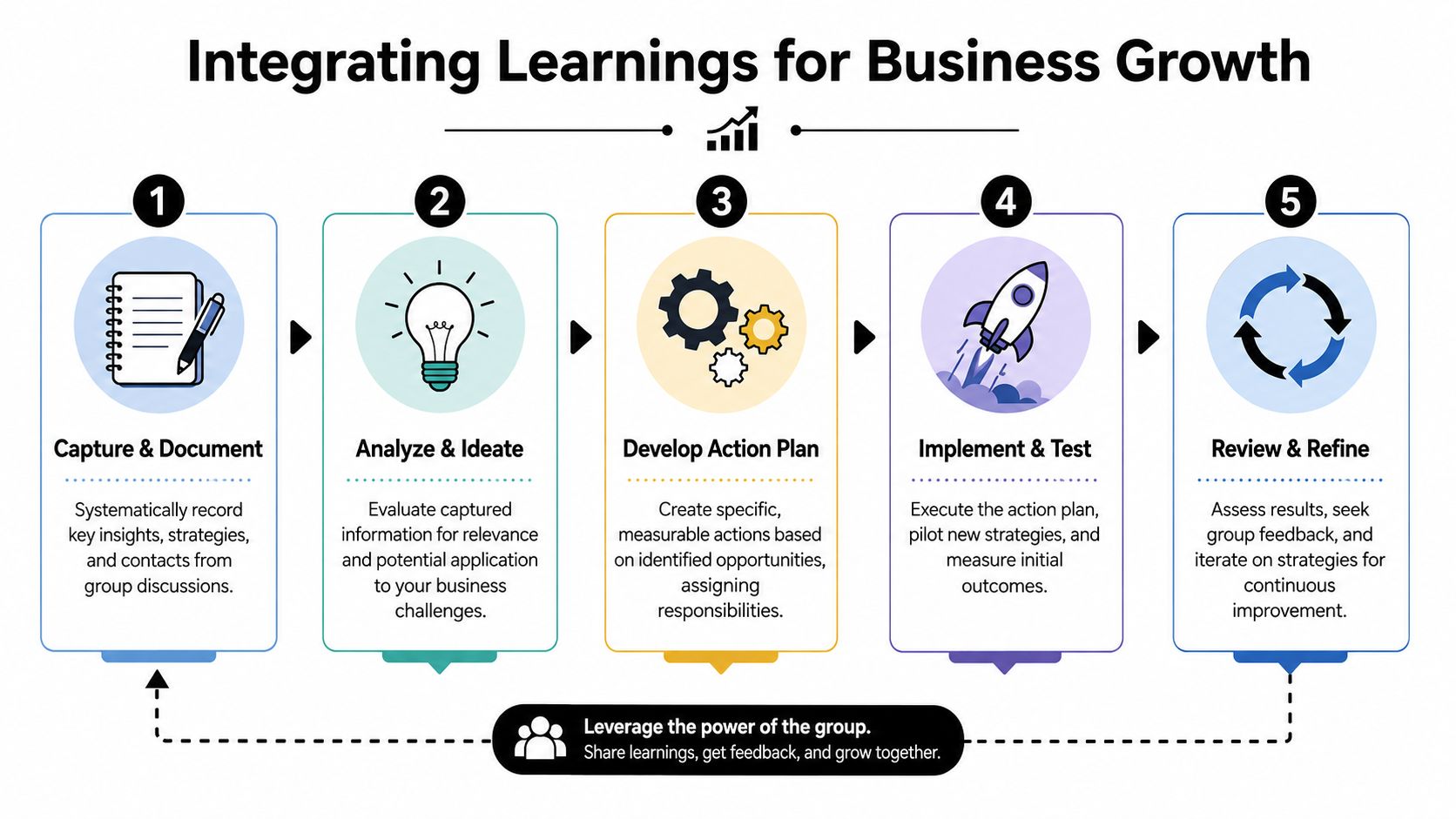
Turn network input into an operating loop
Use a simple cycle inside your team:
- Capture the insight or recommendation.
- Decide whether it affects message, offer, channel, audience, or partnerships.
- Test it in one market or segment first.
- Review results against the same primary outcome metric.
- Feed back what happened to the group if the conversation is ongoing.
If your team needs broader thinking on content and channel trends, a creator-focused resource like this digital marketing guide for creators can help frame experiments. Just keep your commercial measurement disciplined when you bring those ideas into a UAE or GCC rollout.
The founder habit that compounds
The strongest founders don't just collect advice. They create a repeatable rhythm between conversation and execution.
That can be as simple as asking your team every week:
- What did we learn from the market this week?
- What did we hear from peers or partners that changes our assumptions?
- What are we testing next, and how will we measure it consistently?
That's when an international marketing group in Dubai stops being a vague networking concept and starts becoming part of your growth system.
If you want a more structured way to build that support system, Founder Connects is designed for UAE and MENA founders who want curated peer groups, practical conversations, and accountable follow-through rather than surface-level networking.

Building in MENA? You don't have to do it alone.
Join 300+ founders in the Founder Connects Residency. Monthly squad calls, warm intros, $3M+ in perks, and much more. All for less than your monthly coffee budget.
Popular posts





Founder Connects is a premium MENA tech founder community. Meetups in Dubai and across MENA, Residency Squads of 8–10, and 400+ vetted WhatsApp founders (apply and screened).