

Mastermind Groups for Startup Founders UAE

Building in MENA? You don't have to do it alone.
Join 300+ founders in the Founder Connects Residency. Monthly squad calls, warm intros, $3M+ in perks, and much more. All for less than your monthly coffee budget.

You can feel the gap already. You've done the coffee chats, the demo nights, the WhatsApp groups, maybe even the accelerator panels, and you're still making the big calls alone, late at night, with a tab open for free-zone admin, another for investor replies, and another for product decisions you wish someone would just sanity-check. In the UAE, that's a common trap because the ecosystem is busy, but busy doesn't mean useful. The founders who move faster usually stop trying to collect more contacts and start choosing smaller, stricter rooms where other operators will help them solve a problem.
That's why mastermind groups for startup founders UAE is no longer a fluffy networking topic. It's a decision-stage tool, especially if you're past idea mode and tired of rooms full of people who want to pitch, post, or perform. The right group gives you honest feedback, accountability, and tactical introductions. The wrong group just burns your evenings.
Why UAE Founders Are Turning to Mastermind Groups
A lot of UAE founders are running too many parts of the business at once. One hour it's a free-zone document. The next it's an investor follow-up. Then it's hiring, pricing, or a customer issue that can't wait until tomorrow. When you're carrying all that, open networking starts to feel expensive in the wrong way, it eats time and gives back very little.
The local ecosystem is active, but it's crowded with overlapping communities, event formats, and pitch-heavy rooms. Dubai SME reported that in 2024 it facilitated the launch of 3,461 new Emirati businesses, 524 more than in 2023, and it has supported 19,904 SMEs since 2002. It also provided advisory services to 3,075 entrepreneurs in 2024, bringing total advisory beneficiaries to 53,206 since 2002. That depth matters because it means there's a real pool of founders who need sharper peer support, not just more events. Dubai SME's 2024 milestone update
The real shift
Founders don't need more noise. They need a smaller circle that can pressure-test decisions, compare notes on what worked, and keep them moving.
Practical rule: if a community doesn't help you make a decision, introduce you to someone relevant, or keep you accountable, it's probably entertainment disguised as support.
Founder Connects' community materials show what this can look like when it's done properly. Its model has supported 261 UAE founders, facilitated 98 collaborations, helped members collectively raise AED 189 million, and saved AED 3.89 million in costs. That doesn't mean every mastermind will deliver those kinds of outcomes, but it does show the ecosystem can produce measurable value when the format is curated and disciplined. Founder Connects' UAE community guide
The short version is simple. If you're choosing between a larger community and a small mastermind, choose the smaller room when you need traction, clarity, and honest operator feedback. The rest of this is about how to tell the difference.
What a Founder Mastermind Group Actually Is in the UAE
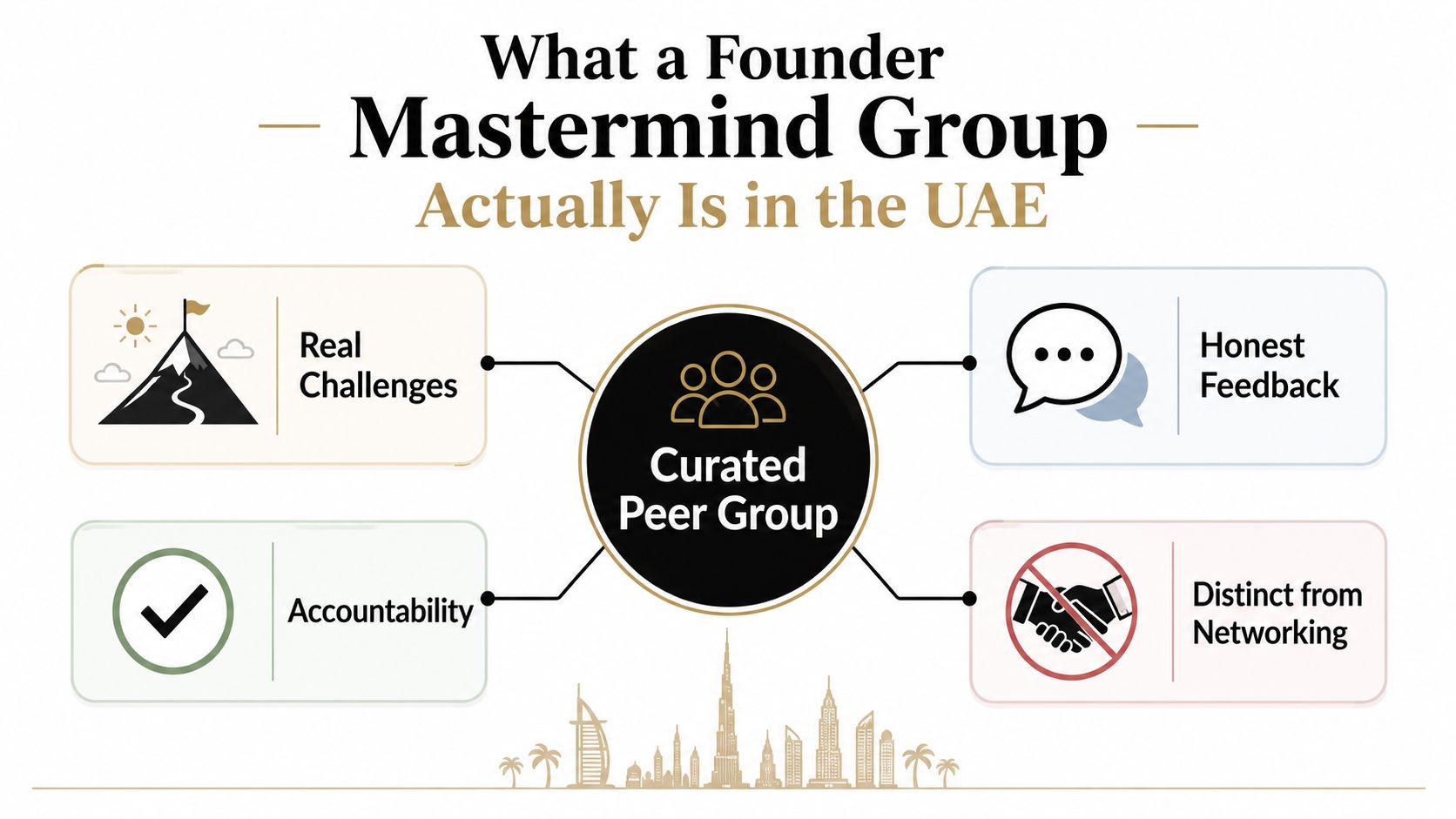
A founder mastermind in the UAE is a curated peer group. It is not a chat group, not a public event, and not a place to dump updates into a void. The founders meet regularly, bring live business problems, and challenge each other with direct feedback. The value comes from repetition, trust, and specificity, not from cramming more people into the room.
That is the point most UAE founders miss when they compare formats. Open online communities are broad and inexpensive, but the signal is weak because members sit at very different stages and show up with different motives. Accelerator cohorts can be strong, but they run on a programme timeline and then end. Chambers and business clubs help with access, but they often reward attendance more than depth.
What the local model looks like
Founder Connects' own Founder Squads are a clear example. They are described as 4 to 6 non-competing founders meeting monthly for moderated 90-minute sessions. That moderation matters. Without it, a mastermind turns into a loose discussion circle where the loudest voice dominates and the quietest founder leaves with nothing useful.
A practical guide to virtual mastermind best practices for UAE startups points to the same direction. A UAE business-community guide says mastermind groups in Dubai usually work best at 5 to 12 members meeting bi-weekly or monthly, while Founder Connects guidance recommends 4 to 8 members and UAE-friendly windows such as 9:00 AM to 12:00 PM or 4:00 PM to 6:00 PM on the Sunday to Thursday workweek. The lesson is simple, keep it small, keep it scheduled, and keep it tied to the working week. UAE business-community guide on masterminds in Dubai
A mastermind should feel like a working meeting with peers, not a networking room with better branding.
The fit is straightforward. This format is for founders who want direct feedback, accountability, and relevant introductions. It is not for anyone chasing passive inspiration, broad audience reach, or a room where small talk can hide a weak plan. If you want a place that helps you make a real decision, a curated mastermind makes sense. If you just want to be around founders, it probably does not.
Group Size, Cadence, and Session Structure That Work
The technical variables matter more than the branding. If the group is too big, airtime collapses. If the cadence is too loose, accountability disappears. If the agenda is vague, you've basically paid with time to attend a fancy catch-up.
The size that keeps the room useful
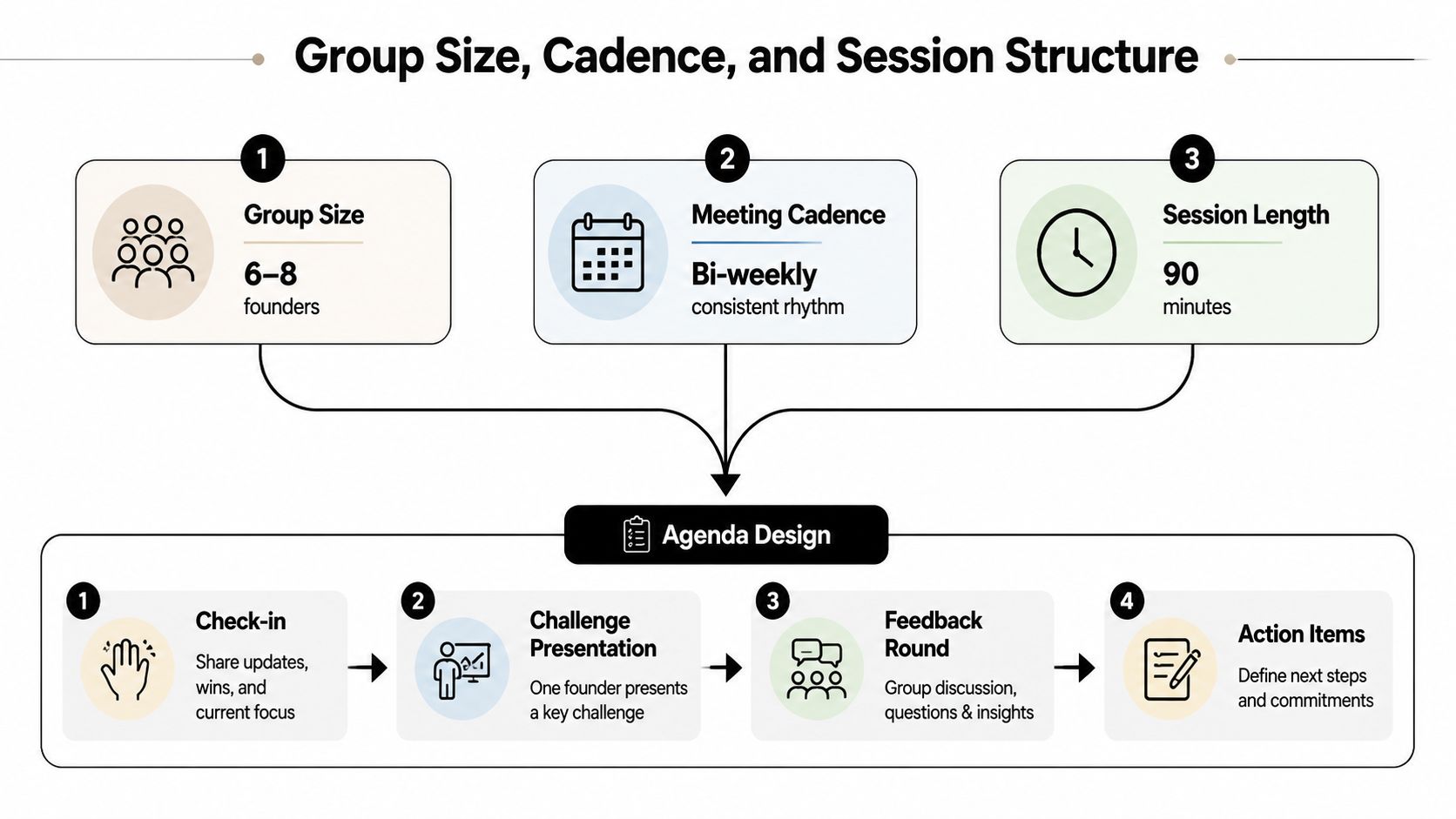
There are two useful UAE benchmarks. One Dubai-focused guide says mastermind groups typically work best at 5 to 12 members meeting bi-weekly or monthly. Founder Connects narrows that to 4 to 8 members, with 5 to 7 as the practical default for startup founders. That tighter range is the one I'd use. It gives enough diversity to surface useful ideas, but not so many voices that the discussion turns into a queue.
For founders in the UAE, 90 minutes once a month is the cleanest default. It respects the Sunday to Thursday workweek, it's easier to protect on the calendar, and it's long enough to get past the superficial update layer. If you can't protect a 90-minute block once a month, you're not ready for a serious mastermind anyway.
The easiest UAE-friendly windows are 9:00 AM to 12:00 PM or 4:00 PM to 6:00 PM. Those times fit founder schedules better than random lunch breaks or late-night calls that everyone resents.
The agenda that stops meetings from drifting
A disciplined session doesn't need creativity, it needs repeatability.
- 10-minute check-in. Everyone says what's changed since the last meeting.
- Around 5 minutes per member. Each founder shares one progress update and one blocker.
- Guided problem-solving segment. The group spends the remaining time on one or two hot-seat issues.
- Clear action items. Every founder leaves with one next step, not a vague sense of being heard.
The point is to create a loop. The same founder comes back next month, reports what happened, and gets pushed again. That's what makes the format compound over time.
For a sharper operating guide, this Founder Connects virtual mastermind best-practices post is worth reading before you join or build a group.
Practical rule: ask for a six-month commitment up front. Masterminds compound slowly, and the first couple of meetings are usually just trust-building.
That's the default. Small group, fixed cadence, clear agenda, enough time to let continuity do its work.
How to Choose a Mastermind Worth Your Time
Don't join a mastermind because it sounds founder-ish. Join it if it clears a practical test before you give it half a year of evenings. The right question isn't “Is this a good community?” It's “Will this group help me make better decisions faster?”
The five filters that actually matter
Use these five criteria before you say yes.
- Curation process. Ask how members are selected and whether the group is matched by stage, sector, or operator experience.
- Non-compete rules. If members are direct competitors, the room gets cautious fast.
- Facilitation quality. Someone needs to manage airtime, keep the group honest, and stop drift.
- Accountability mechanisms. There should be a visible follow-up loop, not just a nice conversation.
- Proof of outcomes. Ask what the last group produced, introductions, collaborations, hires, or closed loops on real problems.
Comparing common founder formats in the UAE
| Format | Typical Size | Time Commitment | What You Get | Best For |
|---|---|---|---|---|
| Open communities | Large and mixed | Flexible, but scattered | Broad access, events, general visibility | Early exploration and casual networking |
| Paid operator networks or chambers | Medium to large | Ongoing membership and attendance | Credibility, access, introductions, institutional touchpoints | Founders who need market access and business relationships |
| Curated moderated masterminds | Small and focused | Regular recurring sessions | Honest feedback, accountability, relevant introductions | Founders who need decisions, not noise |
Most UAE coverage tells you what exists, but not what it produces. It rarely translates community activity into founder outcomes. So ask direct questions in a trial session. How are people matched? How often do members meet? What happened in the last cohort that mattered?
If a group can't answer those questions plainly, keep moving.
Getting Real Value Inside the Room
Once you're in, your job changes. Don't show up to be impressed. Show up ready to be useful, direct, and easy to challenge. The groups that work are the ones where members know their roles and stick to them.
Roles that stop the room from going soft
A strong session usually has four moving parts. The host keeps the clock honest. The note-taker captures action items. The member in the hot seat brings one specific decision or blocker. The facilitator keeps the room on task and makes sure nobody dominates.
That structure sounds basic because it is. But basic structure is what keeps the conversation from turning into a founder therapy circle.
Confidentiality is not a nice-to-have. It is the reason founders will talk openly about runway, bad hires, pricing mistakes, and investor pushback. Nothing leaves the room unless the presenting founder agrees. That boundary is what makes the feedback real instead of performative.
How to prepare for your hot seat
Bring one decision, not your entire life story. If you walk in with ten problems, the group will skim the surface and you'll leave with half answers. If you bring one decision, the room can get specific.
Use this simple prep:
- State the decision. Say what you need to choose.
- List the constraints. Include cash, timing, team, or market limits.
- Ask for one clear output. Make the room help you decide the next step.
That's how a mastermind becomes operational rather than emotional. You leave with a test, a contact, a script, or a decision path.
The role of the moderator matters here, because founders are excellent at wandering into theory. The moderator keeps the group on the problem, not on ego. If you want a useful benchmark for what members build through this format, this Founder Connects piece on the skills founders develop in mastermind groups is relevant.

If you're not prepared to be challenged, you'll waste everyone's time. If you are, the room becomes a shortcut.
Matching the Right Group to Your Founder Stage
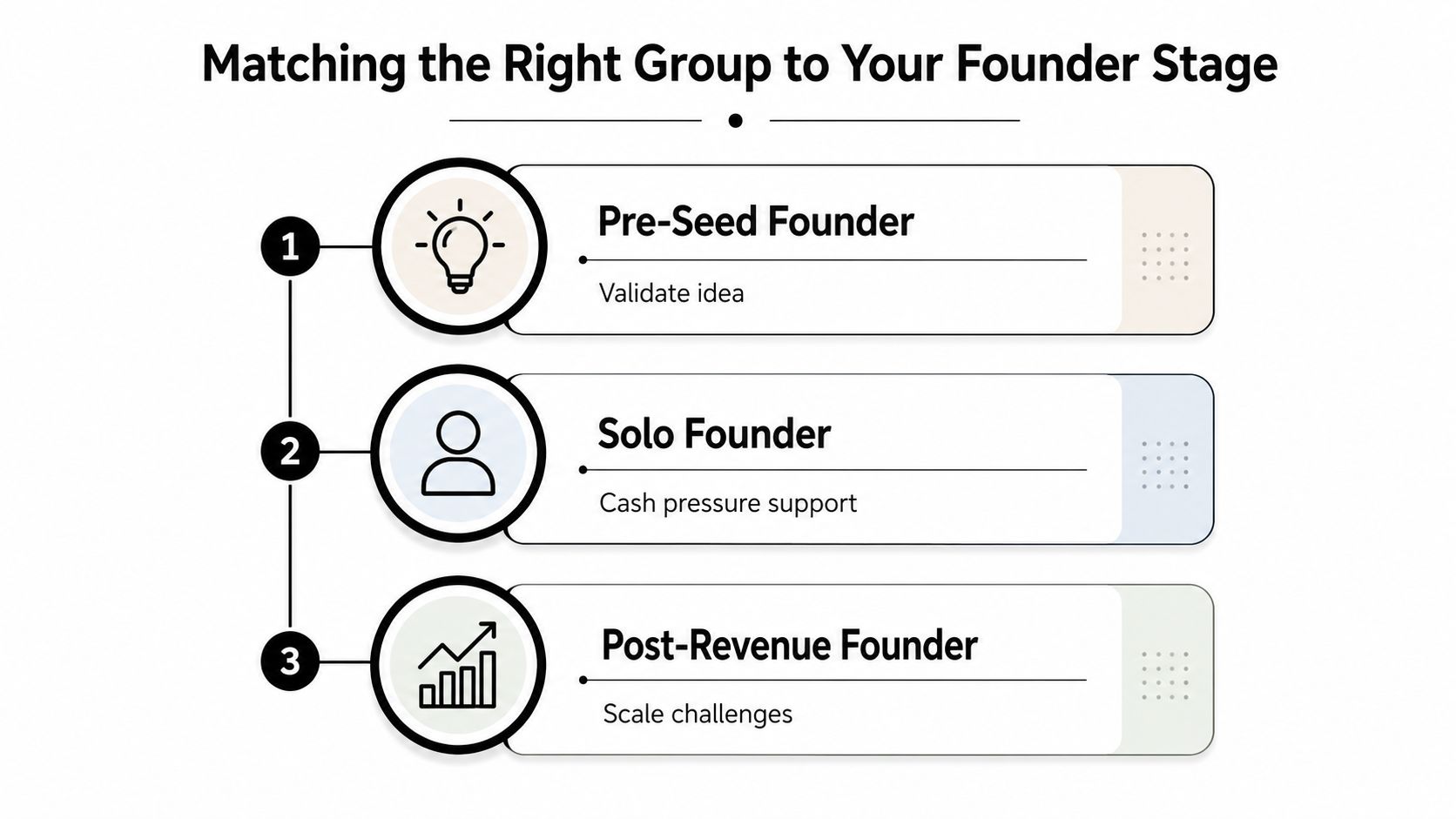
The biggest mistake in UAE founder coverage is pretending every mastermind fits every founder. That's lazy advice. A pre-seed founder, a cash-strapped solo founder, and a scaling founder do not need the same room, because they're solving different problems.
What each stage actually needs
A pre-seed founder needs people who can help validate the idea without turning every discussion into abstract strategy. At least one operator who has shipped before is useful here, because they can spot what's real and what's just founder optimism.
A solo founder needs peers who understand isolation, trade-offs, and the fact that every hire or subscription hurts when cash is tight. The best group for them is one where members are comfortable talking about constrained choices without posturing.
A post-revenue founder needs sharper help on hiring, partnerships, and investor conversations. They're no longer asking, “Is this idea good?” They're asking, “How do I scale without breaking the business?”
Sector and identity fit matter too
In the UAE, sector-specific operator experience is valuable. A founder building in fintech, logistics, or deep tech will usually get better feedback from peers who understand those dynamics than from a generic room of lifestyle founders. Women founders also benefit from moderated, high-trust circles where the room isn't dominated by status games.
A useful rule of thumb is blunt. Join a mastermind when you have a specific decision you're stuck on, not when you're using it as a vague antidote to loneliness. Loneliness is real, but it's a bad selection criterion. Decision pressure is the better one.
For a broader view of why peer groups help founders beyond the obvious networking layer, Founder Connects' peer-group article is a useful companion piece.
A Mastermind Moment From the Founder Connects Community
A B2B SaaS founder in Dubai walked into a session stuck on a hiring decision. He'd delayed bringing in a senior operator because he was worried about burn, and that hesitation was slowing everything else down. The group didn't clap politely and move on, they pushed hard on what was blocking growth.
A marketplace founder in Abu Dhabi identified the core issue first. The founder wasn't short on options, he was avoiding a decision because it felt expensive and irreversible. The moderator kept the room focused, and within minutes the group reframed the problem from “Should I hire?” to “What role will remove the most friction in the next 90 days?”
That shift mattered. One member connected him to a fractional operator from another cohort, and within a week he had a concrete next step instead of another round of self-doubt. That's the kind of outcome generic networking almost never produces, because it depends on trust, context, and the group already knowing how to work together.
Small cohorts are useful because they make that kind of moment possible. The structure gives the founder enough honesty to hear the actual problem and enough continuity to act on it.
Your Next Step With Founder Connects
Use three filters before you join anything. You want a curated, non-competing cohort of roughly 5 to 7 founders, monthly 90-minute sessions with real facilitation, and proof of outcomes such as introductions, collaborations, or clear follow-through. That's the standard, not a bonus.
Founder Connects' Founder Squads map cleanly to that model. They're moderated virtual squads, they meet monthly for 90 minutes, and the community also supports intentional one-to-one introductions between sessions. That makes it a legitimate option if you want structure rather than another open-ended networking feed.
If you're evaluating a group now, ask for one trial session and bring one live decision. Don't join because the member list looks impressive. Join because the room will change how you operate this quarter.
If you want a curated founder environment built around real accountability, relevant introductions, and practical peer support, visit Founder Connects and see whether the current Founder Squads fit the decision you're making now. If you show up consistently, the right mastermind can save you time, sharpen your judgement, and give you a room that acts like a working extension of your startup.

Building in MENA? You don't have to do it alone.
Join 300+ founders in the Founder Connects Residency. Monthly squad calls, warm intros, $3M+ in perks, and much more. All for less than your monthly coffee budget.
Popular posts





The premier community for tech founders, investors, and builders. Connect, collaborate, and grow together.