

Negotiation Tactics for Founders Raising Capital

Building in MENA? You don't have to do it alone.
Join 300+ founders in the Founder Connects Residency. Monthly squad calls, warm intros, $3M+ in perks, and much more. All for less than your monthly coffee budget.

Most founders walk into a fundraising conversation trying to win the highest valuation. That's the wrong fight. In UAE and wider MENA deals, valuation only matters in context, because the outcome is shaped by dilution, control, and process, not by one flattering number on a term sheet. If you care about what you keep, you have to negotiate like the company survives a down round, a tough board vote, and a future investor who is far less generous than the first one.
The better question is simple, and it's the one I'd want every founder to ask in the room: what does this deal look like when things get ugly, and how much of my company do I still control? Founder-focused fundraising guidance commonly targets selling 15% to 25% of the company in a seed round, which is a reminder that the math of ownership matters as much as the headline price, and that process affects your influence as much as pitch quality does how to negotiate your valuation with investors.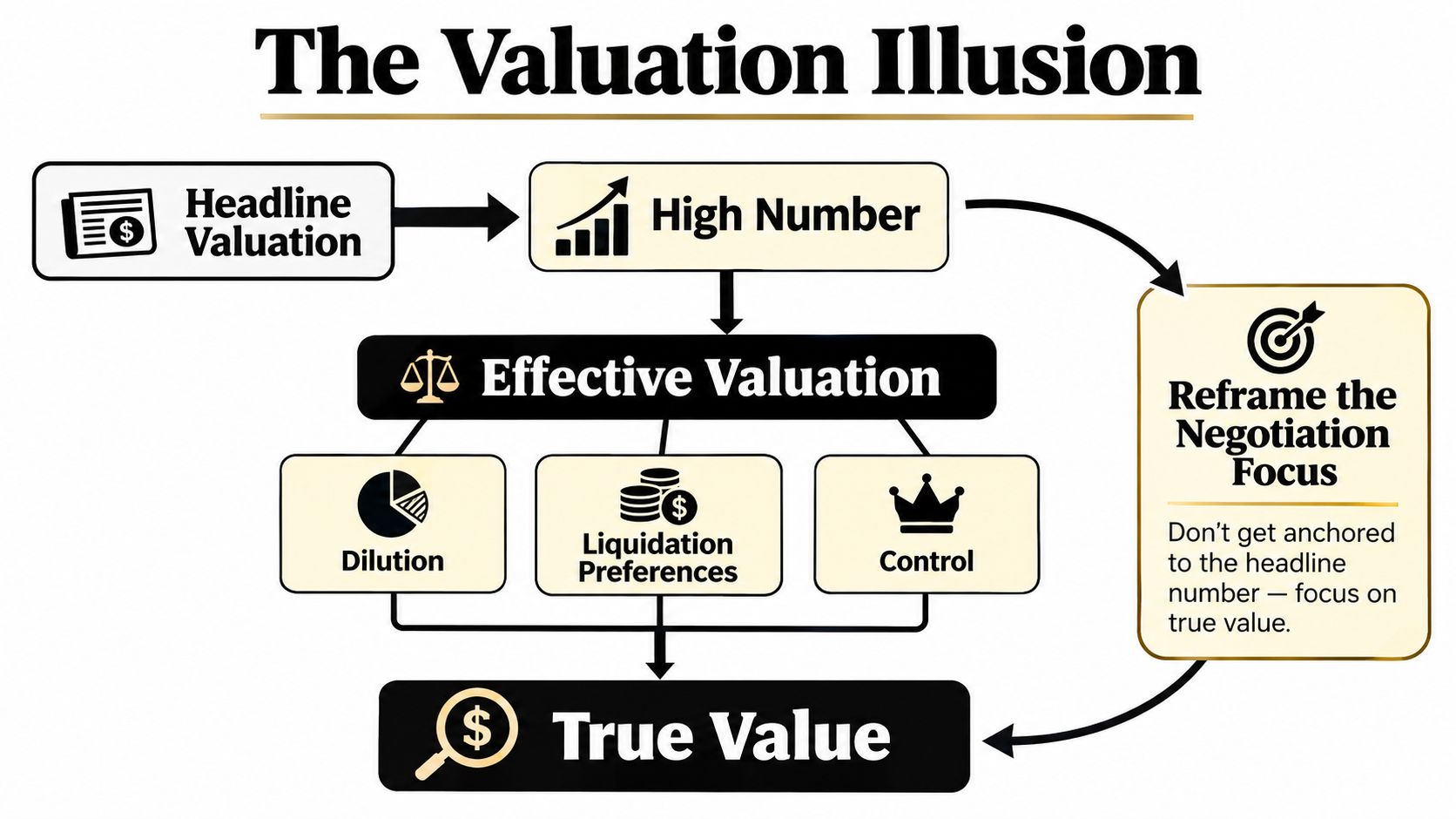
The founders who do this well don't chase one “best” offer in isolation. They run a process that keeps multiple investors warm, so valuation becomes one lever among several, not the only thing they can talk about.
Why the Headline Valuation Is the Wrong Fight
A high valuation can still be a bad deal. I have seen founders celebrate the biggest number in the room, then learn later that they gave up control, accepted heavy downside protection, or signed a structure that makes the next round harder. The headline number flatters your ego. The term sheet decides your future.
Think in ownership, not applause
The practical lens is dilution. If you sell too much too early, you may win on valuation and still lose strategic flexibility, especially when future rounds get tighter. The founder-friendly seed guidance that targets 15% to 25% dilution exists for a reason, it leaves room to raise again without handing the company over on the first cheque.
Practical rule: if you cannot explain how much of the company you still own after this round, you are not ready to negotiate valuation.
The right framing is dilution and process. If you create competitive tension, keep investors active, and avoid anchoring too early, you defend price without begging for it. That matters in UAE and MENA markets, where investor fit and stage can vary widely, and where a weak first offer can set a lazy anchor for the rest of the raise.
Ask the down-round question early
A founder who only asks, “What's your valuation?” is negotiating like a first-timer. Ask, “If this company has a rough year, what happens to ownership, board control, and liquidation rights?” That question forces the investor to show their real view of risk, not just their marketing language.
For a useful background benchmark on company valuation, this Founder Connects explainer on startup company valuation is a sensible companion read, especially if you want to sanity-check the assumptions before you get into a live process.
The founder move here is blunt. Stop negotiating with emotion. Start negotiating with ownership math, control rights, and a clear view of what the deal does under stress.
Preparation, BATNA, and the 3-Year Model
Negotiation starts before the first investor call. If you show up unprepared, you're not negotiating. You're reacting. The founders who get better outcomes in MENA build their position early, because they know their BATNA before they hear someone else's price.
Build the dossier before you speak
I'd prep three things for every serious investor:
- A counterparty dossier. Know what they usually back, how fast they move, what stage they like, and who on their team makes decisions. Don't waste time pitching a fund that doesn't fit your round.
- A written BATNA. If this deal disappears tomorrow, what happens? Can you bridge? Can you wait? Can you raise from another source? If the answer is fuzzy, your position is weak.
- A defensible 3-year model. Not a fantasy spreadsheet. A model you can defend with comparable transactions and recent market data, because vague ranges don't hold up when an investor starts challenging assumptions 10 ways to negotiate better as an entrepreneur.
That model matters because it gives you a language for valuation that isn't emotional. You can point to traction, milestones, and runway instead of saying, “We feel this company is worth more.”
Decide what you trade before the meeting
The cleanest founders decide in advance which non-price terms they can move on and which they can't. Faster closing is a real concession. So are governance terms, milestone structure, and some information rights. What you should not do is give away economics because you ran out of patience.
If you haven't written down your walk-away point, the investor will write it for you.
I'd also use a simple pre-meeting checklist:
- Know your red lines on control, dilution, and board rights.
- Bring market comparables so the conversation stays grounded.
- Set your ideal, acceptable, and unacceptable outcomes before the call.
- Prepare one clean answer for “What's your valuation?” that pivots back to traction and milestones.
If you want investor-ready numbers and structure to support that work, this Founder Connects guide to startup fundraising financials in the UAE is the sort of practical reference I'd keep close before opening a process.
The point is simple. You don't walk into a raise hoping to discover your advantage. You build it first.
Running a Parallel, Time-Boxed Process
Serial fundraising weakens your hand. You meet one investor, wait, follow up, explain the round again, then repeat the same cycle with the next firm. By the time the third or fourth conversation happens, the first one has cooled off. That is not a process. It hands control to the investor.
Make interest overlap on purpose
The better structure is a parallel, time-boxed auction. I would run it by speaking to roughly 20 to 30 investors at the same time over 6 to 8 weeks, then compress partner meetings into the same 2-week window so the process looks live and moving negotiating. The first term sheet then becomes fuel for better terms, not a trophy you admire on its own.
If you want a cleaner way to create that pressure, use a deliberate multi-fund process like pitching multiple VCs to create competition. One live process changes the tone of every other conversation.
That timing matters because investors behave differently when they know other firms are active. They move faster. They trim lazy clauses. They stop pretending the first offer is the only serious offer.
Use urgency without lying
You do not need to fake scarcity. You need to control the calendar. If a fund asks for exclusivity before it has given a real offer, push back calmly and keep the process moving. The language I would use is:
- “We're speaking with several aligned investors at the same time, and we want the decision to be based on terms and fit.”
- “We're happy to move quickly once there's a concrete offer, but we're not going exclusive before that.”
- “If you're serious, we'd like to keep this on the current timeline so we can compare like for like.”
Those lines preserve influence without sounding combative. They also fit the relationship-led nature of Gulf fundraising, where tone matters, but softness should not become weakness.
Treat the first term sheet like fuel
Once one investor sends a term sheet, keep moving. Tell the rest of the process that live interest exists, and keep the other meetings warm. The point is not to bluff. The point is to make sure the market sees that this round is real, active, and still open.
If you go silent for a week, your influence drops. The founder who controls the pace usually controls the process.
The Five Terms That Quietly Decide Your Control
Most founders get burned by the wrong fight. They spend hours arguing over valuation, then sign away control through terms they barely discussed. In tighter MENA markets, that mistake gets expensive fast, because investors often ask for stronger downside protection when capital is selective.
The terms that matter most
| Term | Founder-Friendly Position | Common Investor Ask |
|---|---|---|
| Liquidation preference | 1x non-participating | Participating preference or stacked downside protection |
| Anti-dilution | Broad-based weighted average | Full ratchet protection |
| Board composition | Founder seat plus neutral seat, no investor majority | More investor seats or board control |
| Option pool expansion | Keep it tight and preferably post-money | Expand the pool before investment |
| Founder vesting | Fresh tranche for new commitments | Restarting the vesting clock without new grant |
Liquidation preference is the first place I'd hold the line. A standard 1x non-participating structure is defensible, and anything more aggressive changes the economics of a future exit in ways that are easy to underestimate Startup Essentials. If an investor pushes for participating preferred, they're telling you they want stronger downside protection than a standard venture deal.
Anti-dilution is the second fight. Broad-based weighted average is the line I'd defend. Full ratchet is punitive, and in a down round it can wreck founder economics much faster than people realise term sheets for founders.
Don't give away the board
Board composition decides who can steer the company. If an investor wants board majority too early, I'd push back hard. You need a board that can govern without taking the company away from the people building it.
Option pool expansion is the stealth dilution most founders miss. It looks technical, but it isn't. If the pool expands before the round, the dilution usually lands on you. That's why you need to see the cap table math, not just the legal language.
Founder vesting is the last place to be careful. If a new vesting clock appears, it should come with a fresh tranche of equity, not a quiet reset of your old rights.
The mindset I'd use is simple. Ask, “Which structure gives me the most control over the trade-offs?” That question keeps you focused on the terms that decide ownership, governance, and the cost of a bad exit.
Choosing Between SAFEs, Convertible Notes, and Priced Equity
Instrument choice is part of the negotiation. Founders act like the structure is neutral, but it isn't. The document you choose changes how much you negotiate, how fast the round closes, and how much control you give up along the way.
Match the instrument to the cheque
SAFEs are fast, simple, and usually the friendliest to founder control, but they give you less certainty on final ownership until conversion. I'd use them for very early cheques from angels you already trust, especially when speed matters more than drafting a heavy document.
Convertible notes are useful when an investor wants a debt-like return profile. They often carry interest and a maturity date, which means they're more structured than a SAFE and can suit situations where speed matters but the investor wants a little more protection.
Priced equity gives you the most negotiation surface. It's slower, more formal, and better for a meaningful institutional round where board rights, liquidation preference, and dilution all need to be set carefully.
Use a simple decision rule
If the cheque is small, the relationship is strong, and the terms need to stay light, I'd lean SAFE. If the investor wants debt optics or timing flexibility, I'd look at a convertible note. If you're raising a real institutional round, I'd push for priced equity because that's where you want the full term sheet and the full negotiation.
The right question isn't “Which instrument is easiest?” It's “Which structure gives me the most control over the real trade-offs?”
If an investor asks for a structure you don't understand, don't bluff. Ask why they want it, what problem it solves for them, and what it does to your future dilution and governance. That's not amateur behaviour. That's disciplined fundraising.
Keep the MENA context in view
In the UAE and wider region, relationship quality often determines whether a simpler instrument really stays simple. A friendly early SAFE with someone you trust can be clean. A rushed note from a vague counterparty can become a headache later, especially if the rest of the round slows down.
So choose the instrument with the same discipline you'd use for the investor. Structure is not paperwork. It's part of the bargain.
Investor Psychology and the UAE MENA Negotiation Room
A generic Silicon Valley script falls flat in the Gulf. In the UAE and broader MENA market, investors often care about trust, repeat access, and how you handle pressure as much as they care about your pitch deck. If you ignore that, you'll sound polished and still lose momentum.
What the room actually feels like
A regional lead investor often opens with something like, “We like the business, but we move carefully,” and founders hear it as delay. I read it differently. It usually means the investor is testing whether you panic, over-explain, or give away too much just to keep the conversation alive.
The best response is calm and specific. You do not need to rush. You need to keep the relationship warm while protecting your position.
- When they ask for exclusivity early: “We'd rather keep the process open until we have a concrete offer and can compare terms fairly.”
- When they say they move slowly: “That works for us as long as we keep the timeline clear and the next step concrete.”
- When a senior partner pushes hard on price: “We can discuss valuation, but we'd like to make sure the downside terms and governance match the stage of the company.”
- When the conversation turns to structure: “Which structure gives me the most control over the trade-offs?”
Those answers keep the tone respectful and the bargaining power intact. They also signal that you understand the core negotiation is not just about price.
Use relationship capital without giving away control
Warm introductions matter in this market, but warmth is not the same as weakness. A founder can stay relational, answer promptly, and still hold the line on structure. That is the balance I'd aim for every time.
If you are screening local investors and want a structured starting point, discover UAE fintech investors with Gritt is a useful way to shortlist relevant names before the conversations get serious.
The main mistake I see is founders trying to be so agreeable that they negotiate against themselves. Do not do that. Be patient, be direct, and keep the process moving even when the room wants you to slow down.
Red Flags, Walking Away, and Closing the Deal
A strong negotiation includes a clean exit. If the terms are bad enough, walking away is the right move, and founders should treat it that way. The people who stay in bad deals usually do not lose in one dramatic moment. They lose by accepting one concession after another until the company no longer feels like theirs.
Know the lines you don't cross
I would walk if I saw any of these without a very good reason:
- Full-ratchet anti-dilution. That is too harsh for most founder-friendly venture deals.
- Board removal without cause. If an investor can remove you too easily, control is already slipping.
- Option pool expansion above 15%. That level of dilution needs a strong explanation.
- Aggressive liquidation preferences stacked on participating preferred. That is not a normal founder outcome.
A founder should be able to say, plainly, “We are not comfortable with that structure, and we would rather keep the process moving than sign something that creates the wrong incentives.” That sentence is better than panic, and it is better than a fake yes.
The point is to spot the early warning signs before the paper gets dressed up to look harmless. The checklist of red flags to watch for when buying is a useful reminder that bad terms often hide inside normal-looking language.
Close cleanly and protect the relationship
When the terms are acceptable, do not get sloppy at the finish line. Confirm the side letter, align co-investors, and tell existing investors and your team what changed and why. Then keep a 30-day follow-up rhythm after the wire clears so the relationship does not turn transactional the moment the money lands.
What the room feels like
Deals in the UAE and across MENA often fail in the quiet moments, not the obvious ones. An investor can sound friendly and still ask for control that leaves the founder with little real room to operate. That is why I care less about polished enthusiasm and more about whether the draft paper protects the founder when pressure shows up later.
You should know how the room changes when terms get serious. The tone shifts, the pace slows, and people start testing whether you understand what you are giving away. If you do, you can keep the conversation calm and direct. If you do not, you will get pushed into a structure that looks fine on the surface and weak everywhere else.
The final move is simple. Bring the term sheet into a moderated peer-group session and pressure-test it with founders who have closed their own rounds. That is where weak terms get spotted fast, and where good founders stop negotiating alone.
If you are about to raise, Founder Connects gives you a place to pressure-test your term sheet with other founders, compare notes on investor behaviour, and get practical feedback before you sign. If you want that kind of founder-to-founder support in the UAE and wider MENA ecosystem, visit Founder Connects and bring your next raise into a room that will tell you the truth.

Building in MENA? You don't have to do it alone.
Join 300+ founders in the Founder Connects Residency. Monthly squad calls, warm intros, $3M+ in perks, and much more. All for less than your monthly coffee budget.
Popular posts





Founder Connects is a premium MENA tech founder community. Meetups in Dubai and across MENA, Residency Squads of 8–10, and 400+ vetted WhatsApp founders (apply and screened).