

7 Proptech Trends Driving UAE Real Estate Growth

Building in MENA? You don't have to do it alone.
Join 300+ founders in the Founder Connects Residency. Monthly squad calls, warm intros, $3M+ in perks, and much more. All for less than your monthly coffee budget.

If I had to sum it up in one line: UAE real estate growth in 2026 is being pushed by better data, digital finance, smart leasing, smarter buildings, and faster access between founders and big property firms.
If you’re a founder, investor, broker, or developer, here’s the short version:
- AI search tools are helping buyers and renters find better-matched listings faster.
- Digital leasing is cutting paperwork across viewings, contracts, Ejari, and payments.
- Online mortgages and embedded finance are moving funding into the property journey itself.
- Pricing and valuation tools are helping firms make better calls using sales and rental data.
- Fractional ownership and tokenisation are lowering the entry point for property investors.
- Smart building systems and IoT are helping cut downtime, trim energy use, and reduce tenant issues.
- Founder networks and pilot access are helping startups get in front of decision-makers sooner.
This shift is tied to major UAE policy plans, including the Dubai 2040 Urban Masterplan and the D33 Agenda. It’s also visible in market activity. In July 2026, the Dubai PropTech Hub brought founders to Union Properties’ Motor City Sales Centre, giving startups direct access to senior property leaders. That matters because, in proptech, a small pilot can lead to SaaS revenue, platform deals, or long-term rollout.
The Dubai PropTech Reality Check | Founders, Investors, and What's Really Happening
Quick Comparison
| Trend | Who it serves | Main startup opening | Common revenue path |
|---|---|---|---|
| AI property search | Buyers, renters, brokers | Better listing discovery and lead quality | Lead fees / SaaS |
| Digital tenancy | Tenants, landlords, brokers | End-to-end rental workflow tools | Subscriptions / transaction fees |
| Digital mortgages | Buyers, lenders, platforms | Mortgage journeys inside property platforms | Loan commissions |
| Valuation and pricing data | Brokers, developers, investors | Pricing engines and market dashboards | SaaS / API fees |
| Fractional ownership | Retail investors | Lower-ticket property access platforms | Platform and management fees |
| Smart buildings and IoT | Developers, FM teams, landlords | Building monitoring and maintenance tools | SaaS / setup fees |
| Founder-led ecosystem access | Startups and investors | Pilot access and market entry support | Membership / partner fees |
My read: the clearest openings sit in leasing, pricing data, embedded finance, and building management. Why? Because these solve day-to-day problems, tie into digital policy goals, and can move from pilot to paid use without a long wait.
So if you want the plain answer, it’s this: the UAE proptech market is moving from interest to use, and the startups that solve direct workflow problems have the best shot at growth.
1. AI-Powered Property Search and Discovery
Property search in the UAE is getting more personal. Buyers and renters now expect platforms to show more relevant listings, faster. For UAE tech startups, that can mean shorter sales cycles and better leads.
That shift is pushing demand for UAE AI startups building property discovery tools. LEOS Developments, for example, has launched an AI ecosystem called LEOS Royal to link AI with sustainable living [1]. Developers are already piloting AI tools to support data-led decisions.
This lines up with the direction of D33, the Real Estate Sector Strategy 2040 and the Urban Masterplan 2040, all of which back data-led property workflows [1][2]. On the startup side, the DIFC Innovation Hub and ADGM offer specialised support and licensing routes for AI and fintech startups [3].
Put simply, UAE AI startups have a direct route into broker tools, developer platforms and lead-generation workflows. And that push for speed isn’t stopping at discovery. It’s also starting to reshape leasing and tenancy journeys.
2. Smart Leasing and Digital Tenancy Journeys
Renting a property in the UAE has long meant paperwork, office visits, and too many manual handoffs. Digital leasing is changing that. It turns a process that used to drag on for days into one connected flow, from viewings and contract signing to Ejari registration and payments.
For UAE startups, this shift opens the door to one clear need: faster onboarding with less friction for tenants.
The bigger opening is building leasing tools that bring the whole journey into one place, including:
- Viewings
- E-signatures
- Ejari
- Payments
That kind of setup saves time, cuts back-and-forth, and makes the rental journey feel far less painful for everyone involved.
PropTech Elevate gives founders direct feedback from senior real estate leaders. That shortens the distance between building a product and getting it used in the market. It matters even more when startups are dealing with rules from the start, not as an afterthought.
Founders who build compliance into leasing products from day one are in a better position to scale. After that, the next area of growth is financing.
3. Digital Mortgages and Embedded Real Estate Finance
Digital mortgages are cutting approval times, reducing paperwork, and easing friction in the UAE property market. At the same time, embedded finance brings funding options straight into the buying journey. As property transactions shift online, finance is moving into that same path.
This push is not coming from buyers alone. Leading developers are also looking for proptech and fintech tools to improve efficiency and customer experience [1]. That opens a clear path for UAE fintech startups building mortgage and embedded finance products that sit natively inside property platforms.
For these startups, licensing and compliance matter from day one. Teams that build within DIFC's framework and stay aligned with UAE real estate policy are in a better position to scale. The same transaction data can also support valuation and pricing tools.
4. Data-Driven Valuation, Pricing, and Market Intelligence Tools
As digital transactions grow, pricing accuracy becomes the next bottleneck. In the UAE, property pricing is still uneven. That makes day-to-day decisions harder than they should be, whether you're setting an asking price, reviewing stock, or sizing up an area. Data-led valuation tools aim to fix that by using transaction records, rents, and area-level data to sharpen pricing decisions.
This isn't just theory. Developers are already testing these tools. In July 2026, Union Properties PJSC hosted a group of proptech founders at its Motor City Sales Centre in Dubai, organised by the Dubai PropTech Hub - the region's first dedicated proptech innovation hub. [1][2] In plain terms, founders aren't pitching from the sidelines anymore. The Dubai PropTech Hub is putting them in front of senior real estate decision-makers who can approve pilots and move deals along.
That shift matters. D33 and the Real Estate Sector Strategy back transparent, data-led pricing, and that gives UAE startups a better shot at winning pilots with brokers and developers. Developers are moving from interest to pilots and product plans. [1]
Once the market starts asking for clearer pricing, the next step is pretty natural: investor platforms and fractional ownership.
5. Investor Platforms, Tokenisation, and Fractional Property Ownership
As pricing data gets better, the next change is simple: more people can get into the market.
Digital investor platforms and fractional ownership are bringing down the entry barrier in UAE property. Instead of buying an entire unit, investors can buy a smaller, managed share.
The table below shows how these two models differ [1].
| Feature | Fractional Ownership Platforms | Traditional Investment |
|---|---|---|
| Entry cost | Low (e.g., a fraction of property value) | High (100% of property value + fees) |
| Management | Professionally managed by the platform | Owner-managed or third-party agency |
| Liquidity | Secondary resale marketplaces often provided | Traditional secondary market |
Tokenisation pushes this one step further. In the UAE, the Dubai PropTech Hub gives startups a regulated path to build tokenisation products [1][2].
In short, the same digital rails that open up investment access are also changing how assets are run.
sbb-itb-f597d8f
6. Smart Buildings, IoT, and Intelligent Property Management
Once assets are acquired, the focus moves to day-to-day operations. This is where smart building tech starts to matter. It takes a lot of the friction out of running a property.
IoT sensors, AI systems, and property management platforms are changing how UAE developers and facility managers handle daily work. Instead of waiting for something to fail and then fixing it, teams can spot issues early and act before they turn into bigger problems. That shift toward predictive maintenance and data-led operations helps lower costs, reduce breakdowns, and keep tenants happier for longer. Developers are already using these tools to cut downtime, reduce energy waste, and improve tenant satisfaction.
A clear example came in November 2025, when LEOS Developments launched its LEOS Royal AI ecosystem to optimise building performance and sustainability from the start [1].
For UAE startups, the opening is pretty clear. Build tools that reduce energy use, ease maintenance pressure, and cut tenant complaints. Those products are often easier to sell because many developers and facility managers are already heading this way.
The next growth layer is how founders turn these operational gains into market adoption at a larger scale.
7. Founder Connects and Community-Led Proptech Growth
Once your data is in better shape and your ops stop leaking time, the next lever is distribution. For UAE proptech founders, growth often comes down to one thing: getting in front of the right people. That means pilots, buyers, and investors.
This is where community-led networks start to matter in a very practical way. Founder Connects helps close that gap through group-matched masterminds, warm introductions, and investor access. In plain terms, it’s not just a networking layer. It’s a route to market.
Direct founder-to-enterprise access still matters a lot because pilots often decide whether a proptech product makes it into the market. That loop gives founders a clear read on what teams need day to day, not what sounds good in a pitch deck.
For UAE startups, small pilots can lead to faster proof, stronger references, and better investor signals. The smart move is usually simple:
- Start with one pilot
- Focus on one use case
- Keep the review cycle short
Then use community connections to find out if a brokerage partner can pull your product into a daily workflow. For UAE founders, this is the point where community helps turn product readiness into market traction.
Trend Snapshot Table
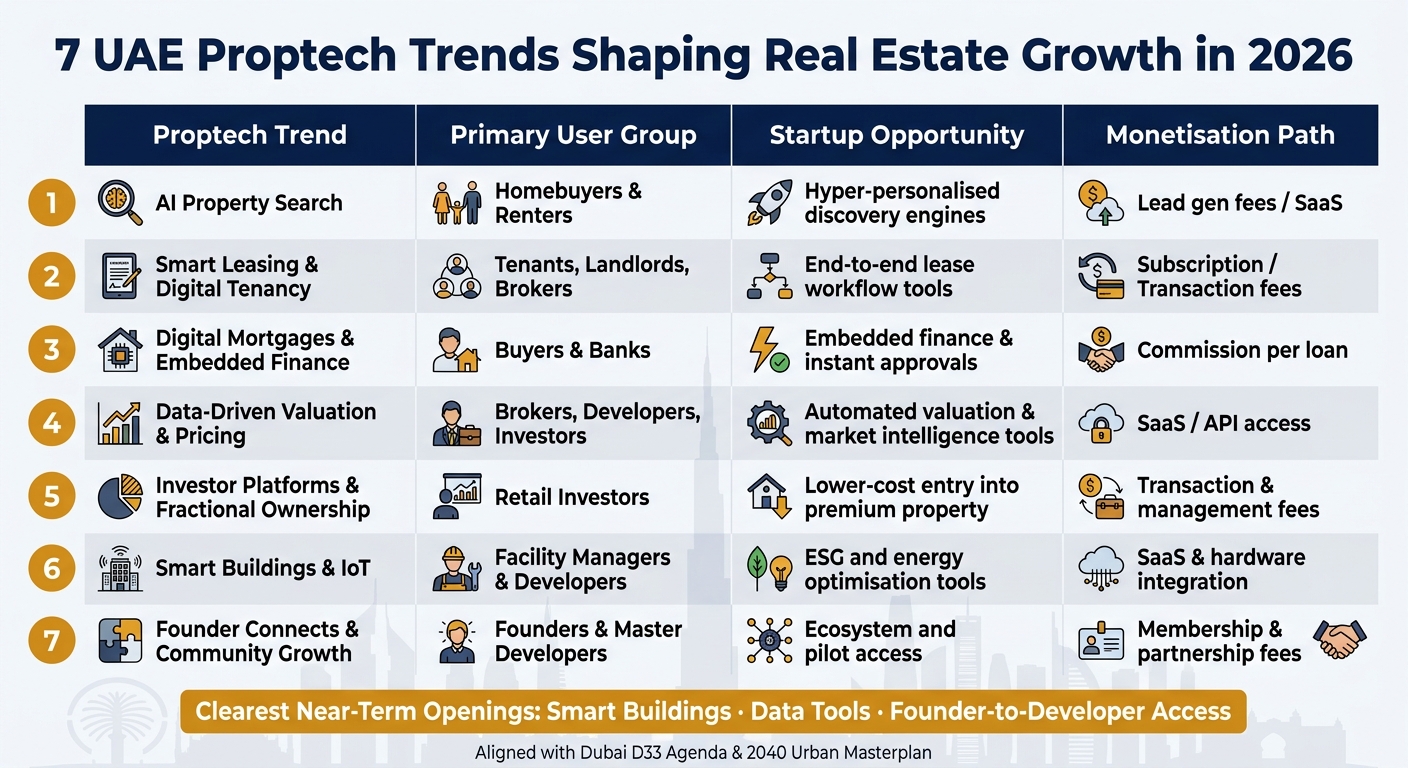
7 UAE Proptech Trends: Opportunities, Users & Revenue Paths (2026)
Here’s a quick look at the seven trends shaping proptech in the UAE.
| Proptech Trend | Primary User Group | Startup Opportunity | Monetisation Path | Key UAE Adoption Driver |
|---|---|---|---|---|
| 1. AI Property Search | Homebuyers and renters | Hyper-personalised discovery engines | Lead gen fees / SaaS | D33's digital-growth push |
| 2. Smart Leasing and Digital Tenancy Journeys | Tenants, landlords, brokers | End-to-end lease workflow tools | Subscription / transaction fees | Ejari-linked digitisation and faster rentals |
| 3. Digital Mortgages and Embedded Real Estate Finance | Buyers and banks | Embedded finance and instant approvals | Commission per loan | Real Estate Sector Strategy, 2040 Urban Masterplan, and D33 Agenda [1][2] |
| 4. Data-Driven Valuation, Pricing, and Market Intelligence Tools | Brokers, developers, investors | Automated valuation and market intelligence tools | SaaS / API access | Need for sharper pricing and market visibility |
| 5. Investor Platforms, Tokenisation, and Fractional Property Ownership | Retail investors | Lower-cost entry into premium property | Transaction and management fees | Demand for lower-entry investment access in Dubai and Abu Dhabi |
| 6. Smart Buildings, IoT, and Intelligent Property Management | Facility managers and developers | ESG and energy optimisation tools | SaaS and hardware integration | 2040 Urban Masterplan [1] |
| 7. Founder Connects and Community-Led Proptech Growth | Founders and master developers | Ecosystem and pilot access | Membership and partnership fees | Dubai PropTech Hub (DIFC) [1] |
For UAE startups, the clearest near-term openings sit in smart buildings, data tools, and founder-to-developer access. For investors, those same signals help narrow the field from broad market noise to areas with a clearer route to adoption and revenue.
What These Trends Mean for UAE Startups and Investors
These trends are coming together in a way that opens the door for UAE startups. Policy support is lining up with buyer demand, and that mix is creating more pilot opportunities, especially for startups in SaaS, fintech, and property management. In plain terms, getting in front of the right decision-makers and landing pilot projects has become the main growth lever.
The clearest sign of this is how closely startup activity now lines up with the D33 Agenda, the 2040 Urban Masterplan, and the Real Estate Sector Strategy. In July 2026, the Dubai PropTech Hub brought founders to Union Properties' Motor City Sales Centre so they could present their solutions straight to senior leadership.[1][2] That kind of direct access matters. For investors, it can shorten validation cycles and make it easier to judge whether a startup has real traction.
It’s not just policy pushing things ahead. Market demand is doing its part too. For UAE startup investors, this is a big deal because the Dubai PropTech Hub links founders with industry leaders, giving them a clearer way to test product roadmaps and get direct feedback from the people who may end up buying the product.[1][2]
Demand from expat tenants and digital-first buyers is strongest in digital leasing and fast mortgage approval. That gives startups a clearer path to adoption and revenue, especially in leasing, mortgages, valuation, and property management.
Founder and Ecosystem Angle
Beyond product trends, the next growth driver is how founders get in front of pilot partners, investors, and buyers. In UAE proptech, growth now hinges on pilots, partnerships, and funding.
You can already see that shift in how developers are opening their doors to startups. In July 2026, the Dubai PropTech Hub brought founders face to face with Union Properties leadership through its PropTech Elevate programme. That gave founders direct access to CEO Eng. Amer Khansaheb and senior leaders, so they could get practical feedback on product fit and integration [1][2].
For founders, the right network can speed up those same links. Founder Connects offers UAE founders peer support, warm introductions, and access to investors and experts, helping them move faster from idea to pilot.
That’s why ecosystem access matters just as much as product quality in the UAE proptech market.
Conclusion
These seven trends are coming together and changing how property is found, financed, managed, and owned in the UAE. The thread running through all of them is adoption. Tech on its own isn't enough.
For startups, the edge comes from turning pilot projects into repeatable rollouts with developers, brokers, and landlords. That matters most in areas like leasing, mortgages, pricing, and property management.
Policy is helping push that shift forward too. The Dubai 2040 Urban Masterplan and the D33 Agenda continue moving the market towards digital, data-led property workflows [1]. Founder Connects gives UAE founders access to masterminds, introductions, events, tools, expert advice, and investors. Put together, that mix of policy, partnerships, and community is what helps proptech products grow into scaled businesses.
Founders who move fast, build strong partnerships, and stay close to market demand are in the best position to lead the next phase of UAE proptech.
FAQs
Which proptech trend has the fastest path to revenue in the UAE?
In the UAE, the fastest path to revenue for proptech startups is direct brokerage partnerships and close working ties with teams on the ground.
When founders work with large local brokerages, they get feedback much faster. They also gain access to developer inventory and a clearer view of live demand and day-to-day process friction. That matters because it lets startups test product-market fit through focused pilots, then tighten workflows like lead management and tenant or owner communication.
How can UAE startups turn a proptech pilot into a long-term deal?
Focus on showing how your product fits into the partner’s day-to-day workflow, not just how strong your pitch sounds.
Start with a small test in one team or one office. Pick one clear use case and assign a defined owner on the brokerage side. Then agree on a written definition of success from the start.
What matters most is proof. Show measurable results that make work easier, help teams make decisions based on data, or improve the customer experience.
What regulations matter most for proptech founders in the UAE?
For proptech founders in the UAE, compliance with local rules isn't optional. It's a core part of building a business that can operate with confidence and earn investor trust.
That starts with a few basics done well: strong corporate governance, complete regulatory paperwork, and careful checks on the registration status of any brokerage or commercial partner. Miss one of these, and things can get messy fast.
Many proptech products now also include ESG reporting tools. These help teams prepare for audits and show that they meet environmental, social and governance standards. In practice, that can make reporting less painful and give investors and partners a clearer view of how the business is run.
It also helps to learn from people who are dealing with the same roadblocks. Communities like Founder Connects give founders a place to share practical know-how on common regulatory hurdles, swap lessons, and avoid mistakes that others have already made.
Related Blog Posts

Building in MENA? You don't have to do it alone.
Join 300+ founders in the Founder Connects Residency. Monthly squad calls, warm intros, $3M+ in perks, and much more. All for less than your monthly coffee budget.
Popular posts





Founder Connects is a premium MENA tech founder community. Meetups in Dubai and across MENA, Residency Squads of 8–10, and 400+ vetted WhatsApp founders (apply and screened).