

10 Small Business Ideas from Home for UAE Founders in 2026

Building in MENA? You don't have to do it alone.
Join 300+ founders in the Founder Connects Residency. Monthly squad calls, warm intros, $3M+ in perks, and much more. All for less than your monthly coffee budget.

You have the expertise, the drive, and a laptop. You're based in Dubai, Cairo, or Riyadh, and you're ready to build something of your own, but a full-time leap still feels too risky. That tension is real. Most founders don't fail because they lack ambition. They fail because they choose a model that is too expensive, too vague, or too hard to validate from home.
That's why small business ideas from home work so well for a first move. You can test demand before you overcommit, keep overhead low, and build around skills you already have. The timing also makes sense. Home-based work became far more viable after the pandemic shift, with research showing a meaningful share of knowledge work can be done entirely from home, which supports service businesses like consulting, bookkeeping, virtual assistance, and digital marketing (PMC study on work from home and SME relevance).
In the UAE and wider MENA region, that matters even more. You can sell digitally, work across borders, and start lean. But there's a catch. Generic advice often skips the local realities around licensing, activity type, and whether your service can legally operate from a home base. This guide fixes that. You'll get 10 practical business ideas, the actual trade-offs behind each one, and a simple validation lens you can use before you spend months building the wrong thing.
1. Consulting and Advisory Services
If you already solve expensive problems at work, consulting is usually the fastest home-based business to launch.
Founders overcomplicate this. They think they need a polished agency brand, a full website, and a giant audience. They don't. They need a narrow offer that solves one painful problem for one clear buyer. In practice, that could mean go-to-market advice for B2B startups, fundraising preparation for first-time founders, or fractional CFO support for companies that need financial clarity but not a full-time hire.
What works in practice
The consultants who get traction usually do three things well:
- Pick a niche: “Strategy consultant” is too broad. “Advising seed-stage SaaS founders on pricing and investor materials” is easier to buy.
- Package the first offer: Start with a paid diagnostic, audit, or strategy session instead of a vague monthly retainer.
- Sell from proof, not personality: Show frameworks, before-and-after thinking, or a sample roadmap.
A good home-based consulting offer is simple to deliver on Zoom, Google Meet, Notion, and Loom. It doesn't depend on inventory, office space, or a team.
UAE and MENA validation lens
Before you commit, answer these questions:
- Can this be delivered fully online: If yes, it usually has less friction.
- Is your expertise linked to a regulated field: Legal, financial, medical, and some technical advisory areas may need extra care.
- Can you get three calls quickly: If not, the niche may be too broad or too weak.
Practical rule: Don't start by asking, “What consulting business should I build?” Ask, “What problem have people already asked me to help with?”
If you want a broader view of service-led business ideas from home, start there, then narrow to one problem and one buyer.
2. Digital Content Creation and Personal Branding

Content creation is a business if it leads somewhere. On its own, posting online is just activity.
The strongest home-based creators in MENA don't try to become generic influencers. They build authority around one theme, such as startup hiring, fintech explainers, product lessons, founder interviews, or operator playbooks. That audience can later support consulting, sponsorships, workshops, paid communities, or courses.
What monetises and what doesn't
Posting broad motivational content rarely turns into revenue. Specific content does. A LinkedIn creator breaking down customer onboarding mistakes for SaaS founders has a much clearer path to paid work than someone posting generic entrepreneurship advice.
The startup environment still favours small operators. New business applications in the U.S. doubled in 2020 versus prior years and have remained above 5 million filings annually since, with 1.75 million filed by April 2024, according to the U.S. Chamber small business data centre. That doesn't prove your content business will work, but it does show sustained demand for practical guidance aimed at founders and small operators.
Validation framework
Use this simple test before you spend six months publishing:
- Choose one platform: LinkedIn, newsletter, YouTube, podcast. Don't split too early.
- Choose one audience: Early-stage founders, SME owners, operators, creators, or jobseekers.
- Choose one conversion path: Consulting call, sponsorship deck, workshop waitlist, or course pre-sale.
Useful tools here include Substack, Beehiiv, ConvertKit, Riverside, Descript, Canva, and the top AI tools for content creators.
The mistake isn't starting small. The mistake is creating content with no buyer, no offer, and no feedback loop.
3. Virtual Assistant and Business Operations Support
This is one of the most practical small business ideas from home if you're organised, reliable, and good at keeping other people's chaos under control.
A strong VA business today looks less like “I can help with anything” and more like operational support with boundaries. Think inbox triage, meeting coordination, travel booking, CRM clean-up, research, invoicing follow-up, customer support workflows, and project tracking in Asana or ClickUp. If you can combine admin support with basic systems thinking, you become much harder to replace.
Where people go wrong
The weak version of this business is hourly task-taking with no process. That creates stressful clients and unpredictable income. The better version is offering scoped support packages, with response windows, tool preferences, and weekly priorities clearly defined.
In the UAE, digital execution is highly practical because internet penetration is 99.0% and mobile connections equal 209% of the population. For home-based support work, that matters. You can run client communication, task management, and reporting from home with very little operational friction.
How to validate fast
Try this before you build a full service site:
- Offer one package: Example, founder admin support for calendar, inbox, and follow-ups.
- Use known tools: Google Workspace, Slack, Notion, Trello, Zoom.
- Test with one client type: Agency owner, startup founder, consultant, or ecommerce operator.
A realistic first step is to help one founder for a short trial period and document the recurring work. Once you see patterns, turn them into a standard service.
4. Freelance Writing and Content Strategy
Freelance writing still works, but only if you stop selling “writing” and start selling business outcomes.
Founders don't wake up wanting blog posts. They want qualified traffic, stronger positioning, better thought leadership, sharper sales materials, and content their team can publish. That's why the better home-based writing businesses include strategy. A writer who can shape topic clusters, interview subject experts, write landing pages, and build a publication rhythm has a real business. A writer who only says “I write articles” gets pushed into commodity pricing.
Best niches from home
The strongest writing niches are usually tied to complexity:
- B2B SaaS and tech
- Fintech and regulated sectors
- Founder-led thought leadership
- Case studies and customer stories
- SEO content tied to buyer intent
This works especially well from home because the inputs are digital. Research, interviews, drafting, revisions, and content planning can all happen remotely.
Validation questions to ask yourself
Ask these before you launch:
- Do I understand one industry's language: If yes, use that edge.
- Can I show samples with a clear business purpose: Portfolio pieces should solve real problems.
- Can I pitch a retainer instead of one-off articles: Retainers stabilise the business.
A useful scenario is this: a UAE startup has a capable product team but no one who can turn internal expertise into public content. You become the person who interviews the founder, builds the editorial plan, writes the assets, and keeps publishing moving. That's much more valuable than “freelance writer” alone.
5. Product Management and UX Research Consulting
Some early-stage founders don't need more code. They need better decisions.
That's where product and UX consulting becomes a strong home-based business. If you've worked in product, research, or design, you can help startups validate assumptions, run user interviews, prioritise features, improve onboarding, and stop building things no one asked for.
A good engagement often starts with a short discovery sprint. You review the product, map the customer journey, interview users, identify friction points, and recommend priorities. This is high-value work that can be delivered remotely through Figma, Notion, Miro, Maze, Typeform, Google Meet, and Loom.
Here's a useful walkthrough on product thinking in action:
What makes this viable in the UAE
Many generic lists ignore a key local issue. In the UAE, the question isn't just which idea sounds good. It's which idea can be launched legally and with low friction under the right permit or licence setup. That matters for home-based work. Broad content often skips this, even though entrepreneurship demand is strong and the country ranked first globally for the fourth year in a row in the Global Entrepreneurship Monitor's 2023/24 National Entrepreneurship Context Index, as noted in this discussion of gaps in home business advice and UAE founder needs.
A better validation approach
Don't sell “fractional product management” first. Sell one specific outcome, such as user interview synthesis, onboarding review, or roadmap prioritisation.
That makes buying easier for founders who know they have product issues but don't want a vague advisory contract.
6. Bookkeeping and Financial Management Services

A founder closes a decent sales month, then realizes the bank balance still feels wrong. Invoices are late, expenses are scattered across cards, VAT records are messy, and no one can say with confidence what the business actually earned. That is the point where bookkeeping stops feeling administrative and starts feeling urgent.
For a home-based business in the UAE, this can be a strong service if you sell clarity, not data entry. Early-stage founders, agencies, ecommerce operators, and small service firms often need someone to reconcile transactions, keep records current, and give them a monthly view they can act on. They do not want a pile of exported spreadsheets. They want to know what needs attention now.
What makes this viable in the UAE
Many small businesses in the region are still building finance discipline while trying to grow. That creates room for a specialist who can handle recurring bookkeeping, basic reporting, and VAT-ready records from home. You do not need to position yourself as a full finance department. A tighter offer usually wins faster.
The practical constraint is trust. Founders are handing over bank feeds, invoices, payroll details, and supplier records. If your process looks loose, they will hesitate. Clear confidentiality terms, secure file sharing, defined monthly workflows, and fast response times matter as much as your bookkeeping skill.
What to offer first
Start with one service package that solves a painful, recurring problem:
- Monthly bookkeeping: Xero, QuickBooks, or Zoho Books setup and ongoing reconciliation
- VAT-ready recordkeeping: Organizing expenses, invoices, and supporting documents before filing periods
- Founder finance summaries: Plain-English monthly reports on revenue, costs, cash position, and outstanding receivables
- Clean-up projects: Fixing neglected books before an audit, fundraising process, licence renewal, or year-end review
This category gets weak fast when the offer is too broad. "Financial management services" sounds vague. "Monthly bookkeeping for UAE agencies and small ecommerce brands that need clean books and simple cash visibility" is easier to buy and easier to refer.
A better validation approach
Before you invest in branding, test demand with a narrow client profile and one outcome. Pick a segment you understand, such as marketing agencies, consultants, clinics, or Amazon sellers. Then speak to five operators and ask the same questions: what software they use, who currently handles reconciliations, where reporting breaks, and what finance task they keep postponing.
If three conversations point to the same pain, build your first package around it.
A useful early validation offer is a paid diagnostic. Review the books, identify reporting gaps, list overdue reconciliations, and give the founder a 30-day cleanup plan. That gets you into real accounts quickly and shows whether clients want ongoing support.
Cost and setup reality
This is not an expensive business to start, but there are real setup decisions. You will need accounting software access, secure document storage, proposal and invoicing tools, and a legal structure that matches the way you plan to operate from the UAE. The software cost is manageable. The bigger investment is process quality.
If you are not already qualified, do not overstate your scope. Bookkeeping, management reporting, and cash tracking are one lane. Tax advisory, audit, and regulated accounting work can be another, depending on jurisdiction and licensing. Staying inside your lane protects both you and the client.
For broader practical reading, Escrow Consulting financial guidance for entrepreneurs is a useful complement. If you want sharper perspective on how founders in the region evaluate expert support, this breakdown of founder mentorship benefits for UAE startups is also useful because the same trust and accountability dynamics shape finance services.
7. Startup Coaching and Founder Mentorship
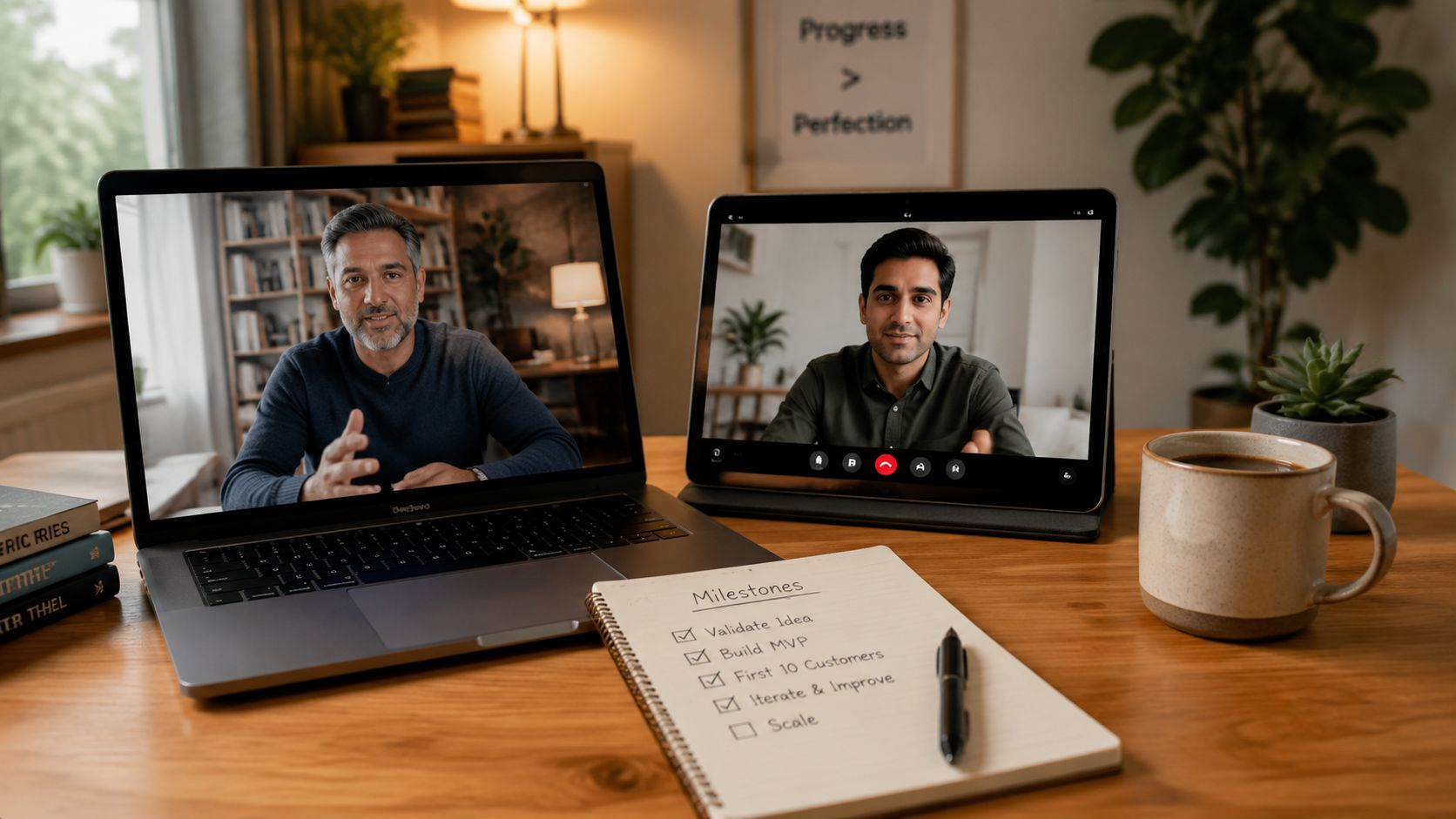
Coaching is easy to sell badly and hard to build well.
A lot of people enter this category with good intentions and weak positioning. They offer “founder coaching” with no specific lens, no structure, and no clear boundary between mentoring, therapy, consulting, and accountability. That rarely lasts. What works is a specific founder problem paired with a repeatable process.
Strong angles for a home-based coaching business
Examples that are much easier to validate:
- First-time founder accountability
- Fundraising preparation coaching
- Leadership support for technical founders
- Decision-making support for solo founders
- Mentorship for women founders navigating early growth
The best coaches usually blend lived founder experience with a clear cadence. Weekly sessions, written reflections, milestone tracking, and practical prompts all help. If you're serious about this category, it's worth reading more about founder mentorship benefits for UAE startups.
Reality check before you launch
This model works when clients leave each call with decisions, not inspiration.
Useful filter: If your sessions don't produce actions, accountability, or clearer judgement, you're not coaching effectively enough for founders to keep paying.
One practical way to test demand is to run a small pilot with a defined founder profile and a fixed duration. That gives you language, outcomes, and testimonials without pretending you already have a mature coaching practice.
8. Marketing Strategy and Growth Consulting
Growth consulting from home can work very well, but only if you stay close to execution.
Many marketers pitch strategy when what clients really want is clarity on positioning, messaging, channels, and experiments. A founder doesn't need a beautiful slide deck about growth. They need someone who can look at their funnel, offer, website, ads, CRM, and conversion path and tell them what to fix first.
The modern solo operator advantage
A more interesting angle now is the AI-enabled microbusiness. The UAE has made AI a strategic priority, and Microsoft reported in 2024 that 59% of organisations in the UAE were already using AI in some form. That changes what a solo founder can offer from home. One person can now handle content ideation, research, lead generation support, reporting, and customer communication with far less manual work than before.
That doesn't mean clients want “AI marketing”. They want better output. But behind the scenes, tools like ChatGPT, Claude, Perplexity, Notion AI, Canva, HubSpot, and Zapier can help a solo consultant deliver faster and more consistently.
Best way to package the offer
Start narrow. Good examples include:
- Messaging and positioning for early-stage startups
- LinkedIn growth for founder-led B2B businesses
- Lifecycle email strategy for ecommerce brands
- Paid acquisition audits for SaaS or apps
If you want clients to understand the difference between random promotion and actual growth systems, this guide on what sales and marketing means for founders is a helpful reference point.
9. Online Course Creation and Educational Content
This sounds passive. It usually isn't, at least not at the start.
Courses work when you already know the exact question people will pay to solve. They fail when founders try to package broad expertise into generic “masterclasses” nobody asked for. If you're considering this as one of your small business ideas from home, start by solving a narrow, practical problem.
Better course topics than generic startup advice
A strong course usually has one clear transformation. Think investor update writing, discovery call handling, customer interview methods, UAE founder compliance basics, product onboarding audits, or LinkedIn content for B2B founders. The more concrete the topic, the easier it is to validate.
A useful route is to teach live first. Run a workshop cohort on Zoom, gather the questions people ask, then turn that material into recorded lessons, templates, and exercises.
Validation before recording anything
Use this order:
- Sell the outcome first: A landing page and waitlist are enough.
- Teach it live once: This exposes confusion in your material.
- Capture templates and repeat questions: Those become key assets.
- Record later: Once the promise is proven.
This category pairs well with community. Founders often finish courses faster when they also get peer discussion, office hours, or accountability. Without that layer, completion often drops because people buy the idea of learning, then get pulled back into daily work.
10. Fractional HR and People Operations Support
This is a strong home-based business for operators who understand hiring, onboarding, culture design, policies, and founder-team dynamics.
Early-stage companies often wait too long to get help here. They hire reactively, write vague job descriptions, onboard inconsistently, and handle people issues informally until something breaks. A fractional people operator gives them structure without the cost or commitment of a full-time head of HR.
Where the demand usually comes from
The best buyers are companies that have moved beyond a tiny founding team but still don't have dedicated people leadership. Common services include hiring process design, interview scorecards, onboarding systems, policy drafting, manager support, performance rhythms, and culture documentation.
This works from home because most of the work lives in documents, calls, hiring tools, and internal systems. You don't need a physical office to improve hiring discipline or employee experience.
What to watch in the UAE and MENA context
This category has more compliance sensitivity than generic advisory work. That means your positioning matters. If your service touches contracts, labour compliance, visa processes, or formal legal interpretation, know where your expertise ends and where specialist legal support should begin.
A good starting package could include:
- Hiring workflow design
- Interview process clean-up
- Onboarding playbooks
- People policy documentation
- Founder coaching on team management
The founders who buy this service usually aren't buying HR. They're buying fewer hiring mistakes, smoother onboarding, and less internal confusion.
10 Home-Based Business Ideas: Side-by-Side Comparison
| Service | 🔄 Implementation complexity | ⚡ Resource requirements | 📊 Expected outcomes | ⭐ Ideal use cases | 💡 Key advantages |
|---|---|---|---|---|---|
| Consulting & Advisory Services | Medium–High: tailored strategy work, client-specific processes | Low overhead; high time and network investment | Strategic clarity, faster decisions, fundraising support | Early-stage founders needing strategy or investor prep | High margins, retainer potential, builds credibility |
| Digital Content Creation & Personal Branding | Medium: consistent content pipeline and platform mastery | Low cash cost; high time, content skills, basic tools | Audience growth, inbound leads, long-term passive revenue | Thought leadership, attracting consulting or sponsorships | Scales with audience, multi-revenue streams, compounding |
| Virtual Assistant & Business Operations Support | Low–Medium: repeatable processes and SOPs | Minimal startup cost; productivity tools and reliable time | Operational relief, improved founder focus, steady retainer income | Founders needing admin, ops, or customer support | Low barrier to entry, recession-resistant, recurring revenue |
| Freelance Writing & Content Strategy | Medium: research + strategic positioning for clients | Low overhead; portfolio and SEO/content skills required | Improved SEO, lead generation, stronger brand voice | Startups needing content, case studies, growth marketing | Flexible engagements, premium rates with niche expertise |
| Product Management & UX Research Consulting | High: deep research, frameworks, and cross-functional work | High skill level, user research tools, time-intensive | Validated concepts, better adoption, prioritized roadmaps | Pre-launch validation, feature prioritization, PM gaps | High-impact advice, premium rates, measurable product outcomes |
| Bookkeeping & Financial Management Services | Medium: routine processes plus compliance needs | Accounting software, certifications/knowledge, attention to detail | Accurate books, cashflow clarity, fundraising readiness | Startups requiring financial ops and investor reporting | Consistent recurring revenue, essential service, scalable with tools |
| Startup Coaching & Founder Mentorship | Medium–High: personalized coaching frameworks and follow-up | Coaching skills, time commitment, optional certification | Improved founder decisions, accountability, leadership growth | Founders seeking accountability, leadership, stress support | High-touch retention, premium pricing, deep client relationships |
| Marketing Strategy & Growth Consulting | High: multi-channel experiments and analytics-driven work | Marketing tech stack, analytics, channel expertise | Accelerated customer acquisition, measurable revenue uplift | Startups seeking go-to-market or scaling acquisition | Direct revenue impact, strong case-study potential, flexible pricing |
| Online Course Creation & Educational Content | High upfront: design, production, and curriculum building | Time, multimedia skills or contractors, platform/marketing spend | Scalable passive income, authority building, lead generation | Teaching founder skills at scale or cohort-based programs | Highly scalable, passive once built, complements consulting offers |
| Fractional HR & People Operations Support | Medium–High: policy, compliance, and people processes | HR knowledge, legal/regulatory awareness, tools | Better hiring, compensation structure, retention improvements | Scaling startups without full-time HR or building initial teams | Retainer stability, direct impact on team quality, specialized value |
Your Next Step From Idea to Action
It's 10:30 p.m. in Dubai. Your day job is done, the house is finally quiet, and you have two browser tabs open. One says “best small business ideas from home.” The other is a blank doc with no offer, no target client, and no next move. That's the point where founders lose weeks.
The right move is usually simpler than people expect. Start with the skill you can already sell, deliver from home, and test with real buyers in the UAE or wider MENA market. Service businesses win here because they need less capital, give faster feedback, and let you learn from actual client conversations before you build anything bigger.
A good idea is not enough. It has to fit your constraints.
If you have 10 hours a week, pick an offer you can scope tightly and deliver yourself. If your network is strongest among founders, consultants, or SME owners, choose a service they already buy and understand. If local setup costs, visa rules, or banking admin are a concern, begin with a lean model that can be validated before you commit to more overhead.
Use this 90-day test:
- Choose one buyer group: early-stage founders, ecommerce operators, clinics, agencies, or family businesses
- Choose one expensive problem: inconsistent leads, messy finances, weak hiring, low conversion, unclear product direction
- Package one offer: audit, setup sprint, monthly retainer, advisory session, or team workshop
- Run one validation cycle: 10 direct messages, 5 discovery calls, and 1 paid pilot
That framework matters more than branding in the beginning. A paid pilot, a fast yes, a sharp objection, or a buyer who asks for the same outcome twice gives you something useful. A polished logo does not.
Peer feedback also changes the speed of execution. Founder communities can help you pressure-test pricing, tighten positioning, and get warm introductions to first customers. For founders building service businesses online, or exploring adjacent digital models like optimising ecommerce for AI, the advantage is faster validation and fewer wasted months.
There is a trade-off here. Starting lean from home keeps risk low, but it also forces discipline. You do not get to hide behind planning. You need outreach, client conversations, and proof that someone will pay.
If you want faster feedback, better founder conversations, and a high-signal community while you validate your home-based business, join Founder Connects. It's built for UAE and MENA founders who want practical support, curated peer groups, and meaningful introductions that help turn ideas into real progress.

Building in MENA? You don't have to do it alone.
Join 300+ founders in the Founder Connects Residency. Monthly squad calls, warm intros, $3M+ in perks, and much more. All for less than your monthly coffee budget.
Popular posts





Founder Connects is a premium MENA tech founder community. Meetups in Dubai and across MENA, Residency Squads of 8–10, and 400+ vetted WhatsApp founders (apply and screened).