

How UAE Startup Founders Navigate Pharmacy Licensing

Building in MENA? You don't have to do it alone.
Join 300+ founders in the Founder Connects Residency. Monthly squad calls, warm intros, $3M+ in perks, and much more. All for less than your monthly coffee budget.

If I were opening a pharmacy in the UAE, I’d treat licensing as the launch plan - not as paperwork at the end. This mindset is essential for launching your startup in the UAE successfully. The main issue is simple: I have to clear two tracks at the same time - premises approval and pharmacist licensing - and either one can delay opening.
Here’s the short version:
- I need to deal with the right regulator first: DHA in Dubai, DOH in Abu Dhabi, and MOHAP/EDE in other federal cases.
- I should get layout approval before fit-out starts, or I risk paying for changes later.
- I need to hire my pharmacist-in-charge (PIC) early, because DataFlow checks often take 2 to 4 weeks.
- I should budget for more than setup costs alone: a Dubai community pharmacy may need AED 500,000 to AED 1.3 million to get started.
- A licence in one emirate does not let me trade in another, so branch plans need separate filings.
A few numbers shape almost every founder decision:
- UAE pharmaceutical market size: USD 4.15 billion in 2024
- Typical DHA approval costs: AED 20,000 to AED 30,000
- Fit-out cost in Dubai: AED 2,000 to AED 3,000 per sq m
- PIC salary range: AED 120,000 to AED 180,000 per year
- Minimum community pharmacy size: 30 sq m
What I take from the article is clear: the biggest delays usually come from timing mistakes. Late PIC hiring, mismatched documents, or starting works before health approval can push back launch dates and add rent and payroll costs fast.
That’s the core lesson I’d keep in mind before reading the rest.
UAE Pharmacist License Process 2025 | HAAD, DHA, DOH, MOH Step-by-Step Guide
sbb-itb-f597d8f
The licensing steps founders actually go through
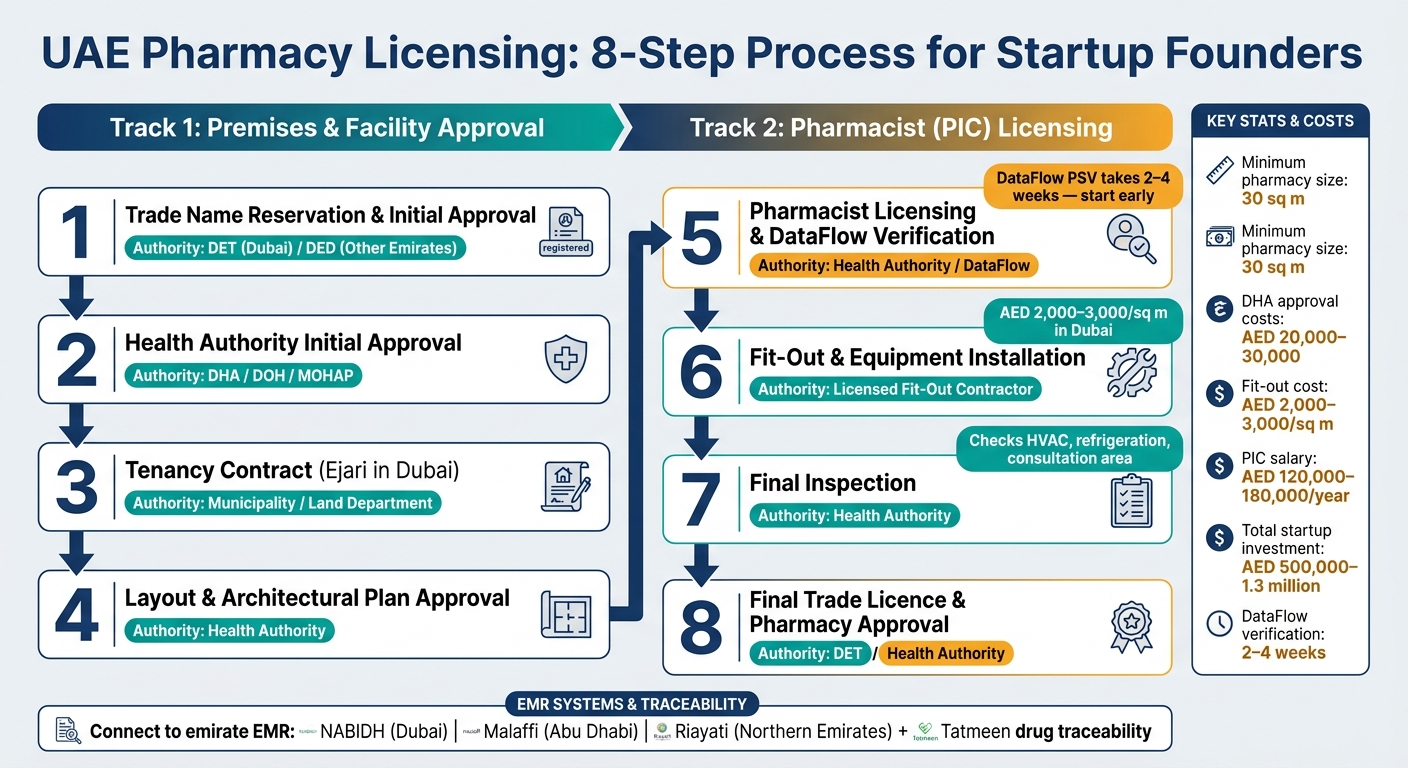
UAE Pharmacy Licensing: 8-Step Process for Startup Founders
Pharmacy licensing usually runs on two parallel tracks: facility approval and professional licensing. If you handle both at the same time, you can cut down on delays. The founders who move fastest tend to map the full file from day one: commercial approval, health approval, premises, and pharmacist licensing.
Most founders go through eight steps, from trade name reservation to final licence issuance. The exact order, and the authority you deal with, depends on the emirate. Founders can use a UAE startup ecosystem analyzer to better understand regional variations.
| Step | Action | Authority Involved |
|---|---|---|
| 1 | Trade name reservation and initial approval | DET (Dubai) / DED (other emirates) |
| 2 | Health authority initial approval | DHA / DOH / MOHAP |
| 3 | Tenancy contract (Ejari in Dubai) | Municipality / Land Department |
| 4 | Layout and architectural plan approval | Health authority |
| 5 | Pharmacist licensing and DataFlow verification | Health authority / DataFlow |
| 6 | Fit-out and equipment installation | Licensed fit-out contractor |
| 7 | Final inspection | Health authority |
| 8 | Final trade licence and pharmacy approval | DET / Health authority |
The first bottleneck is usually the premises file.
Initial approval, premises, and trade licence alignment
Get layout approval before fit-out starts. Architectural and engineering plans need sign-off from DHA, DOH, or MOHAP before any construction begins. If the space does not meet the rules - poor ventilation, no consultation area, or weak refrigeration setup - you can end up paying for retrofitting and pushing back your launch.
On the commercial side, trade name reservation and initial economic department approval move alongside the health authority track. In Dubai, this goes through the Department of Economy and Tourism (DET). Your trade licence activity needs to match the health licence exactly: community pharmacy, hospital pharmacy, or drugstore. If those don’t line up, the file usually stalls.
For a community pharmacy, the minimum premises size is 30 square metres [1][3]. Your tenancy contract, including Ejari in Dubai, also needs to match the approved location before the health authority will move the file forward.
Final approval after inspections and compliance checks
Once the fit-out is done, the health authority carries out a physical inspection of the premises. This checks HVAC, refrigeration, and the consultation area, along with general compliance against the approved layout.
Your pharmacist in charge (PIC) must already be licensed before you can clear this final stage. DataFlow verification for foreign qualifications usually takes two to four weeks, so it’s smart to start early. If not, the fit-out may be finished while the file just sits there waiting [2].
Before opening, you also need to connect to the mandatory EMR system for your emirate:
You also need integration with the Tatmeen drug traceability platform.
Ownership structure and local compliance rules
After layout and staffing, ownership structure often becomes the next approval risk.
The rules have changed a lot in recent years, but they still vary by emirate and business category. In Dubai and Abu Dhabi, 100% foreign ownership is now possible for many mainland pharmacies, subject to approval. Some MOHAP-governed categories still require 100% UAE national ownership [1][2].
For single-branch founders, the main goal is a clean entity structure that is set up the right way from the start. For multi-branch founders, each emirate needs a separate entity. Approval in one emirate does not carry over to another. These structure decisions tend to come back later, and in many cases the first delay comes from an approval gap, not the lease itself.
How pharmacist licensing affects your launch date
Once premises approval is in motion, the PIC file usually becomes the next thing that sets the pace. In plain terms, the PIC licence often decides your actual opening date, because the pharmacy cannot open until the PIC is linked to the pharmacy licence [1].
Why founders should hire a pharmacist-in-charge early
Founders should start the PIC process as soon as they’ve picked the candidate. The biggest hold-up is usually DataFlow Primary Source Verification (PSV), so it makes sense to start that step the moment you hire the PIC, not after the fit-out is finished [2].
The PIC must have:
- a recognised pharmacy degree
- relevant experience
- a valid Good Standing Certificate
- a current home-country licence [1]
If the PIC is based in Dubai, they also need to pass the DHA Prometric exam [1].
There’s also one simple shortcut worth checking. If a candidate has already cleared DHA licensing steps, you may cut weeks from the timeline [1].
How founders budget for licensing delays
This delay isn’t just a licensing issue. It hits cash flow too. Most of the runway usually goes towards rent and PIC payroll. At AED 120,000 to AED 180,000 per year [3], even a short gap between fit-out completion and opening can add a meaningful extra cost.
A good rule is to keep 3 to 6 months of runway for rent and PIC salary while approvals move through the system, as outlined in our UAE entrepreneur guide.
Case studies: How UAE founders handled licensing bottlenecks
These cases show where pharmacy launches tend to slow down in practice.
The same rule can trip people up in different ways across emirates.
Dubai case: coordinating DHA approval and store readiness
In Dubai, one mistake comes up again and again: starting the fit-out before DHA approves the layout. It may feel like a way to save time, but it often does the opposite. Instead of moving faster, founders end up paying for rework. And in Dubai, fit-out costs usually sit around AED 2,000–3,000 per square metre, so even small changes can add up fast [1][2].
It also helps to start PIC licensing early. When founders leave it until the premises are almost ready, the opening date can slide by weeks. That usually means more rent, more staff costs, and no sales coming in yet [1][2].
In many Dubai launches, late PIC licensing becomes the next hold-up.
MOHAP-governed emirate case: managing two-stage approval and document accuracy
In MOHAP-governed emirates, the main issue is often document inconsistency. If the paperwork does not match at the preliminary approval stage, the application can be rejected. Once those issues are fixed and the file is sent again, the process can move to final approval after a physical inspection checks refrigeration standards and confirms that the PIC is on-site [2].
Abu Dhabi or multi-branch case: building repeatable compliance processes
For founders expanding into Abu Dhabi, the fix is simple: build one master compliance folder before opening any branch. A single master document set makes it easier to tailor submissions for each regulator without rebuilding everything from zero. It also cuts the risk of delays when the next branch is ready to open [2].
That is why many founders use peer review before each submission. Joining mastermind groups can help founders share these challenges and refine their processes.
Community support and what founders would do differently
The big lesson here is pretty simple: late compliance calls slow everything down. In most cases, the worst delays start when founders leave lease decisions, layout approval, or the pharmacist-in-charge choice until too late.
That’s why many founders speak with peers and specialist advisors before they submit the first file. It saves time, cuts back-and-forth, and helps avoid mistakes that are expensive to fix later.
How peer networks lower licensing risk
Speaking with founders who have already gone through the process is one of the fastest ways to cut filing mistakes. These conversations help people compare realistic timelines, catch document issues before submission, and see how licensing delays can affect fundraising and scaling.
Pharmedic used innovation programmes to build regulator relationships and reduce approval friction.
Founder Connects gives founders a place to compare licensing timelines, document checks, and compliance tactics with peers.
A simple way to think about it:
- Use advisors for filings
- Use internal teams for control
- Use peer networks for fast, practical feedback
In many cases, peer input brings out the most useful compliance guidance because it comes from people who have dealt with the same regulator, the same forms, and the same bottlenecks.
Key points for founders planning a pharmacy launch
The practical takeaway from these cases is to run approvals, staffing, and budgeting in parallel.
Choose the regulator first - DHA, DOH, or MOHAP - before signing anything. Get layout approval before fit-out starts. Start DataFlow verification for your pharmacist-in-charge as early as possible, because the process usually takes two to four weeks and can delay the final opening [2].
You should also budget for delays in AED. A total initial investment of AED 500,000 to AED 1.3 million is typical for a community pharmacy in Dubai [1]. Compliance also needs to be treated as an ongoing operating function, not a one-time task. That means tracking rule changes as they happen, including EDE’s takeover of 44 core services from MOHAP on 29 December 2025 [4].
Peer networks are most useful when founders use them to check regulator-specific details before submission.
FAQs
How long does UAE pharmacy licensing usually take?
UAE pharmacy licensing usually takes about two to three months from start to finish for a well-prepared application, as long as the pharmacist’s DataFlow primary-source verification doesn’t slow things down.
DataFlow verification usually takes 2–4 weeks. If it stretches to three to six weeks, the full timeline can slip. The same goes for lease delays, fit-out work, inspections, or having to reschedule appointments.
Can I open branches in multiple emirates under one licence?
No. Each pharmacy branch in the UAE needs its own licence from the relevant health authority and the local Department of Economic Development.
A licence issued in one emirate does not allow you to operate in another. So if you plan to open in more than one emirate, each branch must go through a separate licensing process.
What documents cause the most approval delays?
The main causes of delays are pharmacist credentialing documents. In many cases, the biggest holdup is DataFlow Primary Source Verification for overseas qualifications, along with any licensing exam that still needs to be booked and completed.
Delays also happen at the DHA initial approval stage. This usually comes down to a missing or incorrect business plan, wrong pharmacist or Sheryan details, or document issues tied to the inspection process. A common problem is simple but costly: fit-out or layout submissions don’t match the approved plans.
Related Blog Posts

Building in MENA? You don't have to do it alone.
Join 300+ founders in the Founder Connects Residency. Monthly squad calls, warm intros, $3M+ in perks, and much more. All for less than your monthly coffee budget.
Popular posts





Founder Connects is a premium MENA tech founder community. Meetups in Dubai and across MENA, Residency Squads of 8–10, and 400+ vetted WhatsApp founders (apply and screened).