

UAE Startup Pitch Competitions: What to Expect

Building in MENA? You don't have to do it alone.
Join 300+ founders in the Founder Connects Residency. Monthly squad calls, warm intros, $3M+ in perks, and much more. All for less than your monthly coffee budget.

If I enter a UAE startup pitch competition, I should expect a shortlisting process, a timed live pitch, hard judge questions, and fast follow-up after the event.
Most programmes cut a large pool down to around 12 to 15 finalists, and judges usually score startups on market potential, team, traction, and product edge. So if I want a better shot, I need to do three things well: submit a clear deck, show proof that the startup is moving, and answer questions with numbers.
Here’s the short version:
- Before pitch day: I submit a deck, founder details, and traction data
- To get shortlisted: I may need an MVP or prototype
- On pitch day: I get only a few minutes to present, then face live Q&A
- What judges look for: traction, team strength, market size, unit economics, and fit with the organiser
- What I can gain: investor meetings, feedback, exposure, and in some cases pilot deals or funding access
- What matters after the event: follow up within 7 days, update the deck, and keep conversations moving
A big point many founders miss: the organiser changes the game. An investor-led event will lean harder on financials and growth. A government-backed one may care more about local impact. A tech-led event may put more weight on IP, AI, or product depth.
So I would not treat these competitions like a one-shot stage moment. I would treat them like a process: application, shortlist, pitch, follow-up. That is where most of the upside sits.
Bottom line: to do well in a UAE startup pitch competition, I need to be clear, brief, data-led, and ready for pressure in the room.
How the Competition Process Works
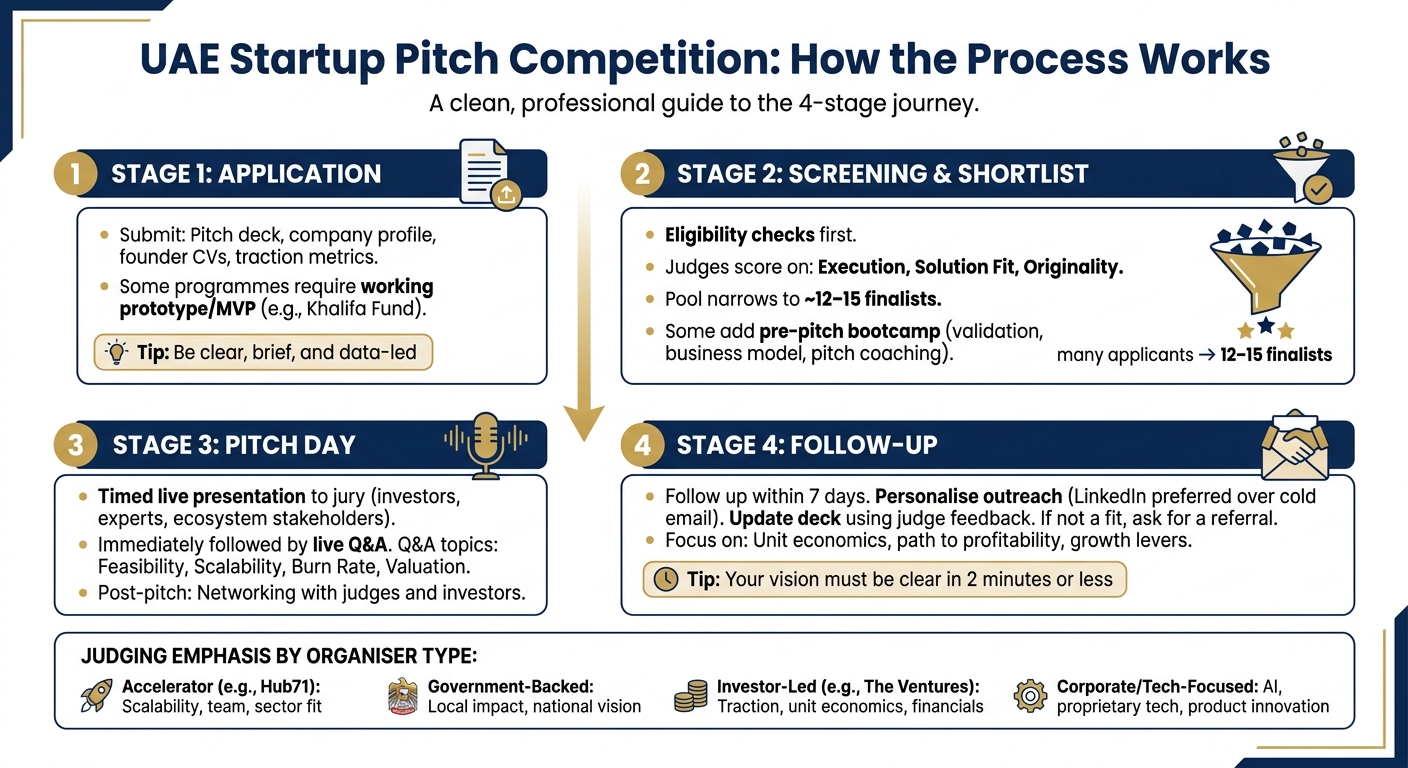
UAE Startup Pitch Competition: Step-by-Step Process Guide
Once founders apply, the process usually moves from document review to live judging.
Application, Screening, and Shortlist Stages
Most UAE pitch competitions start with an online application. Founders are usually asked to submit a pitch deck, company profile, founder CVs, and traction metrics. Staying updated on UAE startup news can help founders understand current market expectations. Some programmes ask for more than that. For example, the Khalifa Fund Entrepreneurship Competition requires proof of a working prototype or MVP before an application is even looked at [2][1].
Screening often begins with basic eligibility checks. After that, judges or review panels score applications against set criteria such as execution, solution fit, and originality [2][1]. And the cut can be sharp. Some UAE competitions narrow a large applicant pool down to just 12 to 15 finalists [2][1].
At this stage, the focus is simple: Is this startup ready enough to move forward? The shortlist phase filters for readiness, while pitch day tests how well the team performs under pressure.
Some competitions also add a short bootcamp before the final pitch. These sessions often cover validation, business model work, and pitch coaching [2].
What Happens on Pitch Day
Pitch day is timed and tightly run. Finalists present in person to a jury made up of investors, experts, and ecosystem stakeholders [2][1]. After the presentation, judges usually move straight into Q&A. That part often digs into feasibility, scalability, burn rate, and valuation.
Once the pitches wrap up, finalists usually stay on for brief networking and follow-up chats with judges, investors, or organisers [2][1].
What Changes Between Application and Pitch Day
The same startup is judged in different ways at each stage. What works in a written application is not always enough in a live room.
| Requirement | Application Stage | Pitch Day |
|---|---|---|
| Pitch Deck | Submission deck | Pitch deck |
| Product | Working prototype or MVP details | Live demo or recorded walkthrough |
| Financials | Financial snapshot and traction metrics | Readiness for deeper Q&A on burn rate and valuation |
| Interaction | Asynchronous review by screening committee | Live Q&A with the jury panel |
Application materials get you shortlisted; pitch-day delivery decides whether you move ahead [2][1].
That gap matters. Judges do not score a written submission the same way they score a live pitch.
sbb-itb-f597d8f
How Judges Evaluate Pitches in UAE Startup Competitions
After the shortlist stage, judges move from reviewing documents to scoring the live pitch.
Core Scoring Criteria to Expect
By pitch day, judges usually focus most on four areas: innovation, market potential, team strength, and traction. The Ventures Award 2026, for example, uses these four as its main evaluation framework [1].
Out of those four, traction often gets extra attention. Jigar Sagar, Investor and Founder of Triliv Holdings, says it plainly:
"Momentum matters more than storytelling. Show real signals - revenue, users, partnerships." - Jigar Sagar, Investor and Founder of Triliv Holdings [3]
That tells you a lot. A polished story helps, but judges want proof that the business is moving. They look for signs such as revenue, user growth, and partnerships. They also check unit economics and scalability. Growth can be uneven; scale needs to be repeatable [3].
Founders also need to be exact about the funding ask. That means stating how much capital is needed, why it is needed, and how it links to clear growth levers, instead of throwing out a vague runway figure [3].
In some AI categories, proprietary technology can matter just as much as early revenue [1].
Those priorities can shift based on the organiser.
Why Presentation Quality Affects Results
Because judges score the live pitch, structure and delivery can swing a close decision.
"Your vision must be clear in two minutes or less. Be concise, compelling, and memorable." - Bijan Alizadeh, Founding Partner, Cypher Capital [3]
A strong deck can still fall apart if the founder struggles during Q&A. Weak answers on burn rate, margins, or the funding ask can hurt an otherwise solid pitch [3]. Judges want to see that the founder knows the business in detail and can back it up with numbers and clear reasoning [3].
How Judging Criteria Differ by Organiser Type
Not every competition weighs the same factors in the same way. Here’s how the emphasis changes depending on who runs the event.
| Organiser Type | Primary Judging Emphasis | Key Requirement |
|---|---|---|
| Accelerator (e.g., Hub71) | Scalability, team strength, sector fit | Relocation and team presence [4] |
| Government-Backed | Economic diversification, local impact | Contribution to national vision [4] |
| Investor-Led (e.g., The Ventures) | Traction, unit economics, risk assessment | Clean financials and a clear capital strategy [1][3] |
| Corporate / Tech-Focused | Innovation, AI, proprietary technology, or product fit | Unique IP or proprietary solution [1] |
The takeaway is simple: a pitch built for an investor-led event will not land the same way in a government-backed programme. Hub71, for instance, looks at how a startup supports Abu Dhabi’s economic diversification goals [4]. So the pitch needs to match the organiser’s priorities, not some generic investor audience.
These criteria should shape how founders build the deck and prepare for Q&A.
How to Prepare a Pitch That Fits the Competition
Use the judging criteria to shape your deck, your delivery, and the way you handle Q&A. The easiest place to start is the deck itself.
Build Your Deck Around Problem, Traction, and Ask
A strong deck should cover the basics: Problem, Solution, Traction, Business Model, Team, and Ask.
Keep it easy to scan. Judges often review a lot of pitches in a short window, so clarity matters. If they need to hunt for the point, you’re already on the back foot.
Put extra weight on traction and team strength, because those are two of the main pillars judges score against [1]. If the competition expects product readiness, show an MVP or prototype. Don’t just talk about it - let people see that it exists.
Once the deck is in place, the next job is making sure you can deliver it cleanly under pressure.
Practise for Timing, Live-Demo Failure Risk, and Judge Questions
Pitch slots are short, so rehearse to a hard stop. Not “close enough” timing. The full thing, start to finish, within the exact limit.
In major UAE finals, attendance is often mandatory so judges can interact with founders directly [1]. That means your spoken pitch, your body language, and your answers in the room all count.
Before pitch day, run timed rehearsals and use a simple checklist. For example:
- Test slides, clicker, laptop, and backup files
- Decide what happens if the live demo fails
- Practise short answers to likely judge questions
- Check who will speak, when, and for how long
You should also expect scoring and feedback after the pitch, so prepare as if every part of the session is being watched closely.
Tailor Your Pitch to the Organiser and Audience
Not every event wants the same story. A pitch that works at an investor-led competition may fall flat in a government-backed programme.
Match the angle to the organiser:
- Investor-led events: lead with traction, market size, and financials
- Government-backed programmes: focus more on impact and public value
- AI-focused categories: show product edge and why the model matters
For AI-focused categories, a unique model addressing a significant issue can qualify even without proven revenue [1]. That matters, especially for early-stage founders who have strong tech but limited sales history.
Also, show how the business can scale beyond one market. Judges usually want to see that the idea is not limited to a small niche or one city.
If you want to stress-test the pitch before the event, Founder Connects can help founders through group-matched masterminds and peer feedback before pitch day.
After that, the focus shifts to what the event can unlock.
What Founders Gain After Participating
Funding Exposure, Credibility, and Ecosystem Access
After pitch day, a lot of the upside comes from who you meet and what doors open next. Competitions run by groups like the Ministry of Industry and Advanced Technology (MoIAT) can place startups in front of policymakers, financiers, and industrial partners in one setting [5]. That kind of access is hard to get through outreach alone.
These events can also lift a startup’s profile across the UAE tech scene, which may help bring in investors and new partners [5]. In programmes like the Make it in the Emirates (MIITE) Startup Pitch Competition, winners may also get the chance to work on pilot projects with major industrial partners [5].
What to Do in the First 7 Days After the Event
Once the event ends, move fast. Follow up within 7 days, while people still remember the pitch, and make each message personal.
As Sami Khoreibi, Founding Partner, Incubayt Investments, advises:
"Warm introductions win: Use LinkedIn, network hard, and personalise your outreach. Cold emails often get ignored." [3]
Before you send your deck to interested contacts, tighten it using the feedback you received. Be ready to answer questions on unit economics, path to profitability, and growth levers [3]. If someone isn’t the right fit, ask for a referral instead of letting the conversation stop there.
It also helps to stay active in the UAE startup community through Founder Connects. Its networking introductions, investor connections, and group-matched masterminds can make it easier to turn event contacts into longer-term relationships.
Conclusion: What to Expect and How to Make the Most of It
The first week after the event often decides what happens next. Interest can fade fast, or it can turn into meetings. That usually comes down to how well you handle the follow-up.
Go in knowing the format before you apply. Build your deck around what judges score. Practise until the delivery is clean and your timing is tight. Then stay visible, act on feedback, and follow up fast. That’s how one pitch can lead to investor conversations and longer-term ecosystem access.
FAQs
How early should I start preparing?
Start as early as you can. 3 to 6 months before the competition deadline is a good window.
That gives you enough time to:
- build your pitch deck
- pull together the key materials
- present a clear case for innovation and growth potential
It also gives you breathing room if you still need to build or refine an MVP or prototype. And if you get feedback along the way, you’ll have time to sharpen your pitch instead of rushing it at the last minute.
What numbers should I know before pitching?
Know your key metrics inside out: unit economics, revenue streams, path to profitability, revenue, user growth, and partnerships. These numbers show financial health, room to scale, traction, and proof that the market cares.
You should also know your market size, the competitive landscape, and your go-to-market plan. Be clear on the problem, your solution, and your financial model. In UAE startup competitions, clarity, momentum, and a strong grip on your core numbers matter most.
What if my startup is still pre-revenue?
If your startup is still pre-revenue, you can still enter many UAE startup pitch competitions. That’s especially true for programs open to early-stage companies.
A lot of them accept startups from pre-seed to Round A, as long as you have an MVP or prototype and can show innovation and growth potential.
So what should you lean on in your pitch?
- Your value proposition
- Market fit
- Your team
- Progress so far
- Your revenue plan
No revenue yet? That doesn’t automatically shut the door. In many cases, judges want to see that you’re solving a clear problem, that people want what you’re building, and that your team can turn the idea into a business.
These competitions can also do a lot for you beyond prize money. They can give you exposure, mentorship, and direct networking with UAE startup investors.
Related Blog Posts

Building in MENA? You don't have to do it alone.
Join 300+ founders in the Founder Connects Residency. Monthly squad calls, warm intros, $3M+ in perks, and much more. All for less than your monthly coffee budget.
Popular posts





The premier community for tech founders, investors, and builders. Connect, collaborate, and grow together.