

UAE Startup Setup Checklist: Free Zone vs Mainland
Building in MENA? You don't have to do it alone.
Join 300+ founders in the Founder Connects Residency. Monthly squad calls, warm intros, $3M+ in perks, and much more. All for less than your monthly coffee budget.

If I had to boil this down to one point, it’s this: the best setup depends on how I plan to make money, where my customers are, and whether I need direct UAE market access.
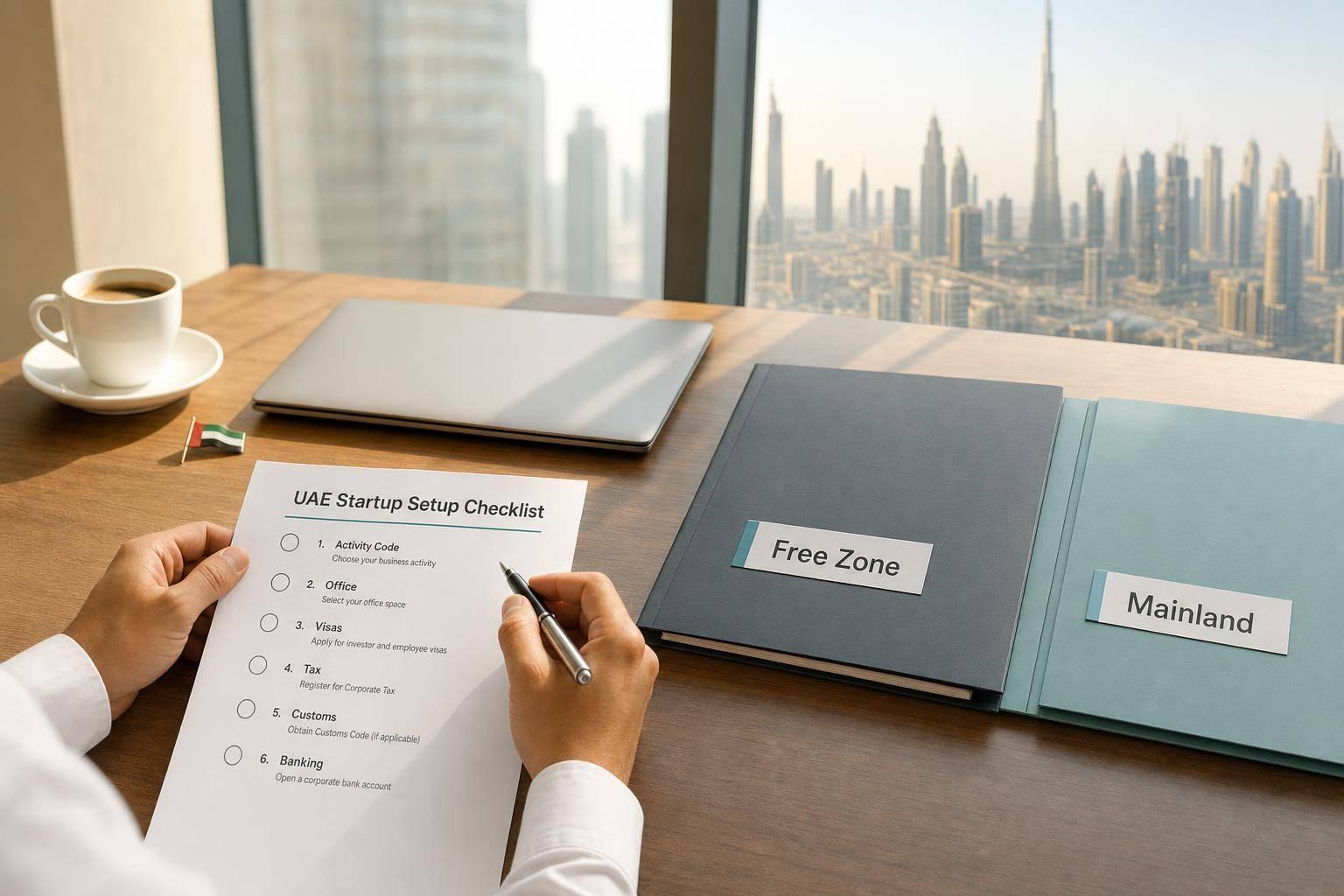
Before I pay any setup fee, I’d check these six points in order:
- Activity code: it must match what I will invoice for
- Jurisdiction: free zone or mainland
- Legal form: solo founder or multiple shareholders
- Office setup: flexi-desk, virtual, or physical office
- Visa plan: founder and team visas
- Tax, customs, and banking: files ready before launch
A few numbers stand out straight away:
- VAT registration is mandatory once taxable supplies and imports pass AED 375,000
- Voluntary VAT registration starts at AED 187,500
- Corporate Tax registration must be done within 3 months of incorporation
- Missing that Corporate Tax deadline can lead to an AED 10,000 penalty
- A visa package often costs around AED 5,000 to AED 8,000 per person
- Bank account opening can take about 2 to 8 weeks
If I mainly sell abroad, want lower office costs, or run a digital business, a free zone setup often fits better. If I want to sell straight into the UAE market, open a shop, or bid for public sector work, mainland is often the better route.
Mainland vs Free Zone vs Offshore - The Honest Comparison
sbb-itb-f597d8f
Quick Comparison
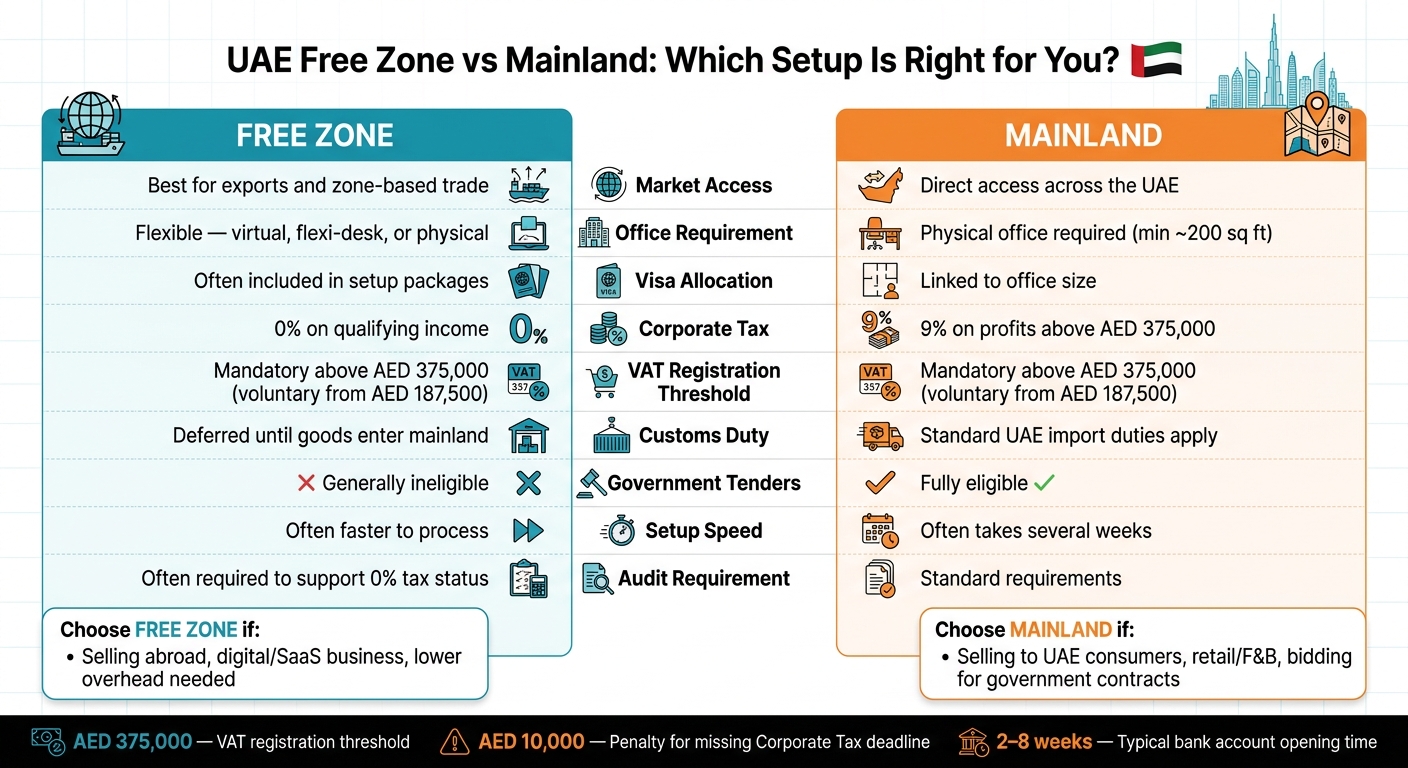
UAE Free Zone vs Mainland: Side-by-Side Startup Comparison
| Factor | Free Zone | Mainland |
|---|---|---|
| Market access | Best for exports and zone-based trade | Direct access across the UAE |
| Office | More options, including flexi-desk or virtual in many cases | Physical office required |
| Visas | Often tied to package | Linked to office size |
| Tax position | 0% on qualifying income, subject to rules | 9% on profits above AED 375,000 |
| VAT and corporate tax thresholds | AED 375,000 | AED 375,000 |
| Customs | Often deferred until goods enter mainland | Standard UAE import duty rules |
| Tenders | Usually not allowed | Allowed |
| Setup time | Often faster | Often takes longer |
| Approvals | Depends on zone and activity | More authority checks in many cases |
My short take: I’d pick based on sales model first, not package price. This includes understanding startup tax rules that impact your long-term profitability. That one choice affects banking, visas, tax, customs, office cost, and renewals from day one.
2. Free zone setup checklist
Use this checklist to check your activity code, licence type, office, visas, tax, banking, and approvals before you apply. Follow this same order for a UAE business setup guide for a free zone application.
Confirm the activity code, free zone, and licence type
Your activity code sets your licence category - Commercial for trading and sales, Professional for services, consultancy, and specialist work, or Industrial for manufacturing or production - and it affects banking readiness and renewals [1]. A licence can be valid on paper and still be a poor fit for the business. When that happens, the issues often show up later during bank onboarding, visa processing, activity changes, tax registration, or renewal.
Don’t pick a code that’s “close enough”. Write one clear sentence that explains how the business makes money, then match that sentence to the free zone’s official activity list [2]. Also check if the activity needs regulator approval. This often applies to sectors such as health, legal, telecom, tourism, and engineering [1]. The activity code should also match what the company will actually invoice for [1][2].
Once the activity and licence are set, move to the office and visa structure.
Choose the legal structure, office package, and visa plan
Free zones usually offer three legal forms: Free Zone Establishment (FZE) for one shareholder, Free Zone Company (FZC) for more than one shareholder, and Free Zone LLC (FZ-LLC) [1].
Pick an office package that banks are likely to accept. Virtual and flexi-desk setups often get more checks during account opening [1][2]. Plan for Investor/Partner visas for founders and employment visas for staff [1]. If you already have UAE residency, check whether you need a sponsor NOC [1].
After that, put together the tax, customs, and banking file.
Prepare tax, customs, banking, and regulator documents
All free zone companies must register for Corporate Tax and get a Tax Registration Number [1]. For VAT, registration becomes mandatory once taxable supplies and imports go above AED 375,000. Voluntary registration is open from AED 187,500 [1].
If your business will import or re-export goods, confirm customs registration and make sure the trade flow is set correctly before launch.
For banking, prepare one file with:
- Your business plan
- Ownership chart
- Proof of source of funds
- Expected transaction profile
- Trade licence
- Incorporation documents
- Passport copies
- Office agreement
- Board resolution [1]
If there are corporate shareholders, include the parent company incorporation papers, a Power of Attorney, and UBO details. These often need notarisation or legalisation [1].
3. Mainland setup checklist
Use this checklist in the same order as the free zone section above. On the mainland, there are more authorities involved, so the order matters.
Confirm the activity code, licensing authority, and licence structure
On the mainland, your licence comes from the relevant emirate’s Department of Economic Development (DED) - or the Department of Economy and Tourism (DET) in Dubai. The activity code needs to match exactly what you’ll invoice for.
A licence can be valid on paper and still be the wrong fit in practice. That usually shows up later during bank onboarding, visa processing, activity amendments, tax registration, or renewal. If the code is vague or only close enough, it can create issues with banking, renewals, and licence changes.
A simple way to check this: write down, in one sentence, how the business makes money, following a founder's roadmap. Then pick the code that matches that sentence.
Before you submit the application, check if your activity needs extra regulator approvals. Sectors like health, education, media, transport, fintech/finance, legal, and telecommunications may need sign-off from the relevant regulator before the licence is finalised. On the mainland, that means your office choice and immigration timing are tied more closely together than they are in a free zone.
Secure the office, tenancy registration, and immigration file
A physical office is mandatory for mainland companies. After you sign the lease, register it - Ejari in Dubai, or the equivalent tenancy registration in your emirate. This document feeds straight into your banking file, immigration file, and visa quota.
Your visa allocation is linked to your office size, so check that before you commit to the lease.
Before any visa step begins, the company needs an Establishment Card, which records the trade name, licence number, and partners [1]. It helps to line up the sequence: licence issue, Establishment Card, medical, and Emirates ID filings. If one step slips, the rest usually slip with it. Once the lease is registered, use it straight away for banking and visa processing.
Complete tax, customs, banking, and record-keeping requirements
Once the immigration file is in place, finish tax, customs, and banking before launch. Register for Corporate Tax, complete VAT registration at the UAE threshold, and set up customs registration before the first shipment. If your business moves goods - importing, re-exporting, or distributing - confirm that your customs code is active before the first shipment.
For banking, prepare your KYC file while the licence is still in process. Include:
- ownership details
- UBO details
- revenue model
- expected customer, supplier, and payment flows
If you have a corporate shareholder, you’ll also need constitutional documents and board resolutions [1].
Start accounting from day one [1]. For deeper insights into the local market, use a startup ecosystem analyzer to identify key players and opportunities.
4. Free zone vs mainland: comparison table before you apply
Use this table to pick the route before you prepare the document pack in Section 5.
| Factor | Mainland | Free Zone |
|---|---|---|
| Market access | Unrestricted access across the UAE | Best for zone-based trade and exports; sales into the mainland need the right setup |
| Office requirement | A physical office is required, usually from 200 sq ft | More flexible options, including virtual, flexi-desk, or physical offices |
| Visa allocation | Linked to office size | Often included in setup packages |
| Corporate Tax | 9% on profits above AED 375,000 | 0% on qualifying income, subject to rules |
| VAT registration | Mandatory once taxable supplies and imports exceed AED 375,000 | Mandatory once taxable supplies and imports exceed AED 375,000 |
| Customs duty | Standard UAE import duties apply | Duty is usually deferred until goods enter the mainland |
| Government tenders | Fully eligible | Generally ineligible |
| Setup speed | Often takes several weeks | Often faster to process than mainland |
| Regulator approvals | Often required for regulated sectors and local authority approvals | Depends on the zone and business activity |
| Audit requirement | Standard requirements | Often required to support 0% tax status |
When a free zone setup is the better fit
A free zone often makes more sense if your customers are mainly outside the UAE. It also suits digital businesses, SaaS companies, and export-led firms that want lower overhead and more flexible office options.
When a mainland setup is the better fit
Mainland is usually the better pick if you want to sell straight to UAE consumers, run a physical retail shop or F&B outlet, or bid for government contracts. Free zone companies are generally ineligible for government tenders, and selling into the local market without a mainland entity or a local distributor adds extra steps.
Some sectors also need local approvals before they can operate in the UAE market. This often applies to healthcare, legal, telecommunications, and engineering. Once you’ve picked your route, Section 5 lists the documents to prepare.
5. Documents to prepare and final pre-launch checks
Core documents needed for submission and banking
Once you’ve chosen free zone or mainland, it’s time to get your paperwork in order. This is the last admin stretch before filing, bank setup, and compliance work.
Start by creating one well-organised digital folder. That sounds basic, but it saves a lot of back-and-forth. One missing file can slow down the whole process, and bank account opening can take 2 to 8 weeks [3].
Here’s the document checklist to prepare:
| Document Category | Items |
|---|---|
| Identity | Identity documents, UAE visa and Emirates ID copies, if applicable |
| Legal/Corporate | Formation and shareholder documents |
| Operational | Lease and workspace documents |
| Financial/Banking | Bank KYC pack |
| Compliance | UBO details, regulator approval letters, tax and VAT records, audit reports, if required |
It also helps to budget beyond the setup fee. A lot of founders focus on the first-year price and then get caught off guard by renewal and immigration costs later.
Set aside AED 5,000 to AED 8,000 per person for a visa package, including medical tests and Emirates ID [2][3]. Year-two renewals and visa fees should also be part of your plan from day one.
Final launch checklist and founder support after setup
With the document pack ready, check every detail before you submit anything. This is where small mismatches turn into annoying delays.
Make sure the company name, activity code, legal structure, shareholder details, office address, visa plan, and authorised signatory details are the same across all forms, including:
- licence paperwork
- immigration records
- VAT forms
- customs records
- bank documents
Tax registration needs close attention too. Register for Corporate Tax through EmaraTax within 3 months of incorporation. Miss that deadline, and the penalty is AED 10,000 [3].
You should also track taxable supplies every month against the AED 375,000 VAT threshold. Waiting until the last minute can create a mess fast.
After launch, founders can also lean on peer support instead of figuring out every issue alone. Founder Connects supports UAE founders with group-matched masterminds, networking, live talks, curated investor resources, and expert advice.
FAQs
How do I choose the right activity code?
Choose the activity code based on your actual revenue model, not the description that just sounds close enough. Write a one-sentence summary of how you make money and what you deliver to clients, then match that summary against the official activity lists from the Department of Economic Development or your chosen free zone.
It also needs to match how you invoice. If there’s a mismatch, it can affect licensing requirements, bank onboarding, VAT compliance, and later changes to your licence.
Can a free zone company sell in the UAE market?
A Free Zone company can usually operate only inside its own free zone or outside the UAE.
In Dubai, that line has started to shift. Recent rule changes now allow some Free Zone companies to operate on the mainland through specific branch licences, linked mainland licences, or short-term permits.
Without one of these, they’ll usually need a local distributor or agent to sell to mainland customers.
What can delay bank account opening?
Opening a bank account in the UAE can take longer if your documents don’t tell one clear business story.
Banks run their own due diligence checks. So if your trade licence, business activity, ownership details, or address seem unclear or don’t match across documents, they may pause the process and ask for more information.
Delays can also happen when your expected transaction volumes don’t line up with your business description. The same goes for incomplete contracts, invoices, or supplier details.
Before you apply, make sure these key items are aligned:
- Trade licence
- Lease agreement
- Visa plan
- Business explanation
That kind of consistency can help the bank review your file with fewer back-and-forth requests.
Related Blog Posts

Building in MENA? You don't have to do it alone.
Join 300+ founders in the Founder Connects Residency. Monthly squad calls, warm intros, $3M+ in perks, and much more. All for less than your monthly coffee budget.
Popular posts





Founder Connects is a premium MENA tech founder community. Meetups in Dubai and across MENA, Residency Squads of 8–10, and 400+ vetted WhatsApp founders (apply and screened).