

Warm Introductions to Investors UAE: A Playbook

Building in MENA? You don't have to do it alone.
Join 300+ founders in the Founder Connects Residency. Monthly squad calls, warm intros, $3M+ in perks, and much more. All for less than your monthly coffee budget.

The UAE pulled in USD 30 billion in FDI inflows in 2023, and Dubai alone attracted AED 52.3 billion, or USD 14.24 billion, in FDI capital in 2024, up 33% from 2023, so investors can afford to be selective, and founders need a sharper path in. In that kind of market, warm introductions to investors UAE founders trust are not a soft preference, they're the access layer that gets your company seen in the first place. The practical difference between a ignored cold email and a trusted referral is the difference between disappearing into a full inbox and getting a real meeting.

Why Warm Introductions Dominate UAE Fundraising
Cold outreach in the UAE is a weak bet, and the numbers make that plain. One UAE-focused founder guide says reply rates sit between 1% and 3% across MENA, while more than 70% of UAE angel investors explicitly reject unsolicited emails. The same guide says funding success rises by approximately 45% when founders use warm introductions through verified networks, and broader investor-access data shows warm introductions convert to first meetings at 35%–40%, versus 0.5%–2% for cold outreach, a gap that is hard to ignore. UAE angel investor pitching guidance
Why the market behaves this way
The UAE has capital, but investors do not have spare time. Deal flow is heavy, the ecosystem is tightly connected, and intros serve as a trust filter before anyone opens a deck. UAE guidance calls a warm introduction the gold standard for serious investor attention. Invest UAE guidance on founder access
That filtering matters because a mutual contact shortens the investor's job. A founder referral that comes from someone the investor already trusts gives context around stage, fit, and traction before the first call. A cold note shifts that work back onto the investor, and many will not spend the time.
Practical rule: if the investor would need to decode your business from scratch, a cold ask is the wrong move.
Warm introductions also shape the conversation before it starts. The connector frames your company, signals why the meeting belongs on the investor's calendar, and gives the investor a reason to take the first look seriously. In a market where local validation carries weight, that framing often separates a polite pass from a real reply.
Why founders should build the path before they need it
Founders usually start asking for intros only after cash pressure shows up. By then, the connector list is thin, the ask is rushed, and the response rate drops. The better approach is to build relationship capital during the quiet months, so the path is already there when the raise begins.
That is where process matters. If you wait until fundraising pressure is high, you end up using whoever is available. If you map the market early, you can choose connectors who already understand your space, your stage, and the signals that make you credible. For a structured approach to the rest of the raise, the fundraising for startups playbook is a useful companion, because introductions work best when the rest of the process is already disciplined.
For a detailed email warmup guide, see our resource on email warmup guide.

Mapping Your Target Investors and Connection Paths
Start with a list of 30 to 50 investors who fit your stage, sector, and round size. Anything broader turns into vanity prospecting, and anything narrower leaves you dependent on luck. The best mapping process starts with the investor's thesis, not your contact list.
Build the investor list with intent
Write down the investors who have backed companies like yours, then sort them by stage and relevance. If you're pre-seed, don't waste time chasing growth funds that only show up later. If you're B2B software, don't treat every fintech-adjacent fund as a match just because they are visible in the ecosystem.
Then look for the bridge. A good connector is usually a founder from the investor's portfolio, an advisor they trust, or an operator who knows their pattern of backing. The quality of the bridge matters more than the existence of a bridge, because investors notice when an intro came from someone who understands their thesis.
A practical benchmark from a warm-intro playbook is that mapping 40 investors can take about 3 hours and typically yields 5 to 8 viable warm-introduction sources, which means only 12.5% to 20% of targets usually surface a real path. That's useful because it resets expectations. You're not chasing everyone, you're identifying the few names where the path is real. Warm introduction strategy playbook
Use LinkedIn and portfolio scans like a technician
Search the investor's portfolio one by one, then check who among those founders or team members overlaps with your network. On LinkedIn, look for mutuals who are not just connected, but contextually relevant. A founder who raised from that investor is often a stronger connector than a distant acquaintance with no shared operating history.
Useful filter: ask, “Would this person feel comfortable forwarding my note without rewriting it?”
That question is better than “Who do I know?” It forces you to judge whether the intro can move. If the connector is unlikely to vouch for the fit, don't push them.
One founder guide recommends limiting the target list to no more than 20 people connected to the investor when you're searching for a path, then preparing a concise forwardable email with the target's name, title, company, LinkedIn profile, and a clear ask. That discipline keeps the search grounded and stops you from building a bloated spreadsheet that never turns into meetings. Warm investor intros resource
Prioritise the right connector
Use this simple order of operations.
- Founder first: someone who has already raised from the investor and can speak to the experience.
- Advisor second: only if they've got a real relationship with the investor, not a ceremonial one.
- Operator third: best when they've worked with the investor or know their portfolio closely.
The connector should match the investor's actual pattern of backing. That's especially important in the UAE, where a relationship-driven capital network rewards relevance more than volume. If you choose the wrong bridge, you can still get “introduced”, but the message won't carry.
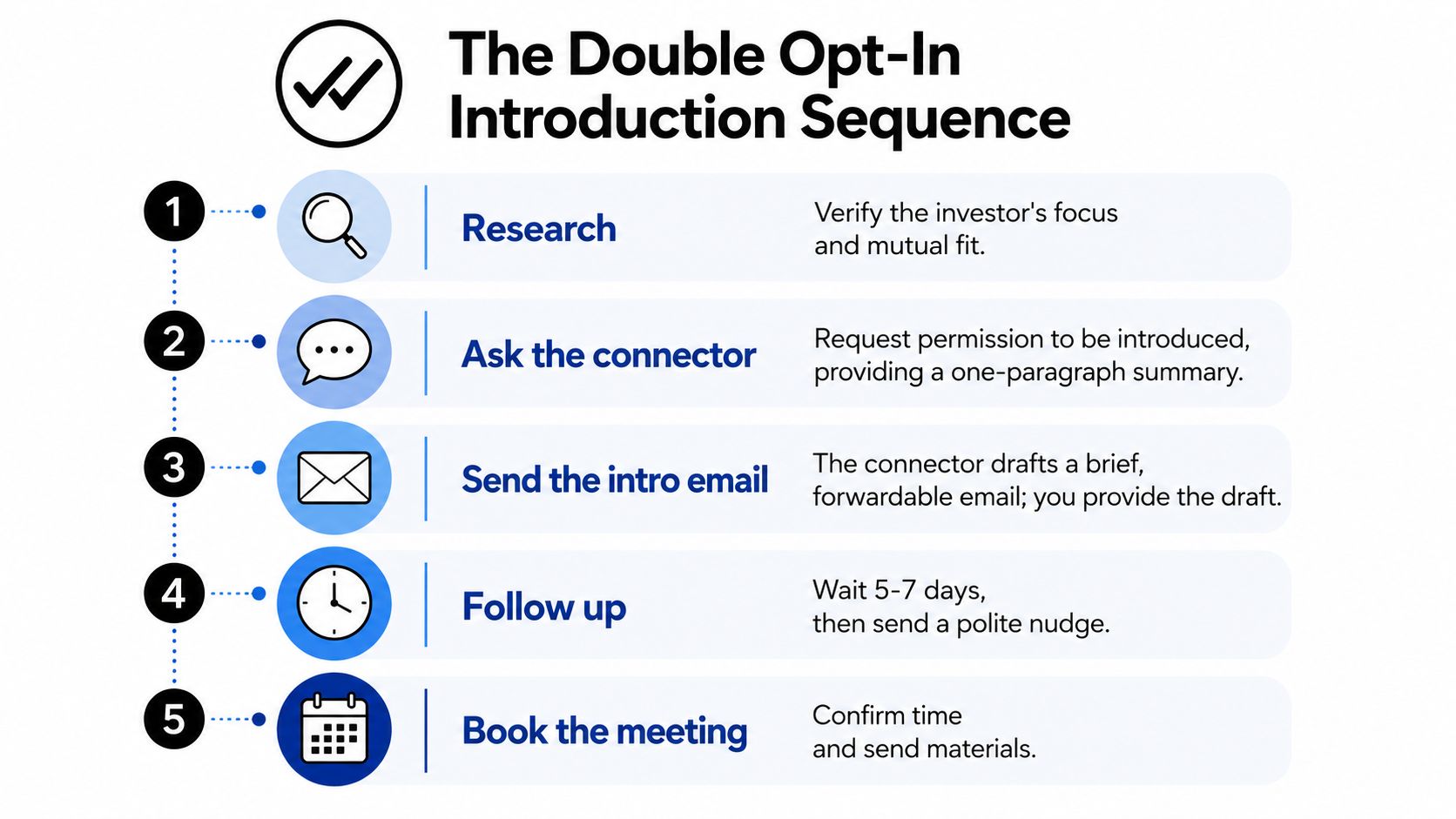
The Double Opt-In Introduction Sequence
The cleanest intro process is a double opt-in. First, ask the connector if the investor is open to an introduction. Then, if the investor is interested, ask the founder to approve the forward. Only after both sides agree should the intro go out. That keeps the process respectful, and it keeps the connector from becoming the bottleneck.
Ask in a way that is easy to forward
Don't ask, “Can you intro me?” That forces the connector to do the thinking. Instead, send a short note they can forward without editing. Keep it under 100 words, and make sure it includes a one-line company description, your strongest traction signal, and the specific ask.
A clean structure looks like this:
- Who you are: one sentence with your company and category.
- What you do: one plain-English line about the problem you solve.
- Why now: the market trigger or timing reason.
- What traction exists: the strongest proof point only.
- What you're raising: the amount and use of funds.
- Why this investor fits: one sentence tied to stage, sector, or portfolio.
That line about fit matters. It tells the connector you have done the homework, and it tells the investor the note wasn't sprayed around blindly. The best intro packets feel like a short decision brief, not a pitch deck dump.
Use the forwarding note as the real asset
The forwarding note should be tight enough that someone can paste it into an email in seconds. A rough template:
Hi [Connector], I'm building [company] in [space]. We help [customer] solve [problem] using [solution]. We've already [strongest traction signal], and we're raising [amount] to [use of funds]. I'd love an introduction to [investor] because their work with [relevant portfolio or thesis] matches our stage. If they're open, I'll send a short note you can forward.
That's enough. Anything longer starts to feel like pressure.
For a ready structure on the forwarding side, the referral letter format guidance is worth adapting, because the mechanics of a good referral note are the same whether the intro is formal or casual.
Follow up without becoming a pest
Reply fast when the connector gives you a path. The practical benchmark in UAE warm-intro guidance is to reply within 2 hours when possible, and no later than 24 hours. If the investor has not replied, a polite nudge after a few days is fine, but keep it short and keep the tone light. UAE founder investor guidance
Once the investor replies, move the introducer off the thread. That keeps the conversation direct and efficient. If the connector keeps being pulled into every reply, the process slows down and the investor has to manage an extra layer of context.
A practical follow-up sequence is simple: research, ask permission, send the forwardable note, follow up once, then book the meeting. Clean process beats enthusiasm every time.
A Real Introduction That Led to Funding
One of the strongest intros I've seen came from a founder who didn't ask for help until the packet was ready. She had already mapped the investor's portfolio, found a founder from a previous round, and asked that founder for a permission check before anyone made the introduction. The investor had backed companies in the same operating lane, so the bridge was credible before the first message even went out.
What made it work was not charm. It was specificity. The forwarding note was short, the traction signal was concrete, and the raise was framed as a clear use-of-funds decision rather than a vague appeal for support. The connector could forward it without rewriting, which meant the note arrived polished and credible.
The meeting moved quickly because the founder treated the introduction as the start of a decision process, not as a networking win. She replied fast, shared only the most relevant materials, and kept the introducer out of the thread once the investor engaged. That prevented drift and gave the investor a direct line into the conversation.
The intro did not create momentum by itself. The founder's preparation created the momentum, and the intro simply transferred it into the investor's inbox.
I've seen the same pattern repeat. When the intro is specific, the investor can judge fit quickly. When the founder is responsive and the ask is clear, the meeting turns into a serious diligence conversation instead of a polite catch-up. The actual funding outcome depends on the business, of course, but the intro is what gets the business read on the right terms.
When Not to Ask for an Introduction
Some founders burn introductions because they ask too early. If you don't have any concrete traction, the intro can feel like pressure rather than progress. In the UAE context, that matters because relationship capital alone doesn't overcome weak market validation.
The wrong time to ask
Avoid asking when:
- You have no traction signal: no signed LOIs, no pilot commitments, no early revenue, and nothing concrete to show.
- The investor is not a fit: wrong stage, wrong sector, or wrong cheque size.
- You have no mutual connection: the intro would be forced, weak, or purely transactional.
If any of those are true, hold back and build first. A warm introduction is not a replacement for market validation. It's a bridge to investors who already have reason to care.
The same goes for prep. If your ask is vague, your deck is unfinished, or your materials are still being written on the fly, the intro will waste goodwill. Investors notice when the founder hasn't done the basics, and connectors remember it too.
What burns bridges fast
The common mistakes are usually simple. Founders overshare in the first message, write a long note that nobody wants to forward, or fail to respond quickly after the connector makes the effort. Those habits create friction for the introducer and slow down the investor's decision process.
The safer move is to earn the intro first, then use it well.
- Build the product first: investors need something real to evaluate.
- Get initial customers: even small proof is better than speculation.
- Gain relevant experience: if the market is unforgiving, your credibility matters.
Use those checkpoints as a self-test. If you can't name one clear traction signal and one relevant reason the investor should care, the intro is probably premature. Waiting a few weeks to sharpen the story is usually better than wasting a strong bridge on a weak first impression.
Building Your Repeatable Introduction System
Treat introductions like a system, not a one-off favour. Keep a living map of target investors, list the connectors by strength, and review it every week so you know where real paths exist. That habit turns fundraising from a scramble into a repeatable workflow.
The founders who do this well also keep their visibility active outside the raise. They show up in high-signal communities, stay present in founder circles, and use public progress to make future intros easier. Founder Connects is one place that focuses on curated founder introductions, but the broader principle is the same across any strong network. Build trust, stay useful, and make it easy for people to vouch for you.
This week, do three things. First, build a list of 30 investors that match your stage. Second, identify the connector for each one and tag whether the path is strong, medium, or weak. Third, write one forwardable intro note and test it with a trusted peer before you ask anyone to send it.
If you want a faster way to build the right founder network around your raise, Founder Connects offers curated introductions, peer groups, and high-signal community access for UAE and MENA founders. It's built for practical progress, which makes it useful when you're trying to turn warm introductions into actual investor conversations.

Building in MENA? You don't have to do it alone.
Join 300+ founders in the Founder Connects Residency. Monthly squad calls, warm intros, $3M+ in perks, and much more. All for less than your monthly coffee budget.
Popular posts





The premier community for tech founders, investors, and builders. Connect, collaborate, and grow together.