

5G Innovations for UAE Space Startups
Building in MENA? You don't have to do it alone.
Join 300+ founders in the Founder Connects Residency. Monthly squad calls, warm intros, $3M+ in perks, and much more. All for less than your monthly coffee budget.

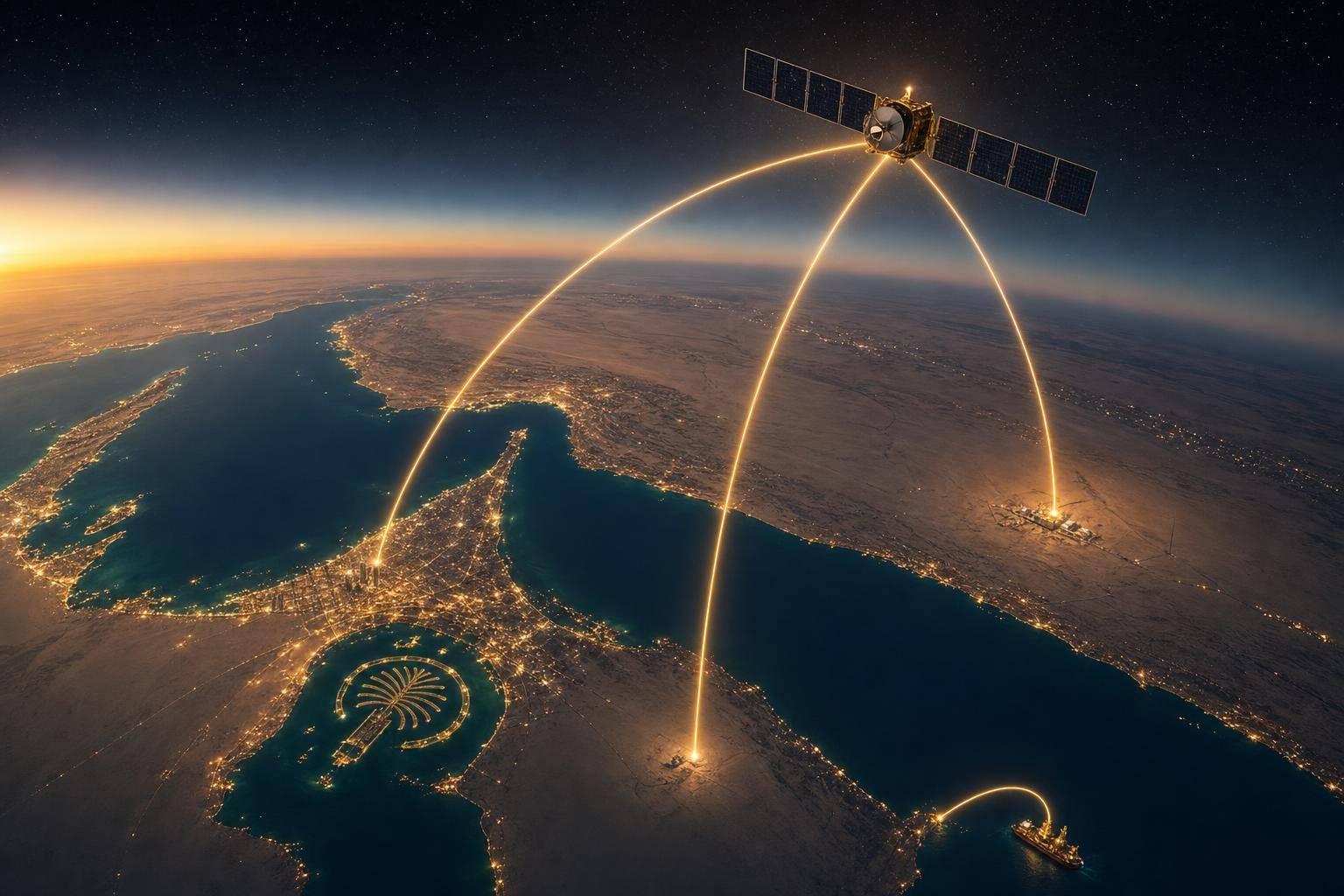
If I were building a UAE space startup in 2026, I’d focus on one clear fact: 5G is turning satellites into part of the mobile network, not a separate system.
That changes where I’d look for revenue. Instead of building expensive hardware from scratch, I’d look at 5 areas first: satellite broadband, IoT for remote assets, Earth observation data delivery, shared ground systems, and orbital edge computing. In the UAE, that matters because space spending has passed AED 44 billion, the Space Fund stands at AED 3 billion, and local moves like Space42 + e& UAE and Orbitworks’ US$1 billion Altair plan show where demand is forming.
Before I built anything, I’d keep three points in view:
- Start with one coverage gap: desert, offshore, mountain, or remote industry sites
- Build to 3GPP Release 17+ so devices and networks can work together
- Handle licences, spectrum, pilots, and funding at the same time, not one after another
Here’s the article in plain terms:
- 5G NTN lets phones and IoT devices connect through satellites in places towers do not reach
- D2D means standard devices can link to satellites without special terminals
- LEO, MEO, and GEO each suit different latency, coverage, and cost models
- UAE startup room sits less in rocket science and more in software, analytics, cybersecurity, orchestration, and managed connectivity
- The main gatekeepers are the TDRA and UAE Space Agency
- Early traction will depend on pilot proof, with metrics like latency, uptime, throughput, coverage, and customer acquisition cost
A short view of where I’d pay attention:
| Area | What I’d watch | UAE fit |
|---|---|---|
| Connectivity | D2D and NTN for dead zones | Desert, offshore, maritime |
| Data | Near real-time EO delivery | Sandstorms, coast, utilities |
| Software | Mission control and orchestration | Shared satellite networks |
| Security | Command link and data protection | Government and enterprise demand |
| Funding | Space Fund, state investors, procurement | Early market access |
My takeaway: if you’re a UAE founder, the smart move is to pick one use case, line up one operator partner, run one pilot, and prove one result with numbers.
That’s the lens I’d use for the rest of this topic.
The 5G basics space founders need to know
How 5G improves satellite communications
For space founders, the big gains from 5G are lower latency, higher throughput, massive device density, and network slicing. These come through the 3GPP Release 17+ NTN framework [4][5]. In practice, they matter most when a network has to grow across devices, partners, and jurisdictions.
5G NTN allows standard smartphones and IoT devices to connect straight to satellites. It also lets them move between terrestrial towers and satellites without losing service [4][5]. That shift changes the playing field for UAE startups, because it opens room to build on top of existing telecom behaviour instead of forcing users onto specialist systems.
Network slicing adds another layer. It lets multiple operators use the same satellite infrastructure while keeping their own spectrum rights and service levels. In simple terms, it's a shared satellite capacity model [2][5]. For startups, that's a big deal: they can get access to capacity without paying to build a proprietary constellation [2][5].
| Capability | 4G Satellite | 5G NTN |
|---|---|---|
| Device compatibility | Specialist hardware required | Standard smartphones and IoT devices |
| Data sessions | Voice and low-bandwidth messaging | High-throughput data |
| Network handover | Manual or dropped | Seamless, automatic |
| Infrastructure sharing | Limited | Multi-tenant network slicing |
Orbit choice still shapes the business model. LEO fits low-latency use cases. MEO works for regional coverage. GEO suits broadcast or backhaul. That one decision affects startup economics, latency, and the kind of service you can sell.
Global progress and UAE startup news and market signals
The Equatys venture, a joint project between Space42 and Viasat, is designed to deploy up to 2,800 satellites across 60 orbital planes [2]. It will use 100 MHz of harmonised global Mobile Satellite Services (MSS) spectrum that is already allocated across more than 180 markets [4][5].
"Equatys represents the future of global connectivity, where space and terrestrial networks operate as one. By partnering with e& as the first Mobile Network Operator to join Equatys, we take a major step toward realizing the vision of universal connectivity." - Ali Al Hashemi, CEO, Space Services, Space42 [5]
UAE leaders are also working on 5.5G (5G-Advanced) satellite-to-device connectivity, with a push on reliability and bandwidth [5]. For startups, that points to demand in a few clear areas:
- Integration
- Device software
- Orchestration
- Analytics
The next step is figuring out where your company fits in that stack.
The startup technology stack from payload to analytics
The first practical choice for a UAE space founder is deciding where to sit in the stack. It runs from hardware in orbit down to the software layer that turns raw data into revenue.
| Technology Layer | What It Involves | UAE Example |
|---|---|---|
| Payload | Satellite manufacturing and assembly | Orbitworks, establishing a facility in Abu Dhabi to scale production from 10 to 50 satellites annually [3] |
| Ground Segment | Shared satellite capacity infrastructure for MNOs | Equatys (Space42 / Viasat) [2][5] |
| Edge Computing | Orbital data storage and processing in LEO | Madari Space, which has completed radiation testing in Switzerland [3] |
| Cybersecurity | Quantum encryption and secure command links | Orbitworks, working with Abu Dhabi's Technology Innovation Institute (TII) [3] |
| Analytics | Real-time AI-driven geospatial insights | Space42's Foresight SAR constellation, which uses AI to process 25-centimetre resolution imagery [6][7] |
Each layer supports a different type of startup model. Some companies will stay close to hardware. Others will make their money from software, orchestration, or data products.
A few technical limits matter early. Orbital edge computing is constrained by thermal management. Cybersecurity stands out as a strong entry point because satellites are networked systems exposed to remote attack, and securing command links and data pipelines is still an unsolved problem at scale [3]. Startups should build on 3GPP Release 17+ from day one so their systems can work with global telecom networks and existing 5G terrestrial hardware [2][5].
sbb-itb-f597d8f
5 areas where 5G is creating real opportunities in the UAE
Satellite broadband, large-scale IoT, and smart infrastructure
For UAE founders, one of the clearest near-term plays is building connectivity services for remote assets across the country, from oil and gas sites to offshore platforms and maritime routes. The key enabler is direct-to-device (D2D) 5G NTN, which works where terrestrial masts simply don’t exist.
That matters because oil and gas assets, shipping routes, and utility networks all depend on always-on, low-power monitoring in places with no standard mobile coverage. 5G NTN IoT changes the setup. Instead of relying on expensive proprietary terminals, as legacy satellite M2M often did, operators can use standardised, lower-cost devices. That’s a major shift in both rollout cost and day-to-day use.
| Feature | 5G NTN IoT | Terrestrial 5G-only | Legacy Satellite M2M |
|---|---|---|---|
| Coverage | Global / universal | Urban and suburban only | Global but fragmented |
| Device cost | Low (standardised) | Low | High (proprietary) |
| Power use | Optimised for long battery life | High | Moderate to high |
| UAE deployment fit | Oil and gas, maritime, desert | Smart cities | Basic asset tracking |
Once that connectivity layer is in place, the next opening is obvious: getting satellite data to users much faster.
Earth observation and faster data delivery
The same low-latency setup also changes how Earth observation data reaches buyers. With older EO workflows, a lot of value is lost in processing delay. For sandstorm tracking or security monitoring, waiting hours between image capture and action can create serious problems.
5G-connected ground networks, paired with on-board edge processing, cut that delay sharply. That gives startups room to build AI pipelines for urban planning authorities, civil defence agencies, and utility operators. In plain terms, they can become the layer that turns raw satellite output into something teams can use right away.
| Feature | Traditional EO Delivery | 5G-Optimised EO Pipeline |
|---|---|---|
| Latency | High (hours for download and processing) | Near real-time |
| Processing location | Ground-based data centres | On-board and edge processing |
| Data freshness | Hours-long delay | Immediate actionable insights |
| Typical UAE use cases | Historical urban planning | Sandstorm tracking, coastal monitoring, infrastructure management |
It’s not just about speed, either. 5G also lowers the cost and friction of operating space missions.
Autonomous space operations and 5G-enabled ground segment
Running a satellite mission used to mean owning or leasing a dedicated ground station. For most early-stage startups, that was a non-starter because the upfront spend was too high. Shared infrastructure models such as Equatys change that by creating a common ground-segment layer, where multiple operators use the same underlying network [2].
That setup cuts CAPEX and shortens launch timelines. A startup can get mission operations live in weeks instead of months, while paying through an OPEX-based model as missions grow. For founders, that can make the jump from idea to live system far less painful.
The opening here covers a few software layers in particular:
- Mission control software
- Cybersecurity tools for command link protection
- Data orchestration platforms for managing multiple satellites across different operators
As the UAE pushes towards a private-sector-led space economy, with a target of 70% private participation within the next decade [9], demand for these software products is likely to grow.
| Feature | Traditional Ground Segment | 5G Virtualised Ground Segment |
|---|---|---|
| Cost structure | High CAPEX (owned hardware) | OPEX-based (shared/cloud) |
| Scalability | Limited by physical site | High (software-defined) |
| Deployment time | Months to years | Weeks (API-driven) |
| Startup suitability | Low (prohibitive costs) | High (pay-as-you-grow) |
Mission control, analytics, and storage are also moving closer to orbit itself.
Orbital edge computing
Orbital edge computing is the fifth opportunity. Startups like Madari Space are building LEO-based edge computing nodes for secure, energy-efficient storage and real-time analytics [8][9]. And with projections pointing to more than 8,000 data centres in orbit by 2028 [10], space-based compute is starting to look like a new infrastructure category.
For the UAE, that opens room for software-led businesses that sit on top of this new layer, especially where low latency and easier operation at scale matter most. 5G is a big part of what makes that possible.
Regulation, funding, and community support in the UAE
Spectrum, licensing, and data governance
Once the use case is clear, the next hurdle is approval. In the UAE, launch speed often comes down to spectrum access, licensing, and data rules.
The TDRA oversees spectrum, market access approvals, and technical standards. The UAE Space Agency handles satellite licensing for satellite build, launch, and operations. Those two bodies have a direct effect on D2D, NTN, and ground-segment services.
| Regulatory Consideration | Relevant UAE Body | High-Level Requirements |
|---|---|---|
| Spectrum Allocation | TDRA | Coordination of L- and S-band MSS spectrum; file international spectrum applications in parallel to secure rights across markets [4][2] |
| Satellite Licensing | UAE Space Agency | Approvals for satellite build, launch, and operations; Space Fund compliance [9] |
| Data Governance | TDRA / Security Bodies | Meet UAE privacy and security rules [5] |
| Technical Standards | TDRA | Compliance with 3GPP Release 17+ NTN framework [5] |
| Market Access Approvals | TDRA | Coordination for regional terrestrial-satellite handover [4] |
This setup matters in plain terms. If a company wants to offer satellite-enabled mobile services across borders, it can't just build the tech and hope for the best. It needs the right spectrum filings, the right licences, and a plan for how data will be handled under UAE rules.
"The spectrum access model allows nations to retain their sovereign autonomy and licensee control, while advancing satellite capacity with significant cost savings." [2]
- Ali Al Hashemi, CEO of Space Services, Space42
Funding options for UAE space and deeptech startups
After approvals, money becomes the next pressure point. Space is expensive, and deeptech isn't cheap either. The UAE has put serious capital behind the sector, with total investment reaching AED 44 billion by early 2026 [9].
Founders usually have three main paths:
- UAE Space Fund: A dedicated AED 3 billion vehicle, or about USD 820 million, that co-funds large projects and backs early-stage satellite build, launch, and operations [8][9].
- Space Economic Zones: Areas such as Masdar City can help with tax breaks, regulatory support, lower office costs, and access to state-backed facilities [8][11].
- Institutional investors and procurement: Mubadala, ADQ, G42, and IHC are active in UAE space and deeptech [2][9]. Government contracts can give startups early revenue and much-needed market proof. Joint ventures can help too. Orbitworks, for example, partnered with Loft Orbital to tap into capital and global markets [1][8].
For many founders, that mix is what makes the difference. A fund may help get the first satellite moving. A government contract may help pay the bills. A joint venture may open doors that would otherwise stay shut.
Why founder community matters in complex sectors
Space and 5G deeptech are hard fields to build in alone. There are too many moving parts: regulation, engineering, testing, hiring, fundraising. One weak link can slow the whole effort.
"Entrepreneurs, they have an idea... But how can they translate this idea into reality? This is where we come in - this is our role. We [guide] them step by step." [11]
That kind of support matters because founders often don't just need funding. They need people who can help them move from idea to execution without wasting months on the wrong steps. Founder Connects gives UAE founders masterminds, events, investor access, and expert advice.
With regulation, capital, and support mapped, founders can move to product design and launch planning.
e& UAE at the Forefront of 5G-A
How to build a 5G-ready space startup in the UAE

How to Build a 5G-Ready Space Startup in the UAE: Step-by-Step Roadmap
A step-by-step path from use case to launch
Start with one clear connectivity gap. In the UAE, that usually means desert, mountain, or offshore dead zones. These are the places where 5G NTN has the clearest business case, and where finding pilot partners is often more straightforward.
Once you’ve locked in the use case, the job is to turn regulation, partnerships, and pilot work into one plan you can actually execute.
| Phase | Key Actions |
|---|---|
| Use Case | Define one IoT, D2D, or EO problem tied to a specific coverage gap |
| Regulatory Path | Secure mission licences; file L- or S-band spectrum applications early |
| Pilot Partner | Sign an MoU with an MNO or satellite operator; run a 5G NTN pilot |
| Commercial Rollout | Scale through space economic zones; engage institutional investors |
A pilot only matters if it shows measurable improvement. Nice slides won’t do much here. You need proof.
The metrics, partners, and risks that matter most
Investors and anchor customers care less about the idea itself and more about what the numbers say. The main metrics are latency, throughput, uptime, coverage footprint, and customer acquisition cost. For 5G NTN, those figures should tie straight back to the opportunity areas already discussed: faster EO delivery, lower-latency IoT, and smooth terrestrial-satellite handover.
After that, partner choice becomes the main driver of scale. The strongest relationships are usually with telcos like e& UAE for terrestrial integration, and satellite operators like Space42 and Viasat for infrastructure access. Government bodies such as MBRSC and the UAE Space Agency still play a central role in testing and licensing.
A few things are worth baking in early:
- Build to 3GPP Release 17+ from day one
- If you’re building hardware, plan early for heat dissipation in vacuum and radiation hardening
Conclusion: Key takeaways for UAE founders
5G is already changing what UAE space startups can build and sell. The strongest near-term openings are in satellite broadband, large-scale IoT, Earth observation data delivery, and hybrid terrestrial-satellite connectivity.
Regulation and funding need to sit at the start of the build process, not at the end. Spectrum filings, mission licences, and investor discussions should move in parallel with technical development. If you treat them as side tasks, they can slow everything down.
In a sector this hard, the right network can save months of trial and error. Founder Connects gives UAE founders access to group-matched masterminds, networking opportunities, exclusive events, and expert advice - practical support for teams working through deep tech, high capital needs, and long approval cycles.
The next phase is commercialisation. Pick one use case, secure one operator partner, run one pilot, and measure one outcome.
"The past 10 years were about developing a space sector. The next 10 years will be instrumental in commercialisation." - Ahmad Belhoul Al Falasi, Chairman, UAE Space Agency [9]
FAQs
How much capital do I need to start?
There’s no set figure here. Costs can vary a lot based on what you’re building and where you sit in the space value chain.
For example, upstream work like satellite manufacturing usually needs far more capital. Downstream work, such as data processing, can be much lighter on budget.
The UAE also backs the sector with major support. That includes the AED 3 billion National Space Fund and AED 1.84 billion in Ghadan 21 incentives. These programmes cover things like seed funding, project grants, equity investment, and R&D rebates.
Which UAE regulator should I approach first?
Start with the UAE Space Agency. For UAE space startups, it’s the main gateway for permits and No Objection Certificates, and it coordinates the approvals you’ll need, including those tied to security agencies.
The TDRA handles satellite licensing, spectrum allocation, and orbital slots. You can also look into support from the Abu Dhabi Investment Office or free zones such as Masdar City.
What should a strong 5G NTN pilot prove?
A strong 5G Non-Terrestrial Network (NTN) pilot should show smooth handover between terrestrial 5G and satellite networks on standard smartphones and IoT devices, with no changes to SIM cards or core network infrastructure.
It should also prove that the satellite acts as a natural extension of existing mobile networks, with 3GPP-compliant open architecture delivering reliable, carrier-grade connectivity in remote or underserved areas.
Related Blog Posts

Building in MENA? You don't have to do it alone.
Join 300+ founders in the Founder Connects Residency. Monthly squad calls, warm intros, $3M+ in perks, and much more. All for less than your monthly coffee budget.
Popular posts





Founder Connects is a premium MENA tech founder community. Meetups in Dubai and across MENA, Residency Squads of 8–10, and 400+ vetted WhatsApp founders (apply and screened).