

AI Startups Middle East Raising Funding: 2026 Playbook

Building in MENA? You don't have to do it alone.
Join 300+ founders in the Founder Connects Residency. Monthly squad calls, warm intros, $3M+ in perks, and much more. All for less than your monthly coffee budget.

AI funding in the Middle East has moved from a niche story to a serious capital market. MAGNiTT says AI reached 12% of all regional venture funding in 2024, with more than 100 AI deals closed, and MENA AI funding then reached $858 million across 194 deals in 2025 according to MAGNiTT coverage. For founders working on ai startups middle east raising funding, that shift matters because investors are no longer treating AI as a side theme. They're underwriting it as a core category, especially in the UAE and Saudi Arabia, where capital is concentrated and buyer demand is clearer.
The practical problem is that not every AI company gets funded for the same reason. Some rounds back sovereign infrastructure, some back workflow automation, and some back security or compliance layers that sit underneath enterprise adoption. This guide cuts straight to the startups that have raised recently, then turns those examples into a usable fundraising playbook for UAE and wider MENA founders.
1001
Dubai and GCC founders building in regulated sectors should pay attention to 1001. The company is building a sovereign AI platform for mission-critical workflows in aviation, logistics, and energy, and it raised a $30 million Series A in mid-2026 with Lux Capital leading and General Catalyst participating.

Why this round matters
1001's strength is not flashy product breadth. It's the combination of reliability, auditability, and a region-aligned sovereign stack that fits procurement realities in the Gulf. That matters because enterprise buyers in the UAE and wider GCC often care less about novelty and more about whether the system can survive security review, data residency scrutiny, and long procurement cycles.
Practical rule: if your product touches regulated operations, make your pitch sound like an implementation plan, not a demo reel.
For founders, the signal here is simple. If your AI startup is tied to infrastructure-adjacent workflows, you need to show how you handle controlled deployment, human oversight, and integration with existing systems. 1001's investor syndicate also shows that global capital will back Gulf-native AI when the thesis is sharp and defensible.
What founders should copy
- Lead with deployment risk: show how the system behaves when it fails, not only when it works.
- Map the buyer: name the operator, procurement gatekeeper, and security reviewer.
- Prove the data boundary: explain where data sits, who can access it, and how logs are audited.
- Tie the AI layer to real work: mission-critical workflows need operational outcomes, not generic “copilot” language.
The company's website is 1001.ai, and it's a useful reference point for founders trying to raise around sovereign AI infrastructure in the GCC.
Think
Riyadh-based Think sits in one of the hardest but most strategically important parts of the market, AI infrastructure. It combines power, cooling, and orchestration software to improve GPU utilization and lower total cost of ownership, and it closed a record MENA AI-infrastructure pre-seed of over $8 million in July 2026 according to the company's funding coverage.

Why investors cared
Infrastructure is not the sexiest AI category, but it often solves the bottleneck everyone else hits. Think is aiming at the cost and utilisation problem that buyers in sovereign and regulated deployments can't ignore. That's a strong wedge in the Gulf because compute planning, energy efficiency, and deployment control are operational concerns, not theoretical ones.
The trade-off is obvious. Infrastructure companies usually face longer sales cycles, more capex pressure, and more execution risk than software-only startups. But when the thesis is tight, the category can earn real attention because it maps directly to the region's appetite for sovereign builds.
Useful filter: if your startup saves buyers from buying more hardware, wasting compute, or overpaying on deployment complexity, you're in a stronger position than a generic AI app.
What founders should learn
- Sell the constraint, not the trend: power, cooling, and GPU efficiency are real pain points.
- Target the right buyer: infrastructure sales are often won with operators, not just innovation teams.
- Keep the architecture simple to explain: too many founders overcomplicate infra pitches.
- Show why local deployment matters: sovereign buyers want control, not dependency.
Think's website is think-ai.com. For founders building AI infra in MENA, it's a reminder that regional buyers will fund practical systems that make AI cheaper, safer, and easier to run.
Algebra AI
Dubai-based Algebra AI is one of the clearest examples of where the market is heading for mid-market adoption. The company builds managed agentic AI services for finance, F&B, manufacturing, and logistics, and it launched publicly with a $7 million raise in June 2026. Its model is more operational than experimental, because Algebra runs, governs, and improves the workflow after go-live.

Why the managed model works
Managed AI is often misunderstood. Many founders assume investors only want pure software, but a large share of UAE and GCC buyers care more about outcomes, governance, and accountability than another tool their teams have to learn. Algebra's AI Harness layer builds in approvals and error checks, which makes it easier to sell into messy workflows where data is incomplete and a single failure can create a real operational problem.
The commercial logic is straightforward. The GCC mid-market often sits between DIY automation and heavy enterprise suites, so a managed layer gives buyers a way to adopt AI without assembling the full stack themselves. That can shorten decision-making, especially where internal AI capability is thin and the buyer still wants control over how the system behaves.
What makes this category fundable
- Governance matters: approvals, error checks, and monitoring reduce adoption fear.
- Mid-market pain is real: many firms want automation, but not a large internal AI team.
- Outcome pricing is easier to defend: buyers understand paid operations better than abstract model access.
- Regional operator pedigree helps: local execution experience builds trust faster than imported slide decks.
There is a trade-off, though. Service-heavy delivery can slow growth if the company cannot standardize enough of the workflow, and that tension sits at the center of this category. Founders can study top 20 AI startups for broader pattern recognition, then compare that with Algebra's website, getalgebra.ai, and the Founder Connects fundraising guide if they are raising around AI services in the GCC.
AppliedAI
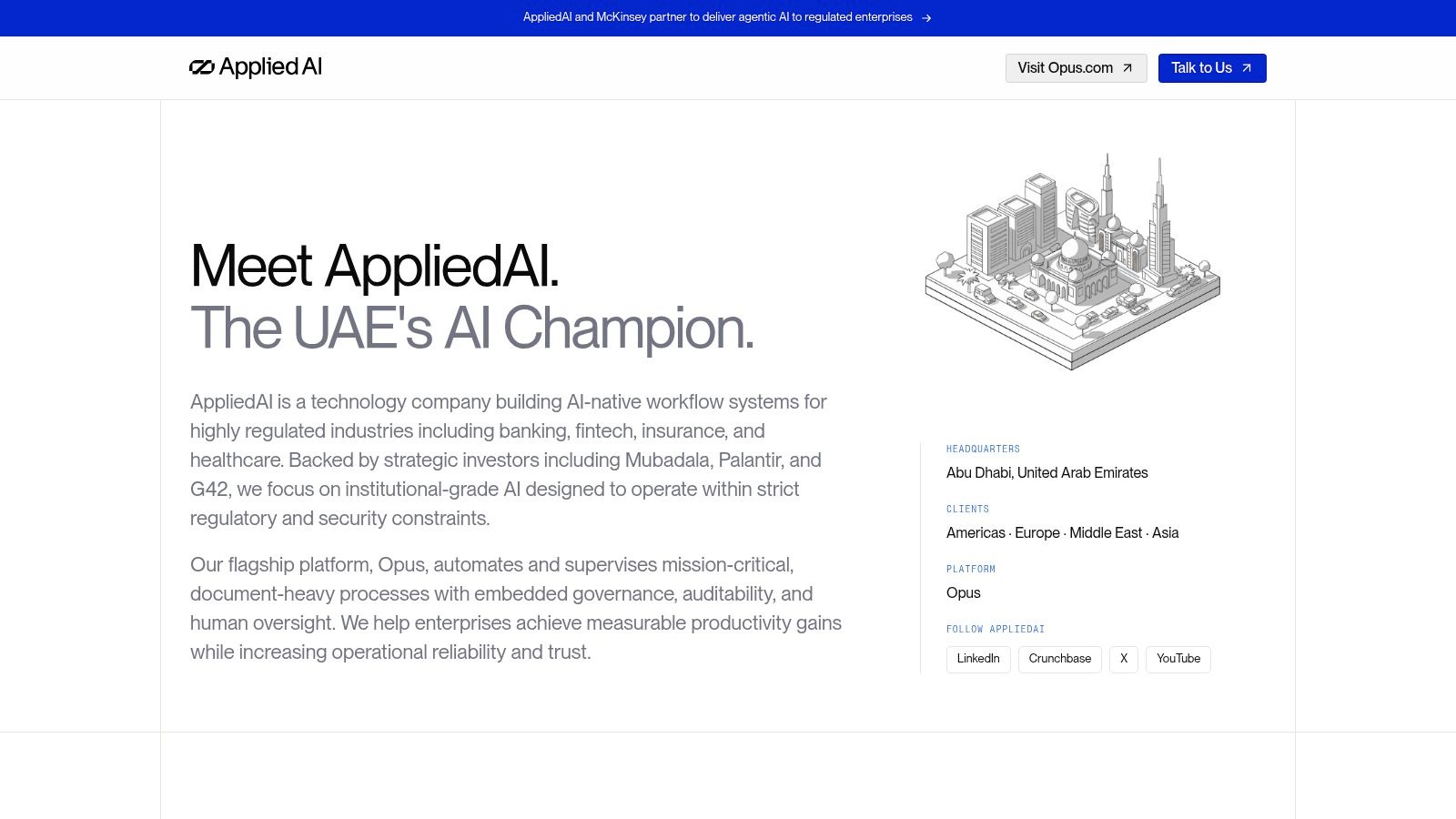
Abu Dhabi-headquartered AppliedAI is a useful reference point for founders building regulated enterprise AI in the UAE. The company builds AI-native workflow platforms, including Opus, for banks, insurers, and healthcare organisations, and it secured a Pre-Series B investment in January 2026 led by Mubadala's MENA VC Fund and Arbor Ventures.
Why this wins in the UAE
AppliedAI's pitch matches the concerns enterprise buyers raise first, governance, auditability, and human-in-the-loop control. In regulated sectors, that matters more than a flashy demo because workflows need to be traceable, reviewable, and safe to operate.
The investor mix matters too. A Mubadala-led round signals that local institutional capital will back AI companies with a narrow vertical focus and clear enterprise utility. For founders, that is a practical lesson about UAE fundraising, trust often carries as much weight as product maturity.
Where the bar is high
- Security review is required: regulated buyers will test the stack carefully.
- Procurement takes time: enterprise AI does not close like PLG software.
- Vertical focus needs depth: being “for healthcare and finance” is not enough unless the workflow is specific.
- Implementation support is part of the product: if the customer cannot deploy it safely, the deal stalls.
AppliedAI's website is aaico.com. If you are building in FinTech, InsurTech, or HealthTech, it is a useful benchmark for how to package governance as a selling point rather than a burden. The Founder Connects fundraising guide is worth revisiting if your next raise depends on enterprise proof rather than consumer traction.
Revora
Revora, formerly MyAlice, is the kind of startup many Gulf merchants can immediately understand. It provides an AI operating layer for online merchants that automates sales and support across WhatsApp, Instagram, web chat, and Shopify. The company raised a $2 million seed in June 2026 and already operates in 20+ countries, with GCC expansion as a clear focus.

Why commerce AI keeps getting funded
Revora is in a category investors understand because the ROI is easy to frame. If the AI agent can improve conversion, reduce support load, or handle repetitive pre-sale questions, the business case lands quickly. That's one reason conversational commerce keeps showing up in funding conversations across MENA.
The company's strengths are practical. It works with merchant catalog data, CRM data, and messaging channels buyers already use. That makes it less abstract than many AI startups and more connected to revenue.
What can go wrong
- Data quality decides performance: weak product data leads to weak answers.
- Integration depth matters: if the channel stack is shallow, merchants churn.
- Competition is crowded: global alternatives exist, so differentiation has to come from execution.
- Channel ownership can shift: platforms change rules, and startups need resilience.
Revora's website is userevora.com. For founders building in retail, ecommerce, or conversational commerce, the lesson is straightforward. Investors will fund AI if it plugs directly into revenue workflows and doesn't ask merchants to change how they already sell.
Lyrie.ai
Dubai-based Lyrie.ai is a good example of an overlooked but increasingly relevant category, security for AI agents. It exited stealth after a $2 million pre-seed in May 2026 and focuses on protecting AI agents, endpoints, and web apps through modules such as LyrieHEX for vulnerability scanning and AI-driven pentesting.

Why this vertical is interesting
Security is one of the clearest places where AI funding in MENA still looks underbuilt relative to demand. As more teams deploy agents into workflows, they also create new attack surfaces. Lyrie's bet is that companies will need a security OS that can map attack paths, prioritise findings by business impact, and test agentic systems before attackers do.
That pitch is stronger than generic cybersecurity because it focuses on the new stack, not just old controls. It also reduces tool sprawl by packaging scanning, pentesting, and endpoint defence in a modular way.
What founders can borrow
- Name the new risk surface: AI agents create different failure modes from classic SaaS.
- Rank by business impact: security teams care about what breaks operations, not just raw CVEs.
- Keep modules modular: buyers like being able to start small.
- Build for the stack they use: AI-native security needs to fit product and infrastructure teams.
The company's website is lyrie.ai. If your startup touches trust, identity, or model safety, this is the kind of category investors will increasingly ask about. It also helps to understand how regional capital thinks about infrastructure-heavy AI, so this guide to UAE investors backing AI startups is a useful reference if you are planning outreach.
AVELIN AI
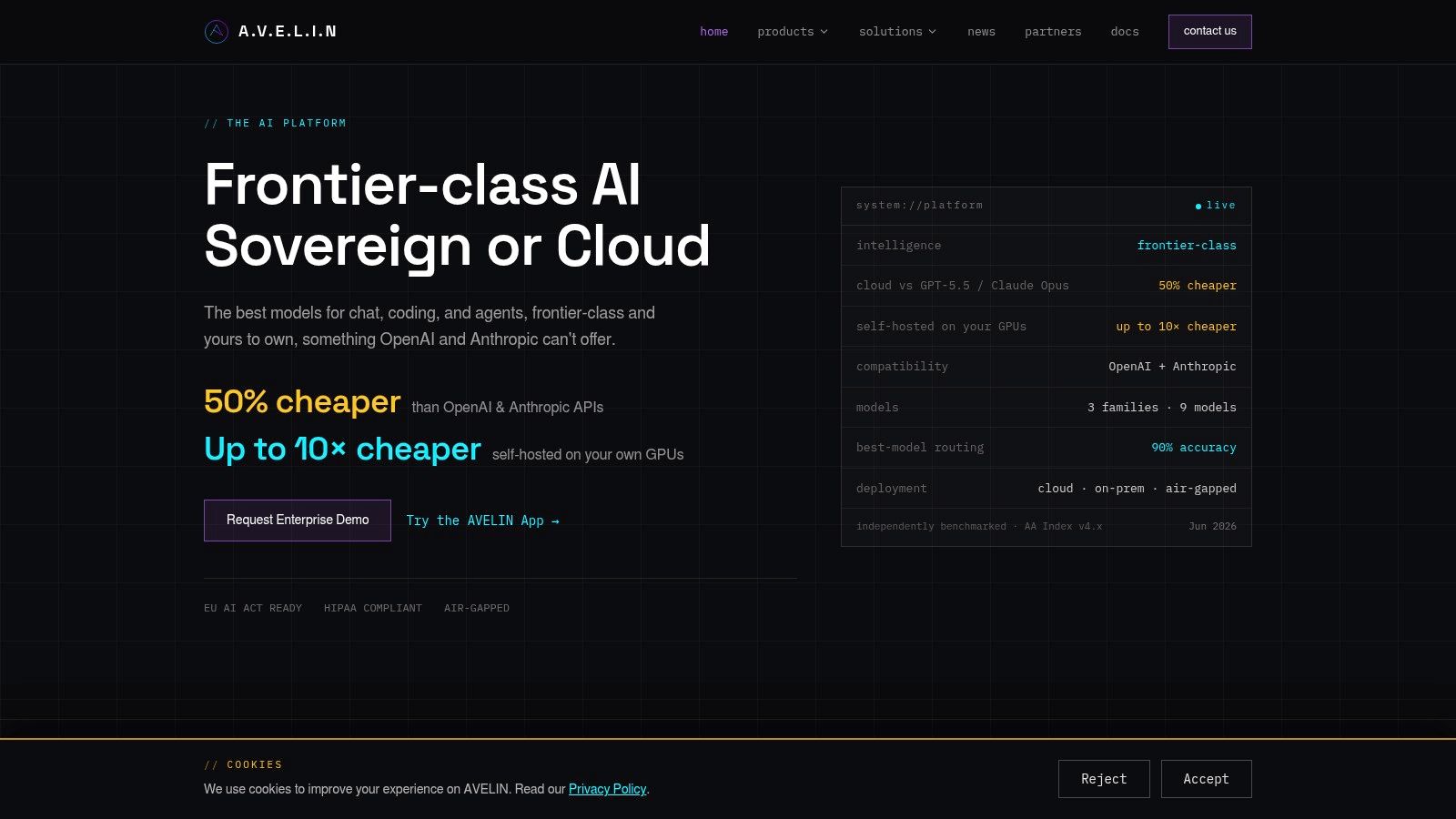
AVELIN AI is another Dubai startup that speaks directly to Gulf buying behaviour. It's building a sovereign AI laboratory and deployment stack with cross-model fusion and on-prem GPU deployments, and it raised a $3.7 million pre-seed in July 2026.
Why sovereign architecture keeps showing up
AVELIN's thesis is basically the UAE in startup form. Customers want full data control, vendor-independent architecture, and compliance-ready deployment options. That matters in a region where enterprise and government customers often prefer a stack they can control rather than a black box they have to trust.
The company also benefits from flexibility. Cross-model routing lets buyers avoid locking into a single hyperscaler or model provider, which can be a strong selling point in procurement-heavy environments.
Standout insight: if your buyer asks about sovereignty before they ask about accuracy, your product needs to be framed around control, not just performance.
What this tells founders
- Data residency is a product feature: don't treat it like a legal footnote.
- Vendor independence can be a differentiator: many customers want optionality.
- On-prem still matters: not every buyer wants a pure cloud deployment.
- Regulated use cases reward control layers: the more sensitive the workflow, the more important the deployment model becomes.
AVELIN AI's website is avelin.ai. For UAE founders, it's a reminder that sovereignty is not a buzzword here, it's a sales lever.
Which AI verticals are overheated versus overlooked in MENA
The funding pattern in MENA is starting to separate into crowded categories and underpriced ones. The overheated side is easy to spot, especially where startups are pitching generic copilots, broad chatbots, or thin wrappers around foundation models. Those ideas can still raise, but they face intense competition and weaker differentiation.
Overheated
- General-purpose AI wrappers: easy to copy, hard to defend.
- Basic chatbot builders: many teams can ship the same interface.
- Thin workflow assistants: if the product doesn't own an outcome, investors get cautious.
- Model-access plays without distribution: access alone is not a moat.
Overlooked
- Industrial automation: especially where AI reduces downtime, waste, or manual coordination.
- Supply chain resilience: procurement, logistics, and planning are still under-served.
- Specialized compliance for FinTech and HealthTech: this is one of the clearest enterprise opportunities in the region.
- AI security and governance: the agent stack is expanding faster than many teams are protecting it.
The reason this matters is visible in the broader funding mix. MAGNiTT's regional data shows AI's share of venture funding climbing fast, while the UAE and Saudi Arabia together captured 87% of regional AI venture capital investment in one regional summary. That concentration means founders need sharper positioning, not broader buzz. The money is there, but it's moving toward businesses that look operational, defensible, and locally relevant.
What to do next
- Pick a workflow with a measurable outcome.
- Show how you integrate into existing systems.
- Build for governance from day one.
- Avoid “AI for everything” messaging.
7 Middle East AI Startups, Funding Comparison
| Company | Implementation Complexity (🔄) | Resource Requirements (⚡) | Expected Outcomes (⭐ 📊) | Ideal Use Cases (💡) | Key Advantages (⭐) |
|---|---|---|---|---|---|
| 1001 | High 🔄, mission‑critical integrations, long sales cycles | High ⚡, on‑prem infra, engineering & compliance effort | High ⭐📊, reliable, auditable operational intelligence for critical workflows | Aviation, logistics, energy; regulated/infrastructure‑adjacent deployments | Sovereign stack + strong investor backing; regional procurement fit |
| Think | High 🔄, hardware + orchestration complexity, deployment planning | Very High ⚡, capex (power/cooling), GPU infra and ops | High ⭐📊, improved GPU utilization, lower TCO, energy efficiency | Edge/sovereign compute, regional data centers, KSA infra projects | End‑to‑end infra approach; tackles real cost/power constraints |
| Algebra AI | Medium 🔄, managed service customization per client | Medium ⚡, operational teams, integrations with CRM/catalogs | Medium‑High ⭐📊, governed agent workflows with faster time‑to‑value | Mid‑market finance, F&B, manufacturing, logistics seeking managed AI | Managed governance layer; focused on messy, regulated workflows |
| AppliedAI | High 🔄, enterprise governance, audit trails and controls | High ⚡, deep integrations, compliance, enterprise support | High ⭐📊, enterprise‑grade compliance, auditability and governance | Banks, insurers, healthcare; documentation‑heavy regulated processes | Verticalized platforms; Mubadala‑led credibility and market access |
| Revora | Low‑Medium 🔄, merchant integrations and conversational flows | Low‑Medium ⚡, Shopify and messaging channel integrations | Medium ⭐📊, conversion uplift, retention, support deflection | Ecommerce merchants using WhatsApp/Instagram/web chat/Shopify | Practical revenue focus; multi‑channel conversational commerce |
| Lyrie.ai | Medium 🔄, security integration for agentic systems | Medium ⚡, security tooling, validations and pentesting resources | Medium‑High ⭐📊, reduced attack surface; prioritized, business‑impact findings | Organizations running AI agents/endpoints needing proactive security | Early mover on agentic AI security; modular security OS |
| AVELIN AI | High 🔄, cross‑model fusion and on‑prem deployment complexity | High ⚡, GPUs, on‑prem infra or managed deployment options | High ⭐📊, failsafe, vendor‑independent AI workflows with full data control | Government/enterprise requiring data residency and model routing | Vendor‑independent fusion; compliance‑ready, sovereign architecture |
From Pitch to Term Sheet
Seeing who gets funded is one thing, raising capital is another. The UAE and MENA market rewards founders who can connect AI to real operational pain, not just model novelty. That's why overheated AI verticals like generic API wrappers and basic chatbot builders get crowded quickly, while overlooked opportunities like industrial automation, supply chain resilience, and specialised compliance for FinTech and HealthTech still have room.
The numbers back up the seriousness of the market. MAGNiTT's 2025 tracking shows $858 million raised across 194 deals, and the UAE alone captured $519 million of that regional AI capital. That doesn't guarantee your raise, but it does mean investors are already active, especially where the story fits local infrastructure, governance, or enterprise adoption.
Before you pitch, make sure your story answers three questions fast. What workflow do you own, what proof do you have, and why is your deployment model acceptable to a buyer in the Gulf? If those answers aren't crisp, you'll spend too much time educating investors instead of moving them toward conviction.
When you negotiate, prioritise clean terms over vanity valuation. A strong partner who understands the local market, can make introductions, and won't slow you down later is worth more than a headline number that creates pressure without support. Curated founder communities like Founder Connects can help with warm introductions, peer feedback, and more realistic fundraising preparation, especially if you're still sharpening the narrative for UAE investors.
If you're raising now, send your deck to two people who sell into your buyer segment, tighten the business case, and test the ask against a real investor intro before you open the round.
If you're building an AI startup in the UAE or wider MENA region, Founder Connects can help you turn fundraising from a solo grind into a guided process. Visit Founder Connects to access curated founder peer groups, relevant intros, and practical support for your next raise.

Building in MENA? You don't have to do it alone.
Join 300+ founders in the Founder Connects Residency. Monthly squad calls, warm intros, $3M+ in perks, and much more. All for less than your monthly coffee budget.
Popular posts





Founder Connects is a premium MENA tech founder community. Meetups in Dubai and across MENA, Residency Squads of 8–10, and 400+ vetted WhatsApp founders (apply and screened).