

Coffee Series vs Tech After Hours: Which Meetup Fits You

Building in MENA? You don't have to do it alone.
Join 300+ founders in the Founder Connects Residency. Monthly squad calls, warm intros, $3M+ in perks, and much more. All for less than your monthly coffee budget.

You're staring at two Meetup options, a finite evening, and one real problem you want other founders to help you think through. Book the wrong room and you'll waste money and momentum. Book the right one and you'll leave with sharper judgement, better contacts, and a clear next step.
| Decision factor | Coffee Series | Tech After Hours |
|---|---|---|
| Best use | Live feedback on one specific problem | Broader ecosystem visibility |
| Room shape | Small, one-table conversation | Wider after-work setting |
| Conversation style | Structured and focused | More informal and expansive |
| Best for | Quiet founders, solo founders, early validation | Fundraising visibility, partnerships, wider reach |
| Booking reality | Paid, in person, book ahead, walk-ins turned away | Paid, in person, book ahead |
| Current status | Check the Meetups listing | No date scheduled, check the Meetups page |
Two Meetups, One Decision for Your Month
A lot of founders book the wrong networking format because they're choosing based on mood instead of need. If you've got one live issue on your plate, say a customer objection, a market-entry decision, or a hiring problem, you do not need a room full of vague handshakes. You need a table where people actually talk.
That is why the coffee series vs tech after hours decision should start with your goal, not the vibe. Coffee Series is built around one-table conversation with a small founder group, which makes it the obvious pick when you want focused feedback. Tech After Hours is the better fit when you want broader ecosystem exposure after the workday, with more room for varied conversation.
Both are paid, in person Meetups, and both need advance booking. That matters, because this is not a casual drop-in where you decide at 7 pm and show up. You're spending time and money, so the format should match the outcome you want.
If you need one good conversation more than twenty polite introductions, choose the smaller room.
By the end of this article, you should be able to decide which Meetup fits your current founder decision, which one to skip for now, and how to prep so you don't waste the seat you paid for.
How Each Format Actually Works
Coffee Series is built for depth
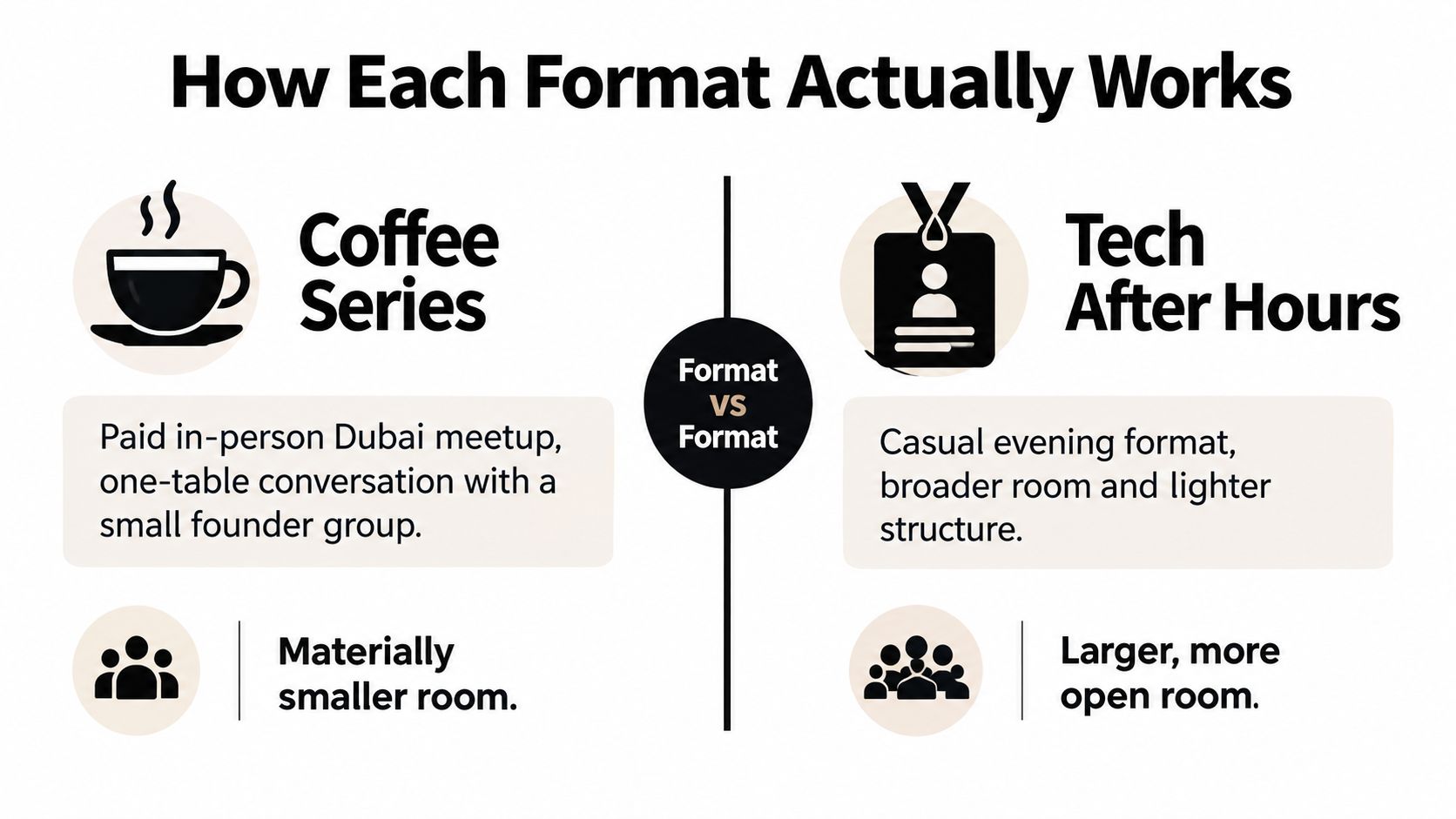
Coffee Series is a paid, in person Dubai Meetup built around a small founder group at one table. That structure is the whole point. You're not wandering a room trying to catch someone between sips, you're sitting down and getting into the substance fast.
The Founder Connects page describes Coffee Series as a one-table conversation format, which makes it materially smaller and more structured than general networking. The practical effect is simple, everyone has airtime, the pace stays tight, and the conversation can stay anchored on actual founder problems. If you want to understand the format before you book, the official description is on the Founder Connects Coffee Series post.
Tech After Hours is the broader evening counterpart
Tech After Hours is the after-work version. The room is looser, the conversation is less table-led, and the energy is closer to a social but business-focused founder gathering after the working day. That makes it useful when your aim is contact breadth, not deep problem-solving in one sitting.
The important update is practical, Tech After Hours has no date scheduled right now, so don't assume there's a calendar entry waiting for you. Check the main Meetups listing on the official page instead of planning around a date that isn't there yet.
The difference is not subtle. Coffee Series compresses the room. Tech After Hours opens it up.
The biggest structural difference is this, Coffee Series forces depth, Tech After Hours allows breadth.
Networking Dynamics Compared
One table changes the conversation
At a small table, the social pressure shifts. Nobody can hide in the back, nobody can dominate a whole room, and nobody can pretend they were “too busy” to speak. That matters if you're the sort of founder who thinks better in dialogue than in a crowd.
Coffee Series rewards people who want actual exchange. The moderated setting keeps the conversation on live challenges, so you're less likely to drift into pitch-speak or small talk that goes nowhere. It also makes repeat attendance useful, because continuity is easier when the same kind of conversation keeps happening in the same format.
Wider rooms reward motion, not just thought
Tech After Hours works differently. It's better for founders who already know what they're hunting for, because you can move across the room, test a few conversations, and spot people outside your immediate circle. That makes it a stronger play for visibility, especially if you want to be seen by a wider mix of founders and operators.
It also suits people who like informal mingling. If you're confident starting conversations, switching topics quickly, and following up later, the broader room gives you more angles. If you're quieter, it can be useful, but it does not guarantee airtime the way a small table does.
For a founder who gets drained by loud rooms, Coffee Series is the safer bet. For a founder who enjoys scanning the room and working it, Tech After Hours can be more productive. That's the trade-off, depth versus breadth.
Practical rule: choose the format that protects your weak point, not the one that flatters your personality.
The Tech After Hours listing is the better place to understand the broader room style if you're deciding whether you want reach or depth this month.
Which Founder Stage Fits Which Format
Early-stage founders need a table, not a crowd
If you're validating an idea and need honest feedback on one customer problem, Coffee Series is the better fit. You do not need more ambient networking at that stage, you need a founder who can tell you, plainly, what sounds weak, what sounds promising, and what they'd do differently. A small table makes that kind of conversation much easier.
If you're a solo founder feeling isolated, Coffee Series also has the edge. Regular, structured peer conversation helps more than a big room full of strangers because it creates continuity. That continuity matters when your week is full of decisions and there's no internal team to sanity-check them with you.
Fundraising and partnerships lean broader
If you're getting ready to fundraise and want to understand how others talk about their business, Tech After Hours gives you a wider view. You hear different positioning styles, different sector angles, and more varied founder stories. That is useful when your goal is visibility and pattern recognition, not one tight problem-solving session.
If you're scaling and testing partnerships, Tech After Hours can also be the stronger option. A broader room gives you more chances to spot relevant operators, adjacent founders, and possible collaboration paths. Coffee Series can still help, but its strength is depth, not range.
Founder Connects also runs a broader founder community, including 500+ vetted founders in its WhatsApp network and Residency Squads of 8 to 10, so the ecosystem already supports both tight peer circles and wider access. That doesn't make every Meetup interchangeable, it just means the format should match the stage.

Ask yourself one blunt question
Are you trying to solve a live problem or broaden your network surface area?
If it's the first, book the table. If it's the second, watch for the after-hours listing.
Realistic Outcomes from Each Meetup
Judge the right outcome, not the loudest one
Coffee Series is strongest when you want decision-quality feedback. A founder at the table has often already wrestled with a similar problem, which makes the conversation more useful than a stack of business cards. The room also makes it natural to pick up the thread later, because you are not starting from zero.
Tech After Hours is stronger for visibility and breadth. You leave with more surface area, more sector variety, and a better shot at finding people who think differently from your immediate circle. That can be useful when you want partnerships, investor context, or a broader sense of what the ecosystem is talking about.
The mistake is measuring both by attendance energy. A good evening is not the one with the most greetings. It is the one where at least one substantive conversation changed how you think about the next move.
| Outcome Comparison at a Glance | Coffee Series | Tech After Hours |
|---|---|---|
| Decision-quality feedback | Strong | Moderate |
| Broader visibility | Moderate | Strong |
| Partnership potential | Selective and focused | Wider and more varied |
| Quiet founder comfort | Strong | Depends on mingling style |
| Best success signal | One sharp insight you can act on | One useful connection you can follow up with |
After you leave, write one sentence per conversation before you get home. Then pick one follow-up within a week and send it. That tiny discipline matters more than the event itself.
For a founder thinking about whether a contact is worth building on, the earlier how to vet a co-founder guide is a useful way to separate real signal from friendly noise.
Booking and Preparing for Your First Meetup
Book like a grown-up founder, not a hopeful walk-in
Founder Connects states that Coffee Series seats are booked through its Meetups page or Luma, and walk-ins are turned away because rooms are capped. So don't build your evening around a maybe. Confirm the listing, book ahead, and treat the seat as committed once you've paid.
Tech After Hours is simpler on paper and messier in practice, because there's no date scheduled right now. That means you should watch the official Meetups page rather than assume a fixed cadence or a live booking slot.
For Coffee Series, prepare one specific question that another founder can answer from experience. Do not walk in with a vague “I'd love to hear your thoughts on growth.” That gets you vague answers. Bring a live decision, and the room can do useful work.
Fifteen-minute checklist
- Confirm the listing: Check the date, venue, and booking details before you travel, especially if you're moving between Dubai and Abu Dhabi.
- Write one question: Make it narrow enough that another founder can answer it from experience.
- Choose a follow-up goal: Decide whether you want feedback, a referral, or a new contact.
- Prepare a one-line context note: Explain your business in a sentence without pitching.
- Set a follow-up rule: Commit to sending one message within a week to the person who gave you the most useful input.
Do this before you leave home: know what problem you want solved, or you'll drift into pleasant conversation and call it networking.
If you want the booking path in one place, use the official Founder Connects Meetups page or the Luma listing, then travel only after you've confirmed the details. That's the difference between being prepared and being the person standing outside a capped room.
Decision Checklist and Final Recommendation
Use these yes or no questions
- Need feedback on a live decision? Book Coffee Series.
- Prefer a small moderated room? Book Coffee Series.
- Want a recurring circle of peers? Book Coffee Series.
- Looking for broader casual exposure? Watch for Tech After Hours.
- Already clear on your problem and want more contacts? Tech After Hours fits better.
My view is straightforward. If you're an early-stage founder, a solo founder, or anyone carrying one messy decision into the week, Coffee Series is the better choice. If you're trying to widen your network, get visible, or meet more people across the ecosystem, Tech After Hours is the better bet.
The strongest founders do both over time. They use Coffee Series for depth, because depth helps them think. They use Tech After Hours for reach, because reach helps them move.
Your next move is simple. Prepare one specific question, then book through the official Founder Connects Meetups page or Luma listing instead of treating either Meetup as a drop-in option. If you want a room that matches the problem you're trying to solve, Founder Connects is where to start.

Building in MENA? You don't have to do it alone.
Join 300+ founders in the Founder Connects Residency. Monthly squad calls, warm intros, $3M+ in perks, and much more. All for less than your monthly coffee budget.
Popular posts





Founder Connects is a premium MENA tech founder community. Meetups in Dubai and across MENA, Residency Squads of 8–10, and 400+ vetted WhatsApp founders (apply and screened).