

How to Vet a Cofounder After a Dubai Meetup

Building in MENA? You don't have to do it alone.
Join 300+ founders in the Founder Connects Residency. Monthly squad calls, warm intros, $3M+ in perks, and much more. All for less than your monthly coffee budget.

You met a promising founder at a Founder Connects Cofounder Match Meetup in Dubai. The conversation was easy, the energy was strong, and you can already see how their skills might fit your idea. That excitement is useful, but it isn't evidence that you should share a cap table.
How to vet a cofounder is a question of observed behaviour, not chemistry. Founder conflict is widely cited as a major startup failure risk, with one benchmark attributing 65% of high-potential startup failures to conflict among cofounders, as discussed in Dubai-focused guidance on partnership failures. In a MENA review of more than 60 failed startups, poor team was identified as a direct cause in 13.6% of cases, while no market need accounted for 27.3%.Wamda's startup failure analysis
You don't need another inspirational conversation. You need a written workflow that tests role fit, commitment, working style, references, execution, and long-term alignment before incorporation.
Write Down the Relationship Within the First 48 Hours After the Meetup
The first 48 hours should convert Meetup enthusiasm into a small, testable process. Don't promise equity, announce yourselves as cofounders, or make a verbal handshake feel like a commercial commitment.
Use the first day to capture the idea
Within the first 24 hours, each of you should write a short paragraph covering:
- The problem: Who has the problem, and what makes it urgent?
- The proposed solution: What would you build or deliver?
- The customer: Who would pay, use it, or introduce it?
- The founder role: What would you personally own?
Write separately before comparing notes. If your paragraphs describe different customers, different urgency, or different businesses, you've found an important disagreement early and at no cost.
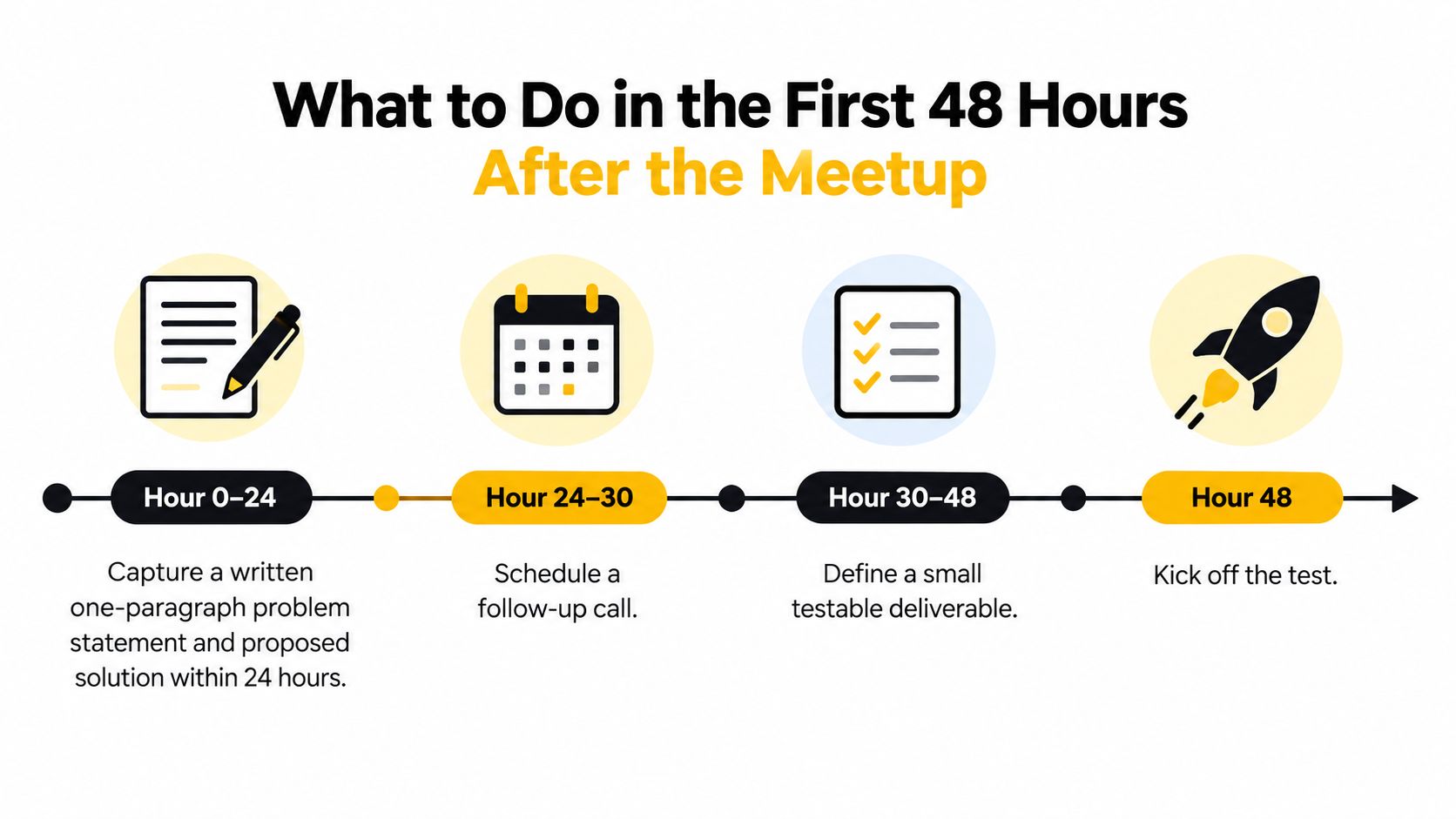
Send a WhatsApp follow-up the same evening. Dubai, Riyadh, and Cairo operate across different schedules, and promising conversations lose momentum quickly when neither person takes ownership of the next step. Use the post-networking follow-up checklist to keep the message clear and specific.
Make the second conversation practical
Schedule a 60-minute working session, not another coffee. Agree that each person will privately prepare one useful piece of work, such as:
- a small set of user interviews
- a basic market-sizing view
- a competitor scan
- a draft customer journey
- a list of likely distribution partners
Your follow-up message should make the request easy to accept and easy to decline. EmailScout's guide for asking collaboration is useful for framing a collaboration request without creating false pressure.
End the 48 hours with a short written summary of what you both think the partnership would look like, including the problem, initial roles, expected next step, and unresolved questions.
Practical rule: If either person can't produce a short written summary within 48 hours, the fit probably isn't real.
Define Role Ownership and Commitment Before You Get Excited
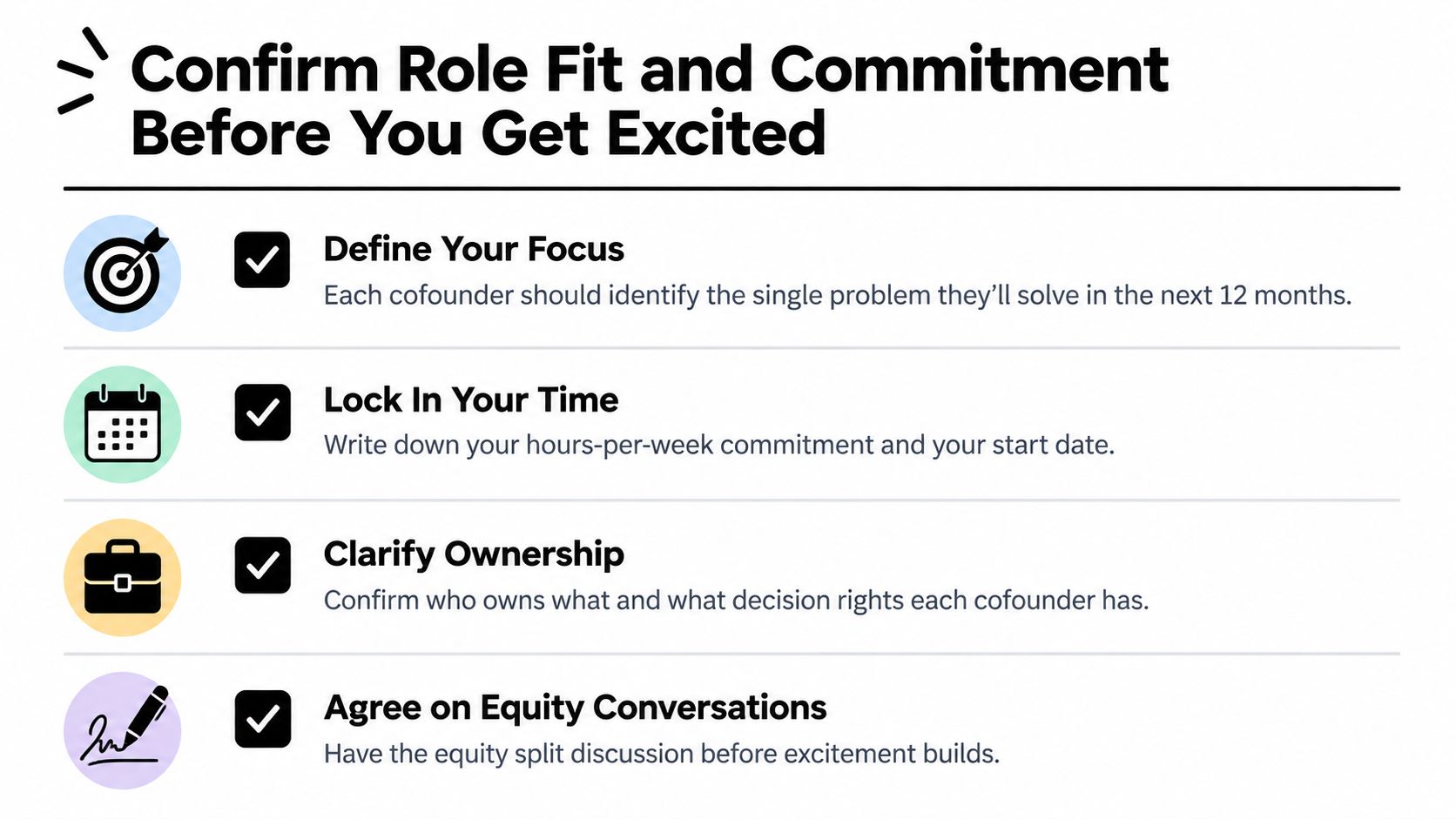
You should only treat someone as a potential cofounder when they can own a critical problem, make decisions in that area, and commit enough time to do the work. “I'll handle product” is not a role. It hides the decisions, workload, and accountability that matter.
Assign one problem to each founder
Start with a 12-month view. Ask each person to complete this sentence:
“For the next 12 months, I will be accountable for solving…”
The answer should identify a business problem, not a job title. “I'll handle sales” is weak. “I'll secure early design partners, build the UAE pipeline, and convert validated demand into paid pilots” gives you something to inspect.
Then define decision authority. Who decides the product roadmap? Who owns customer pricing? Who controls hiring in the first phase? Who can commit the company to a partnership? Complementary skills only help when ownership is clear. A role framework such as Fluidwave's guide to team roles and responsibilities can help you turn broad titles into accountable areas of work.
Compare stated commitment with actual life
Write down:
- Expected hours: What will each person contribute each week?
- Start date: When does meaningful work begin?
- Availability: Which days and hours are realistic?
- Current obligations: What job, family, visa, or relocation constraints apply?
- Decision rights: What can each founder decide without permission?
- Long-horizon ambition: Is the target venture scale, a profitable regional business, or a lifestyle company?
Be direct about whether this venture is the person's main focus or a side project alongside a comfortable salary in DIFC, a government role, or another business. Neither choice is automatically wrong. The problem is pretending that both founders have made the same choice when they haven't.
Use the earlier Dubai and MENA cofounder matching guide as the starting point, then move into evidence. Watch whether the person completes agreed work, arrives prepared, and raises constraints early.
If role, hours, start date, and decision authority aren't written down and accepted by both of you, you don't yet have a cofounder. You have a friend with an idea.
Test Working Style Through Real Disagreement
You need to see how a prospective cofounder behaves when the answer isn't obvious. A Meetup tests social chemistry. A disagreement about target customers, pricing, or product scope tests whether the relationship can survive pressure.
Create a useful disagreement
Pick a real decision and argue both sides properly. For example, one founder may want to sell to UAE enterprises first, while the other wants to start with a narrower Saudi customer segment. Don't stage a fight. Ask each person to set out their assumptions, evidence, risks, and preferred decision.
Watch for the behaviour underneath the argument:
- Do they ask questions before defending their position?
- Can they change their mind without treating it as defeat?
- Do they use evidence, or rely on status and confidence?
- Can they disagree without becoming personal?
- Do they accept a decision once the discussion ends?
The right cofounder doesn't need to agree with you quickly. They need to make disagreement productive.
Use deadlines and bad news as tests
Give them a small deliverable with a short, mutually agreed deadline. It could be a customer list, a competitor comparison, or a draft outreach sequence. The deliverable matters less than the response to the work.
If they miss the deadline, do they warn you early? Do they explain the constraint clearly? Do they return with a revised plan, or disappear until you chase them?
Ask about a difficult real example. “Tell me about a failed deal in Saudi.” “What happened when a difficult client rejected your proposal?” “How did you respond when a regulator questioned your approach?” Listen for ownership. Someone who blames every former employer, client, or cofounder is giving you a forecast of future conversations.
Ask one uncomfortable question deliberately, such as, “What would make you leave this company?” or, “What decision do you think I'm most likely to get wrong?” A mature founder can answer without performing certainty.
Look for patterns over several weeks, not one polished conversation. Cofounder relationships are tested by disagreement, not by easy Meetup energy. If they can't handle a hard conversation now, they won't handle one when revenue, reputation, or customer trust is on the line.
Run a 30 to 60 Day Trial With a Written Scorecard
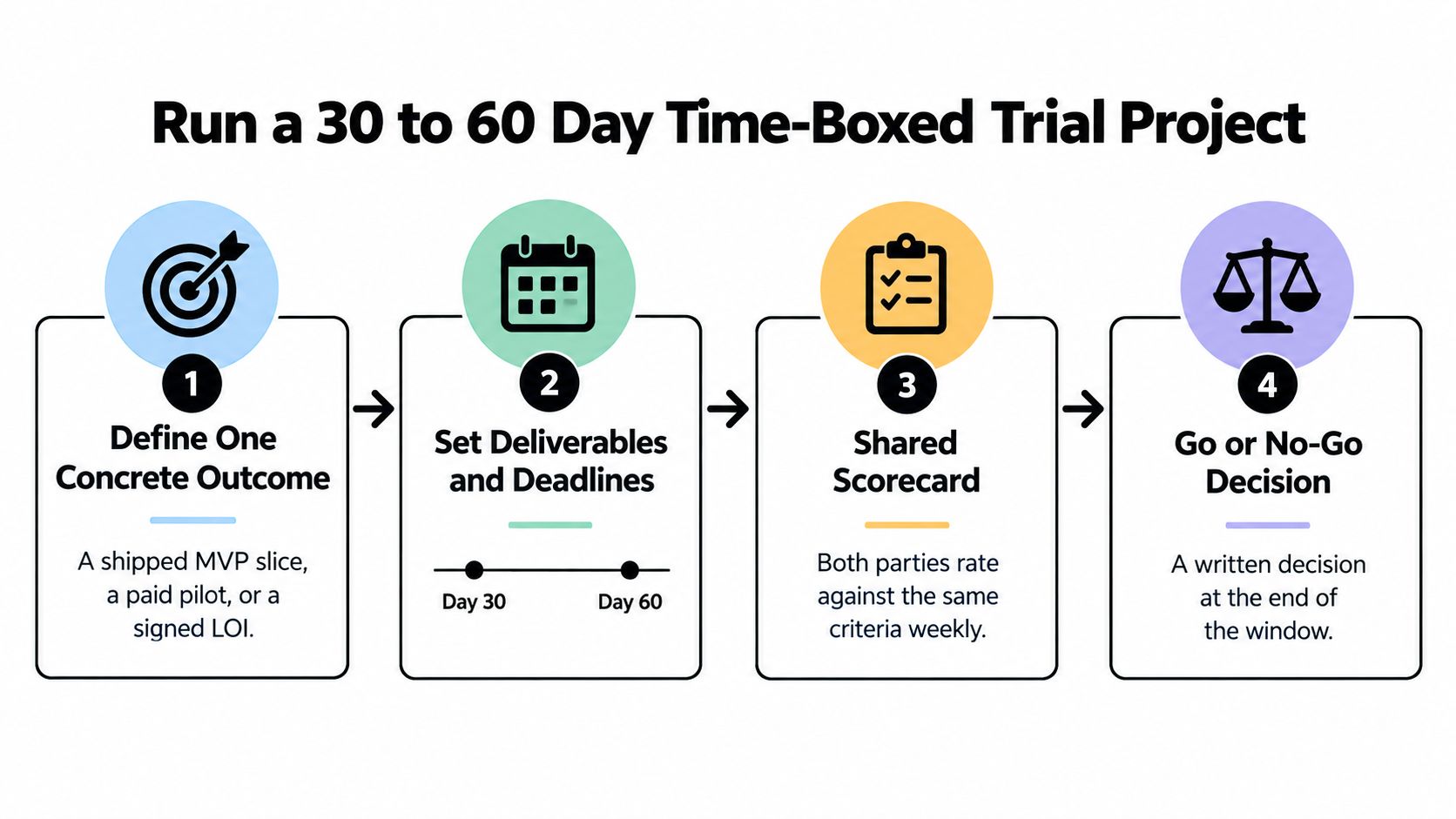
A trial should be a structured evaluation, not a friendship month. Set a clear window of 30 to 60 days, define the output, and decide in advance what would make you continue or stop.
Choose one concrete outcome
Pick one result that both founders can recognise. Suitable examples include:
- a shipped MVP slice
- a paid pilot
- a signed letter of intent
- a completed customer-validation package
- a defined fundraising milestone
Don't choose “make progress”. That phrase protects weak execution because nobody can agree what it means. A good outcome has an owner, a deadline, and evidence that the work exists.
Put the operating rhythm in writing
Use a shared document in Notion, Google Docs, or Linear. Record:
| Area | What to agree |
|---|---|
| Outcome | The single result the trial must produce |
| Ownership | Who makes each decision and completes each task |
| Cadence | Weekly sync time and progress update format |
| Evidence | What counts as completed work |
| Behaviour | Expected response times and escalation process |
| Decision | The pass, pause, or no-go conditions |
Rate output, reliability, communication, and decision quality, not personality or “vibes”. A charismatic founder who doesn't close tasks is still a risk. A quieter founder who consistently completes difficult work may be the stronger partner.
The Cofounder Fit assessment method uses 62 questions across eight dimensions, reverse-scored items, and pairwise comparison to create a 0-100 compatibility score. Its practical recommendation is more important than the score itself: work together on a real deliverable for 30 to 60 days before discussing equity, then seek references from people who have seen both candidates under pressure.
Keep the trial short enough to fit the legal and practical realities of your UAE arrangement. Check whether the person's current employment, freelance permissions, visa sponsorship, or employer obligations create restrictions. Don't allow unpaid work to drift into an undefined arrangement. Write the scope, ownership, expenses, confidentiality expectations, and exit process before the trial begins.
At the end, make a written go or no-go decision. If you continue, move to formal founder documentation. If you stop, close the project cleanly and return or delete shared materials as agreed.
Ask References About Pressure, Not Personality
LinkedIn endorsements won't tell you how a candidate behaves when a plan fails. Ask for references who worked with the person on a difficult project, such as a former cofounder, a manager during a crunch, a client who relied on their delivery, or a co-investor from a previous venture.
Ask the candidate to make the introduction directly. If they offer only people who have known them socially or who will provide polished praise, ask why. The quality of the reference matters more than the number of names.
Ask questions that force useful answers
Use three questions:
- How did they behave when the plan failed?
- What was their default approach during a real disagreement?
- Would you bet on them again in a high-pressure company? Why?
Then stop talking. Let the silence work. A reference's hesitation, carefully chosen wording, or refusal to answer directly can reveal more than an enthusiastic endorsement.
Ask for a specific example rather than a general opinion. “Are they reliable?” produces a polite answer. “Tell me about a deadline they missed and what happened next” gives you something to compare with your own observations.
Add a UAE or MENA reference
A cross-border career can look impressive while hiding practical differences in communication, operating pace, authority, and customer expectations. Where possible, speak with someone who has worked with the candidate inside the local ecosystem, such as a mentor connected to Hub71 or DIFC, or a peer from a previous MENA company.
Verify basic claims respectfully. Confirm previous roles, dates, responsibilities, and whether the person owned the work they describe. If you need help locating someone with a legitimate connection to a candidate, a professional service such as Sentry Private Investigators Ltd's tracing agents in London illustrates the distinction between lawful professional tracing and casual online searching. Don't use background checks to replace direct references, and don't seek private information without a proper reason and appropriate consent.
Reference test: Ask yourself whether the reference gave you evidence, or merely gave you permission to feel optimistic.
Treat Early Warning Signs as Decision Data
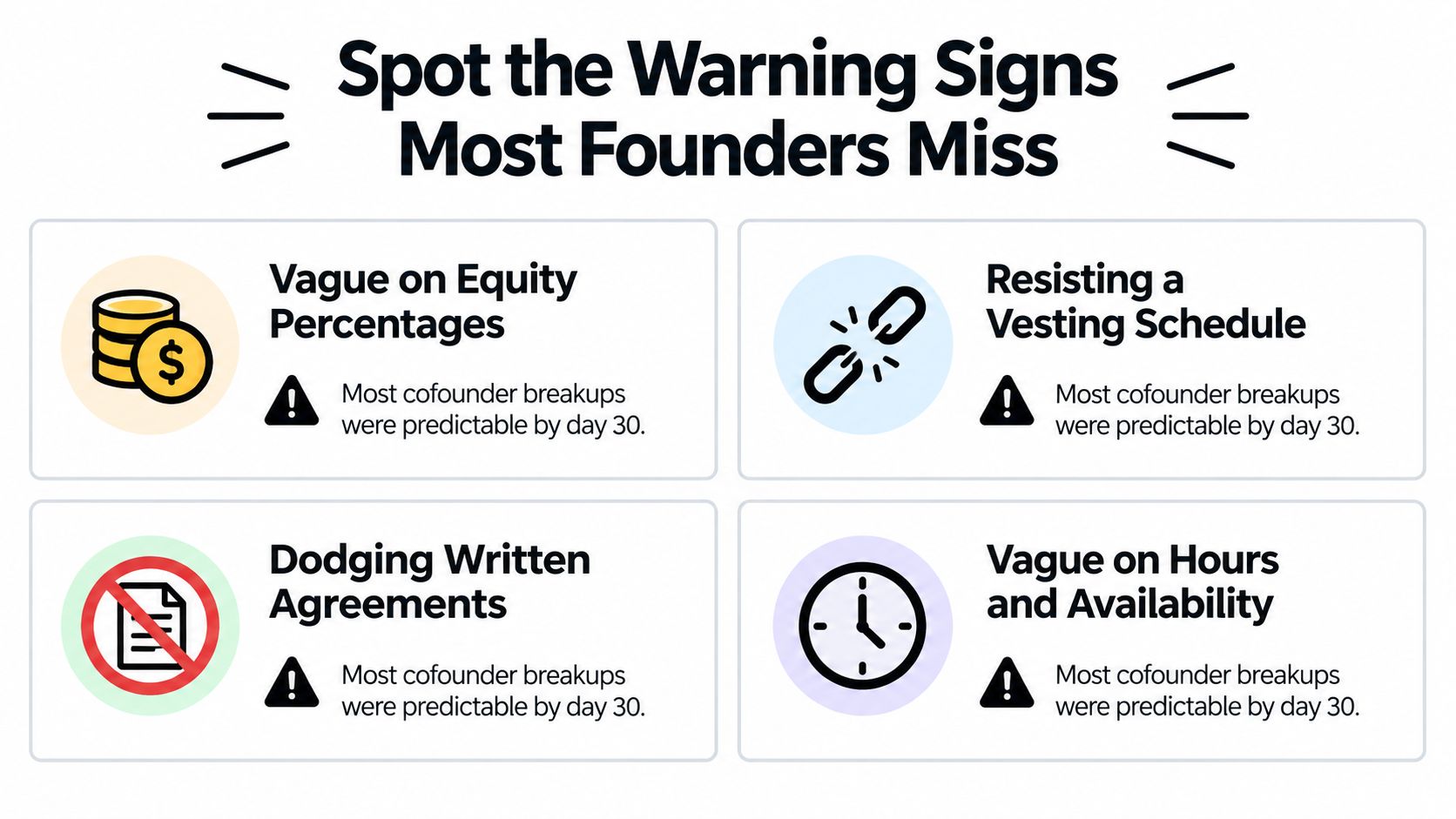
Most founders don't miss warning signs because the signs are invisible. They miss them because they explain them away after an exciting Meetup. Charm creates a story about potential. Vetting requires you to study behaviour.
Watch for these patterns
- Vague equity expectations: The candidate wants to be a cofounder but won't discuss ownership, contribution, dilution, or what “fair” means.
- Resistance to vesting: They want shares immediately and treat a vesting schedule as a sign that you don't trust them.
- Avoidance of written commitments: They agree verbally, then become evasive when you send a short summary.
- Unclear availability: They describe themselves as committed but won't state hours, start date, or competing obligations.
- Premature control requests: They ask for money, authority, access, or a title before delivering meaningful work.
- Refusal to run a trial: They want the relationship formalised before either of you has observed the other under pressure.
- Repeated blame: Every former cofounder, boss, client, or investor is described as incompetent or dishonest.
- Lifestyle mismatch: Their language suggests a demanding build, but their calendar supports only occasional coffee and Meetup appearances.
The most dangerous warning sign is urgency. A candidate who says you must incorporate immediately, split equity immediately, or start building immediately may be trying to bypass the very checks that protect both founders.
Your own discomfort also counts. Don't turn intuition into a verdict, but don't ignore it either. Write down what feels inconsistent, ask a direct question, and check the answer against references and trial behaviour.
If the concern remains and references can't explain it, walk away. Optimism isn't a vetting strategy. Pattern recognition is.
Put Equity, Vesting, and IP in Writing With a UAE Lawyer
Don't incorporate on a verbal promise. Before you assign meaningful work, sign a founder agreement with a UAE-qualified lawyer and align it with the company's Articles of Association and chosen structure, whether you're forming in a free zone or on the mainland. UAE-focused guidance recommends signing before or at incorporation so the company owns its core assets from day one.Dubai South Business Hub's founder agreement guidance
Start with the cap table and vesting
Draft the proposed cap table before the lawyer meeting. It should show founder ownership, any future pool you expect to create, cash or non-cash contributions, and the decision rights attached to the ownership structure.
A practical structure often uses three to four years of vesting with a 12-month cliff. Under a 12-month cliff, no shares vest during the first year, then 25% vests at month 12, with the remainder vesting monthly over the following 24 to 36 months.DIAC's UAE shareholder agreement guidance
That structure protects the company if someone leaves early. Ask the lawyer to explain voluntary departure, termination for breach, long-term incapacity, unreturned company property, and any acceleration provisions. If you want double-trigger acceleration, ask for a plain-English explanation of when it applies and whether it fits your structure.
Don't copy a US template and assume it works in the UAE. Your lawyer should explain how the proposed founder agreement interacts with the Articles of Association, free zone rules, mainland requirements, employment arrangements, and dispute forum.
Assign all IP to the company
The agreement should assign present and future intellectual property created for the venture to the company. It should also address work created before incorporation and work created outside the UAE, including code, designs, product documentation, domain assets, brand materials, customer lists, and inventions.UAE and DIFC founders' agreement guidance
Here founders create avoidable risk. A founder may build code while employed elsewhere, use a previous employer's materials, or develop assets before the UAE company exists. Ask the lawyer to identify what can legally be assigned, what must be excluded, and what permissions are required.
Take this checklist to the first meeting:
- draft cap table and proposed ownership split
- vesting schedule and cliff
- founder roles and decision rights
- leaver and exit triggers
- IP assignment for pre-incorporation and future work
- confidentiality and use of company information
- dispute and deadlock process
- treatment of company assets when someone leaves
- any restrictions connected to current employment
- alignment with the Articles of Association
UAE-focused legal guidance also recommends spelling out ownership, vesting, roles, exit terms, deadlock procedures, and IP ownership rather than leaving them informal.The Legal Rooms' guidance on founder agreements Ask your lawyer to explain any non-compete language, its practical limits, and whether proposed clauses are likely to withstand the relevant employment or court review. Get a written fee proposal based on your actual structure and complexity instead of relying on a generic template or an unexplained fixed figure.
For a fuller list of common omissions, use this guide to startup legal gaps in UAE founder agreements before your meeting. Legal paperwork won't fix a weak relationship, but it will expose assumptions while they can still be resolved.
Answer These Cofounder Vetting Questions Before You Decide
Should we split equity after the first conversation? No. Discuss the principles early, but don't finalise ownership before you have tested commitment, role fit, and execution. Equity should reflect a documented agreement, not the emotional high of a successful Meetup.
Can a cofounder keep a full-time job during the trial? Possibly, but only if both founders state the arrangement clearly. Compare hours, availability, employer restrictions, conflicts of interest, visa position, and the point at which the venture becomes their primary commitment.
What should we test during the trial? Test the work that the company actually needs. For a technical founder, that might be a defined product slice. For a commercial founder, it might be customer discovery, a paid pilot, or a partnership pipeline. Use one concrete outcome and a shared scorecard.
How many references should we ask for? Ask for references who have seen the person under pressure, not merely people who like them. One detailed conversation can be more useful than a list of generic endorsements, especially when the reference gives specific examples and answers uncomfortable questions directly.
Should we choose a cofounder from the same country? Not automatically. Cross-border fit must include time zones, relocation, visa sponsorship, jurisdiction, customer access, and local networks. In one founder-matching analysis, 55% of actual matches occurred within the same country and 69% within the same continent, despite many founders saying location should not matter.Siift's analysis of cofounder matching Treat location as an operating question, not a preference.
Does diversity belong in cofounder vetting? Yes, but never as a token exercise. Dubai Chamber ecosystem data tracks female founder and cofounder representation between 35% and 43% in one segment and between 6% and 20% in another, with some ecosystems showing only one female founder.Dopamine Capital's regional startup partnership analysis Ask whether the founding team has the perspectives, networks, and governance needed to spot blind spots.
When should we walk away? Walk away when the person refuses written commitments, rejects a fair trial, avoids references, demands premature control, or repeatedly behaves unlike the founder they claim to be. A promising idea is replaceable. A damaged cap table and an entrenched cofounder dispute are much harder to remove.
Founder Connects helps UAE and MENA founders build meaningful relationships through curated introductions, small peer groups, moderated sessions, and practical accountability. If you want more high-signal conversations before choosing a partner, visit Founder Connects and take the next cofounder conversation beyond Meetup chemistry.

Building in MENA? You don't have to do it alone.
Join 300+ founders in the Founder Connects Residency. Monthly squad calls, warm intros, $3M+ in perks, and much more. All for less than your monthly coffee budget.
Popular posts





Founder Connects is a premium MENA tech founder community. Meetups in Dubai and across MENA, Residency Squads of 8–10, and 400+ vetted WhatsApp founders (apply and screened).