

Communication Skills for Technical Founders: A 2026 Guide

Building in MENA? You don't have to do it alone.
Join 300+ founders in the Founder Connects Residency. Monthly squad calls, warm intros, $3M+ in perks, and much more. All for less than your monthly coffee budget.

You can build elegant product code and still lose the room in the first thirty seconds. That happens often for technical founders in the UAE, where you might be speaking to an investor in Dubai, a customer in Riyadh, and a hiring candidate who needs the value explained in plain business terms, fast. In a market that had about 13,000 startups in 2024 and a Dubai target to increase startups by 20% by 2033, communication stops being a nice extra and becomes a growth lever, because every conversation has to translate technical work into a decision someone else can act on, as described in Founder Connects' UAE startup market context.
Why Your Code Does Not Speak for Itself
A clean architecture diagram does not close a round. A detailed product demo does not automatically make a buyer care. The gap for most technical founders isn't product intelligence, it's translation.
In the UAE and wider MENA market, that translation matters more because the audience is mixed by default. You're often speaking across founders, operators, investors, regulators, and customers who don't share your technical background, and regional founder communication guidance makes the point plainly, explain what the product changes, not just what it does. That's the shift that turns a feature dump into a business case.
This is why communication skills for technical founders are not a personality issue. They're an operating advantage. If you can say, in one clean line, what pain you remove and what outcome becomes possible, you've already improved trust, relevance, and speed.
Practical rule: if your listener can't repeat the value back in their own words, your message isn't ready yet.
The hardest part is that technical founders often over-index on precision and under-index on relevance. Precision matters inside the team. Outside the team, relevance wins. The market does not reward the most detailed explanation, it rewards the clearest decision path.
That's the reason communication is tied to scaling in the UAE. Not because founders should become polished speakers, but because the ecosystem is getting denser, faster, and more competitive. If you can't make the value obvious, someone else will.
A useful test is simple. Read your pitch, then ask whether it sounds like a product description or a business change. If it sounds like the first one, rewrite it.
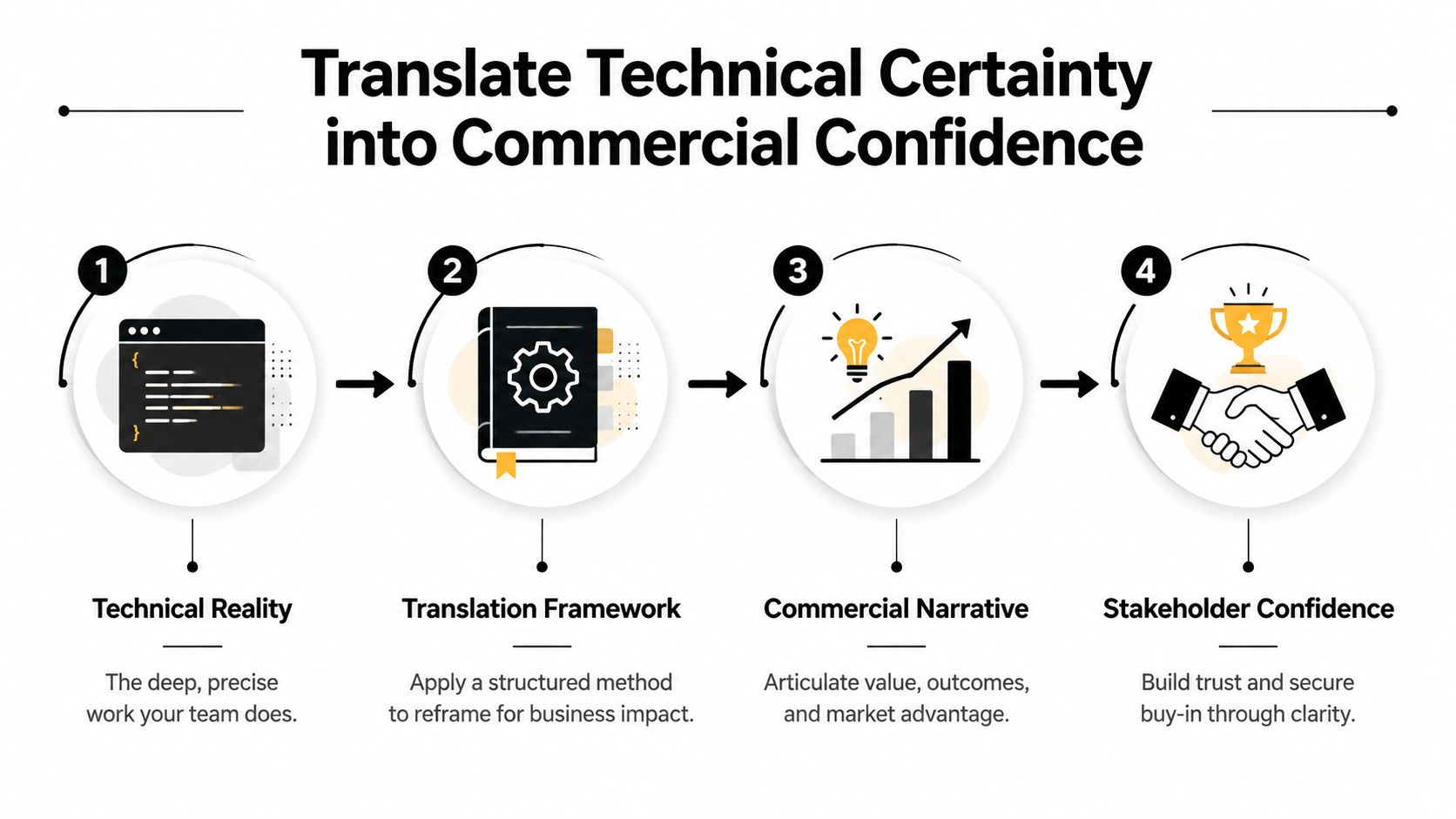
Translate Technical Certainty into Commercial Confidence
The fear is familiar. Simplify too much, and you sound vague. Explain too much detail, and you lose the room. The answer is not to flatten the work, it's to sequence it better.
Use problem first, then mechanism
Start with the customer's problem in their language. That means naming the pain before you name the product. In practical terms, the first sentence should sound like a business issue, not a codebase summary.
Then add the impact. What happens when the problem stays unsolved, and what changes if it's fixed. That's the bridge from technical certainty into commercial confidence, and it's the part many founders skip when they rush to explain the architecture.
Only after that should you explain the mechanism. Keep it short. You're not hiding the tech, you're giving it a place in the story. The listener needs enough detail to trust the solution, not enough detail to get lost in it.
The simplest working model is:
- Problem. What's broken for the buyer right now.
- Audience language. How that buyer already talks about the pain.
- Evidence. What proves your approach works.
- Next step. What you want them to do now.
This is the same logic behind audience-calibrated communication in Founder Connects' pitch guidance, where the point isn't to perform knowledge, it's to create clarity fast. For a technical founder in Dubai Internet City or Abu Dhabi, that means resisting the urge to lead with APIs, models, or infrastructure unless the listener has already asked for that level of detail.
What to say instead
Use phrases that convert features into outcomes:
- Instead of: “We built an automated workflow engine.”
Say: “We help teams remove manual handoffs that slow delivery.” - Instead of: “Our system uses advanced data processing.”
Say: “Customers get faster decisions with less internal back-and-forth.” - Instead of: “We've improved the underlying stack.”
Say: “The product is easier to deploy and simpler to trust.”
That isn't overselling. It's translation.
A useful contrast sits in one sentence. Technical certainty tells you the product works. Commercial confidence tells the listener why it matters now. Founders who can make that jump tend to hold attention longer, especially with skeptical non-technical stakeholders who don't want a lecture, they want a decision.
Mastering Investor vs Customer Conversations
Investors and customers may both ask hard questions, but they're not asking for the same thing. Investors want to know whether the business can de-risk and scale. Customers want to know whether the pain goes away and the product is worth the switch.
Lead with the wrong frame and you lose momentum. A founder who talks to a buyer like an investor sounds abstract. A founder who talks to an investor like a buyer can sound narrow. The fix is not a new personality, it's a different conversation shape.
| Communication Focus Investor vs Customer | Investor Conversation Goal De-Risking | Customer Conversation Goal Problem Solving |
|---|---|---|
| Opening line | Market pain, why now, why you | Current workflow pain, what breaks today |
| Language | Scale, defensibility, execution, efficiency | Time saved, fewer errors, easier adoption |
| Evidence | Traction, clarity of logic, team ability | Demo, use case, workflow fit, outcomes |
| Main concern | Can this become a durable business | Will this solve my problem fast enough |
| Close | Next diligence step, deeper follow-up | Trial, pilot, purchase, implementation |
A UAE SaaS founder selling to a logistics company in JAFZA should not talk to the buyer the same way they talk to a seed investor in DIFC. The buyer wants to know where the friction sits today, how quickly teams can adopt the tool, and whether it will fit their current workflow. The investor wants to know whether that same workflow pain exists broadly enough to support a durable business.
For both audiences, the same communication protocol works. Start with the problem, then match the audience's language, then show evidence, then end with a next step. That structure is especially useful in the UAE's mixed-audience environment, where one meeting can include both commercial and technical decision-makers and jargon can bury trust before the question surfaces, as outlined in this founder communication framework.
“If they don't understand the problem, they won't remember the product.”
That line matters because many technical founders accidentally over-explain the mechanism and under-explain the consequence. Investors can forgive missing detail if the logic is sharp. Customers can forgive limited technical depth if the outcome is obvious. Neither group tolerates confusion for long.
A reliable script for investors is: “The market has a repeatable pain, our product removes that friction, and the team is set up to execute.” A reliable script for customers is: “Your current process creates delays or cost, this product removes that problem, and here's what implementation looks like.” Different goal, different emphasis, same discipline.
The common failure is one-size-fits-all pitching. It wastes meetings, creates awkward follow-up questions, and forces the listener to do the translation work your startup should be doing.
How to Tell a Story with Your Data
Data without narrative turns into a spreadsheet. Narrative without data turns into opinion. Technical founders need both, and they need them in the right order.

The cleanest story shape is simple. Start with the old way, move to the insight, then end with the new way. That structure works whether you're writing an investor update, presenting in a board meeting, or speaking to your team on a Monday morning.
The old way
Describe the accepted pain. This is the manual process, the duplicated work, the endless follow-up, or the slow approval chain everyone tolerated before your product existed. Keep it close to the workflow so the audience recognises itself immediately.
The insight
This is the moment your team understood the problem differently. Maybe the bottleneck wasn't speed, but visibility. Maybe the issue wasn't data, but handoffs. The point is to show why your approach is different, not just newer.
The new way
Now show the better future your product creates. Keep the language commercial, not internal. A strong data point becomes meaningful when it sits inside a story about less friction, cleaner decisions, or a faster path to value.
That's also where a strong presentation resource like storytelling in speeches can help founders think about rhythm and sequence, not just slides. Story structure matters because stakeholders remember change, not raw input.
A practical example: if a product milestone reduced setup complexity, don't present it as an engineering win alone. Present it as a step toward faster onboarding, lower confusion, or easier adoption. Same fact, better meaning.
You can use that approach in three places:
- Pitch decks. Turn each slide into part of the company's unfolding logic.
- Investor updates. Show what changed since the last update and why it matters.
- All-hands meetings. Connect technical progress to customer value and company direction.
That same discipline helps founders prepare for demo day strategy and investor engagement, where the story has to move quickly and still feel credible. If the audience can follow the arc, they're more likely to remember the business.
A strong rule here is to avoid listing achievements like isolated trophies. Stack them into a timeline of progress. Once your team learns to speak that way, your metrics stop sounding like vanity and start sounding like momentum.
Build Communication into Your Operating System
Inside a scaling startup, bad communication rarely looks dramatic. It looks like a missed priority, a vague owner, a decision that got “circulated” but never landed, or a team that leaves the meeting with different interpretations of the same brief. That's execution debt.
Treat meetings like decision tools
If a meeting does not end with a decision, a named owner, and a next step, it was probably too loose. Technical founders often run meetings as updates, then wonder why nothing moves. The fix is to make each meeting carry one job.
Use a simple opening line: “What decision do we need by the end of this conversation?” That question cuts through status theatre fast. It also helps commercial and engineering teams stay aligned when they're solving different parts of the same problem.
Write more than you speak
Written communication preserves context. It also protects teams from memory drift, which gets worse as headcount rises and time zones multiply. If a decision matters, write it down in plain language.
Good written communication in a startup is short, direct, and searchable. It's a note after a customer call, a decision log after a product meeting, or a clear brief before a handoff. The point isn't documentation for its own sake, it's making sure the team can work without re-asking the same questions.
Use feedback to reduce friction
Feedback is not a personality test. It's a tool for keeping the company honest. Give it early, keep it specific, and tie it to observed behaviour, not character.
A useful format is:
- Observation. What happened, without interpretation.
- Impact. Why it mattered to the project or team.
- Request. What you want done differently next time.
That structure works in multicultural teams because it stays concrete. In the UAE and wider MENA region, where teams are often multilingual and cross-functional, that kind of clarity prevents ambiguity from turning into silence.
For founders looking for a practical community to practise these habits with peers, Founder Connects is one option that combines peer groups, moderated check-ins, and founder-to-founder introductions. The value isn't noise, it's repetition with accountability.
The bigger point is simple. Communication inside the company is not separate from growth. It is the coordination layer that keeps the rest of the company from slowing down.
A Practical Plan for Measurable Improvement
Communication gets better the same way product quality gets better, through repetition, review, and tighter standards. The fastest improvement comes from practising on low-stakes conversations before you need the skill in a high-stakes room.
Start with one framework. Use the Problem, audience language, evidence, next step sequence in your next customer call or investor intro. Keep it brief enough that you can remember it under pressure.
Then record yourself. Watch the replay and check for three things, whether you started with the problem, whether you used your listener's language, and whether you ended with a clear ask. Many founders are surprised by how much filler shows up when they speak live.
You can also practise with peers. A founder group like Founder Connects is useful here because it gives you a real audience, not just a polite one. Role-play the same pitch twice, once for an investor and once for a customer, then ask which version made the value clearer.
Practical rule: if you can't explain it simply in a rehearsal, you won't explain it clearly in a meeting.
Measure the work by business outcomes, not just comfort. Watch for shorter sales cycles, fewer follow-up clarifications, cleaner meeting decisions, and better alignment between engineering and commercial teams. Those are the signs that communication is becoming a real operating system, not just a polished surface.
Founders who invest in their message often see that work carry into their broader market presence too. If you're also thinking about public-facing content, content marketing for SaaS companies is a useful complement because it forces the same discipline, clear audience, clear pain, clear value.
Pick one meeting this week and test one framework. Don't wait until the next round, the next launch, or the next hiring sprint. Communication skills for technical founders improve through use, and the best time to start is before the room gets bigger.
Founder Connects helps UAE and MENA founders build the kind of communication muscle that moves the business, through peer groups, founder-to-founder introductions, and high-signal conversations. If you want practical feedback, accountability, and a stronger way to practise the hard conversations that come with building, visit Founder Connects.

Building in MENA? You don't have to do it alone.
Join 300+ founders in the Founder Connects Residency. Monthly squad calls, warm intros, $3M+ in perks, and much more. All for less than your monthly coffee budget.
Popular posts





Founder Connects is a premium MENA tech founder community. Meetups in Dubai and across MENA, Residency Squads of 8–10, and 400+ vetted WhatsApp founders (apply and screened).