

How to Give Better Startup Pitches That Win in the UAE

Building in MENA? You don't have to do it alone.
Join 300+ founders in the Founder Connects Residency. Monthly squad calls, warm intros, $3M+ in perks, and much more. All for less than your monthly coffee budget.

Investors don't spend long deciding. DocSend-based analyses showed the average pitch deck viewing time dropped from 3 minutes 44 seconds in 2021 to 2 minutes 24 seconds in 2024, a 24% decline (pitch deck statistics). In practical terms, that means your first slides need to do the heavy lifting, because in UAE and MENA meetings you're usually earning the right to continue, not closing the room with polish.
The problem with most startup pitches isn't that the slides look weak. It's that the founder makes the audience work too hard to understand the business, the traction, and why now matters. A slick deck can't rescue a confused opening, and a confident founder can't rescue a deck that buries the point until slide eight.
Why Most Startup Pitches Fail Before the Deck
The first minute decides more than founders want to admit. Analysts at pitch deck statistics found that the first 3 slides drive about 70% of the investment decision. In the UAE and wider MENA market, that means you need to put traction, market size, and team credibility up front, because investors are sorting signal from noise fast.
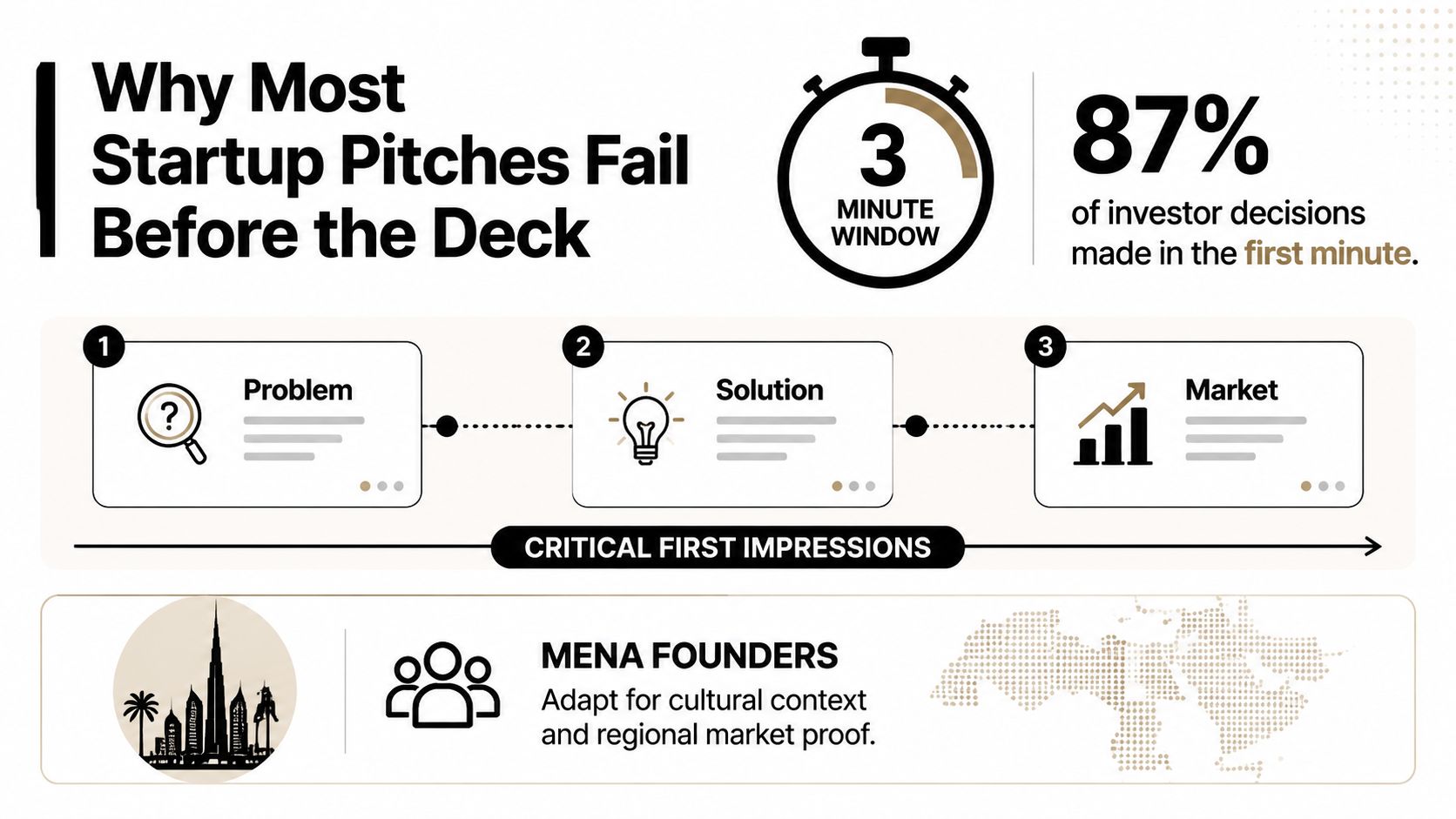
The real failure is structural
Founders keep blaming the slide design. The problem is usually the structure of the conversation. If the investor cannot tell what you do, who pays, and why the opportunity matters in the first minute, the deck is already behind.
Microsoft's pitch guidance says a technically stronger startup pitch should start with a 30 to 60 second opening, then move through one idea per slide with a verbally led narrative (Microsoft pitch guidance). That is how you keep control. The slides support the explanation, they do not replace it.
Practical rule: if someone has to read three slides to understand the business, the pitch is too slow.
Warm intros matter, but only after clarity
In the UAE, a warm introduction can get you into the room, especially if it comes through the right network. It does not rescue a fuzzy story. If the first meeting turns into a scavenger hunt for the business model, the intro loses value fast. The founder still has to make the first minute easy to follow.
Founders who rely on long explanations usually bury the core risk. Founders who lead with the problem, the solution, and visible demand make the room easier to work in. If you want the logic behind stronger intros into investor conversations, see warm introductions to investors in the UAE.
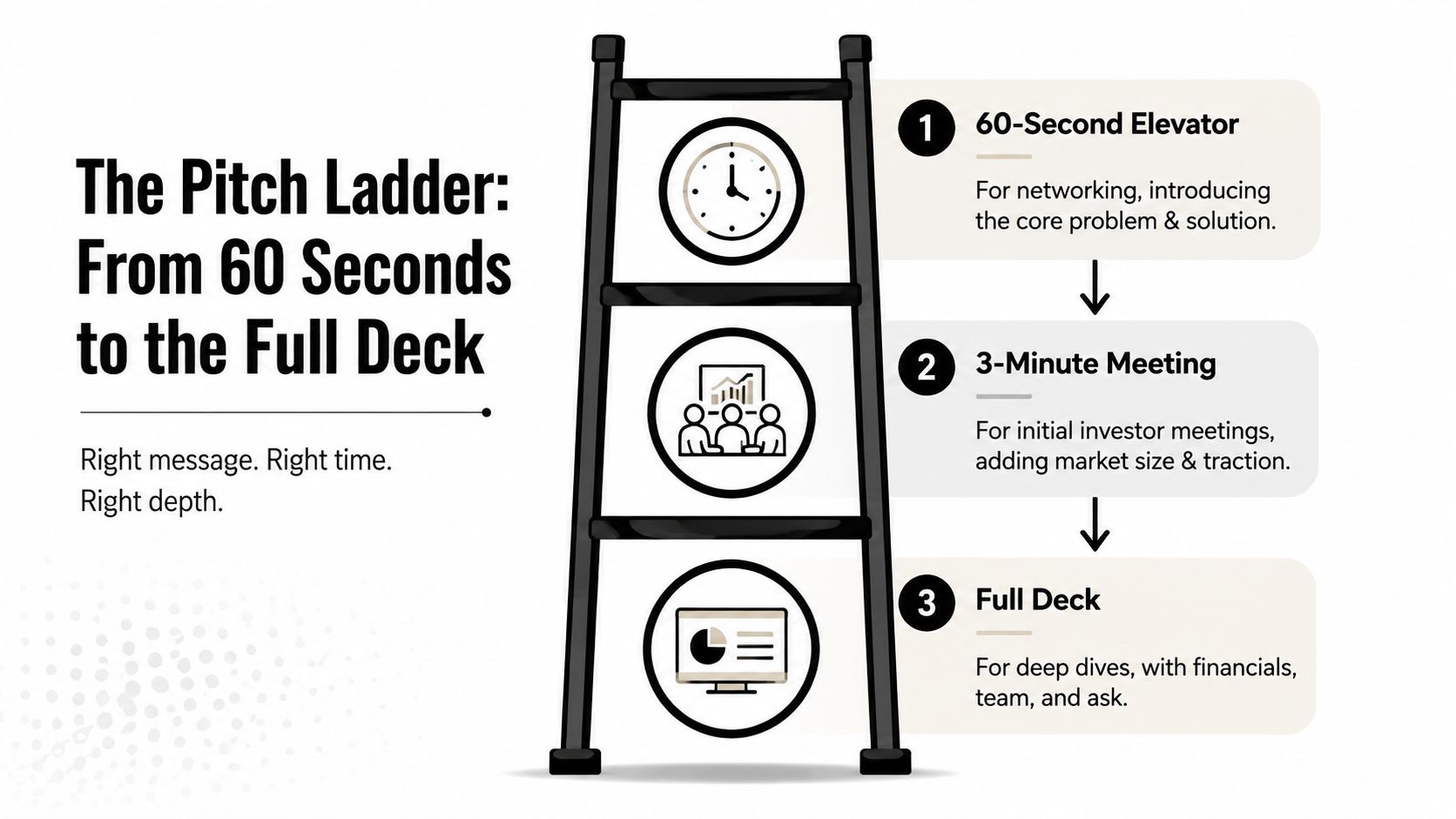
The pitch should work in layers. Start with the 60-second version for live conversations, move to the 3-minute version for first meetings, then let the deck version handle follow-up diligence. Build it that way and you stop improvising under pressure.
The Pitch Ladder from 60 Seconds to the Full Deck
A single script is a mistake. Different rooms need different depth, and strong founders treat the pitch like a ladder, not a monologue. The job is to keep one story intact while changing how much detail you give.
Use the 60-second version in live conversations
The 60-second pitch is for networking events, intros, partner mixers, and those quick conversations in Dubai or Abu Dhabi where nobody wants a full narrative. A fintech founder at a Founder Connects-style spotlight meetup should be able to say what the company does, who it serves, and what pain it removes without drifting into product architecture.
Keep it tight. One sentence for the problem, one for the solution, one for the buyer. If the person across from you wants more, you have earned the next minute.
Use the 3-minute version in first meetings
The 3-minute pitch belongs in first investor calls, ecosystem spotlights, and demo-day style rooms like a Hub71 session. This version needs more structure, not more clutter. You are still leading with the problem and solution, then adding traction and market context only if they make the case sharper.
Microsoft recommends rehearsing at least 10 times for a 3-minute investor pitch, and it also recommends at least one hour of practice for every minute of pitch time (Microsoft pitch guidance). Treat that as preparation, not polish. If you cannot deliver the 3-minute version cleanly under pressure, you are not ready for investor rooms.
Use the full deck for diligence
The full deck is for the second conversation, the deeper partner meeting, or the investor who already sees the shape of the opportunity and now wants proof. Venture Atlanta recommends keeping the deck to around 10 slides, using 2 to 3 direct competitors only, and limiting text so no more than 1/4 of slides are filled with text (Venture Atlanta startup pitch tips).
A regional VC, a corporate partner, and a customer do not want the same depth on the first pass. The ladder keeps you from over-explaining too early and under-explaining when the room is ready. In the UAE and wider MENA market, that matters even more because investors listen for traction signals that sit outside revenue, repeat conversations, channel pull, customer meetings, partner interest, and any sign that the market is leaning in before the numbers fully show it. That is how to give better startup pitches without turning every meeting into a lecture.
Storytelling Framework That Lands Within 40 Seconds
Harvard Innovation Labs says the strongest pitch arc starts with the founder's why, gets to the problem quickly, and lands the core message within the first 40 seconds (Harvard Innovation Labs storytelling guide). That order works. In UAE and MENA rooms, investors do not wait for a slow build, and they do not reward founders who hide the point behind product language. State the reason the company exists, name the problem fast, and make the room care before attention drops.
Start with the founder's reason, then compress the problem
Your personal motive is not a biography and it is not therapy. Use it to show why you saw the problem earlier, or more clearly, than the people already living with it. Then move straight into the pain point and identify the buyer without delay.
A logistics founder in JAFZA could open like this, in spirit: “We saw SME exporters losing time to customs friction, and we built software that helps them clear documents faster.” That works because it tells the audience who is hurting, where the friction sits, and what the company does in plain language. It also fits the region. UAE investors hear a lot of product talk, and they respond better when the founder ties the story to a real operational pain they recognize.
Use data to reinforce, not to drown the story
Stripe's pitching guidance pushes founders to use real data, cite metrics correctly, and include a prototype when possible (Stripe Atlas pitching guidance). Use that discipline after the story is clear. Data should answer the listener's doubt, not replace the explanation.
Data should answer the listener's doubt, not replace the explanation.
Keep one idea per slide, and let the narrative do the heavy lifting in the room. If the audience has to work out the business model late, you have already made the pitch harder than it needs to be. Say what the company solves, who feels the pain, and what proof you have that the market is already leaning in. In this region, that proof can be repeat customer conversations, partner interest, channel pull, pilot demand, or other traction signals that sit before full revenue.
The strongest founders sound calm, not theatrical. They state the problem, they name the customer, and they move on. That makes the company feel understood, and understood companies get more serious follow-up.
The Deck Blueprint Investors Read
The deck investors read is a decision document, not a brand brochure. Start with a precise structure, keep the text light, and give the room enough evidence to lower risk without burying it in detail.
The 10-slide spine
A clean 10-slide structure works because it forces discipline. Here's the order that holds up in real meetings:
| Slide | Purpose | Discipline Rule |
|---|---|---|
| Problem | Define the pain and who feels it | Make it concrete, not abstract |
| Solution | Show the product's direct answer | One idea only |
| Traction | Prove momentum or signal demand | Use evidence, not hype |
| Market | Show the wedge and regional relevance | Avoid bloated TAM language |
| Competition | Map alternatives clearly | Keep it to 2 to 3 named competitors |
| Business Model | Explain how money comes in | Keep the logic simple |
| Team | Prove why this team can win | Lead with credibility, not bios |
| Ask | State what you need | Make it specific |
| Use of Funds | Tie capital to milestones | Show what changes after funding |
| Milestones | Define near-term execution | Make progress measurable |
That structure fits what investors in the UAE generally want to see. It also matches how many reviewers read decks, they skim first, then come back only if the early slides are sharp.
Traction before revenue still counts
A lot of founders think traction only means revenue. That is too narrow for the UAE market, especially at earlier stages. Signed pilots, waitlist conversion, repeat usage, partner LOIs, and direct access to decision-makers all count when they clearly reduce uncertainty.
Regional pitch quality rises or falls here. You do not need revenue to look credible. You need proof that buyers, partners, or operators are leaning in for reasons that matter.
What to leave out
Cut oversized product screenshots unless they explain the point instantly. Cut vague market sizing if you cannot tie it to a real buyer and a believable wedge. Investors close decks early when founders try to prove too much at once.
If you need a sharper deck conversation for angel meetings, see how to pitch UAE angel investors. The same rule applies there, lead with proof, not decoration.
The deck is not the pitch. It is the evidence trail behind the pitch. If you treat it like that, you stop wasting slides on explanations the room does not need.
Tailoring the Pitch to Investors, Partners, and Customers
A founder who keeps the same script for every room usually loses all three. Investors want proof of demand and a path to scale. Partners want to know why your company helps their channel, brand, or distribution. Customers want to know if the product solves a real problem without creating extra work.
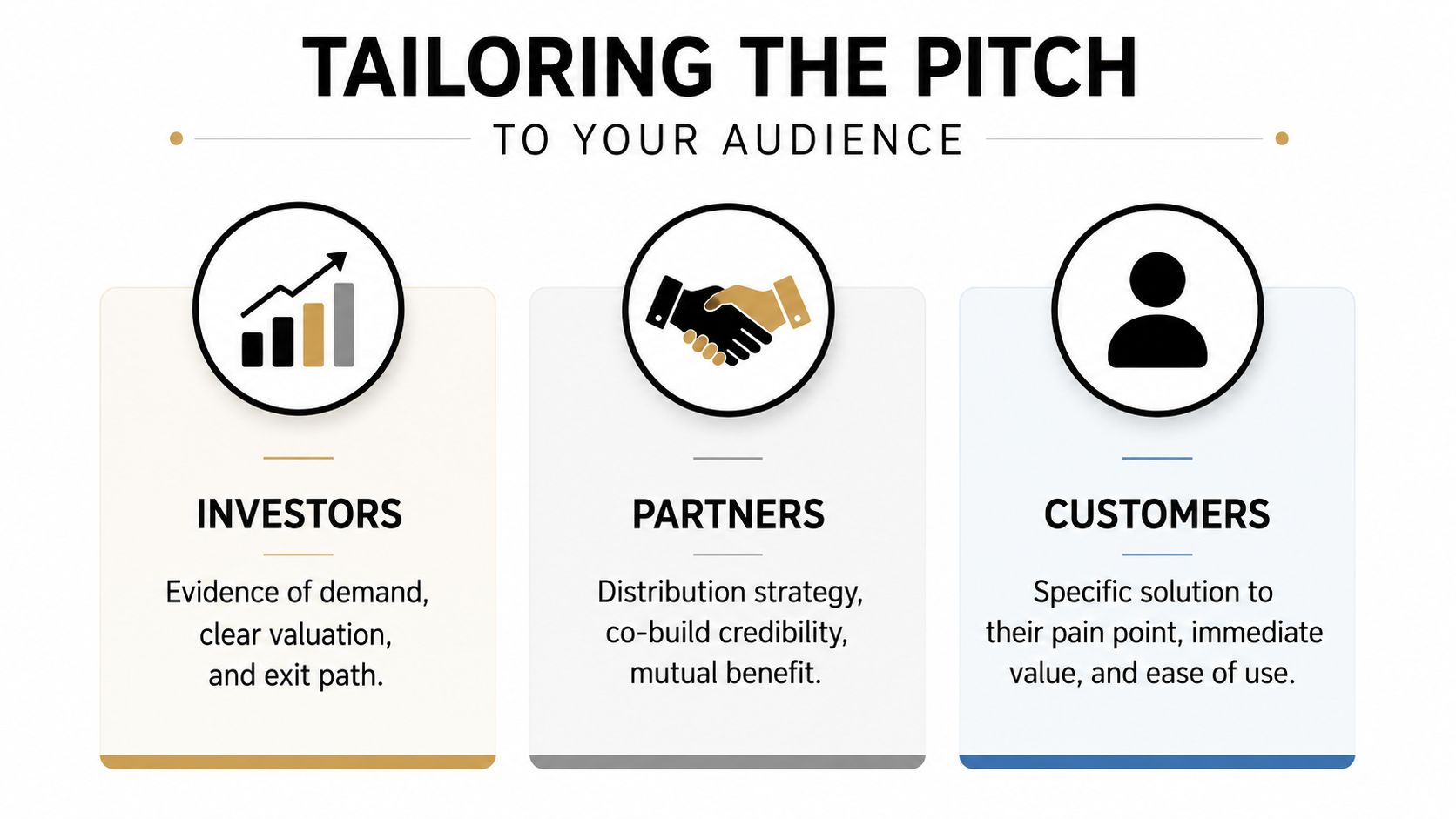
Different rooms, different proof
| Audience | Top proof point | Main risk question | What should change |
|---|---|---|---|
| Investors | Evidence of demand and a believable path to scale | Why will this win now and keep winning? | Emphasise traction and market wedge |
| Partners | Distribution value and co-build credibility | Why should we attach our name or channel? | Highlight mutual benefit and integration |
| Customers | Clear problem solved and easy onboarding | Will this actually save us time or money? | Focus on workflow and adoption |
A Dubai-based family office may care more about stability, founder credibility, and whether the business can scale without chaos. A regional distributor wants to know if your product helps them move more volume with less friction. A B2B buyer in Saudi wants to know if onboarding will create pain or remove it.
Adjust the opening and the proof slide
The deck can stay largely the same, but the first minute should not. For investors, lead with the market pain and traction. For partners, lead with how you help each other. For customers, lead with the specific job they need done.
Founders waste rooms by opening with the wrong proof. One audience wants signal on demand, another wants signal on distribution, and another wants signal on adoption. If you pitch all three the same way, the room stops listening because the evidence does not match the buyer.
In relationship-driven markets, proof travels through people as much as through metrics. That is why you should tailor the pitch without rewriting the business. For a sharper angel-investor frame, use this guide to pitching UAE angel investors as a check against your current script.
The rule is simple. The deck is the same, the opening and proof slides are not. That keeps your story consistent without making it generic.
Handling Q&A, Rehearsal Math, and Follow-Up Strategy
Q&A is where weak preparation shows up fast. In UAE and MENA rooms, founders usually face three kinds of questions, and each one needs a different response. If you treat every question the same way, you sound polished and unready at the same time.
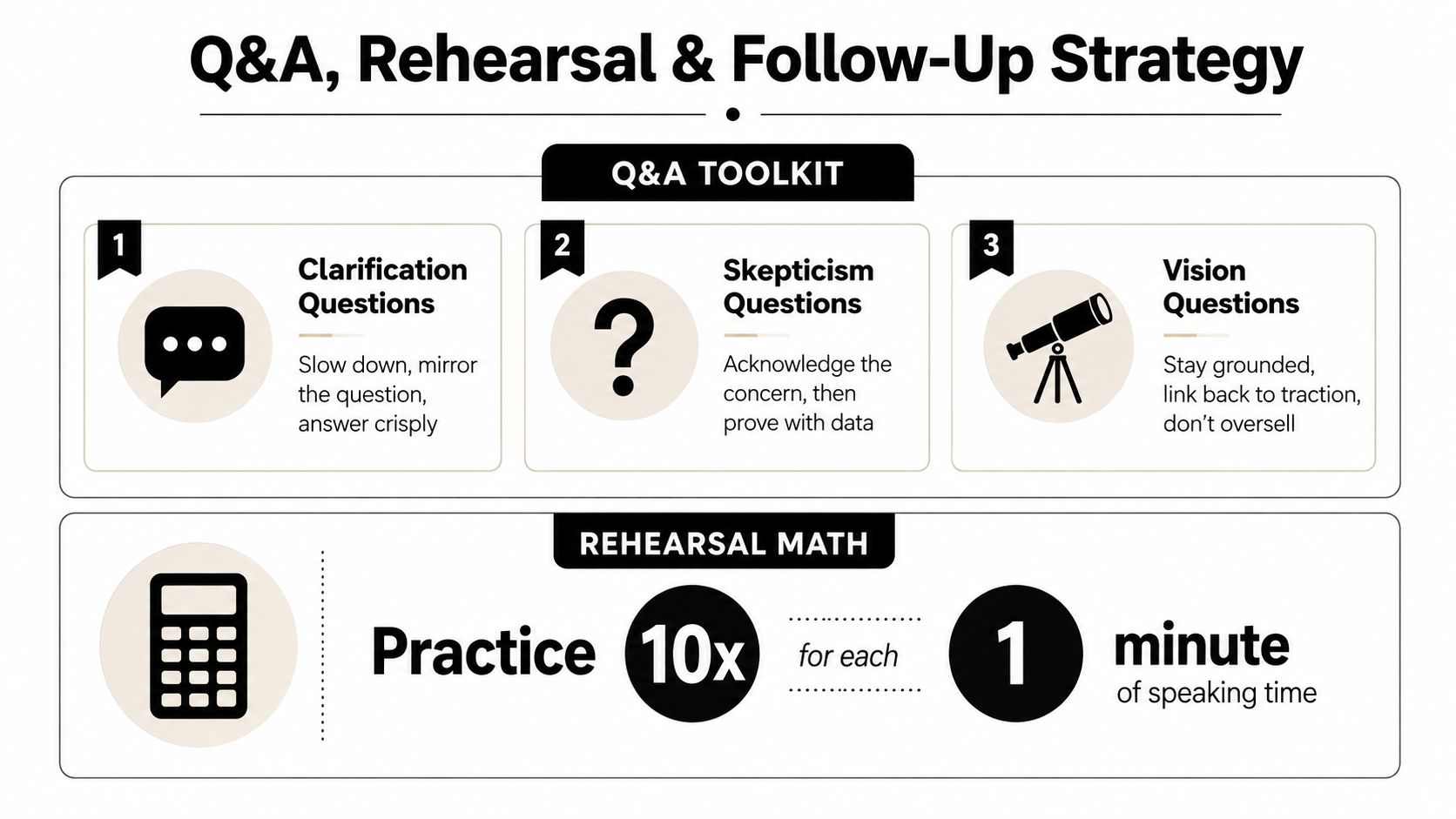
Sort every question before you answer it
Clarification questions call for speed and precision. Mirror the question, answer in one clean sentence, and stop.
Scepticism questions call for acknowledgement first, then proof. Do not get defensive, just show the evidence that matters.
Vision questions call for restraint. Stay grounded and tie the answer back to traction instead of stretching into a bigger story than your company can support today.
The fastest way to lose a room is to treat a sceptical question like an argument you have to win.
Rehearsal is a measurable job
Do the work before the room does it for you. A common industry benchmark is roughly one hour of practice for every minute of pitch time, and strong founders still run the deck enough times that the delivery stops sounding memorised and starts sounding natural. If your pitch is for investors, spend the time. If it is for partners or customers, spend it anyway, because the first rough answer usually sets the tone for the whole conversation.
A 20-minute investor pitch needs real conditioning, not a quick read-through. You should know where you stumble, where you ramble, and where your proof gets thin. That is the point of rehearsal, remove the weak spots before they become visible in front of capital.
A workable week for a UAE founder looks like this:
- Day 1: draft the 60-second version and read it out loud twice.
- Day 2: stress-test the problem slide with a peer who can interrupt you.
- Day 3: record the pitch, then listen back without watching the screen.
- Day 4: build the deck outline and cut any slide that repeats another.
- Day 5: rehearse the 3-minute version three times in a row.
- Day 6: run a mock Q&A with two hard questions you do not like.
- Day 7: lock the follow-up template and the one-page summary.
For founders who want a structured practice loop, a moderated peer group such as Founder Connects helps because the format forces blunt feedback, repeated practice, and real introductions. If you are preparing for a room full of investors, the demo day investor engagement checklist is a useful way to pressure-test what happens before, during, and after the pitch.
Follow-up decides whether momentum survives
Send the right deck version within 24 hours, attach a one-page summary, and state the next ask clearly. A vague thank-you note wastes momentum. A focused follow-up keeps the conversation alive and tells the investor you know how to run a process.
Book the second meeting before you leave if the room is warm enough. In relationship-heavy markets, the founder who makes the next step easy often beats the founder with the flashier delivery.
Three rituals separate closers from time-wasters. A tight opening. A clean answer to the hardest question. A follow-up that makes the next meeting obvious. Everything else is decoration.
Your 7-Day Practice Sprint and Next Action
Use one week to turn a rough pitch into a usable one. Don't wait for a perfect deck. Build the muscle first, then polish the surface.
A simple seven-day sprint
- Day 1, write the 60-second version. Keep it to the problem, the buyer, and the solution.
- Day 2, pressure-test the problem slide. Ask a peer to tell you where the pain feels weak or generic.
- Day 3, record yourself. Watch once, then listen once. You'll hear the filler immediately.
- Day 4, build the 10-slide outline. Don't design yet, just lock the order and the purpose.
- Day 5, rehearse the 3-minute version three times. Treat each run like a real investor call.
- Day 6, run mock Q&A. Bring two questions that make you uncomfortable and answer them anyway.
- Day 7, finalise the follow-up note. Include the summary, the ask, and the next meeting proposal.
The point of the sprint is not perfection. It's to remove the obvious friction before your next live conversation.
Use a small peer group properly
A moderated founder group works best when people are blunt and specific. Don't ask for “thoughts”. Ask which slide lost them, which proof point felt thin, and which sentence they'd cut first. That kind of feedback is what sharpens a pitch in the UAE, where trust and clarity carry real weight.
If you only do one thing this week, do this: book a 20-minute mock pitch slot and bring one question you fear being asked. That single session will expose more than another night of slide polishing ever will.
Founder Connects gives founders in the UAE and wider MENA region a place to rehearse, get honest feedback, and compare notes with peers who are also raising, selling, and building. If you want a sharper pitch before your next investor meeting, visit Founder Connects and use the community to pressure-test your story, your deck, and your follow-up.

Building in MENA? You don't have to do it alone.
Join 300+ founders in the Founder Connects Residency. Monthly squad calls, warm intros, $3M+ in perks, and much more. All for less than your monthly coffee budget.
Popular posts





Founder Connects is a premium MENA tech founder community. Meetups in Dubai and across MENA, Residency Squads of 8–10, and 400+ vetted WhatsApp founders (apply and screened).