

Customer Acquisition Cost UAE Startups: Lower CAC for UAE

Building in MENA? You don't have to do it alone.
Join 300+ founders in the Founder Connects Residency. Monthly squad calls, warm intros, $3M+ in perks, and much more. All for less than your monthly coffee budget.

You're probably seeing one of two situations right now.
Traffic is up, demos are happening, and your team feels busy. But your cash balance tells a different story.
Or your pipeline looks thin, so the instinct is to spend more on ads, sponsor another event, push the agency harder, and hope volume fixes it.
In the UAE, that usually gets expensive fast. Founders often watch lead counts, click costs, and booked meetings, then realise too late that none of those numbers answer the only question that matters. How much does it cost to get one new paying customer?
That's why customer acquisition cost for UAE startups matters so much. It's not a marketing metric sitting in a slide deck. It's the number that tells you whether growth is real, whether your pricing can support scale, and whether your GTM engine deserves more budget or a full rethink.
The Most Expensive Number You Might Be Ignoring
A founder spends more each month on Meta and Google, gets more signups, and assumes the machine is working. Then finance closes the month and asks a painful question. How many of those signups converted to paying customers?
That gap between activity and revenue is where CAC wrecks otherwise promising startups.
In the UAE, this problem gets sharper because the market looks large from the outside but behaves like a set of tightly clustered buyer groups. Trust matters more. Category education takes longer. Enterprise buyers often need more touchpoints. A cheap lead can still become an expensive customer.
Why CAC is the real operating metric
Customer acquisition cost is the cost to acquire one new customer. But in practice, it does much more than that.
- It protects cash: If you're paying too much to win customers, growth just scales losses.
- It exposes bad channels: Plenty of channels produce leads. Fewer produce revenue.
- It sharpens pricing decisions: If your acquisition cost is rising, low-ticket offers become harder to defend.
- It gives investors a clean signal: They want to know if your GTM improves with scale or breaks under it.
Practical rule: If your team can tell you cost per click, cost per lead, and impressions, but can't tell you fully loaded CAC for the last quarter, you're flying blind.
What early warning signs look like
You don't need a complex dashboard to spot a CAC problem. Usually it shows up as a pattern:
- Sales says leads are weak: Marketing is producing names, not buyers.
- Paid channels need constant topping up: The minute spend drops, pipeline disappears.
- Retention is shaky: You're paying to acquire customers you can't keep.
- The founder is the best channel: Warm intros convert far better than everything else, but nobody has systemised them.
Most founders don't have a traffic problem. They have a conversion, qualification, or retention problem wearing a traffic costume.
That's why customer acquisition cost for UAE startups can't be treated as a vanity KPI. It's the number that tells you whether your business is built for scale or just built to look busy.
How to Calculate Your True CAC Without Guesswork
Most CAC calculations are too flattering. Founders count ad spend, divide by customers, and stop there. That gives you a partial answer at best.
The formula is simple:
Total sales and marketing costs ÷ new customers acquired
The hard part is deciding what belongs inside “total costs”.

What to include in total cost
If you want a number you can use in a board meeting, include the obvious and the annoying.
- Ad spend: Meta, Google, LinkedIn, sponsorships, print, paid newsletter placements.
- People cost: The prorated salaries, commissions, and bonuses for sales and marketing staff.
- Tools: HubSpot, Pipedrive, email software, analytics, outbound tools, webinar platforms, design subscriptions.
- Agency and freelancer fees: Performance marketing, copy, content, PR, landing page work.
- Content production: Video shoots, blog writing, case study creation, founders' time if it's part of acquisition.
- Partnership costs: Referral fees, affiliate commissions, channel partner payouts.
- Event spend: Booths, tickets, venue costs, follow-up materials, travel if the event is part of your acquisition engine.
Blended CAC and paid CAC
You need both.
Blended CAC includes all customers from all channels. That gives you the closest view of the business.
Paid CAC isolates customers from paid channels only. That tells you whether ads are working, or whether organic, founder-led sales, referrals, and partnerships are carrying the business.
A lot of startups think paid is efficient because they mix referral customers into the same denominator.
If one warm intro closes in a week and a paid lead needs six follow-ups and a discount, they should not sit inside the same story without a label.
Use periods and cohorts, not averages alone
Looking at one lifetime average hides too much. Track CAC by month or quarter, and group customers into cohorts so you can compare what changed after a pricing shift, a new landing page, or a channel test.
A practical founder-level setup looks like this:
- Pick a time period: Usually monthly for operating reviews, quarterly for cleaner decision-making.
- Total all acquisition-related costs: Don't leave out salaries or tool spend.
- Count new customers: Not leads, not trials, not repeat buyers.
- Split by source: Paid, referral, event, partner, inbound content, founder network.
- Review by cohort: Ask which acquisition batches retained and expanded best.
If your KPI reporting still feels loose, this guide on startup KPI development is a useful way to tighten definitions before the next review cycle.
One more step matters. Once you know CAC, define the ceiling you're willing to tolerate for each channel. This breakdown of setting your ideal target CPA is useful because it forces the question many teams avoid. Not “can we buy customers?” but “what's the maximum we can pay and still like the economics?”
CAC Benchmarks for UAE and MENA Startups
Founders usually ask whether their CAC is good or bad. The better question is whether it's normal for their sales model.
A self-serve SaaS product, an SMB workflow tool, and an enterprise platform in the UAE should not expect the same customer acquisition cost. The buying motion is different, the trust requirement is different, and the sales effort is different.
According to UAE SaaS CAC benchmarks, self-serve PLG startups incur CAC between AED 185–740 ($50–$200), SMB-focused B2B SaaS startups face CAC between AED 740–2,220 ($200–$600), mid-market B2B deals can rise to AED 2,220–4,440 ($600–$1,200), and enterprise deals often exceed AED 18,500 ($5,000+).
UAE Startup CAC Benchmarks by Sales Model 2026
| Sales Model | Typical CAC Range (AED) |
|---|---|
| Self-serve PLG | AED 185–740 |
| SMB-focused B2B SaaS | AED 740–2,220 |
| Mid-market B2B | AED 2,220–4,440 |
| Enterprise | AED 18,500+ |
Why the spread is so wide
The jump from PLG to enterprise isn't just about ad spend. It's about the whole motion.
- PLG products benefit from lower-friction adoption: Users can try, invite teammates, and convert with limited human support.
- SMB sales need more hand-holding: Demos, objections, local proof, and founder credibility often matter.
- Mid-market deals carry more procurement friction: More stakeholders, more internal approvals, more education.
- Enterprise sales are expensive by design: Senior sales talent, longer cycles, custom security reviews, and on-site relationship building all push cost up.
In practical terms, this means a founder shouldn't panic just because CAC looks high in absolute terms. A higher CAC can still be healthy if contract value, retention, and expansion support it.
A useful benchmark lens for UAE founders
There's another reference point worth keeping in mind. For UAE-based SaaS startups, a typical spend of 702 AED (approximately $191 USD) to acquire a single new B2B customer has been cited in local benchmark discussions, with enterprise-focused segments reaching 2,500–4,000 AED depending on sales complexity and contract value. That's a useful reality check for early-stage teams trying to compare local performance against global startup advice.
A lot of generic SaaS content makes CAC sound universal. In the UAE, it isn't. Your sector, deal size, and trust burden matter more than broad internet averages.
If your number sits above benchmark, don't jump straight to cutting spend. First ask whether the issue is channel quality, weak activation, poor qualification, or a pricing model that can't carry the sales motion you've chosen.
Connecting CAC to LTV for Sustainable Growth
CAC on its own is only half the story. You can buy customers at a reasonable cost and still build a weak business if they churn quickly, downgrade, or never expand.
That's why smart founders pair CAC with LTV, or lifetime value.

A healthy benchmark is a 3:1 LTV:CAC ratio. And there are local examples of stronger performance. According to a UAE CAC and LTV discussion, some UAE businesses using Facebook ads with a CPA of AED 70 and a lifetime value of around AED 1,000 have shown LTV:CAC ratios as high as 14:1.
What LTV tells you that CAC can't
LTV helps answer questions CAC alone misses:
- Does your pricing support acquisition?
- Do customers stay long enough to pay back acquisition cost?
- Are you acquiring the right type of customer, or just the easiest one to close?
- Should you spend more confidently, or pull back?
This matters even more if your startup has multiple customer types. One segment might have a pleasant CAC and terrible retention. Another might look slower to acquire but become much more profitable over time.
Keep an eye on payback
The ratio is useful, but cash flow pressure hits earlier. Founders should also watch the CAC payback period. In plain English, how long does it take to earn back what you spent to acquire the customer?
In a market where founders often self-fund early growth or operate with tight runway, short payback matters. Fast payback gives you room to hire, test channels, and survive mistakes.
This short explainer is worth watching if your team needs the concept in plain terms before your next metrics review:
Don't separate acquisition from pricing
One reason CAC gets mismanaged is that founders treat pricing and acquisition as separate conversations. They aren't.
If your average deal size is too low, even decent CAC can become dangerous. If your retention is strong, you can often justify a higher CAC than you first thought. That's why pricing work isn't cosmetic. It's part of unit economics. This guide to UAE pricing strategies is useful if you're reassessing whether your price point matches your acquisition reality.
The strongest acquisition channel isn't always the cheapest one. It's the one that brings customers who stay, pay, and expand.
Acquisition Channels and Their Costs in the UAE
Most founders start with the obvious channels. Google. Meta. LinkedIn. Maybe events if the category is relationship-driven.
That's fine, but the UAE rewards a more mixed approach than many playbooks suggest. Buyers often move through private trust networks before they ever fill in a form. WhatsApp groups, founder circles, industry breakfasts, investor intros, and peer referrals carry more weight here than many imported growth models account for.
What paid channels actually look like
Paid media still matters, but the efficiency varies sharply. In the UAE's digital advertising environment, the cost per transacting customer averages 300 AED on Facebook, 350 AED on the Google Network, and over 1,000 AED on Twitter, according to this UAE CAC analysis.
That's the key phrase: transacting customer.
Cheap clicks aren't the same as cheap customers. A founder can get excited about low CPCs and still end up with awful economics if those visitors never activate, never complete onboarding, or never trust the product enough to buy.
The channels UAE founders often underuse
Some of the most effective channels here don't look like classic demand gen.
- WhatsApp communities: Strong for founder tools, B2B services, events, and niche software where social proof matters.
- Curated events: Not giant expos with weak intent. Smaller rooms with targeted operators, buyers, or ecosystem partners.
- Structured referrals: Warm intros from existing customers, advisors, investors, or adjacent service providers.
- Partner channels: Agencies, consultants, and complementary tools that already serve your buyer.
- Founder-led outbound: Especially early on, when the founder's credibility closes trust gaps faster than brand advertising can.
If you want a practical overview of where these fit in a UAE growth stack, this guide to marketing channels for UAE startups is a strong starting point.
A channel that surprised me
The most efficient channel I've seen in this market wasn't broad paid reach. It was small, curated peer-group introductions.
Not because they scale infinitely. They don't. But because in the UAE, trust compresses the sales cycle. When the introduction comes through a credible mutual connection, half the qualification work is already done. Objections are lower. Response rates are better. Call quality is better.
That's also why referrals and selective events outperform generic networking for many B2B startups here. A room with fewer people but higher relevance usually beats a crowded room full of weak-fit contacts.
In this market, distribution is often social before it is digital.
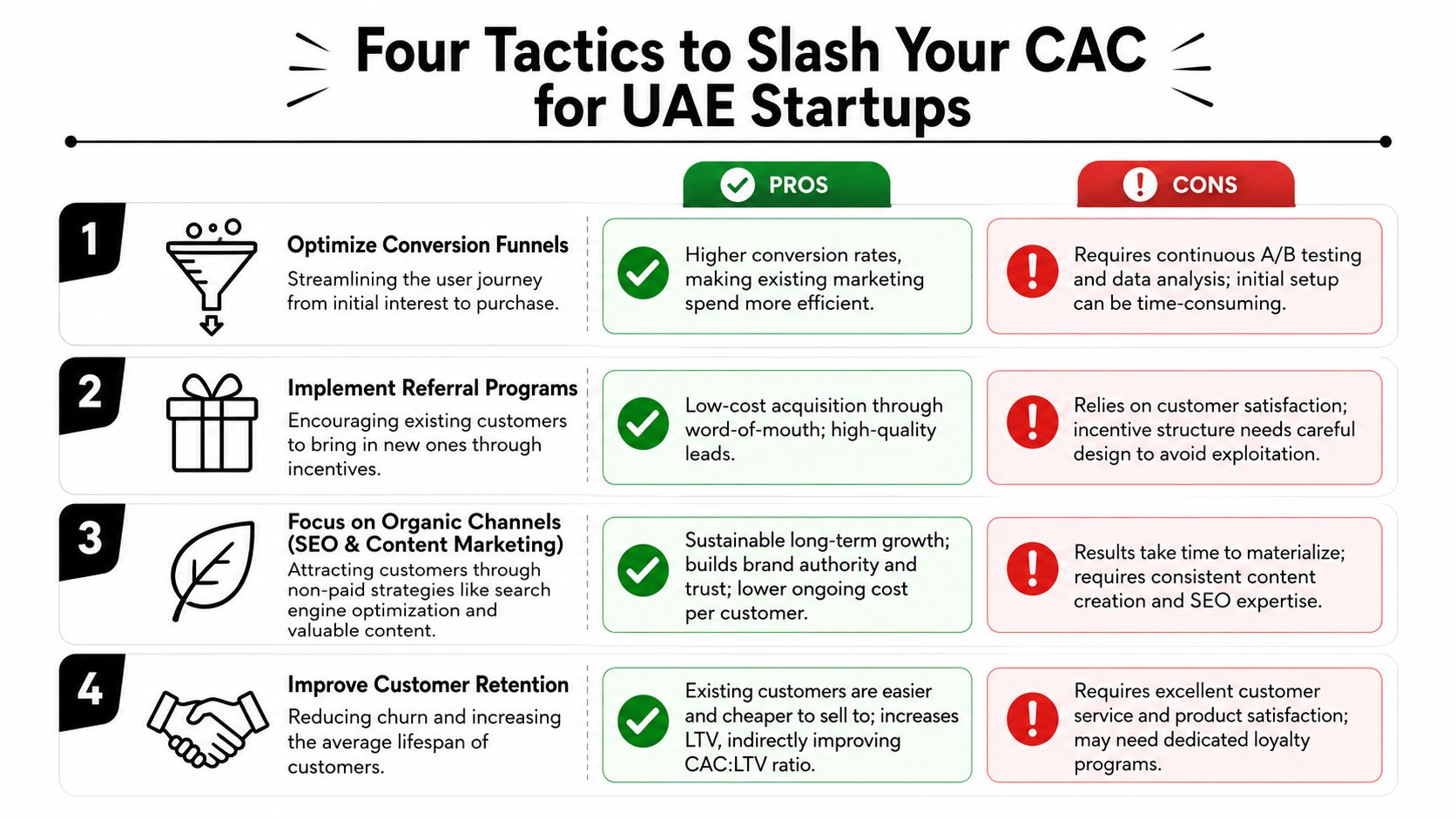
Four Actionable Tactics to Lower Your CAC Now
If CAC is high, a common error is to chase cheaper traffic.
That can help, but it's rarely the first lever to pull. In UAE startups, lower CAC usually comes from tighter budget allocation, better activation, stronger retargeting, and a more deliberate referral engine.
Fix your budget split
A lot of startups overspend on top-of-funnel activity because it feels safer. More reach, more impressions, more “awareness”.
The better operating mix in the UAE is to allocate 15–25% to brand awareness, 50–65% to direct response conversion campaigns, and 15–25% to retargeting warm audiences. That allocation has been identified as the most efficient for minimising CPL and CAC in the UAE.
Founders often underfund the part of the system that converts.
- Brand awareness gives you reach and familiarity.
- Direct response captures intent and drives action.
- Retargeting closes the warm traffic you already paid to generate.
If your current setup is heavy on awareness and light on conversion, CAC often looks worse than it needs to.
Improve activation before buying more traffic
This is the lever founders consistently underestimate.
A Dubai-based fintech app reduced CAC by 82% by implementing a structured 7-day activation sequence that lifted KYC completion from 9% to 31% for a previously lost signup cohort. The lesson is simple. They didn't solve the problem by buying more traffic. They solved it by converting existing signups into transacting users more effectively.
That example is especially relevant in the UAE, where onboarding friction, trust checks, and verification steps can undermine conversion after the click.
Founder move: Audit the first seven days after signup. Every delay, unclear instruction, missing reminder, and trust gap raises CAC whether you track it or not.
Build a referral system, not a referral hope
Most startups say referrals matter. Few run them like a channel.
A workable referral engine usually needs:
- A defined trigger: Ask after a success moment, not at random.
- A narrow ask: “Who are two operators like you?” works better than “Know anyone?”
- A simple handoff: Intro email, WhatsApp message template, or shared calendar link.
- A visible owner: Someone on the team follows up fast and tracks conversion.
Local context matters. In the UAE, trusted introductions cut through noise faster than cold traffic. Not because the market is old-fashioned, but because relationship risk still matters in purchasing decisions.
If you want another operator's perspective on slashing customer acquisition cost, that piece is useful because it pushes beyond media buying and into conversion discipline.
Retarget warm audiences properly
Warm traffic is expensive to generate and easy to waste.
Founders often run prospecting, collect traffic, and then fail to follow up with meaningful retargeting. In practice, that means people who clicked, visited, or even signed up drift away because the startup had no serious second-touch plan.
A solid retargeting setup should include:
- Segmented audiences: Site visitors, demo viewers, abandoned signups, partial onboarding users.
- Message sequencing: Social proof first, objection handling second, direct CTA after.
- Channel mix: Paid retargeting plus email or WhatsApp where appropriate.
- Fast review cycles: If a segment isn't progressing, refresh the creative or offer.
This is one of the clearest places where CAC drops without needing a huge increase in total budget.
Your Next Step to Mastering Unit Economics
Most founders don't need more growth theory. They need one clean operating number and the discipline to act on it.
If you take one thing from this guide, take this. Customer acquisition cost for UAE startups only becomes useful when it is fully loaded, segmented by channel, and judged against customer quality, not lead volume.
The founders who build durable companies here usually get very practical very quickly. They stop arguing about vanity metrics. They calculate true CAC. They compare it against what their pricing and retention can support. Then they shift budget toward what converts.
The most efficient budget allocation for minimising CAC in the UAE is 15–25% to brand awareness, 50–65% to direct response conversion campaigns, and 15–25% to retargeting warm audiences, according to UAE CPL and CAC benchmark guidance. If your spend mix doesn't resemble that, there's a good chance your CAC problem starts there.
What to do this week
- Pull the last quarter's numbers: Ad spend, people cost, tools, agencies, events, commissions.
- Count only new paying customers: Not leads. Not signups.
- Split CAC by channel: Paid, referral, event, partner, founder-led.
- Review activation: Look at what happens after the lead arrives.
- Tighten organic visibility: If LinkedIn is part of your founder-led engine, this guide to LinkedIn posting strategy is a practical resource for making it more consistent.
Schedule one meeting with your co-founder or growth lead. Put one agenda item on it. Calculate your true CAC for the last quarter and decide which channel deserves more budget, which one needs fixing, and which one should be cut.
If you want a sharper founder circle while you work through questions like CAC, pricing, retention, and distribution, Founder Connects is built for that. It brings UAE and MENA founders into curated peer groups, targeted introductions, and high-signal conversations that help you make better decisions faster.

Building in MENA? You don't have to do it alone.
Join 300+ founders in the Founder Connects Residency. Monthly squad calls, warm intros, $3M+ in perks, and much more. All for less than your monthly coffee budget.
Popular posts





Founder Connects is a premium MENA tech founder community. Meetups in Dubai and across MENA, Residency Squads of 8–10, and 400+ vetted WhatsApp founders (apply and screened).