

Deloitte Near Me: A Founder's Guide to UAE Offices

You search Deloitte near me when the stakes have changed.
Usually that happens at a specific moment. An investor asks for cleaner reporting. A bank wants more formal documentation. A tax question stops being something your accountant can answer in one email. Or you're preparing for a transaction, due diligence, or a board conversation where a recognised firm changes how seriously people take your company.
At that point, finding an address is easy. Figuring out how to approach a large professional-services firm as a founder is the hard part. Big firms aren't built like startup-friendly walk-in shops. If you handle the outreach casually, you can lose time, get routed to the wrong team, or end up discussing a scope that doesn't match what your business needs.
From Search Query to Strategic Partner
Most content around Deloitte near me stops at the office pin. That's not enough for founders.
The core question isn't “Where is Deloitte?” It's “Can this office help with my exact problem, and how do I get to the right person without wasting two weeks?” That matters even more in the UAE and wider MENA market, where founders often need practical access to a partner, specialist, or decision-maker, not just a reception desk. As noted in Deloitte's broader office-locator experience, office information often exists, but it doesn't answer the engagement question founders care about Deloitte office-locator context.
A local search can also mean something different depending on your situation:
- Fundraising mode: You may need audit readiness, valuation support, or diligence help.
- Compliance mode: You may be dealing with tax, governance, or internal controls.
- Scale-up mode: You may want help fixing a finance function, reporting process, or risk framework before it breaks under growth.
- Market-entry mode: You may need structured advice rather than another generic intro.
Practical rule: Proximity is helpful. Access is what matters.
That same principle applies to how founders think about visibility. If you're trying to make your own company easier to find locally, this guide on local SEO strategies with AI is useful because it explains how location intent and practical user needs often diverge. The same thing happens when you search for a major advisory firm.
If you're still deciding whether you need a consultant, start with this broader view of when to engage a business consultant near you. It helps clarify whether your issue needs a heavyweight firm, a specialist boutique, or a strong operator inside your team.
Pinpointing Deloitte Offices and Key Contacts
The first thing most founders want is the concrete office detail. In Dubai, Deloitte's office is listed at Business Central Towers, Level 6, P.O. Box 282056, Dubai Internet City, with the phone number +971 4 376 8888, and Deloitte states it has served clients in the UAE for 50 years on its global facts and figures page, which signals a long local presence rather than a recent market entry Deloitte UAE facts and figures.

What that means in practice
Don't treat this like a retail branch. A founder who types Deloitte near me often expects something closer to a service counter, public office, or startup desk. That usually isn't how large firms operate.
These offices function as corporate hubs. The useful question isn't “Can I walk in?” It's “Which team handles my issue, and will they see enough value in the conversation to take the meeting?”
Deloitte's UAE footprint is also described as multi-practice, including audit, tax, consulting, financial advisory, and risk-related work. That matters because your first outreach should mention the service line you likely need. If you write “I'd like to speak to someone about my startup”, you make it harder for internal teams to route you properly.
What to expect when you contact them
A better expectation set looks like this:
| What founders assume | What usually works better |
|---|---|
| Walk in and ask reception | Request an introduction or formal meeting |
| Call the general number and explain everything live | Send a concise summary first |
| Ask for “someone senior” | Ask for the team tied to your exact issue |
| Pitch the whole business | Present one defined problem and one desired outcome |
If your issue is vague, the firm will struggle to place you. If your issue is specific, routing gets easier.
For UAE founders, another useful step is checking ecosystem directories first so you know whether your next move should be a chamber, free zone, legal adviser, or a firm like Deloitte. This Dubai Chamber of Commerce directory guide helps map these options before you start emailing large advisory firms.
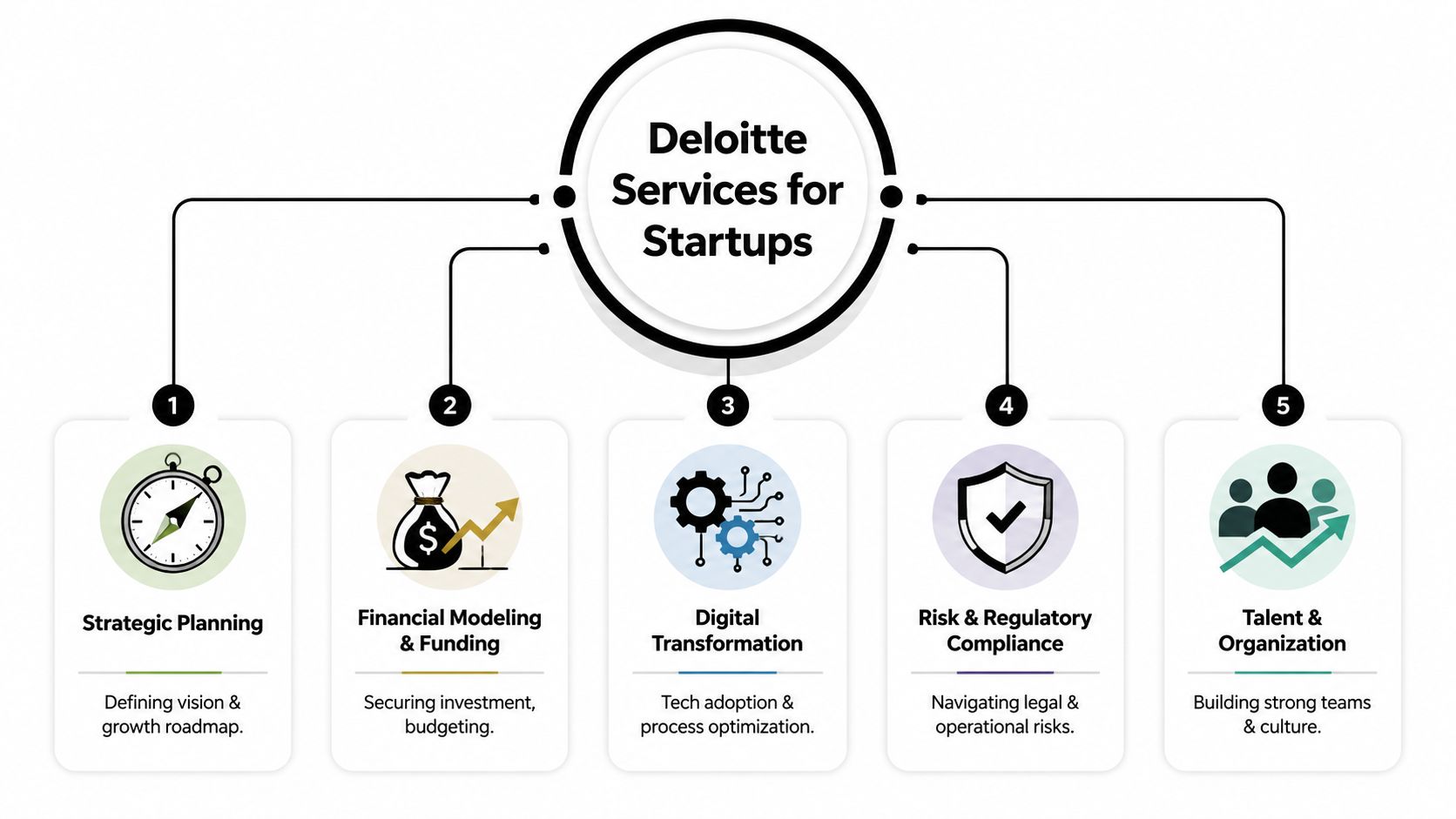
Deloitte Services Relevant to Your Startup
Large firms list many capabilities. Most founders need only a narrow subset. The mistake is contacting a big firm too early for a generic “strategy” discussion, then paying for senior time before the problem is tightly defined.
Audit and assurance
This becomes relevant when an outside party cares about the credibility of your numbers. That might be an investor, lender, buyer, or major enterprise customer.
A practical trigger is simple: your current finance reporting may be enough to run the business, but it isn't enough to satisfy external scrutiny. If your board pack, management accounts, and source records are inconsistent, don't open with “we need an audit”. Open with “we need to understand what level of assurance or audit readiness is required for our next milestone”.
What works:
- Clear reporting history: Bring organised financial statements and bookkeeping records.
- Known objective: State whether this is for fundraising, diligence, banking, or governance.
- Realistic timing: Don't approach weeks before a hard deadline if your records are messy.
What doesn't:
- Using audit as a catch-all: Sometimes you need cleanup before assurance.
- Assuming a startup gets a simplified route: Professional standards still apply.
Tax
Tax is one of the clearest reasons a founder searches Deloitte near me in the UAE. The issue usually isn't theory. It's business structure, exposure, documentation, and getting comfortable that the setup matches the way the company operates.
You're likely in the right lane if you're asking questions such as:
- Entity structure: Does the current structure still fit the business?
- Cross-border activity: Are multiple jurisdictions now involved?
- Investor pressure: Has someone asked for a more formal tax review?
- Operational reality: Has the company outgrown the assumptions it was built on?
Tax work is worth the spend when the downside of getting it wrong is higher than the advisory cost.
Financial advisory
Founders often overestimate what they need. If you're raising a straightforward early round, you probably don't need a major advisory engagement. If you're handling a strategic transaction, shareholder issue, restructuring, or acquisition discussion, that changes.
A few examples:
- You need a valuation that will face scrutiny.
- A buyer asks for structured financial diligence support.
- The cap table, shareholder rights, or transaction path has become complex.
- You need an independent adviser in a sensitive negotiation.
Risk advisory
Risk sounds abstract until a customer security review lands in your inbox or internal controls start failing under growth.
For software and B2B founders, this often intersects with security, access controls, audit trails, procurement reviews, and vendor questionnaires. If that's your world, it helps to review a practical external benchmark like this battle-tested SOC 2 audit prep resource so you understand what “readiness” work usually looks like before paying for a broad advisory scope.
Founders rarely regret getting controls in place before a major customer asks for them. They do regret waiting until the questionnaire arrives.
Consulting
Consulting is the broadest bucket, which is exactly why founders need discipline here. “We want growth advice” is too fuzzy. “We need to redesign our finance operating model before entering a second market” is credible.
Use consulting when the issue is cross-functional and hard to solve with one freelancer or one internal hire. Don't use it for a problem that can be fixed by hiring a stronger finance manager, operations lead, or product marketer.
If you're evaluating advisory support beyond one firm, this overview of international business consulting is a useful lens for deciding when global reach matters and when it doesn't.
How to Prepare for Your First Meeting with Deloitte
A first meeting goes badly when the founder arrives with a broad story and no sharp ask. It goes well when the company shows enough substance to justify senior attention.
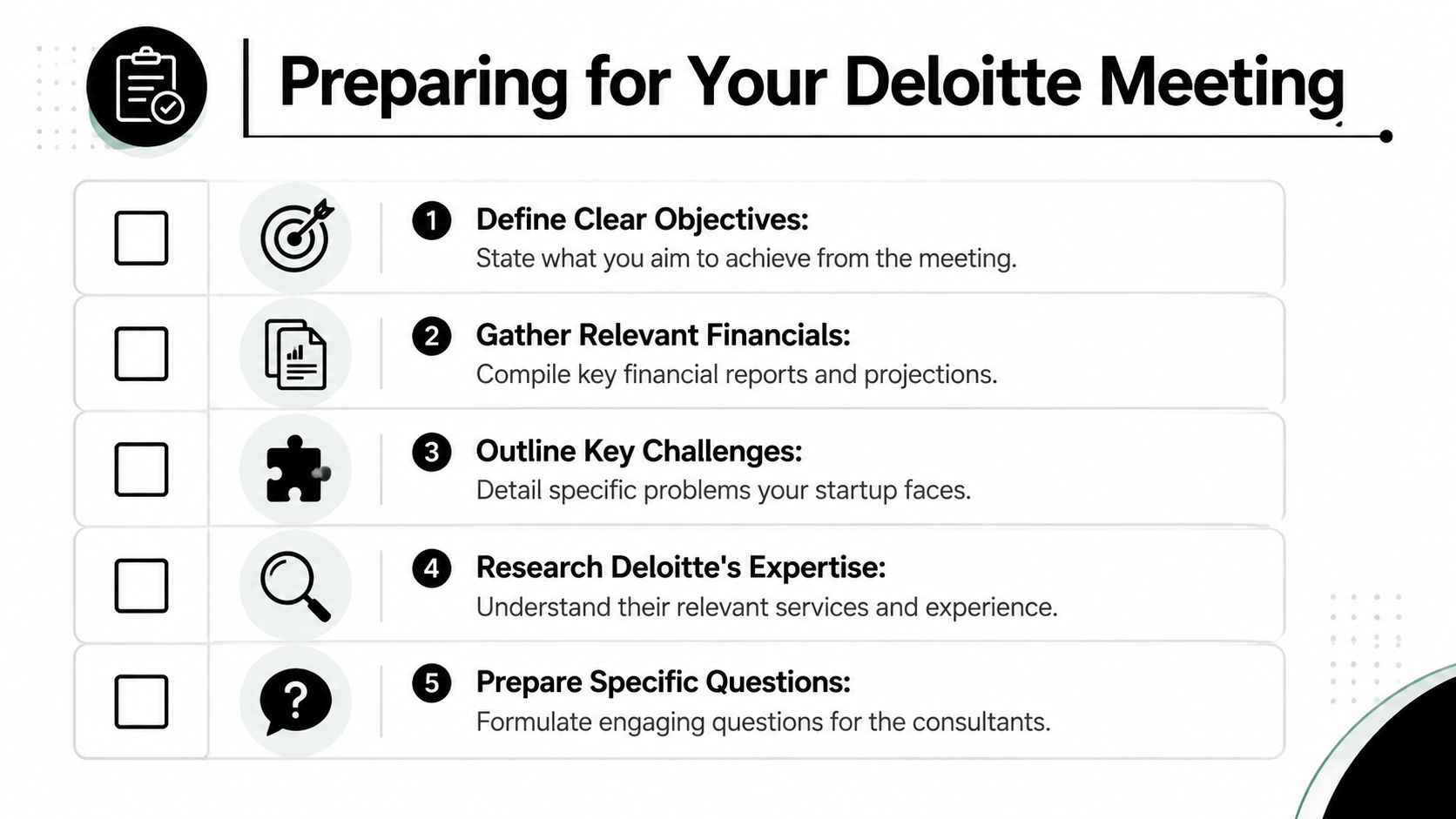
Define the problem properly
Before the meeting, write one sentence that finishes this line:
We need help because…
Then write a second sentence:
A good outcome from this engagement would be…
If you can't complete those clearly, you're not ready. The firm can help solve a problem. It can't manufacture one for you.
A useful self-test:
- Is the issue urgent or just important
- Does this require external credibility
- Is there a transaction, investor, regulator, bank, or customer behind the request
- What happens if we do nothing for the next quarter
Build a founder-grade mini data room
You don't need a huge folder dump. You need a clean, decision-ready pack.
Documents to have ready:
- Pitch deck: Current version, not the one from last year.
- Financials: Historical numbers and forward-looking view.
- Cap table: Updated and accurate.
- Corporate structure: Simple chart if multiple entities exist.
- Problem summary: One page explaining context, urgency, and what advice you want.
- Existing advisers: Note who already handles legal, accounting, tax, or compliance.
Here's a practical explainer on meeting preparation that's worth a quick watch before the conversation:
Ask better questions
Bad first-meeting questions are too broad. Better ones force clarity around scope, fit, and next steps.
Try questions like:
- Fit: Is this the kind of issue your UAE team typically handles for founder-led businesses?
- Scope: What would need to be true for this to become a defined engagement?
- Process: What information do you need to assess whether there's a fit?
- Team: Which service line would lead, and who else would likely be involved?
- Timing: What usually slows these projects down from the client side?
Meeting standard: Leave with either a clear next step, a request list, or a fast no. Ambiguity is not a win.
Understanding Scopes Costs and Alternatives
Founders usually ask about price too late. They spend energy getting the meeting, then realise the likely scope is far above what they intended to buy.

How large firms typically scope work
For a firm like Deloitte, cost usually follows complexity, risk, stakeholder count, and required seniority. That means there often isn't an off-the-shelf founder package for the issue you have in mind.
A narrow diagnostic is different from an execution-heavy engagement. A local tax question is different from a cross-border structuring review. A readiness assessment is different from a full transformation project.
Ask for clarity on these points early:
| Scope question | Why it matters |
|---|---|
| What is the exact deliverable | Prevents vague advisory time |
| Who will work on it | Tells you how senior the team will be |
| What assumptions sit behind the fee | Shows where scope creep starts |
| What is excluded | Avoids surprise follow-on work |
| What depends on our internal team | Exposes hidden workload on your side |
When the premium is worth it
A large-firm engagement can make sense when brand credibility, cross-functional depth, or transaction-level rigour matters.
That usually includes situations like:
- External scrutiny is high: Investors, banks, buyers, or major enterprise clients care who advised you.
- The issue crosses disciplines: Tax, risk, diligence, and governance overlap.
- You need structure fast: Your internal team can't design the answer alone.
- The downside of mistakes is expensive: Weak advice could create legal, financial, or reputational damage.
If your issue is application security rather than broad advisory, a narrower specialist may be the smarter buy. For example, founders looking at product security reviews can learn a lot from this guide to SaaS application security, which illustrates when a focused technical provider may be more useful than a broad consulting scope.
When to choose a boutique instead
This is the trade-off founders often miss. A smaller advisory firm can be a better fit when the problem is specialised, the budget is tighter, and you need direct partner attention rather than a broad branded team.
Choose a boutique when:
- You need one expert, not a platform
- You want more hands-on senior time
- The deliverable is narrow and well defined
- Your stage doesn't justify heavyweight overhead
Choose Deloitte when:
- Stakeholders will care about firm reputation
- The issue touches several service lines
- You may need formal process, governance, and documentation
- You're solving for more than speed
Action Plan Your Next Steps to Engage Deloitte
If you're serious about contacting Deloitte, keep the process tight.
Four moves that actually work
Write the problem statement
Use one paragraph. State the business issue, why it matters now, and what decision or milestone it affects.Name the likely service line
Don't send a generic enquiry if you can avoid it. Decide whether your issue is mainly tax, audit, financial advisory, risk, or consulting.Try for a warm introduction first
Ask your investor, lawyer, board member, senior accountant, or founder peer. Large firms respond better when context travels with the introduction.Send a disciplined outreach email if no intro is available
Keep it short. Show that you know what you need.
Simple email template
Subject: UAE startup seeking discussion on [specific issue]
Email body:
Hello [Name],
I'm the founder of a UAE-based startup operating in [sector]. We're currently dealing with [specific issue], and I believe this may sit within your [service line] team.
The context is straightforward: [one or two sentences on the situation]. We're looking for guidance on [desired outcome], and I'd like to understand whether this is something your team handles and, if so, what information you'd need for an initial discussion.
I'm happy to share a short summary deck and relevant background in advance.
Best,
[Name]
[Role]
[Company]
[Phone]
Short, specific, and commercially serious beats a long founder story every time.
If you want a smarter way to get warm introductions, compare advisers, and talk through decisions like this with founders who've done it before, Founder Connects is built for exactly that. It's a private UAE-based founder community focused on practical support, curated connections, and real progress rather than noisy networking.

Popular posts





The premier community for tech founders, investors, and builders. Connect, collaborate, and grow together.