

DIFC FinTech Accelerator Program Guide for Founders

Building in MENA? You don't have to do it alone.
Join 300+ founders in the Founder Connects Residency. Monthly squad calls, warm intros, $3M+ in perks, and much more. All for less than your monthly coffee budget.

You've got a fintech product that's good enough to demo, maybe even good enough to sell, but the next step in the UAE still feels stuck behind a wall of bank meetings, regulator questions, and “let's circle back next quarter.” That's exactly where the DIFC FinTech Accelerator earns its reputation. It's not a vanity badge, and it's not a generic startup club. It's a structured way to get early fintechs in front of financial institutions that can either validate the product or kill the fantasy fast.
The difc fintech accelerator program guide matters because founders often misunderstand what acceptance buys them. The prize isn't the cohort label, it's the chance to move from a promising prototype to something a bank, insurer, or regulated partner can test in a real environment. DIFC frames the accelerator as a regional innovation gateway, and the value sits in that positioning, not in motivational fluff.

If you're weighing DIFC against other UAE options, this comparison of Hub71, DIFC, and Area 2071 for pre-seed founders is a useful sanity check before you spend time on an application.
What Is the DIFC FinTech Accelerator Really About
Founders who get value from DIFC usually ask a practical question first. Will this help me get a pilot, a contract, or a regulator-ready route into market. That is the right lens, because the DIFC FinTech Accelerator is built less like a broad incubator and more like a market-entry mechanism for seed and pre-seed startups targeting MEASA, including the UAE (MondoVisione).
The core function of the programme
The programme is structured around building, testing, and adjusting solutions with major financial institutions from DIFC's ecosystem, which is how early products move toward bank-ready pilots. That is a different outcome from a founder network where people trade advice and leave with a few LinkedIn connections.
DIFC works because it puts startups close to banks, insurers, and regulators inside a financial district already built for institutional coordination. You are not applying to “go faster” in a vague sense. You are applying to shorten the path from prototype to proof.
Practical rule: if your startup still needs broad customer discovery, you are probably too early. If you can already describe the exact workflow a bank or insurer wants to test, DIFC starts to make sense.
The distinction matters when you compare accelerator choices. A generalist programme can help you sharpen the story. DIFC helps you test whether the story survives contact with regulated buyers, and the right external benchmark can help you separate those two jobs. A useful comparison is this pre-seed guide to Hub71, DIFC, and Area 2071.
The strongest founders use the programme to answer one question quickly, can a partner say yes to a pilot? If that answer is still unclear, the accelerator turns into an expensive distraction, even if the brand name looks strong on the website.
What the ecosystem gives you
That is why DIFC is better treated as a controlled commercial environment than a classroom. The point is direct collaboration with institutions that can validate whether the product is viable in the region. If that is your near-term goal, the accelerator is relevant. If you are still hunting for a market, it may be premature.
For founders still narrowing their idea, RapidNative's mobile app validation is a useful outside reference for checking whether the problem is real before you ask a bank to take a meeting.
Are You the Right Fit Eligibility and Selection Criteria
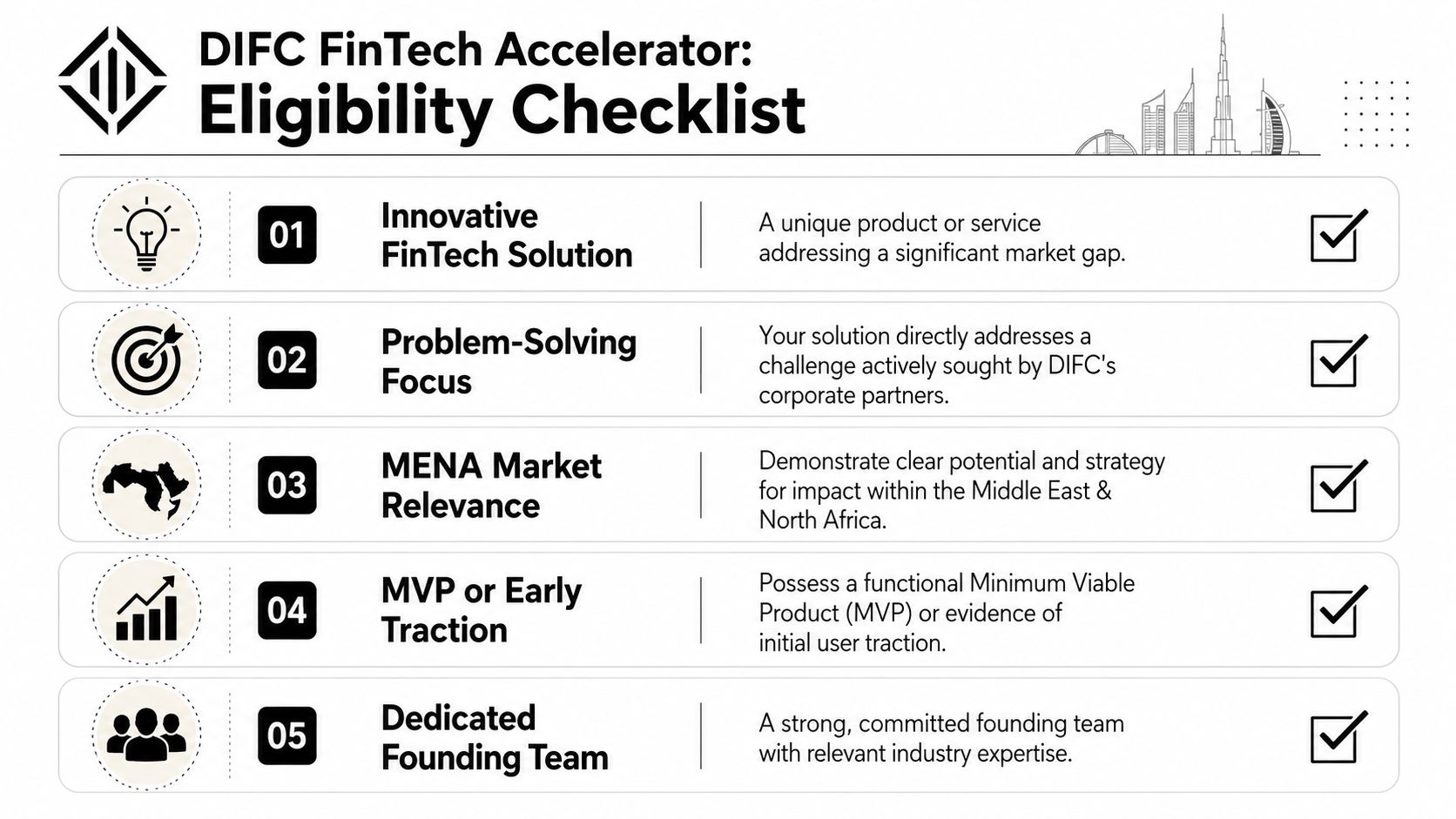
The biggest mistake founders make is assuming DIFC selects for “good ideas”. It doesn't. It selects for ideas that can be tested in a regulated setting and that line up with what partners are trying to solve right now. That means fit matters more than polish.
What the formal bar actually looks like
For the Innovation Testing License, applicants must show that the business uses technology in a novel way, that the planned activity is a DFSA-regulated financial service, that they have a regulatory test plan with objectives and milestones, and that they can explain how they will roll out after testing (Businessetup). That's a serious filter. It tells you the programme is not for casual experimentation.
Many strong founders frequently lose time. Their deck talks about “disruption”, but the application needs concrete evidence that the product can be tested safely and that the business knows what happens after the test. If you can't define the test, you're not ready yet.
A good self-check is simple:
- Innovation: Is the technology fundamentally different from a normal service business?
- Regulated activity: Does the product touch a DFSA-regulated financial service?
- Test plan: Can you define objectives, parameters, and milestones without hand-waving?
- Post-test path: Can you explain the rollout after the pilot?
- Partner relevance: Does a specific institution care about the problem?
Why partner alignment beats generic strength
DIFC's own mechanics make partner alignment a core requirement. Startups are screened in cycles and then matched with financial-institution partners for validation and pilot work (FinTechNews.ae). If your product doesn't map to a partner priority, the process stalls, no matter how strong the team looks.
That's why the smartest application strategy starts with partner research. Look at what HSBC, Citi, Standard Chartered, and Emirates NBD are likely to care about in the context of your category, then shape your use case around that real problem. If your product is trying to solve ten things, cut it down until one institution can see the value in one workflow.
The founder mistake is obvious in hindsight. They apply because the brand is strong, not because they've built a partner-specific pilot case. You can avoid that by treating the application like a commercial proposal, not a pitch contest.
If you want a broader lens on how to evaluate programmes before you apply, this accelerator selection framework is a solid way to pressure-test fit.
The Program Deconstructed Structure Sprints and Timelines
The DIFC programme looks short on paper because it is built to compress decisions. Founders are pushed through a tight sequence that starts with onboarding, then moves into sprint work, and ends with a clear milestone that forces a commercial answer, not just a polished deck. That setup is what makes the programme useful for teams trying to turn interest into pilots, contracts, or a licensing conversation.
How the cadence works in practice
The structure is usually described as a two-sprint model, with each sprint lasting about 6 weeks and closing with an Investor Day style milestone (FounderConnects review). One sprint is for tightening the problem, the next is for proving the path to a pilot or a next-step discussion. The pressure is deliberate.
The opening phase is not a soft introduction. It is a five-day boot camp that covers local regulations, market trends, technology innovation, recruitment, and funding, which tells you the programme expects founders to arrive ready to work, not to learn the basics (BusinessDubai.ae).
A practical way to read the schedule is below:
| Component | Details |
|---|---|
| Programme length | DIFC's accelerator is described as a 14-week programme in some materials, while other descriptions use a 12-week intensive format (MondoVisione, BusinessDubai.ae) |
| Initial onboarding | Five-day boot camp covering regulations, trends, innovation, recruitment, and funding (BusinessDubai.ae) |
| Sprint model | Two sprints, about 6 weeks each, with validation first and pilot work next (FounderConnects review) |
| End milestone | Investor Day or Demo Day style pitching to investors and partners (FounderConnects review, FinTechNews.ae) |
The first sprint should be used to remove ambiguity. Tighten the product scope, define the institutional problem in plain language, and get clear on whether a partner would support a pilot. The second sprint should produce something a decision-maker can review quickly, not a theory that only sounds good in founder meetings.
That matters because bank-facing programmes reward clarity. If your use case is still broad by the midpoint, the accelerator will expose it fast.
What founders should aim to finish with
By the end of the programme, the target should be concrete. A live pilot conversation, a named commercial next step, or a clear regulatory path are all real outcomes. If you leave with only exposure and a few warm introductions, you did not use the structure properly.
The hard truth is that the calendar is not the win. The win is whether the programme helps you move from interest to action, because that is the bottleneck for most fintech founders in the UAE. If you want to compare this format with other accelerator models before applying, this detailed accelerator guide and comparison chart is a useful reference.
Beyond the Stipend Mentorship Partnerships and Real Benefits
The around $20,000 in non-equity funding is useful, but founders who obsess over that number miss the bigger value. The primary advantage is access. DIFC's mentorship model is built around direct engagement with financial institutions and insurance partners, including HSBC, Citi, Standard Chartered, and Emirates NBD, plus coaching and dedicated one-on-one support (Noticas.ae).

Why the mentorship matters more than the cheque
A small grant can help with travel, product tweaks, or testing costs. It does not solve distribution. DIFC's mentorship matters because it gives you structured access to people who understand procurement, compliance, risk, and product-market fit from the buyer side, not just the founder side.
That's where the ecosystem becomes the primary asset. If you can use the programme to turn a mentor into a sponsor, or a sponsor into a pilot owner, your odds improve. If you only collect advice, you've spent time in a prestigious room without moving the business.
Start treating every mentor interaction like a working session. Bring a specific workflow, a live question, and a decision you need them to help unlock.
The best meetings in DIFC usually aren't broad networking chats. They're focused conversations about one problem, one partner, and one next step. That's what makes the model different from generic founder events.
A lot of founders also underestimate the practical environment. Being inside DIFC means the people you need, banks, insurers, advisors, and often regulators, are already close by. That proximity cuts the friction out of relationship-building, but only if you show up prepared.
How to use the network properly
The platform is strongest when you stop asking for “introductions” and start asking for a defined test case. Send a short note before each meeting with three things, the exact problem, the type of institution you want feedback from, and the decision you need after the call. That makes follow-up easier for both sides.
You can also use the wider founder community strategically. Founder Connects, for example, is one option for peer accountability and warm introductions, but the DIFC environment itself should stay the centre of gravity if your goal is institutional validation.
The founder who wins in DIFC is rarely the loudest. It's the one who turns a corridor conversation into a pilot scoping call and then into a document the partner can review.
Pitching Demo Day and Life After the Program
Demo Day is a filter, not a celebration. The teams that perform well treat it as a moment to show evidence, because the room includes investors, partners, and operators who want to know whether the product can work outside the programme.
How to build a pitch that lands
Your deck should focus on what changed during the sprint. Show the problem, the partner relevance, the test you ran, and the next commercial step. Skip generic market ambition. The people in the room want to know whether a real institution can use the product.
Use the strongest evidence you have from the programme period. If a partner validated the workflow, say that plainly. If the product changed after feedback, show the before-and-after logic. If there is a clear commercial ask, make it visible.
A practical pitch structure looks like this:
- Lead with the buyer problem. State the operational pain in the institution's language.
- Show the product in one sentence. Keep it tied to the workflow, not the technology stack.
- Demonstrate proof. Bring pilot feedback, partner interest, or test results.
- Ask for a concrete next step. Pilot, procurement meeting, compliance review, or investment follow-up.
- Close on rollout. Explain what happens after acceptance.
DIFC's investor-facing setup is built around outcomes. It includes fundraising and investment support, an investment clinic, pitch deck design support, and a Demo Day. Founders pitch to investors and connect with a wider network of international investors, industry experts, and partners. Use that structure, but do not mistake it for traction.
What happens after the applause
The important work starts in the 90 days after the programme. DIFC's own ecosystem guidance makes the point clearly, the accelerator opens doors, but the main bottleneck is turning partner meetings into measurable revenue or regulatory approvals (DIFC Innovation Hub). That means your team needs a post-program operating plan before Demo Day even arrives.
That plan should include:
- CRM discipline, so no sponsor or partner goes cold.
- Pilot design, so each opportunity has a scope, owner, and next step.
- Documentation readiness, so your compliance or rollout materials are ready when a partner asks.
- Decision timing, so you know when to push, follow up, or walk away.
If you leave the programme with a stack of conversations and no owner for each one, momentum dies fast. The founders who convert are the ones who assign follow-up inside the team the same day.
Licensing and employment questions also tend to surface once momentum starts, and that is where Smart Classic Business Hub's guide for companies becomes useful for founders who need practical context.
Founder FAQs Costs Licensing and Next Steps
The first assumption to challenge is simple. Getting into DIFC is not the same as winning. You still have to absorb the operating realities of being in a regulated financial centre, and those realities affect cost, staffing, and location choices.
What does the licence really cost
The DIFC Innovation Licence is subsidised at USD 1,500 annually for two years. From year three, the subsidy depends on FTE count, and if a company exceeds 10 FTEs, the fee becomes USD 12,000 per annum, which creates a meaningful breakpoint for scaling teams (DIFC guide).
That matters because the licence economics change as soon as your headcount moves. A lot of founders focus on entry cost and ignore the scaling curve. You shouldn't.
When does DIFC make sense, and when might it not
DIFC is attractive if you need direct access to banks, insurers, and regulated counterparties, and if your product can support a real pilot or licensing path. It's less efficient if you're pre-revenue, highly distributed, or still unsure whether you can maintain the physical presence and operational discipline expected in the zone.
For legal and employment questions that come up once you commit, Smart Classic Business Hub's DIFC employment law guide is a useful reference point alongside your own counsel. If you're hiring in Dubai, that conversation should happen early, not after the offer letters go out.
What should you do next
Before applying, answer these three questions with your team:
- Which institution is the best-fit partner for the pilot?
- What regulatory or operational hurdle does the product remove?
- What will we show 90 days after graduation that proves this was worth it?
If those answers are vague, slow down. If they're sharp, the programme can be a strong bridge into the market.
If you're serious about using DIFC to move from interest to pilots and contracts, build your application around one partner problem, one test plan, and one post-program outcome. Then bring that clarity into your next founder discussion with Founder Connects, where you can compare notes with people who've already tried to convert UAE ecosystem access into actual traction.

Building in MENA? You don't have to do it alone.
Join 300+ founders in the Founder Connects Residency. Monthly squad calls, warm intros, $3M+ in perks, and much more. All for less than your monthly coffee budget.
Popular posts





Founder Connects is a premium MENA tech founder community. Meetups in Dubai and across MENA, Residency Squads of 8–10, and 400+ vetted WhatsApp founders (apply and screened).