

Emotional Intelligence for Startup Leaders: A 2026 Guide

Building in MENA? You don't have to do it alone.
Join 300+ founders in the Founder Connects Residency. Monthly squad calls, warm intros, $3M+ in perks, and much more. All for less than your monthly coffee budget.

You can have a strong product, a committed team, and a decent runway, then lose the week because one cofounder is furious, one investor wants a cleaner answer, and the room goes cold at exactly the wrong moment. In UAE startup life, that kind of pressure shows up fast, often between a late-night WhatsApp thread and an early-morning meeting that nobody feels ready for. Emotional intelligence for startup leaders is what keeps that moment from turning into a cap-table problem, a hiring problem, and a trust problem all at once.
The Hard Moment Where EQ Changed the Outcome
A founder in Dubai once walked into a meeting two weeks from payroll with a cofounder who wanted out and an investor call scheduled for the next morning. The first version of that conversation was the one everybody dreads, raised voices, defensive language, and a rush to blame the other person for the mess. The second version started with a pause, a clear statement of pressure, and one better question: what would make this survivable for the business and fair to both of us?
That shift mattered. Instead of turning the room into a referendum on ego, the founder separated the emotion from the decision. The cofounder still needed a path out, the investor still needed a credible update, but the founder stopped trying to win the argument and started protecting the company's future.
Practical rule: when the temperature rises, slow the meeting down before you speed the decision up.
That is the core job of emotional intelligence for startup leaders in the UAE and wider MENA market. It is not about sounding calm for appearances. It is about preserving enough clarity to keep the cap table, the relationship, and the team's focus intact when one bad reaction could have made the next week unrecoverable.
A founder who can do that is not being soft. They're buying time, options, and trust. That is why the difference between a reactive meeting and a regulated one can be the difference between a messy but recoverable week and a business-ending spiral.
Read more founder growth stories from the UAE startup scene
What Emotional Intelligence Actually Means for a Founder
The corporate version of EQ is usually too vague to help a founder on a Tuesday afternoon. For startup leaders, it's simpler. Emotional intelligence is the ability to notice what you feel, manage how you respond, read what others are showing, and repair the relationship when your first move lands badly.
The four competencies in founder language
Self-awareness is knowing when your tone changed after a Ministry meeting, a funding call, or a bad customer renewal. If you can't see your own shift, your team will feel it before you can explain it.
Self-management is staying effective when a term sheet gets pulled, a senior hire declines, or payroll timing gets tight. It's not suppression. It's choosing the next action instead of letting the mood choose for you.
Social awareness is reading whether your lead engineer is quiet because they're burned out, confused, or just deep in work. In a mixed UAE room, it also means noticing the difference between politeness and agreement.
Relationship management is what happens after the hard moment. You follow up, clarify, apologise if needed, and rebuild trust instead of pretending nothing happened.
For a founder, those four competencies aren't personality traits. They're operating moves. If one breaks, the whole week gets noisier.
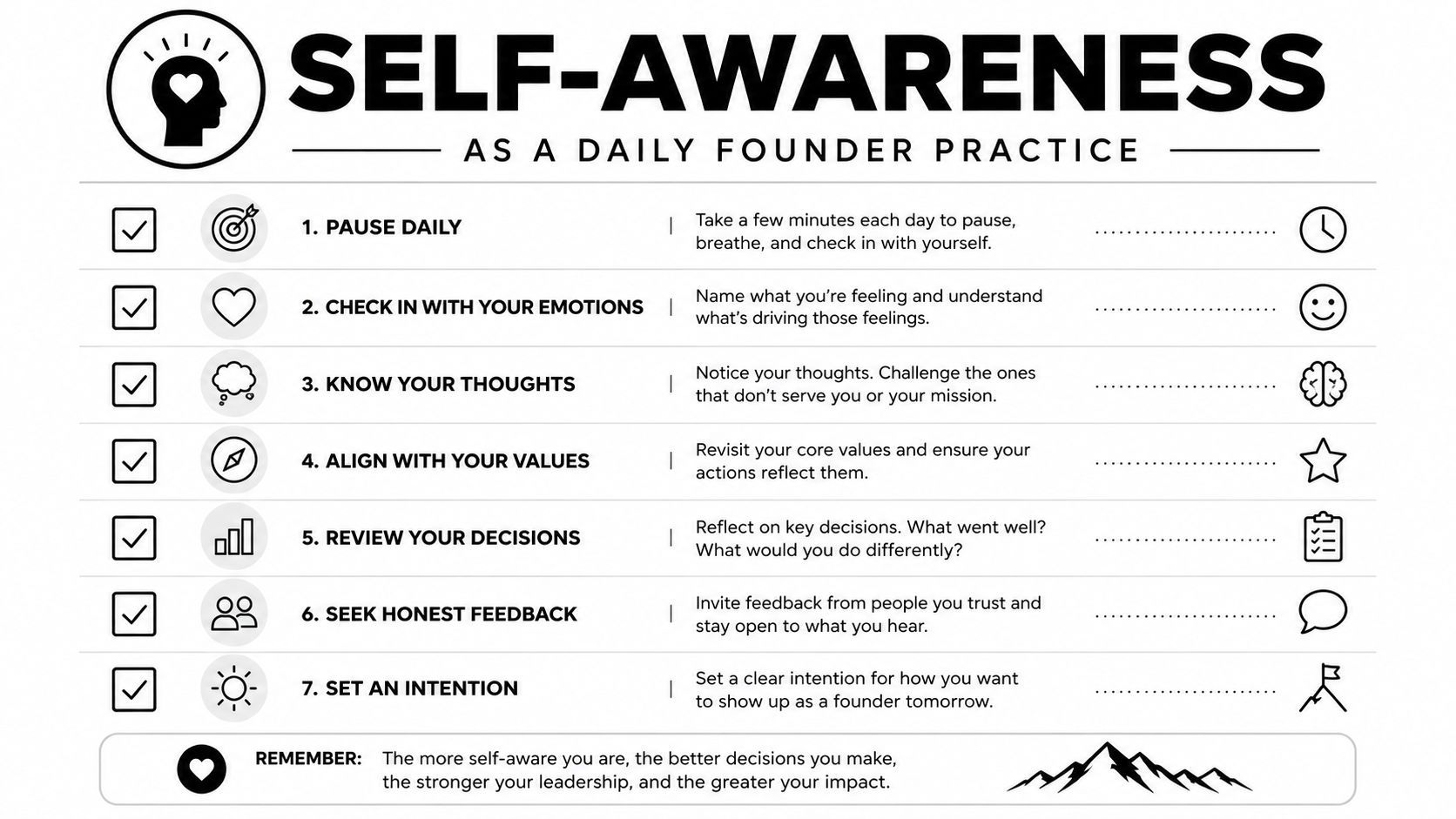
Self-Awareness as a Daily Founder Practice
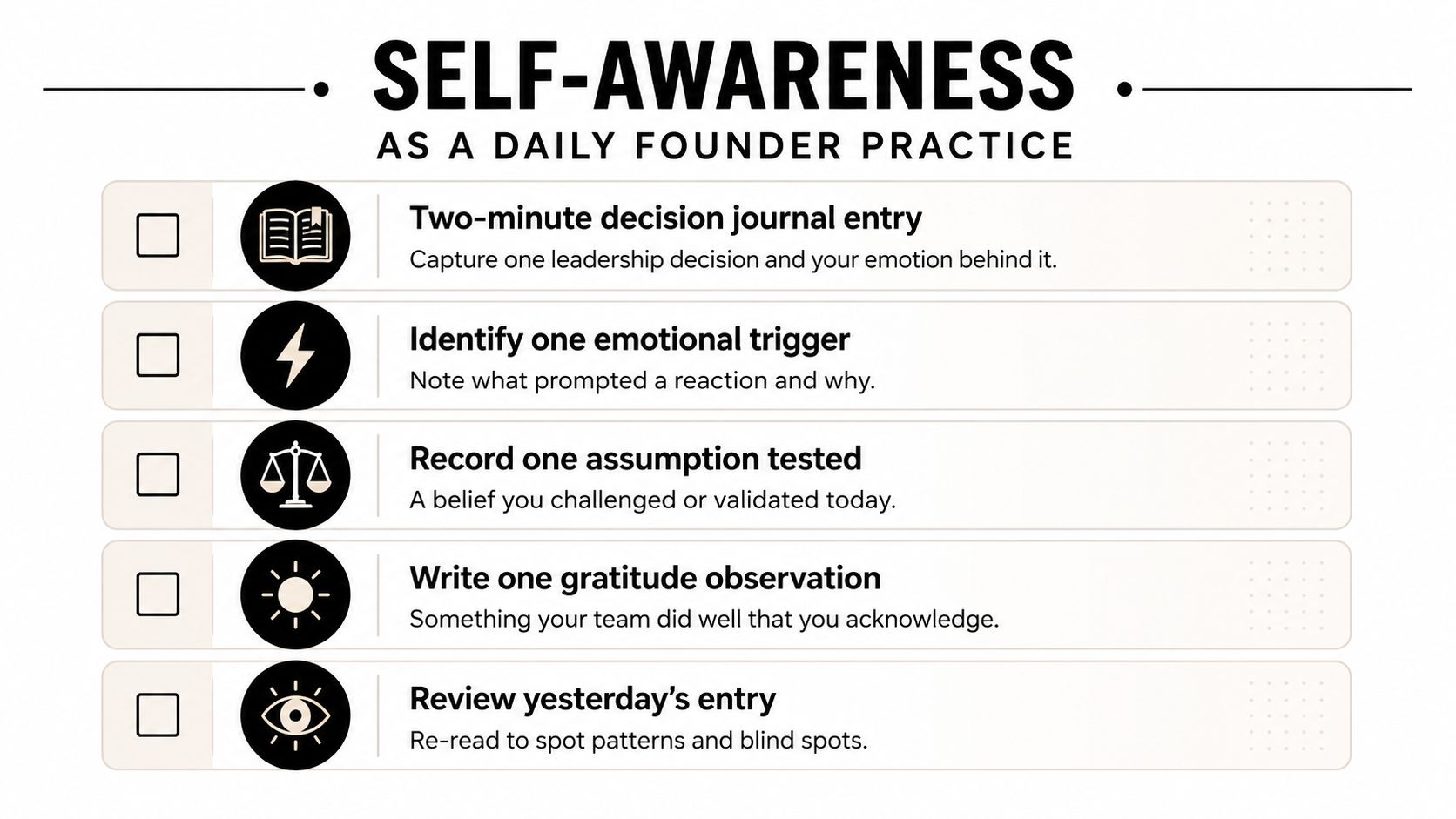
Self-awareness is the part most founders think they already have, right up until they see the evidence that they don't. A two-minute decision journal changes that. Write down the decision, what you felt in the moment, what you believed was true, and what you're worried you got wrong.
Harvard Business School Online recommends recording how emotions influenced decisions and pairing that with a 360-degree assessment to surface blind spots in leadership behaviour. In founder terms, that means you don't rely on memory, because memory protects ego. You use notes, feedback, and patterns.
Use a simple cadence
A workable founder rhythm looks like this:
- Daily: jot one important decision, the emotion behind it, and the result you expect.
- Weekly: review the entries for patterns, especially repeat triggers.
- Quarterly: ask your cofounder, top reports, and one trusted investor what your blind spot looks like in practice.
- After conflict: note what set you off before the discussion, not just what happened after it.
- Before recurring meetings: check whether the same person or topic reliably changes your tone.
A Dubai-based SaaS founder used this exact habit and noticed something uncomfortable. Every angry email went out between 9 and 10 p.m., after a long family call. Once they saw the pattern, they stopped sending partner emails at night and moved the hardest conversations to the next morning. The relationship improved because the founder stopped letting fatigue write the message.
A useful trigger map is even more practical than a general journal. List the three situations that reliably spike your stress, then pre-decide the response. For many UAE founders, that could be a slow-paying enterprise client, public criticism on LinkedIn, or a Ramadan schedule squeeze. The point isn't to eliminate the trigger. It's to remove improvisation.
Useful test: if a recurring situation keeps producing the same bad tone, the problem may be your pattern, not their behaviour.
For founders who want a sharper outside perspective, fundamental burnout prevention strategies for MENA founders are worth comparing against your journal entries, because self-awareness gets stronger when it's tied to energy, not just mood.
Staying Steady When the Startup Pressure Spikes
A founder's regulation skill gets tested when the week goes sideways all at once. A lead investor cools at the last minute. Two senior engineers hand in notice. A regulator asks for documents that aren't ready yet. That's when a founder can either manufacture more chaos or create enough calm for the team to keep functioning.
The unregulated version is familiar. You promise too much to keep staff from leaving. You hide the bad news from the investor because you don't want to look weak. You draft the angry customer email at midnight because the feeling is loud and the inbox is available. None of those moves solve the problem. They usually make it more expensive.
A steadier operating sequence
The regulated version is boring in the best possible way.
- Reset first. Take a short pause and get your body out of threat mode before you speak.
- Write the priorities. Decide what matters in the next 24 hours, not the next quarter.
- Send the honest update. Tell the investor what changed, what you're doing, and when they'll hear from you again.
- Brief the team calmly. Share the plan without drama so people can keep working.
- Delay reactive email. If it feels sharp, wait before sending it.
That is emotional regulation in practice. It's not a meditation lecture. It's a founder choosing not to make the crisis bigger than it already is.
The broader leadership benchmark matters here too. A large-scale global review reported that average emotional-intelligence scores declined by 5.79% between 2019 and 2024 across all eight measured competencies, with statistically significant drops in every dimension. For startup leaders, that means self-management is getting harder in the same period when founders are dealing with funding pressure, hybrid coordination, and market volatility.
If your team is under strain, regulation is not only personal discipline. It's a stabilising signal. Calm leaders make it easier for everyone else to think straight.
For founders who prefer a values-based approach to staying grounded under stress, faith-based mental health help from HolyJot can be a useful complement when pressure is bleeding into the rest of life.
Reading the Room in UAE Investor and Hiring Conversations
Emotional intelligence shows up most clearly when nobody says the important thing out loud. In the UAE, that happens all the time. A family office partner goes quiet after a financial question. A senior hire keeps asking about visa timing. A Saudi operator nods politely in the meeting, then sends the true objection later by message or through a trusted contact.
The mistake is treating all silence the same. Silence after a financial question often means the numbers need work. Silence after a vision question can mean the investor is testing whether the founder has thought beyond the pitch. Those are different openings, and they need different follow-up questions.
What to watch for in mixed rooms
- Investor silence after a metric question: pause and ask what detail would make the answer more useful.
- Candidate questions about visas or relocation: treat them as a signal about certainty, not just paperwork.
- Polite agreement from a regional partner: invite the concern into the open before the meeting ends.
- Delayed follow-up after a strong meeting: don't assume interest. Check whether an unspoken objection is being discussed privately.
That's where empathy becomes useful in a practical way. It's not about being agreeable. It's about noticing the signal behind the sentence. In a market where you may be speaking with Arab, expat, and investor stakeholders in the same day, the founder who listens for subtext usually gets to the underlying issue faster.
If you need a broader cue on how body language can change the tone of interviews and meetings, impress startups with your interview presence is a helpful reference point, especially when your goal is to look composed without sounding scripted.
A founder who reads the room well asks one more question than feels comfortable. That extra question often reveals the concern nobody wanted to name in the first round.
Having the Hard Conversations Without Breaking Trust
Hard conversations are where relationship management either proves itself or falls apart. Firing a cofounder, telling an investor no, or telling a mentor their advice doesn't fit your business all require the same discipline. Name the situation directly, acknowledge the emotion on both sides, state the decision clearly, and define the next step.
Scripts that work because they stay direct
For a cofounder split, start with: “I think we need to talk plainly about whether this structure still works for both of us and for the company.” That opening doesn't blame. It sets the frame.
For a mentor whose advice you're not taking, try: “I value your perspective, and I've decided to take a different path on this decision because the business needs something else right now.” That keeps respect in the room without pretending agreement.
For an investor no, use something like: “I appreciate the conversation, and we're not moving ahead on this round. I want to keep the relationship warm, and I'm happy to stay in touch on the company's progress.” Clear, calm, and not apologetic about the decision itself.
Practical rule: never deliver a hard no at the end of a long day if you can avoid it.
Have one trusted peer in the room or on the call during crucial moments. A witness keeps the conversation grounded, helps you remember what was said, and reduces the temptation to soften or sharpen the message in the moment. Relationship management becomes cumulative here. It isn't the sum of easy meetings. It's the sum of the ones where you stayed truthful without becoming cruel.
A founder who can do that keeps options open. A founder who avoids the conversation usually just delays the damage.
Building EI Habits Inside a Founder Peer Group
Individual habits stick faster when other founders can see them, challenge them, and reflect them back. That's why a peer group matters. A curated 60 to 90 minute session can turn emotional intelligence into a shared operating habit instead of a private self-help exercise.
A simple format works better than a polished one. One founder group can keep the cadence light and still make it useful.
A founder peer ritual that compounds
- Weekly trigger-share: each founder names one emotion-driven mistake from the past week.
- Monthly blind-spot exchange: each person gets one observation from the group about how they show up under pressure.
- Quarterly role-play: two founders rehearse a hard conversation while the others coach on tone, timing, and clarity.
The point is not to sound therapeutic. It's to normalise reflection before the next bad habit becomes a leadership pattern. Founder Connects runs around that kind of curated peer structure, and similar high-signal groups work when they are built around honesty, not performance.
For a deeper look at how founder groups become useful instead of social, building trust among founders in mastermind groups is a relevant companion read.
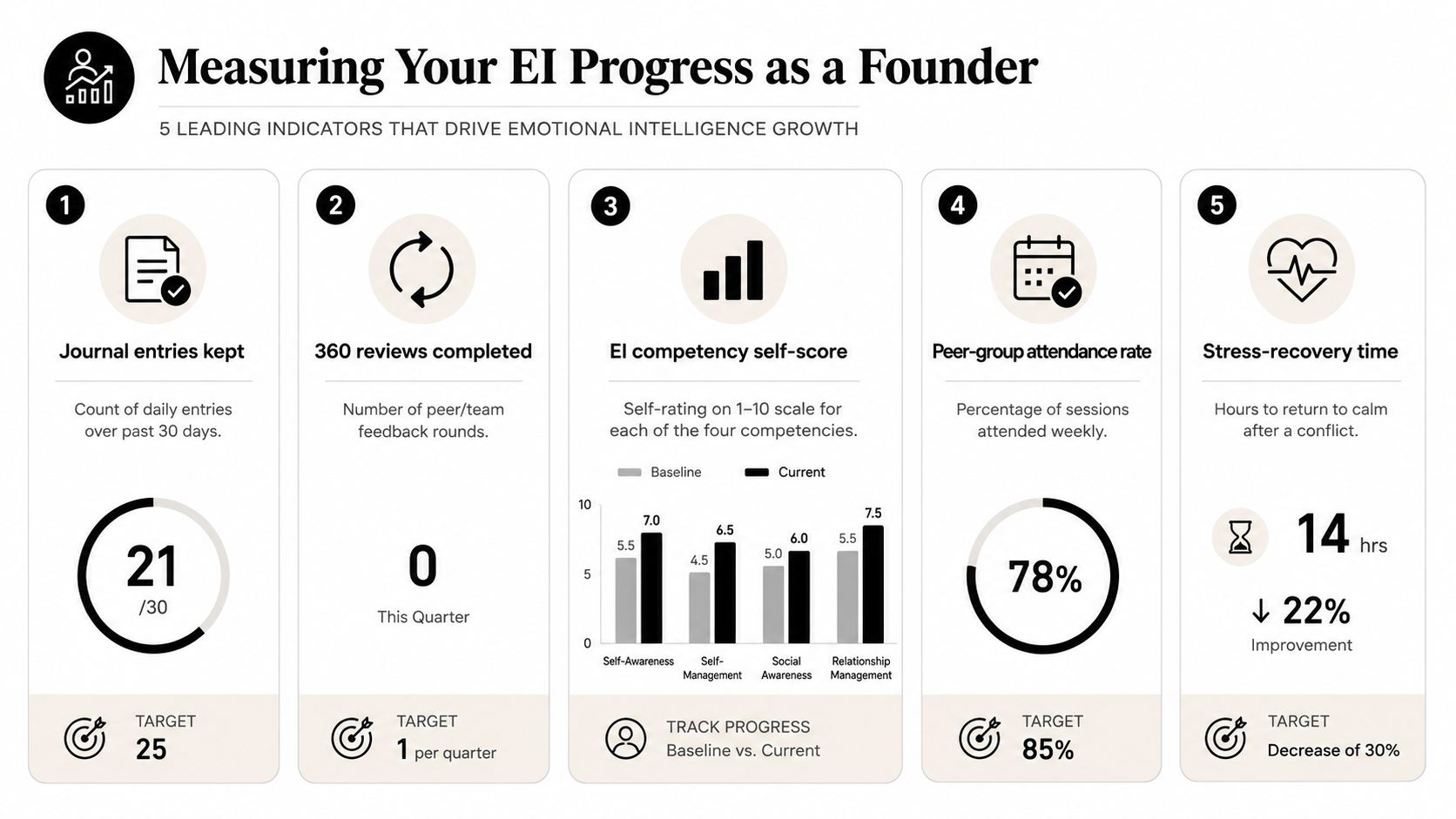
A useful group also measures progress without turning into a corporate workshop. Ask each founder to self-rate the four competencies before the session starts, then compare that to what peers notice over time. Add one note on avoided reactive emails and one behaviour shift that another founder saw clearly. Those are better signals than vague encouragement.
The hardest part is showing up consistently. Once the group becomes part of the calendar, the learning starts to compound.
Measuring Your EI Progress as a Founder
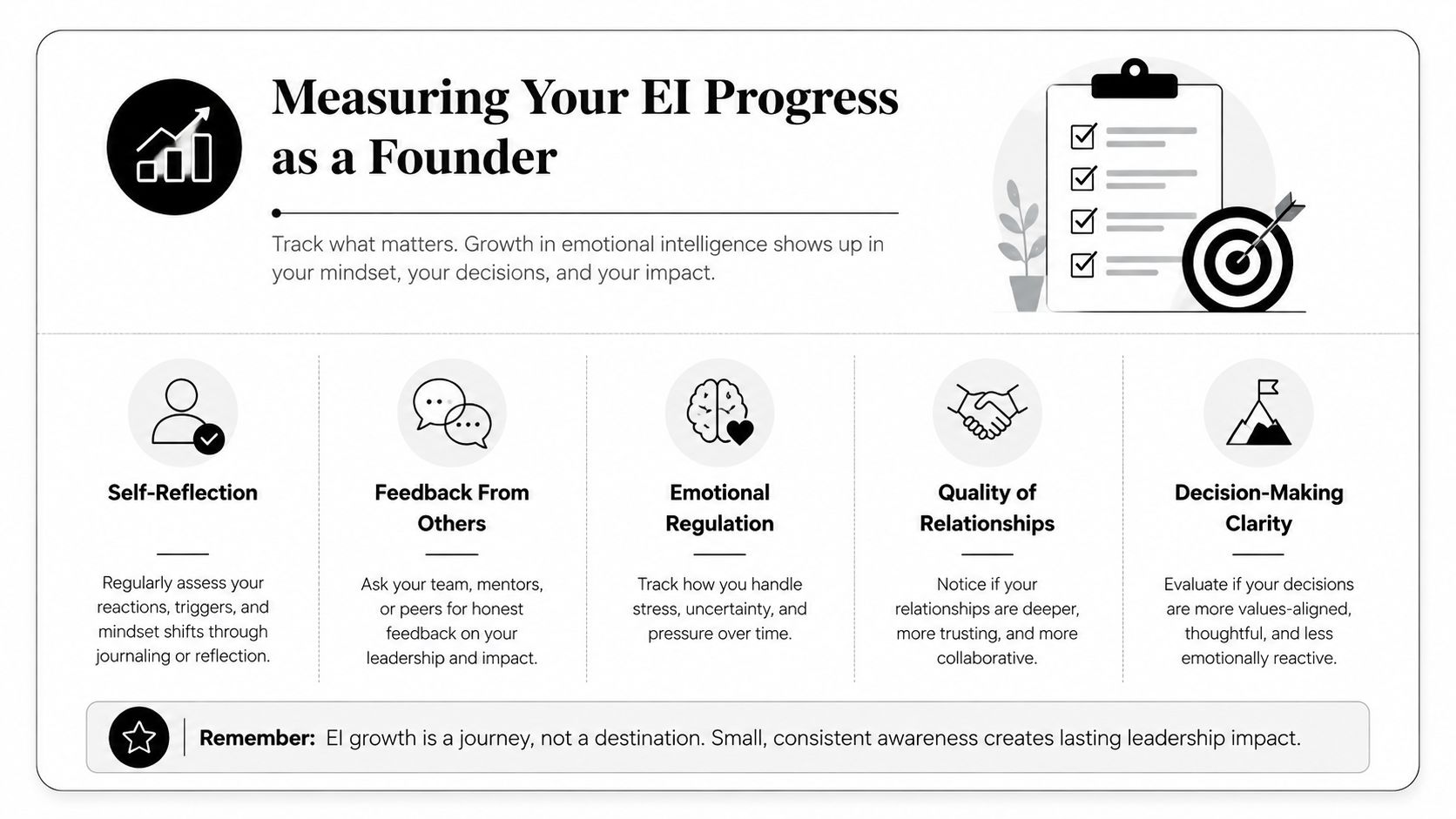
A founder doesn't need a complicated scorecard to know whether this work is helping. Track what you do. Keep a count of decision journal entries, completed 360 reviews, hard conversations delivered on time, reactive emails avoided, and peer sessions attended with one new insight logged.
The right target depends on stage, so don't turn this into theatre. A pre-seed founder and a Series A founder won't run the same rhythm, but both can use the same dashboard to see whether the practice is alive. If you want a good reading list to support the habit, the TekRecruiter leadership book guide is a practical place to look for extra material without turning the work into theory overload.
Your quarterly check-in can stay simple:
- What competency got stronger?
- What triggered me most often?
- Which conversation did I avoid?
- What did my peers notice before I did?
Pick one competency, one practice, one peer, and one review date before you close this tab. That's enough to start building a stronger operating rhythm.
Founder Connects is built for founders who want honest peer groups, sharper decisions, and real accountability in the UAE and wider MENA ecosystem. If you're working on the same emotional patterns, high-stakes conversations, and leadership pressure described here, visit Founder Connects and see how a trusted founder circle can help you keep moving.

Building in MENA? You don't have to do it alone.
Join 300+ founders in the Founder Connects Residency. Monthly squad calls, warm intros, $3M+ in perks, and much more. All for less than your monthly coffee budget.
Popular posts





Founder Connects is a premium MENA tech founder community. Meetups in Dubai and across MENA, Residency Squads of 8–10, and 400+ vetted WhatsApp founders (apply and screened).