

Founder Burnout Prevention Strategies MENA: UAE Guide

Building in MENA? You don't have to do it alone.
Join 300+ founders in the Founder Connects Residency. Monthly squad calls, warm intros, $3M+ in perks, and much more. All for less than your monthly coffee budget.

54% of founders experienced burnout in the previous 12 months, and 72% reported anxiety, burnout, or depression in a separate 2025 synthesis according to the cited founder-burnout research. If you're a UAE founder working past midnight, skipping lunch, and calling that commitment, you're not being disciplined, you're often building a breakdown into the business model.
That's the problem with most burnout advice. It's written for generic office workers or for Western startup environments that don't reflect the UAE and wider MENA reality, where hustle gets normalised, family expectations can sit on top of investor pressure, visa dependence makes stepping back feel risky, and founder circles can feel crowded yet still isolating. A better approach is structural, not motivational, and it has to work in a region where availability is treated like virtue.
This guide is built for founder burnout prevention strategies MENA founders can use. It focuses on warning signs, local pressures, recovery steps, and prevention systems that protect both your health and your company. If you want a broader practical framework on recovery, burnout recovery with Cait Donovan is a useful companion read, but the core point here is simpler, your business needs boundaries as much as it needs ambition.
The Founder Burnout Crisis in MENA and What to Do About It
54% of founders experienced burnout in the previous 12 months in the 2025 survey, and the same research ecosystem shows how widespread the issue is across entrepreneurship more broadly. The problem isn't just that founders feel tired, it's that burnout becomes a scale risk when the same person is carrying product, hiring, fundraising, sales, and customer support at once. The numbers make one thing obvious, this isn't a fringe issue, it's a management problem that shows up in the founder's nervous system first.
A lot of UAE founders recognise the pattern immediately. You answer messages at 1 a.m., skip lunch because a call ran long, then tell yourself you'll rest after the next round, the next launch, or the next hire. The trap is that stepping back feels like falling behind, so you keep pushing until your judgement gets slower and your patience gets shorter.
Why generic burnout advice misses MENA founders
Western advice often says “say no more often” or “build a morning routine”. That's too vague for founders in the UAE and MENA, because the pressure isn't only internal, it's cultural and operational. In this region, peer support, therapy, and structured boundaries are the strongest defenses in the available research, not inspirational speeches or productivity theatre.
One cited intervention found that founders with a support network were 45% less likely to burn out, and boundary-setting reduced burnout risk by nearly 3x in the source summary from the founder-burnout research ecosystem. That matters because the key lever isn't better self-talk, it's reducing isolation and decision overload before they harden into chronic stress.
Practical rule: If your burnout plan depends on motivation, it'll fail on your worst week. If it depends on structure, it can still work when you're overloaded.
The rest of this article is built around that principle. You'll get region-specific strategies, evidence-backed frameworks, and tools you can apply this week, not someday when the startup calms down.
Recognizing Early Warning Signs Before Burnout Takes Over

The early stage of burnout rarely looks dramatic. It looks like functioning well on the outside while your inner battery keeps draining, and that's why founders miss it. Mercury's warning model is useful because it catches the subtle shifts, emotional flatness, heavier decision-making, rising forgetfulness, reduced focus, and dependence on caffeine, sugar, or late nights as described in Mercury's founder guidance.
Use a weekly emotional check-in
Keep this short and honest. Once a week, write down three answers.
- What gave me energy this week? Name the meeting, task, or person that left you clearer rather than more tired.
- What drained me most? Write the one thing you kept avoiding or resenting.
- Where is disengagement growing? Look for boredom, flatness, cynicism, or dread, not just exhaustion.
The point is to spot movement, not perfection. A rough week is normal. A pattern that repeats, intensifies, and takes longer to recover from is a warning.
Separate pressure from burnout
Startup pressure comes and goes. Burnout lingers. If your stress lifts after a rest day, a handoff, or a good night's sleep, you're probably dealing with load. If your focus stays broken, your memory keeps slipping, and simple decisions feel heavy even after rest, the problem is deeper.
A useful habit is to convert repeated decisions into defaults, processes, or documented rules before they eat your attention. The same Mercury guidance recommends reducing cognitive load this way, and it's one of the cleanest early interventions because it stops tiny decisions from becoming daily friction.
If you're re-deciding the same thing every week, it's not a decision. It's a system gap.
For founders who want a second lens on what early burnout can look like in practice, early burnout warning signs UK is a helpful reference point, but the lesson is universal, catch the drift early, not after your output has already started to wobble.
Understanding MENA-Specific Burnout Pressures
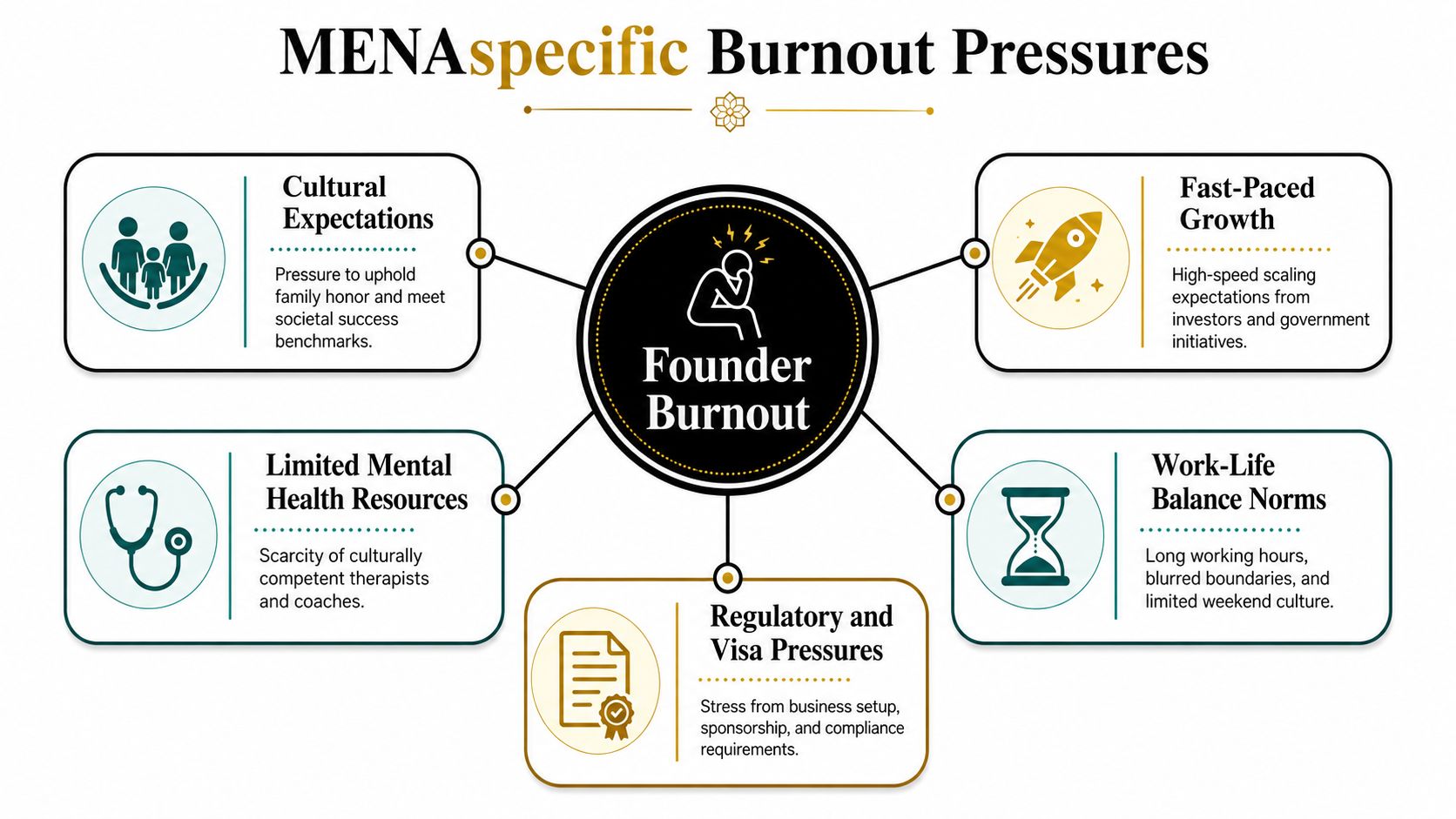
The UAE and wider MENA region add layers that generic startup advice usually skips. Hustle culture gets praised as proof of seriousness, family expectations can turn business performance into identity pressure, and visa or employment dependence can make stepping back feel like you're gambling with your future. On top of that, founder communities can be socially dense, while still emotionally thin, so you're surrounded by people and still feel alone.
Dubai South Business Hub makes this local reality concrete with boundary practices that fit the region's pace, not fantasy idealism. Their guidance includes set WhatsApp business hours, deliberately use the Friday-Saturday weekend, batch networking events, plan recovery time into the calendar, take one full week of leave per quarter, and protect device-free Friday mornings in their Dubai entrepreneur guidance. Those aren't soft wellness ideas, they're operational guardrails.
Why region fit matters
The wrong advice in MENA is often too abstract. “Just disconnect” doesn't work if every client, supplier, investor, and teammate expects instant replies. A founder in Dubai who sets a hard boundary on after-hours messaging isn't being lazy, they're making their business survivable.
The same applies to family pressure. Many founders aren't only trying to build a company, they're trying to justify the risk to parents, spouses, and extended networks back home. That creates a pressure to keep saying yes long after the business should have started saying no.
Use boundaries that match local behaviour
A practical boundary stack in this region looks like this:
- WhatsApp rules: Set business hours and stop treating reply speed as a status symbol.
- Weekend protection: Use the Friday-Saturday rhythm deliberately, not as an afterthought.
- Event batching: Attend networking in blocks instead of scattering it across the week.
- Recovery planning: Put rest on the calendar before work fills every empty slot.
The key takeaway is simple. In MENA, burnout prevention isn't just about working less, it's about designing a life where constant availability isn't the default.
Building Prevention Systems That Actually Work
The strongest prevention signal is operational, not motivational. Founders who delegate and protect recovery time burn out less, and that's the part most advice gets backwards. If you're still doing everything yourself, you're not proving resilience, you're concentrating fragility.
Delegation is a burnout control, not a luxury
One research summary says delegation of administrative work through virtual assistants can free 10–15 hours per week, while early hiring of an executive assistant is explicitly recommended as a prevention tactic from the cited founder-burnout research. That's a meaningful chunk of time, but the larger benefit is cognitive. Every task you stop carrying personally creates room for better decisions.
A lot of founders hesitate. They think delegation means loss of control. In reality, it means you're buying back the attention required to make high-stakes calls properly.
Recovery time changes the quality of your decisions
The same source reports that founders who protect a weekly rest day have 34% lower burnout rates and 23% higher decision quality, while sleeping only 5 hours leads to 39% worse decisions than sleeping 7 hours in the same research summary. Those aren't lifestyle niceties. They're decision-quality inputs.
Hard truth: If you're exhausted, you're not just slower, you're more expensive to your own company.
A separate UAE workplace survey reported 6% burnout among respondents without boundaries versus 45% among those with clear boundaries in the 2025 UAE burnout survey. The exact framing in that source is messy, but the practical lesson is clean. Structure matters more than willpower, and the business case for boundaries is stronger than the emotional one.
A simple founder system you can implement now
Under30CEO recommends writing down three personal warning signs, setting one protected recovery block, and creating two decision rules you no longer re-debate in its founder-burnout prevention guidance. That's enough to start. You don't need a wellness programme, you need fewer open loops.
| Founder stage | What to prioritise first | What to delay |
|---|---|---|
| Solo or pre-team | One recovery block, one delegation task, one decision rule | Complex wellbeing systems |
| Early team | Hard stop time, SOPs for repeated work, weekly rest day | Ad hoc availability |
| Scaling stage | EA or ops support, formal handoffs, quarterly leave planning | Founder-as-firefighter habits |
If you want one external option for peer accountability, Founder Connects runs curated founder experiences with small groups and moderated sessions, which fits this systems-first approach without turning burnout into a self-help project. The point is not the label, it's the structure.
Why Peer Groups Beat Generic Networking for Burnout Prevention
The isolation problem in MENA is weirdly specific. You can go to plenty of events, exchange cards, and still not have one person you can call when you're spiralling over a payroll decision or a broken hire. That's why broad networking often fails founders under strain, it creates motion without trust.
A useful cited finding says founders with a support network were 45% less likely to burn out from the founder-burnout research ecosystem. In MENA, that finding matters even more because the social layer is thick, but the emotional layer can be thin. You see people often, you just don't always get candour.
What actually works in practice
Founder Connects is built around small peer groups, moderated sessions, and intentional one-to-one introductions. That format matters because it changes the kind of conversation you get. Instead of trying to “meet everyone”, founders talk through live problems with people who understand the pressure and can respond with useful context.
The difference is concentration. A crowded mixer gives you noise. A curated group gives you follow-through.

That's why more networking is not automatically better. For overloaded founders, broad community participation can become another obligation. Smaller trusted groups reduce the social cost of honesty, which is exactly what burnout prevention needs.
Choose signal over volume
Use these criteria when evaluating any founder community:
- Confidentiality: Can you speak openly without performing?
- Specificity: Are members close enough in stage or challenge to be useful?
- Consistency: Does the group meet often enough to create momentum?
- Accountability: Does someone follow up on decisions and actions?
For a deeper rationale on this model, founders benefit from peer groups covers the core logic in a startup context. The short version is that curated peer support works because it reduces isolation and cognitive overhead at the same time.
Rule of thumb: If a community leaves you more exhausted than understood, it's entertainment, not support.
Actionable Checklists for Daily Burnout Prevention
Use checklists because they remove debate. If a habit depends on mood, it'll disappear the moment you get busy. A solid founder system is boring in the best way, it runs whether you feel like it or not.
Daily checklist
- Set a hard stop time: Pick one hour and stop work at that time on purpose, not when you collapse.
- Switch notifications to silent after hours: Protect the evening from constant interruption.
- Delegate or automate one task: Move one recurring task off your plate every day until the list gets lighter.
- Protect sleep: Treat 7 hours as the floor you plan around, not the reward you earn later consistent with the sleep-and-decision findings in the founder-burnout research.
Weekly checklist
- Run an energy audit: Write down what drained you and what gave you energy.
- Book one peer or mentor conversation: Use it to make one decision, not to collect advice.
- Protect one full recovery block: Keep it work-free and make it a firm commitment.
- Review repeated decisions: Turn at least one recurring choice into a default, process, or rule.
Quarterly checklist
- Plan leave early: Put recovery time into the calendar before client and investor pressure fills it.
- Review your boundaries: Check whether your hard stop is real or just symbolic.
- Stress-test your support network: Ask whether you've got enough people who can be honest with you.
- Upgrade one system: Add an EA, improve SOPs, or tighten handoffs if the current setup is leaking energy.
The practical version is this. Start with one daily item and one weekly item for the first two weeks, then add more only after those become automatic. If you try to fix everything at once, you'll create another project instead of a healthier operating rhythm.
| Checklist level | Early-stage founder focus | Scaling founder focus |
|---|---|---|
| Daily | Hard stop, sleep floor, one delegation | Silent hours, handoffs, automation |
| Weekly | Energy audit, one peer call | Recovery block, decision review, team load check |
| Quarterly | Boundary reset, leave planning | Support network review, system upgrades |
For a more practical companion template, the Founder Mental Wellness Checklist is a useful reference point because it keeps the focus on habits you can sustain.
Taking Your First Step Toward Sustainable Founder Health
Burnout prevention is a system, not a willpower test. The evidence keeps pointing the same way, structure beats grit when the workload gets heavy, and founders in MENA need systems that account for cultural pressure, constant connectivity, and the reality of running a business in a high-speed ecosystem.
Pick one move today. Book a weekly peer check-in with a founder you trust, set a hard stop time for tomorrow and protect it for two weeks, or join a curated founder community where accountability is built into the format. The goal isn't to feel perfect, it's to stop living on the edge of collapse.
If you want a founder network that's built around real conversations, curated peer groups, and practical accountability, visit Founder Connects. It's designed for UAE and MENA founders who want support that changes how they make decisions, not just more people to meet.

Building in MENA? You don't have to do it alone.
Join 300+ founders in the Founder Connects Residency. Monthly squad calls, warm intros, $3M+ in perks, and much more. All for less than your monthly coffee budget.
Popular posts





Founder Connects is a premium MENA tech founder community. Meetups in Dubai and across MENA, Residency Squads of 8–10, and 400+ vetted WhatsApp founders (apply and screened).