

Fintech Startups UAE to Watch 2026: Top 7 Innovators

Building in MENA? You don't have to do it alone.
Join 300+ founders in the Founder Connects Residency. Monthly squad calls, warm intros, $3M+ in perks, and much more. All for less than your monthly coffee budget.

The UAE fintech market is entering 2026 with real momentum, not just narrative. In Q1 2026, the UAE pulled in US$486 million in fintech funding, ranking third globally behind the US and the UK, while fintech made up 46% of total regional startup investment in the same quarter (Fintech News UAE). For founders, that matters because capital is still chasing businesses that can clear regulation, solve a real operating pain, and scale across the UAE and wider MENA. This isn't a hype list. It's a founder's read on the fintech startups UAE to watch 2026, with the trade-offs that shape partnerships, fundraising, and product strategy. If you're also sharpening investor pitch presence, this executive presence for investors guide is a useful side read.
1. Tabby
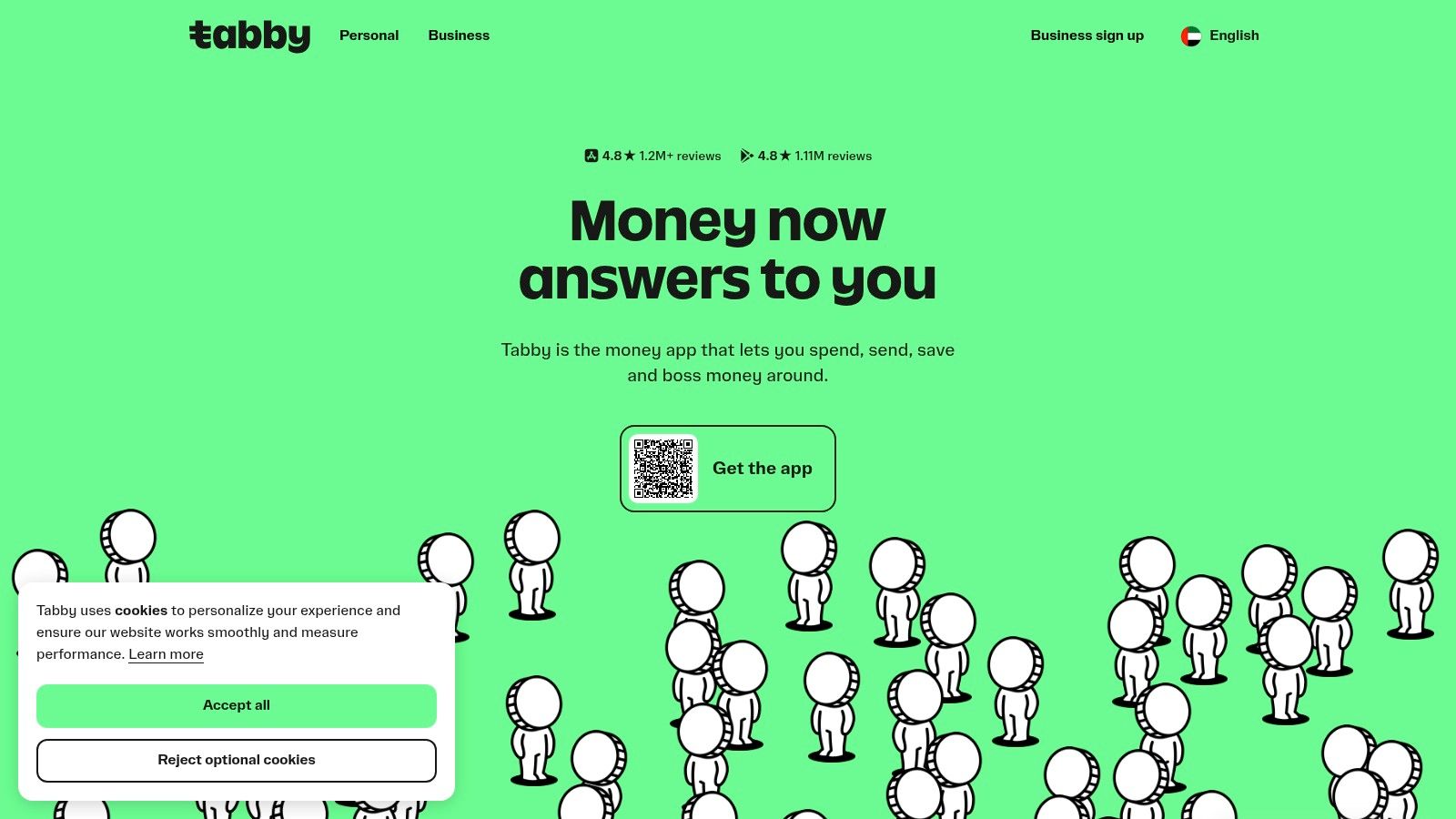
Tabby stays at the top of any serious UAE fintech watchlist because it has done the hardest thing in consumer finance, built scale without staying boxed into one product. Its core BNPL proposition now sits alongside spending accounts and cards after securing a UAE Stored Value Facilities licence in April 2026, which gives it room to hold customer funds and expand its wallet layer. That shift matters more than another launch announcement. It turns Tabby from a checkout tool into a broader money layer for day-to-day commerce.
Tabby sits in a strong position because it already has merchant distribution across the region and can use that network for new products. The core strategic moat is not just brand recognition, it's the habit loop between consumer demand and merchant acceptance. For founders, the lesson is simple, distribution first, product expansion second.
What works and what doesn't
Tabby's strength is clear. It can bundle instalments, wallets, and cards into one flow, which makes it harder for a merchant to replace once integrated. The risk is just as clear, BNPL carries the familiar downside of missed-payment friction, and consumer complaints around promotions or support can surface at scale.
Practical rule: if you're building around consumer credit in the UAE, don't copy the headline feature. Copy the distribution logic, then build a better trust layer.
For founders in adjacent categories, the partnership angle is obvious. Education payments, merchant lending, and payroll-linked spending products all fit Tabby's expanding footprint. If you want to learn from the kind of ecosystem access that helps regulated fintechs move faster, the DIFC ecosystem overview at Founder Connects' accelerator guide is worth a look.
2. NymCard
NymCard is one of the clearest examples of infrastructure value in the UAE market. It doesn't sell a consumer story. It sells the plumbing that lets other fintechs, banks, and enterprises launch cards, process payments, and build embedded finance products without rebuilding the stack from scratch. In a market where regulation and integrations can slow down even good ideas, that kind of platform is valuable.
NymCard has also earned attention because it sits in the middle of the region's card-issuing and processing conversation. Its API-first model is a key edge. When a startup can plug into issuing, processing, and compliance-heavy workflows through one provider, it saves time that would otherwise be spent stitching vendors together.
The trade-off is familiar. Infrastructure businesses usually take longer to close and integrate than app-layer fintechs. They win on retention and breadth, but the sales motion is enterprise-style and rarely quick.
Why founders should pay attention
NymCard matters because it reflects where 2026 capital is flowing, toward specialised financial infrastructure rather than generic consumer wrappers. It also aligns with the UAE's more demanding regulatory environment, which is increasingly filtering for teams that can work within licensed systems instead of trying to route around them. For founders, that means there's real room for partnership if your product needs card issuing, settlement rails, or compliance-ready payment capabilities.
The best collaboration opportunities sit with companies building cross-border payouts, payroll products, vertical SaaS finance, and stablecoin-adjacent settlement use cases. If your roadmap touches regulated financial flows, the useful question isn't whether NymCard is a competitor. It's whether their stack can shorten your time to market.
If you're building regulated products, the operational side matters as much as the product side, and this fintech compliance guide is a good reference point for how to think about licensing, controls, and launch readiness in the UAE.
3. Lean Technologies
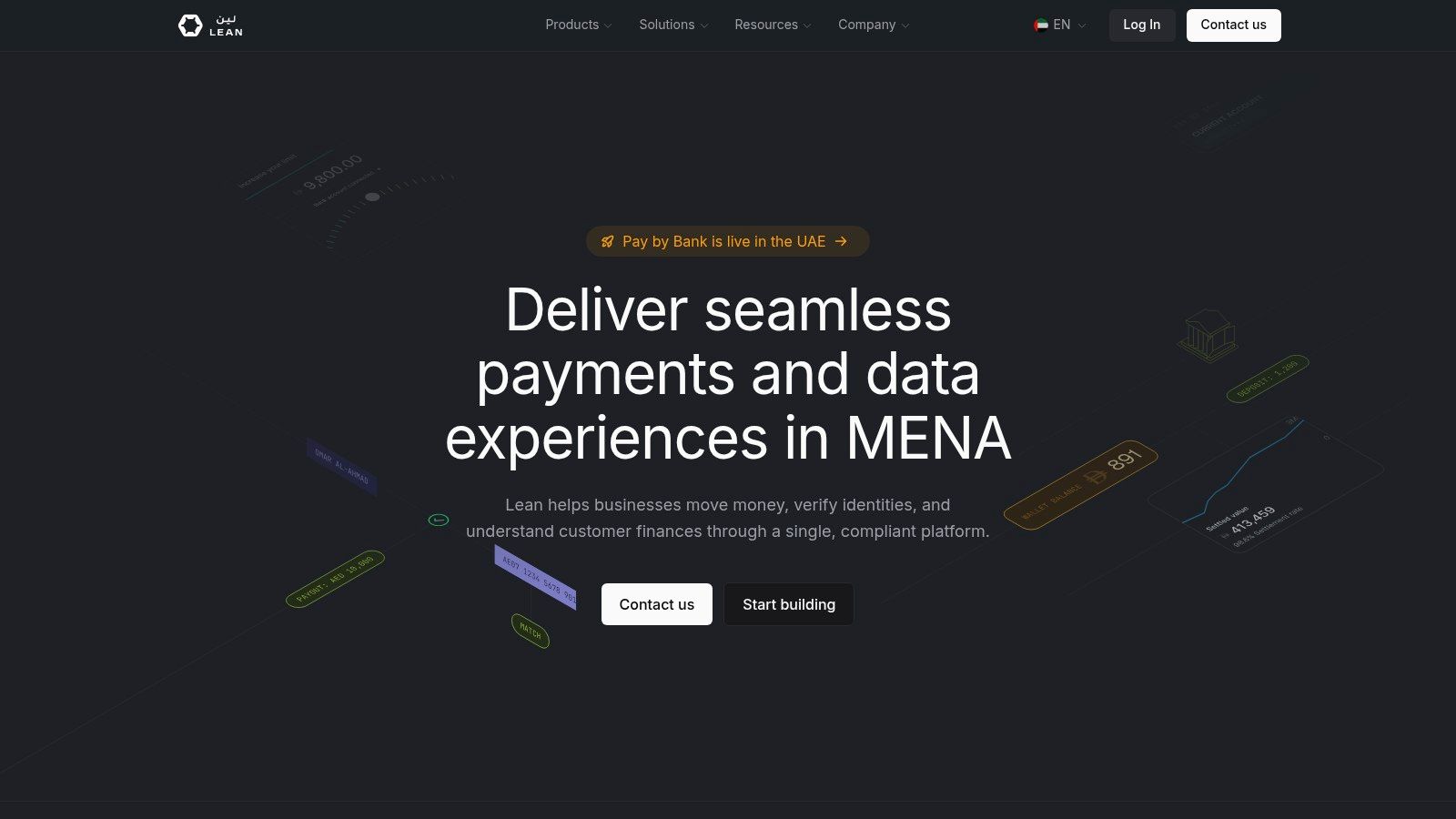
Lean Technologies earns a watchlist spot because it sits right where the UAE's next fintech wave is headed, open finance, account-to-account payments, and identity. That combination gives it more strategic weight than a single-point payment tool. If a merchant can use bank connectivity for data, payments, and KYC in one stack, it has a better shot at reducing conversion friction and avoiding unnecessary card costs.
Lean Technologies also matters because it is aligned with the CBUAE's open finance direction and has already built a position around bank connectivity in the UAE and Saudi Arabia. That regulatory alignment is not a side note. In this market, it is often the difference between a product that can scale and one that stays stuck in pilots.
The founder takeaway
Lean's strongest moat is usefulness. It can sit inside a merchant checkout flow, a lending workflow, or an onboarding flow, which makes it relevant to more than one buyer. The weakness is adoption. A2A payments and open banking-style flows still require banks, merchants, and consumers to change behaviour, and that takes time.
The winners in open finance are rarely the flashiest apps. They're the companies that make bank data and payment rails boring enough to trust.
For founders, the opportunity is partnership-led rather than purely competitive. If you are building lending, payroll, SME finance, or embedded banking, ask a simple question, can Lean remove two or three steps from your current flow? If the answer is yes, the integration case is strong.
The smarter move is to treat Lean as part of your distribution and conversion strategy, not just a backend vendor. In a market where licensing and adoption both matter, that framing is more realistic than chasing a pure technology story.
4. Mamo
Mamo is the kind of company that looks straightforward until you try to run finance operations for an SME in the UAE. Its value is not just corporate cards. It's the combination of spend controls, collections, vendor payouts, and expense workflows in one product. That matters because finance teams don't want another dashboard. They want less switching between tools.
Mamo is also relevant because it has a clear UAE footprint through DIFC and DFSA-regulated payment account, stored value, and money transmission capabilities. That regulatory positioning gives it a stronger foundation than many generic spend tools. In practice, that means founders can think about Mamo as an operating layer for business money, not only as a card issuer.
The product fit is strongest for lean finance teams that need visibility without building a full finance stack. Unlimited physical and virtual cards, real-time controls, and wallet funding support make it flexible enough for day-to-day execution, especially in fast-moving companies.
Where it fits, and where it doesn't
Mamo works best when a company wants control without overengineering. It is a good fit for SMEs and growth-stage teams that care about spend governance, reimbursement discipline, and cleaner approvals. It is less compelling for teams that want fully bespoke treasury workflows or highly customised enterprise finance systems.
Founder lens: if your finance team still uses manual approvals in chat, the product that wins is the one people actually adopt, not the one with the longest feature list.
Partnership-wise, Mamo sits well with payroll providers, accounting platforms, and vertical SaaS tools serving SMEs. That makes it a natural candidate for embedded finance partnerships, especially where the customer needs both payments and operational control. The trade-off is that public pricing is limited, so founders should be ready for a more consultative buying process.
For anyone building SME infrastructure in the UAE, Mamo is a strong reminder that the best fintech products often solve the ugly middle of operations, not the exciting edge cases.
5. baraka
baraka stands out because it bridges two markets that UAE retail investors care about at once, US equities and local UAE stocks. That's a practical wedge. Investors do not want to open multiple accounts just to access different markets, and baraka gives them a single app with a regulated path to both.
baraka also benefits from its DFSA-regulated structure and its partnership with US broker DriveWealth. That combination gives it legitimacy in a category where trust is everything. For fintech founders, the lesson is that access plus regulation is a stronger narrative than access alone.
The product is easy to understand, which helps in a market where many retail investing apps overcomplicate the pitch. Subscription plans that bundle free trades and savings on transfers make the economics clearer for users who want to compare costs without reading a lot of fine print.

Strategic read for founders
baraka's moat is localization. It speaks to UAE residents in a way global brokers often don't, and that matters more than people think. Local market access, education content, and a familiar user experience lower the barrier for first-time investors.
The weakness is that consumer investing apps live and die on service quality and cost clarity. If support feels slow or FX economics are hard to compare, users start shopping around quickly. That's why baraka's next challenge is not just acquisition, it's retention through trust.
For founders building adjacent tools, there's a partnership opportunity in education, portfolio analytics, tax documentation, and local research content. If you serve UAE retail investors, baraka shows how important it is to make the first deposit and the first trade feel simple.
6. Sarwa
Sarwa is one of the clearest examples of a UAE fintech that has moved from promise to scale. In May 2026, it surpassed US$1 billion in client assets, according to reporting from Sarwa. That milestone matters because wealthtech usually needs both trust and patience before users commit serious capital, and it shows the UAE market can support more than one durable winner.
Sarwa combines managed portfolios, a cash/save product, and self-directed trading in one platform. The product breadth is useful, but the key advantage is how it serves different investor profiles without forcing them into separate apps. That makes it relevant for users who want automation first, then the option to move into more active investing later.

Why Sarwa still matters in 2026
Sarwa's advantage is regulatory credibility paired with product clarity. Its ADGM and FSRA footing helps it operate in a category where users are sensitive to safety and oversight. That also gives the company a practical base for longer-term wealth products, not just trading acquisition.
The trade-off is cost structure. Managed portfolios include ongoing fees, and users still need to compare those economics against alternatives. That is not a flaw, but it does mean Sarwa has to keep proving value through outcomes, education, and ease of use.
Useful benchmark: wealth platforms in the UAE win when they make the first meaningful investment feel simple, not when they try to impress users with complexity.
For founders, Sarwa is a strong case study in product layering. If you build around cash management, investment wrappers, or financial education, there is room to partner around onboarding, referral flows, or niche investment content. If you are serving UAE retail investors, Sarwa is a reminder that trust compounds when the platform keeps the experience transparent.
If you want a broader view of how the regional wealth and fintech stack has evolved, this top 30 fintech startups regional analysis is a useful reference.
7. Pemo
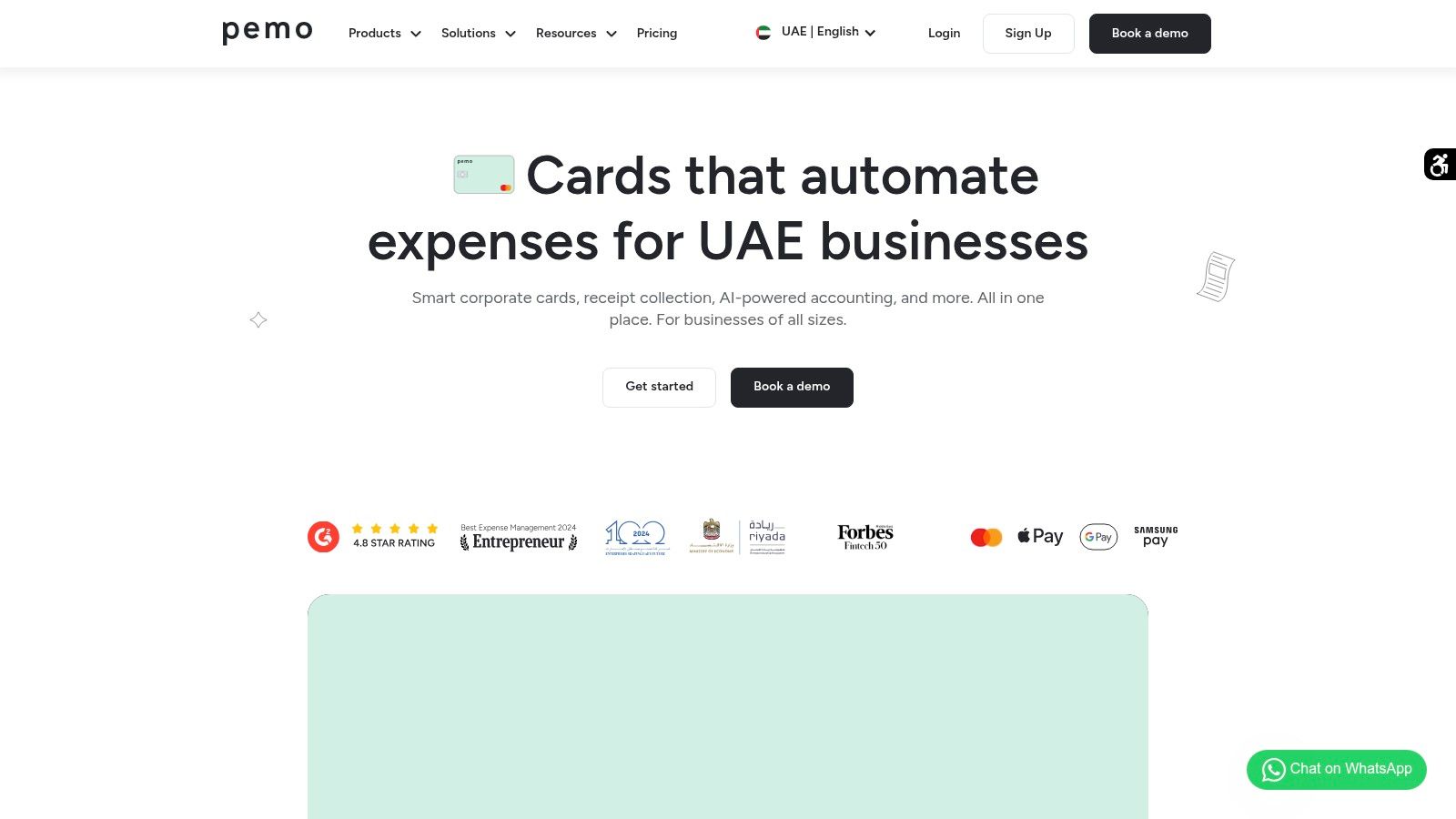
Pemo is a strong watchlist name because it solves the boring but expensive problem of spend control for SMEs. That sounds modest until you look at how many teams still manage cards, invoices, reimbursements, and payouts through a messy mix of spreadsheets and chat threads. Pemo's pitch is to consolidate that operational pain into one system.
Pemo also gained relevance in July 2026 when it received CBUAE in-principle approval for an SVF licence. That is not the same as a full licence, but it does show a regulatory path toward domestic wallet and stored-value features. In the UAE, that kind of progress matters because it signals the company is building with the system, not around it.
What founders should learn from Pemo
Pemo's strongest appeal is consolidation. Virtual and physical cards, invoice workflows, vendor payouts, and real-time controls reduce finance ops overhead in a way CFOs can feel quickly. That gives it a practical sales story, especially for SMEs that need control before they need sophistication.
The downside is familiar in B2B fintech. Pricing is not always public, the sales cycle is more enterprise-like, and features can change as the regulatory roadmap evolves. That means founders considering a partnership should expect a consultative process.
When the buyer is a finance lead, the question is rarely “is the product cool?”. It's “will this reduce my monthly admin and stay compliant when we scale?”
For collaboration, Pemo fits nicely with accounting platforms, payroll operators, and SME vertical software. If you're building for UAE businesses, it's worth studying how Pemo ties spend, approvals, and payouts into one operational layer.
Top 7 UAE Fintech Startups 2026 Comparison
| Product | Implementation complexity (🔄) | Resource requirements (⚡) | Expected outcomes (📊) | Ideal use cases (💡) | Key advantages (⭐) |
|---|---|---|---|---|---|
| Tabby | 🔄 Medium, merchant integrations + regulatory ops | ⚡ High, capital, merchant partnerships, ops | 📊 High consumer reach; diversified revenue from wallets/cards | 💡 Consumer BNPL, merchant checkout conversions, wallet rollout | ⭐ Large merchant network; UAE SVF licence; broad product mix |
| NymCard | 🔄 High, API integrations & enterprise onboarding | ⚡ Medium–High, engineering, issuer/principal relationships | 📊 Strong scale for card issuance and settlement primitives | 💡 Fintechs/enterprises needing card-issuing/BaaS and stablecoin rails | ⭐ API-first platform; CBUAE Open Finance traction; Visa USDC support |
| Lean Technologies | 🔄 High, bank connectivity, KYC and payments integration | ⚡ High, bank partnerships, integration engineering | 📊 Reduced merchant payment costs; improved A2A conversion | 💡 Bank-data aggregation, Pay-by-Bank commerce, Open Finance builders | ⭐ Single platform for data/payments/KYC; regulatory IPA alignment |
| Mamo | 🔄 Low–Medium, card ops + SME onboarding | ⚡ Medium, DFSA compliance, banking integrations | 📊 Faster expense automation; streamlined corporate spend | 💡 SMEs and growth companies needing corporate cards & controls | ⭐ Unlimited physical/virtual cards; DFSA-regulated client money setup |
| baraka | 🔄 Low, consumer app with broker integrations | ⚡ Medium, compliance, broker and market access links | 📊 Broadened retail access to US and UAE markets | 💡 Retail investors seeking US exposure with local regulation | ⭐ DFSA-regulated access; subscription plans and localized experience |
| Sarwa | 🔄 Medium, portfolio management + regulatory compliance | ⚡ Medium, investment infrastructure, advisory tech | 📊 Scalable managed portfolios; high-yield save product (>$1B AUM) | 💡 Long-term retail investors wanting robo/advised + cash yields | ⭐ ADGM-regulated; transparent pricing and scale milestone |
| Pemo | 🔄 Medium, enterprise onboarding; SVF migration roadmap | ⚡ Medium, issuer/processor partnerships, product build | 📊 Consolidated spend workflows; future wallet/balance features | 💡 SMEs needing spend management, invoice/expense automation | ⭐ SVF in‑principle approval; integrated spend, approvals and payouts |
Your Next Move How to Engage with the Fintech Frontier
Watching these startups is useful. Learning from their operating choices is better. The clearest pattern across this list is that the strongest UAE fintechs are not just raising money, they're aligning product, regulation, and distribution in ways that make scale more defensible. That's especially visible in infrastructure players like NymCard and Lean, but it also shows up in consumer businesses like Tabby and Sarwa, where trust and licensing matter just as much as user growth.
For founders, the practical takeaway is to stop asking only who raised capital. Ask which model can survive licensing, integrations, and customer support at scale. If you are building in SME finance, embedded payments, wealth, or open finance, compare your roadmap against these companies and identify the one friction point you can remove better than they can.
There's also a clear partnership angle here. Tabby can open merchant distribution conversations, NymCard can shorten card and payment launches, Lean can compress bank connectivity work, Mamo and Pemo can reduce finance ops pain, baraka can help with investing access, and Sarwa shows how regulated wealth products can grow when the experience stays simple. Those are useful signals whether you're a founder, investor, or ecosystem operator trying to place a better bet in 2026.
If you want high-signal peer support while you build, Founder Connects offers curated founder groups, practical introductions, and events that are designed for real startup progress. For fintech founders in the UAE, that kind of network can be useful when you're navigating regulation, fundraising, and partnerships at the same time.

Building in MENA? You don't have to do it alone.
Join 300+ founders in the Founder Connects Residency. Monthly squad calls, warm intros, $3M+ in perks, and much more. All for less than your monthly coffee budget.
Popular posts





Founder Connects is a premium MENA tech founder community. Meetups in Dubai and across MENA, Residency Squads of 8–10, and 400+ vetted WhatsApp founders (apply and screened).