

Healthtech Opportunities UAE Founders Should Target in 2026

Building in MENA? You don't have to do it alone.
Join 300+ founders in the Founder Connects Residency. Monthly squad calls, warm intros, $3M+ in perks, and much more. All for less than your monthly coffee budget.

UAE-based digital health startups have raised more than $480 million since 2022 and $120 million across 25 deals in 2023 alone, according to UAE-focused industry reporting, and that 2023 total was described as a 45% increase in value versus 2022. That's not a frothy side market, it's a financing lane with repeat investor attention, scaled usage, and enough buyer demand to support real businesses, not just demos. For healthtech opportunities UAE founders should care about, the signal is simple, the market rewards teams that can sell into procurement, clinical workflows, and payer logic, not just pitch elegant software. [UAE digital health funding overview]
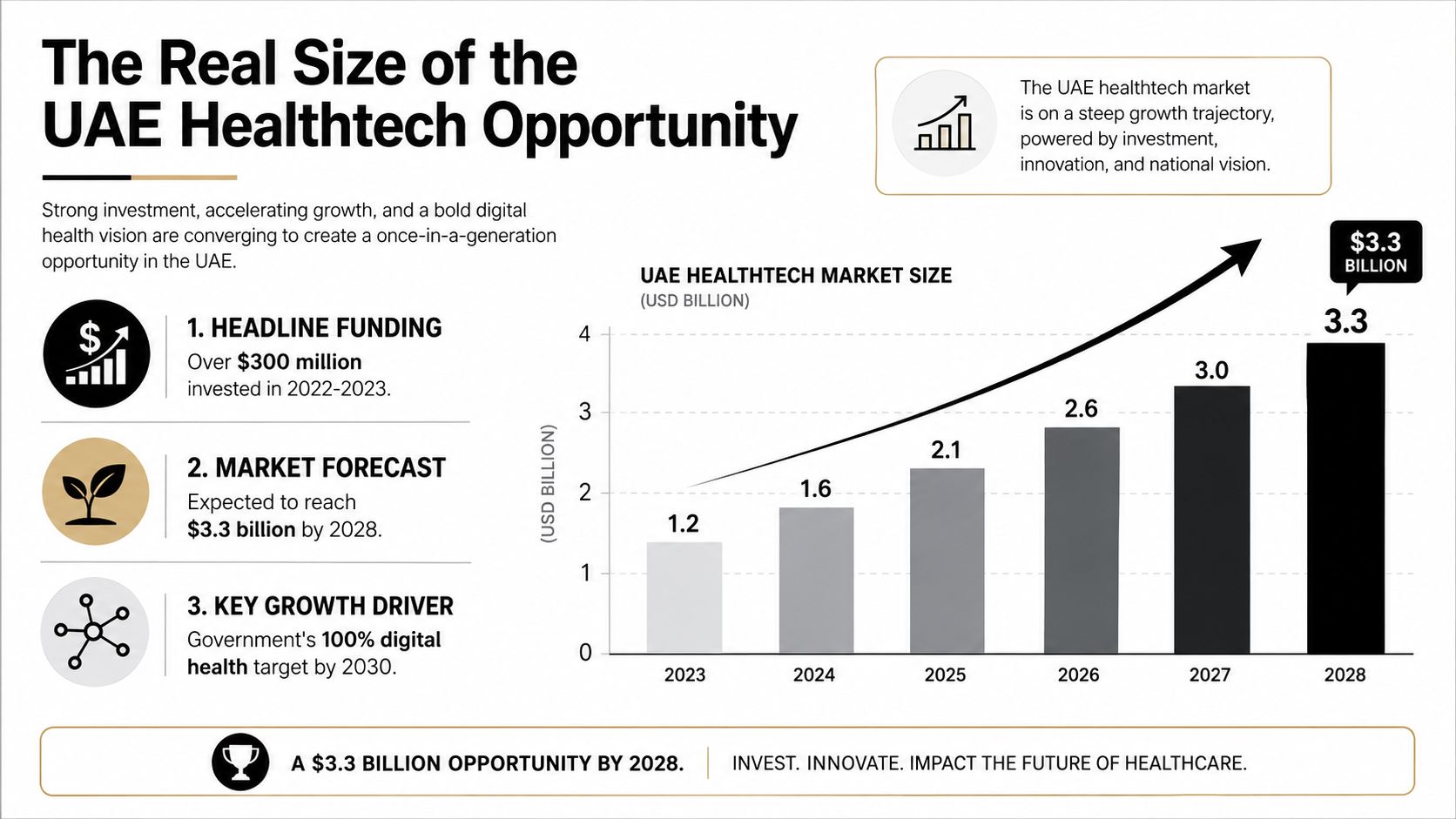
If you're deciding whether the UAE deserves the next 18 months of your life, the answer depends on whether you're building for a market that is still educating buyers or one that already has budget owners. The UAE digital health market was valued at USD 619 million in 2023 and is projected to reach USD 2.6 billion by 2030. That kind of expansion matters because it lowers the friction of adoption over time, especially in segments where hospitals, insurers, and government buyers need a clearer case before they switch workflows. [UAE digital health market forecast]
Reading the numbers like a founder
The market is not growing in a single line, it's splitting into submarkets with very different sales motions. Telehealth is one obvious lane, but the more durable opportunities are usually where digital tools reduce admin load, improve follow-up, or create cleaner handoffs between providers and payers. ResearchAndMarkets-linked reporting says the UAE health tech market is on track to exceed $1.5 billion by 2026, while EY's outlook puts telehealth on track to grow from $121 million in 2019 to $536.5 million by 2025, a 28.2% CAGR. [UAE health tech market forecast]
That's why the most credible founder thesis isn't “the market is booming”. It's that the buyer base is getting more comfortable with digital workflows, but still expects local compliance, integration, and proof that the product fits hospital reality. The founder who can explain why a clinical workflow shortens, how a nurse or claims team uses the product, and where reimbursement or procurement will happen has a better shot than the founder leading with a pretty dashboard.
Practical rule: if your product can't survive a hospital's procurement review, it isn't a market-ready product yet, no matter how polished the demo looks.
For a founder trying to frame this to a co-founder or investor in one sentence, the clean version is this. The UAE is both a capital-active startup hub and a large, expanding digital health market, which makes it one of the few MENA markets where you can build locally and still have a serious regional expansion story. If you want a quick sector map, the healthcare team at Ekipa AI for healthcare is a useful external reference point for understanding where digital tools sit in the stack.
Where the Demand Actually Lives Across Care Segments
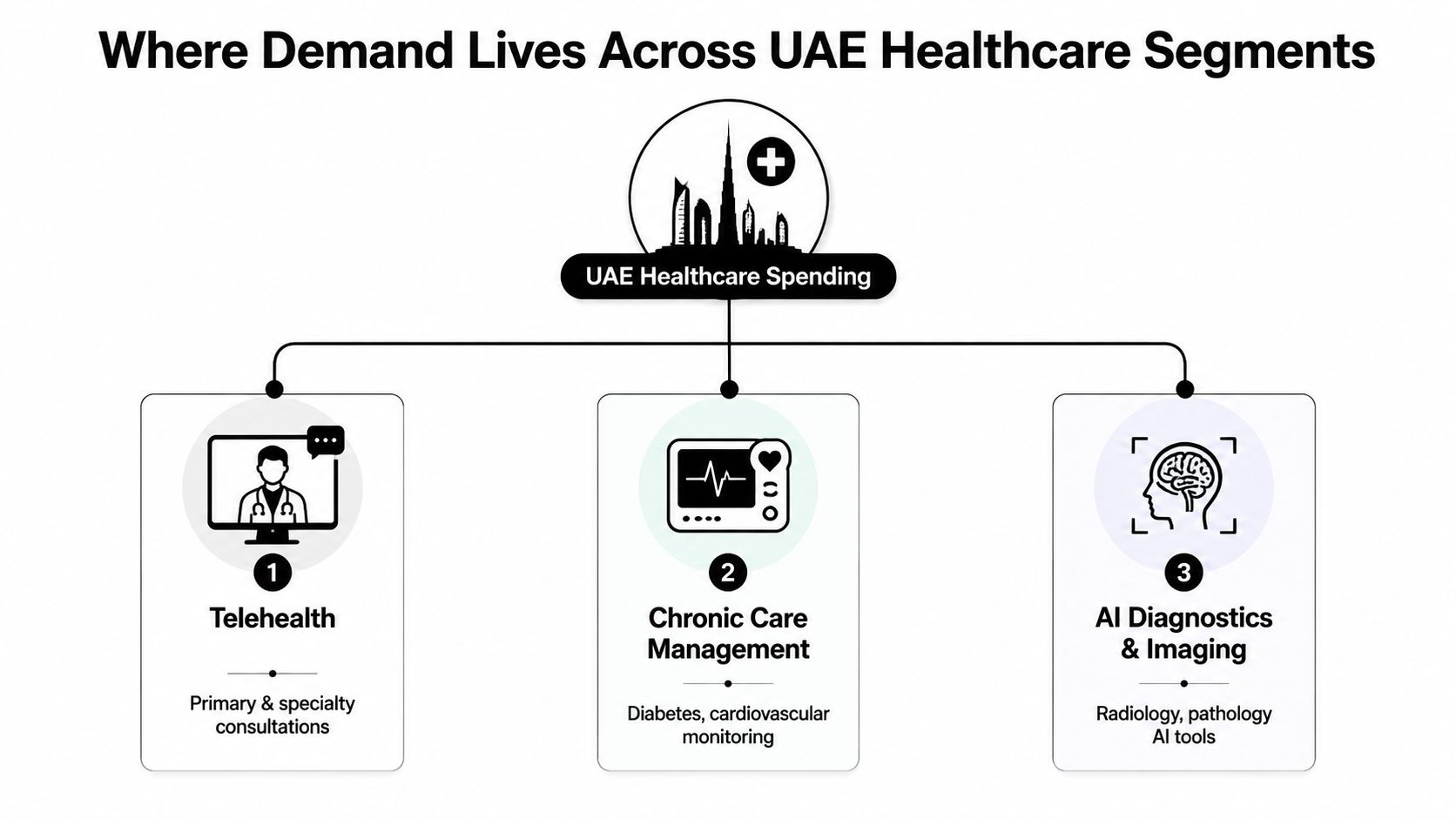
The strongest demand in UAE healthtech isn't spread evenly across every shiny category. It clusters around buyer pain that already has a budget owner, which usually means telehealth, chronic care management, AI-assisted diagnostics, and workflow software that helps hospitals or insurers move faster with fewer manual handoffs. The mistake founders make is chasing a sector label instead of a buyer problem. A hospital doesn't buy “digital health”, it buys a clearer triage path, a faster specialist consult, or a tool that makes reporting and coordination less painful.
The segments with the clearest budget owners
Telehealth is the cleanest starting point if your product already supports structured clinical interactions, follow-up, or virtual triage. It fits buyers who care about access, throughput, and patient convenience, and it tends to move faster when the product already plugs into an existing provider workflow. The catch is that telehealth is no longer interesting just because it's remote, it has to be operationally tidy.
Chronic care management is attractive when the product supports ongoing engagement rather than one-off visits. Diabetes, cardiovascular follow-up, adherence tools, and remote monitoring all fit here, especially where providers need better continuity after the patient leaves the clinic. These products usually need stronger evidence, tighter workflow fit, and a realistic plan for who pays for the ongoing relationship.
AI diagnostics and imaging can be powerful, but they're not the easiest first sale. They usually face more scrutiny from clinical reviewers, regulators, and procurement committees, which means the product needs to be more mature before it enters a serious buyer conversation. Founders often overestimate enthusiasm and underestimate validation burden.
Who can win in each lane
If you're early-stage, telehealth workflow tools and chronic care engagement products are usually more forgiving than diagnostic software. If you're growth-stage and already have clinical proof, AI diagnostics, imaging support, and insurer-facing decision tools can open larger conversations. The critical point is that the buyer persona changes by segment, and so does the proof required to get to yes.
Founder's check: ask whether the buyer is a clinician, an operations lead, an insurer, or a government programme owner. If you can't name the budget owner, the segment is too vague.
The segments to avoid, at least at the start, are the ones where incumbents already own the workflow and the switching cost is high. That doesn't mean you shouldn't build there, it means you should enter with a very sharp wedge, such as one department, one use case, or one reporting pain point. The UAE rewards focus more than breadth, especially when you're still proving that your product can live inside a real care pathway.
Navigating Regulation and Reimbursement Without Stalling
A lot of founders confuse “we can operate” with “we can get paid”. In the UAE, those are separate milestones, and treating them as the same thing is how pilots get stuck in limbo. You may clear a licensing path, then discover that reimbursement, approval, or data governance still blocks commercial rollout.
Choose the regulatory lane before you choose the pitch deck
The first decision is whether your company should sit in a free zone or on the mainland. Free zones can be useful for structuring ownership and building a tech-first base, while mainland entities can be better when the go-to-market depends on direct work with government providers, insurers, or public institutions. The right answer isn't ideological, it depends on where your first serious buyer lives and which regulator you'll need to satisfy first.
The second decision is which health authority you'll deal with first. The UAE doesn't use a single national playbook for every emirate, and companies that plan to expand across the country need to think beyond one pilot jurisdiction. If you're handling clinical data, telemedicine, or regulated medical workflows, you need to know early whether your path runs through Abu Dhabi, Dubai, or the federal layer. A useful regulatory primer is this approval and licensing guide for healthtech founders in the UAE.
The third decision is whether your product needs a reimbursement pathway or only a commercial procurement path. Insurance-billed products are a different category from software subscriptions sold to hospitals, and founders often blur them together. If your business model depends on payer recognition, get that logic mapped before you spend six months perfecting onboarding.
Questions to ask before signing a pilot
- Who owns conversion? Ask whether the pilot sponsor can influence procurement, or whether they're only responsible for testing.
- What happens after success? If there's no named commercial path, you're probably agreeing to a research exercise, not a sale.
- Which authority is in scope? Clarify whether the product touches patient care, medical data, or clinical decision support.
- What's the reimbursement story? If the product saves time but doesn't map to a payer code or budget line, the buyer may still stall.
- What data rights do you keep? A weak pilot agreement can trap future product development.
Practical rule: don't accept a pilot unless someone in the room can describe the next procurement step in plain English.
The best founders treat compliance and reimbursement as design inputs, not legal afterthoughts. That means choosing the legal structure, the regulator, and the buyer channel together. It's slower at the start, but it avoids the worst outcome in UAE healthtech, a nice pilot that can't legally or commercially become a product.
Picking Your First Pilot Partner and Validation Path
The right first pilot partner is the one that can buy, not just test. In the UAE, that gap matters more than founders expect. A partner can be enthusiastic, clinical leaders can like the product, and the pilot can still die if the sponsor is too far from procurement, budget approval, or the team that will use it.
How to evaluate who should run your pilot
Public hospitals are useful when you need credibility and a setting that reflects formal clinical workflows, but decisions can move slowly. Private hospital groups can move faster if the product clearly reduces admin work, improves patient flow, or removes a pain point operations already feel. Insurers are worth serious attention when the product supports utilisation management, member engagement, or claims logic. Government health entities matter when the product fits system-level priorities and has a realistic path to scale across more than one network.
Abu Dhabi's ecosystem is unusually helpful here because it gives founders structured validation support instead of generic encouragement. Hub71+ Life Sciences is built to accelerate commercialization across BioTech, MedTech, and digital health, and Hub71 says it gives startups access to regulators, hospitals, investors, and industry partners. The programme also offers AED 250,000 in in-kind incentives, AED 250,000 in cash funding, and an additional AED 250,000 top-up for high-performing startups, plus access to 40+ capital partners. [Hub71+ Life Sciences]
Abu Dhabi's HealthX programme is also useful for founders who already have an MVP and need a real corporate testing path. It is open to pre-seed to series B startups, runs for six weeks, and is designed for teams ready for corporate testing. That makes it a better fit for founders who can show product readiness and want a structured route into validation, not just an accelerator badge. [HealthX programme details]
What a good pilot looks like
A credible pilot has a clear owner, a narrow use case, and a conversion path that is discussed upfront. It should be obvious what success looks like, who signs off on it, and which team will take over if it works. If those points stay vague, you are probably being offered visibility rather than a commercial relationship.
Founder community matters here too, especially when you need warm introductions into the right room rather than another broad networking event. In the UAE, a curated network such as Founder Connects can be one option alongside accelerators and hospital partnerships, particularly if you need peers who have already worked through procurement conversations and commercialization hurdles.
The strongest pilot strategy is not to get into any hospital. It is to get into the hospital, insurer, or government entity that can turn a successful pilot into a repeatable route to revenue.
Common Pitfalls That Kill UAE Healthtech Startups
The first mistake is building for a clinical problem without checking whether anyone will pay for the solution. Founders fall in love with the clinical merit, then discover that the buyer who feels the pain isn't the buyer who signs the cheque. That gap destroys runway because the product gets good feedback but never a clean purchase path.
The second mistake is treating a single pilot as proof of market fit. A hospital manager saying yes to a test is not the same as a procurement team approving a rollout. If your company celebrates the pilot and ignores the commercial bridge after it, you've probably created a small proof point, not a business.
Early warning signs
- The sponsor avoids procurement language. If nobody can explain how the pilot converts, the deal is decorative.
- The product keeps getting customised for one site. That usually means you're building a service project, not software.
- The clinical team likes it, but operations won't adopt it. That's a workflow problem, not a feature problem.
- Legal keeps delaying signature. You may be missing data, licensing, or liability clarity.
- You hear “we'll review after the pilot.” In practice, that often means the commercial process wasn't decided up front.
The third mistake is over-indexing on “innovation” language while ignoring integration and reimbursement logic. In conservative buyer environments, novelty doesn't get procurement over the line. The product has to fit into existing workflows, satisfy compliance expectations, and show the buyer how it reduces friction for staff or improves a measurable operational outcome.
The fourth mistake is underestimating how much local support founders need when they hit real-world implementation barriers. The market commentary on UAE healthtech is full of opportunity talk, but the harder truth is that scaling hurdles and regulatory complexity are what separate durable companies from pitch-stage optimism. The founders who survive are the ones who design for deployment, not applause.
Practical rule: if your team can't explain how the product will be used on a busy Tuesday, it's not ready for a UAE rollout.
A Prioritised Roadmap for Your Next 90 Days
The next 90 days should be about making one market decision at a time, not keeping every option open. That's how small teams waste time, because each new buyer conversation forces a different regulatory, commercial, or product assumption. The fastest founders pick a lane, document the logic, and then move with discipline.
Weeks one to four
Start with a buyer persona document that names the exact buyer, the actual user, and the person who can approve spend. Don't stop at “hospital” or “insurer”. Separate the clinical champion from the commercial owner, then write down what each one needs to say yes.
At the same time, create a shortlist of use cases you can defend with workflow logic, not just product features. If the product helps telehealth triage, discharge follow-up, claims review, or imaging support, say so in plain terms. If you can't connect it to a buyer pain point, the market is probably not ready for that wedge.
Weeks five to eight
Make the regulatory jurisdiction decision memo before you approach too many partners. Decide whether your first serious market entry should be anchored in Abu Dhabi, Dubai, or a tech-only structure with a later clinical expansion path. If your product touches regulated data or clinical workflows, do not leave this decision to the end of the pilot process.
Use this window to line up outreach. The article on healthcare innovation grants for medical tech startups in the UAE is a useful companion if you're trying to understand the support ecosystem while you shape your first commercial validation path.
Weeks nine to twelve
Draft a pilot term sheet template that includes success metrics, timelines, data rights, implementation support, and a defined post-pilot commercial discussion. That document should force clarity before you accept another “let's test it first” conversation. It's much easier to negotiate conversion at the start than after six weeks of unpaid work.
Then push for either a paid engagement or a funded pilot. If the partner won't pay, the pilot should still have a clear commercial bridge and a named decision maker. If nobody wants to discuss that bridge, move on.
A simple order of operations helps:
- Define the buyer.
- Choose the jurisdiction.
- Secure the pilot partner.
- Write the conversion path before the pilot starts.
Where the UAE Healthtech Wave Is Heading
The next winners will be the founders who can turn a strong product into something hospital procurement teams, payers, and regulators will keep buying. That is the shift in the UAE. Capital still follows promising demos, but commercial traction now depends on whether a team can move from pilot to purchase without restarting the conversation in every emirate or with every buyer.
The same pattern shows up in adjacent service models. If you want a quick read on how care delivery is changing, a review of the top 15 healthtech and medical wellness tech leaders in the UAE gives a useful snapshot of where operators are already building around distributed workflows and digitally managed services. Even telepharmacy jobs point in that direction. Build for the workflow the buyer is adopting, not the one your team hopes they will adopt later.
After enough hospital meetings and Department of Health reviews, one lesson keeps coming back. The UAE rewards innovation that feels operationally safe. If your product can show clinical fit, compliance readiness, and a credible path to use across more than one emirate, you will stand out faster than founders who rely on polished demos alone.
The practical question for founders is simple. What would make this product easy to buy twice, not just once? Ask one operator, one procurement lead, or one clinical reviewer where the answer breaks, then design around that failure point. That conversation will usually reveal more than another month of feature work or pitch deck refinement.

Building in MENA? You don't have to do it alone.
Join 300+ founders in the Founder Connects Residency. Monthly squad calls, warm intros, $3M+ in perks, and much more. All for less than your monthly coffee budget.
Popular posts





Founder Connects is a premium MENA tech founder community. Meetups in Dubai and across MENA, Residency Squads of 8–10, and 400+ vetted WhatsApp founders (apply and screened).