

How to Build a Founder Network in Dubai

Building in MENA? You don't have to do it alone.
Join 300+ founders in the Founder Connects Residency. Monthly squad calls, warm intros, $3M+ in perks, and much more. All for less than your monthly coffee budget.

You're in Dubai, your calendar is full of coffees, and your WhatsApp has become a graveyard of “great to meet you” messages that never turned into anything useful. That's the core problem most founders hit here. The city has a huge, fast-growing founder base, but if you treat networking like an event attendance game, you end up with noise, not results, especially in a market where Dubai Chamber of Commerce reported 71,830 new companies joining its membership in 2025, pushing active membership to 292,486 and marking 13.2% year-on-year growth (Business Insider Markets).
The right move is to treat networking like an operating system. Map the ecosystem, build a small peer circle, earn trust through repeated contact, use WhatsApp properly, and run follow-up like a system, not a mood. That's how founder relationships in Dubai compound.
The Dubai Networking Trap Most Founders Fall Into
A founder lands at a packed DIFC mixer, shakes twenty hands, collects a stack of cards, and leaves feeling busy. Two weeks later, nothing has moved. No warm intro, no follow-on coffee, no serious peer relationship, just a trail of half-decent names and a calendar reminder you'll ignore.
That's the Dubai trap. The city makes it easy to meet people and hard to build trust. The ecosystem is growing so quickly that surface-level networking looks active, but activity isn't the same as strategic value. Dubai Founders HQ said it attracted nearly 500 startups and more than 1,300 entrepreneurs in its first month after opening (Business Insider Markets). More people means more potential, but it also means more distraction.
The founders who do well here stop chasing volume. They build a network with intent, and they protect that network from becoming a social scrapbook.
Practical rule: if a relationship doesn't create a next step, it's just proximity.
The best Dubai founders I've watched don't “network” in the generic sense. They build a small set of high-signal relationships that keep producing intros, feedback, and opportunities. That's the difference between looking connected and being connected.
Map the Dubai Founder Ecosystem Before You Reach Out
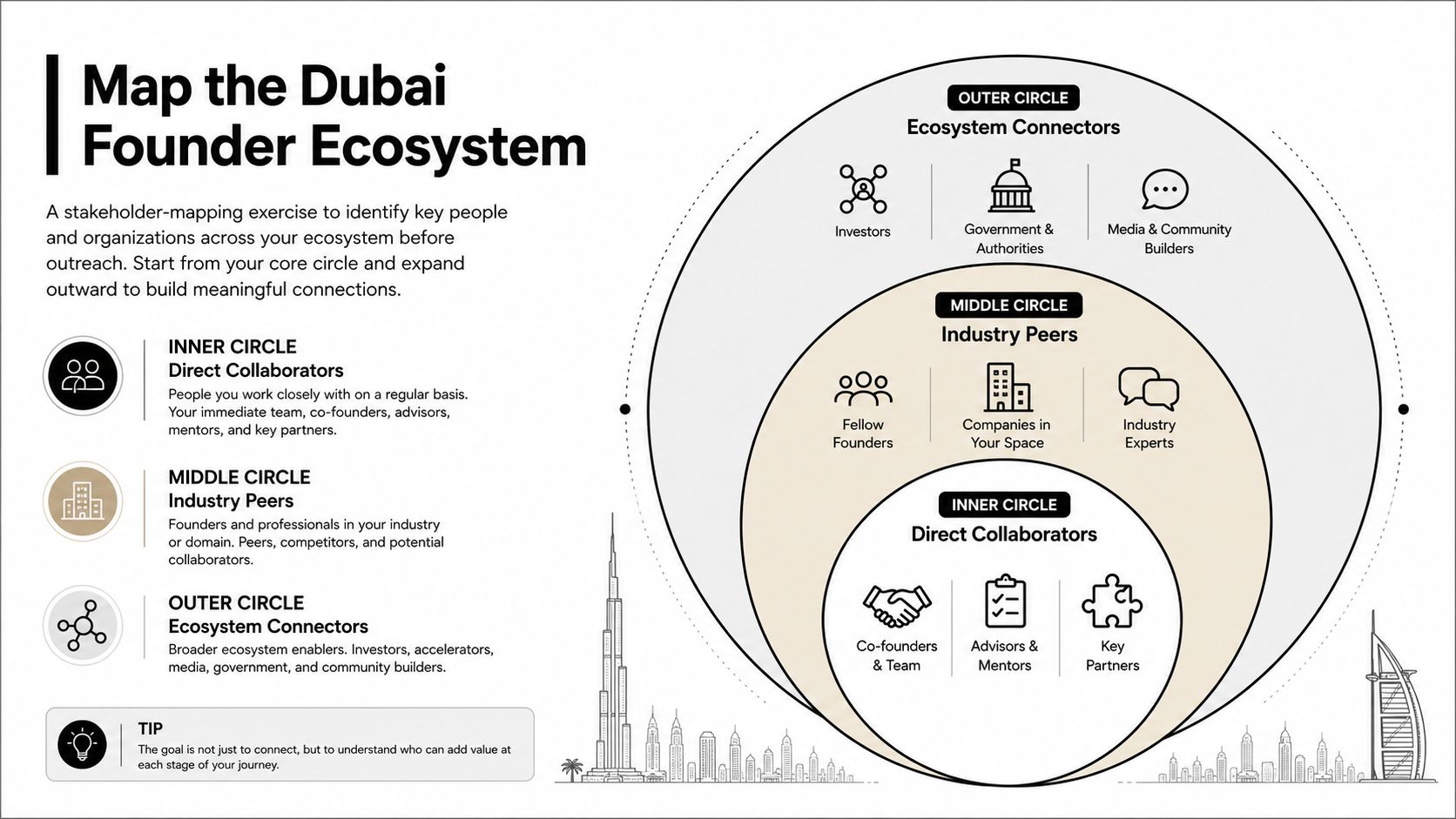
A founder lands in Dubai, opens LinkedIn, joins a few chats, and starts firing off introductions at random. The result is predictable. The replies are polite, the coffee meetings are shallow, and the people who answered first usually have nothing to do with the problem the founder needs to solve.
Map the ecosystem before you reach out. If you know who matters for your stage, each message has a purpose and every meeting can do real work.
Build the map around five circles
- Peer founders at your stage. These are the people who understand your current bottleneck without needing the backstory.
- Founders five years ahead or more. These are the operators who can compress your learning curve because they've already made the mistakes.
- Operator-investors and experienced connectors. These people matter because they can open doors, not just offer opinions.
- Ecosystem builders. Think community leads, hub teams, and moderators who know who is active.
- Service providers who shape outcomes. Lawyers, recruiters, and growth partners often know where real demand is moving.
Rank those circles against your immediate goal. If you need validation, start with peers. If you need growth, start with operators and connectors. If you are fundraising, put the people who can make warm introductions or translate investor expectations near the top.
The same discipline shows up in the guide to networking in Madeira. The setting is different, the habit is the same, map the room before you walk into it.
Use a week to turn the map into a shortlist of 15 to 20 names. Keep the list tight. If a name does not help with your current goal, save it for later.
For a Dubai-specific starting point, use the Founder Connects Dubai business network directory and filter it against your map. Use it as a screen, not a shopping list. Join only the people and spaces that match the problem you are solving now.
Why Small Curated Peer Groups Beat Big WhatsApp Circles
A crowded WhatsApp group can make Dubai feel connected fast. It does not make you useful, remembered, or trusted. The signal is in the quality of the links, not the size of the room. Endeavor's Dubai Tech Map shows that more than 475 companies were supported through 570 connections, and mentorship represented 27% of all ties (Endeavor Dubai Tech Map). That points to the operating rule here, a network works when the connections are dense and intentional.
A 40-person chat looks active. An 8-person moderated cohort usually produces better outcomes.
What moderation actually changes
A moderated peer group does three things a big chat rarely does.
It creates accountability. People have to show up with a real update, not just a “great to connect” message. It forces structure, so one problem gets the room's attention instead of ten side threads. It also builds memory, because repeated contact means people remember your priorities, not just your name.
That is why curated groups work. The conversation stays specific. Follow-through becomes visible. The relationship starts producing business value instead of background noise.
If you are evaluating a peer group, ask three questions before you spend time on it:
- Who moderates it, and do they keep it tight?
- Do members come back, or is there constant churn?
- Does the group produce concrete outcomes like intros, hires, or customer leads?
A good filter is simple. If the group feels broad and vague, it is probably weak. If it feels narrow, consistent, and a little boring in the best way, it is probably worth your time.
For a practical comparison of what peer groups do well, the Founder Connects guide on peer groups is useful because it reflects the same logic, small rooms beat loud rooms.
The 5-Meetup Rule and How to Earn Trust in Dubai
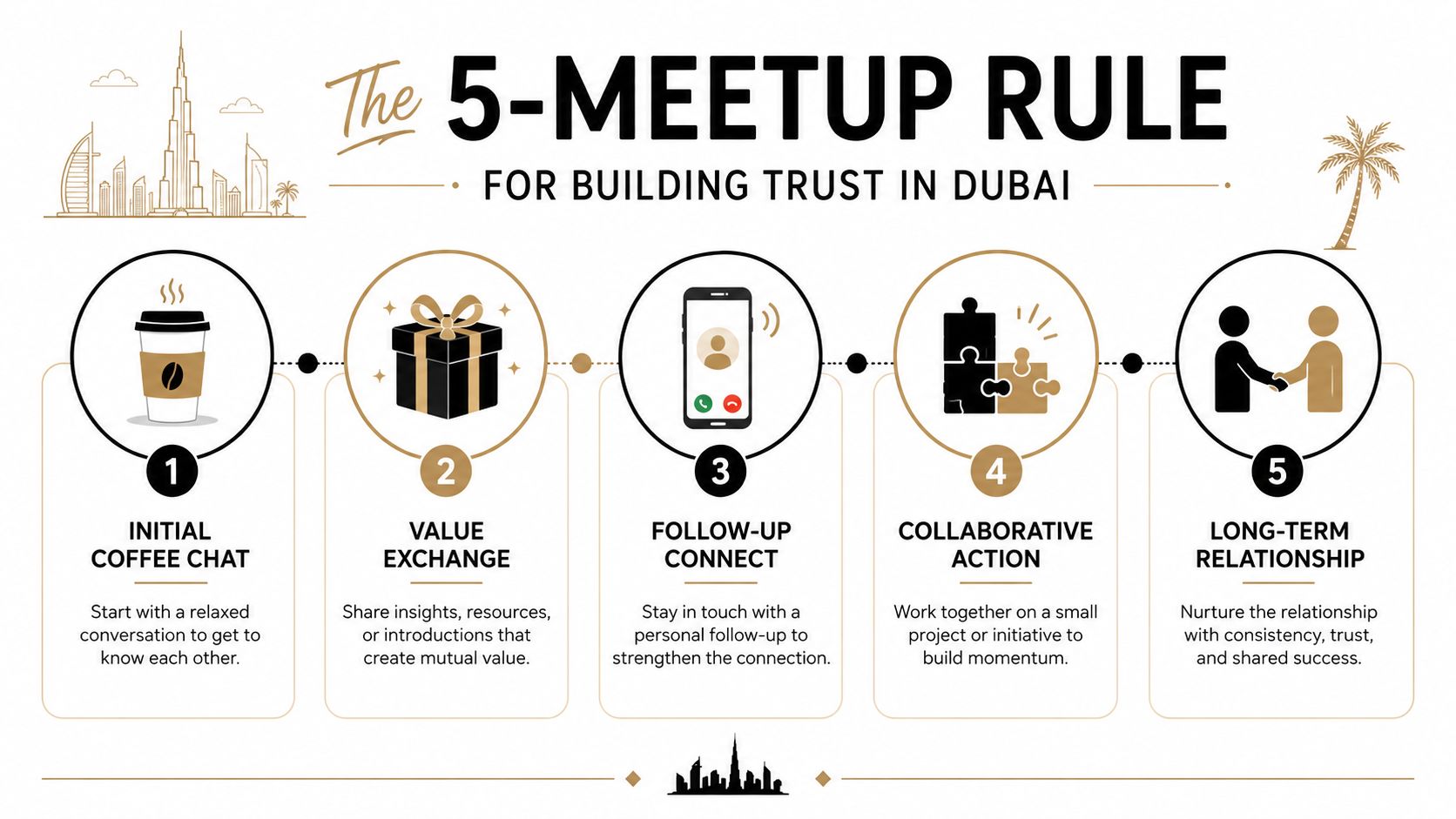
Trust in Dubai doesn't come from one strong meeting. It comes from repeat exposure. A first coffee is just a first coffee. By the fifth intentional touchpoint, people start to know whether you're serious, useful, and stable enough to work with.
Use each meetup for a different purpose
- Meeting one. Ask one sharp question and listen properly. Bring curiosity, not your pitch.
- Meeting two. Share a useful insight or article that fits their actual problem.
- Meeting three. Offer a relevant introduction if you can help.
- Meeting four. Suggest a concrete collaboration, even if it's small.
- Meeting five. Make a real ask, now that there's history behind it.
That rhythm fits Dubai because people move fast, schedules split across time zones, and many founder relationships start online before they ever become real offline. Casual LinkedIn chatter doesn't create trust here. Repetition does.
The best co-founder guidance in the UAE also points in the same direction, trust is built face to face over multiple meetings, and many good co-founder relationships take 3 to 6 months of informal collaboration before they become formal (Founder Connects co-founder guide).
Don't ask for leverage before you've earned memory.
If a relationship still feels flat after five touchpoints, deprioritise it. Not every contact deserves more time. In a city with this much movement, your job is to identify which relationships are compounding and which ones are just consuming attention.
Use the five-meetup rule as a discipline, not a superstition. You're trying to become memorable for the right reasons.
Run a Small Moderated Meetup Without Burning Out
Stop waiting for the perfect event to appear. If you want a network that compounds, host a small room yourself. That's how you stop being a consumer of the ecosystem and become part of its structure.
Keep the room small and the format tight
Pick a venue that supports conversation, not noise. Private rooms at co-working spaces in DIFC, Dubai Internet City, or JLT work far better than a busy café. Cap attendance at 8 to 12 people, keep the room mixed by stage, and set a clear no-pitch expectation before anyone walks in.
A simple agenda is enough:
- 10 minutes for arrivals and context
- 30 minutes for one round of founder updates
- 20 minutes for one live challenge
- 15 minutes for intros or follow-up commitments
- Close with one next step per person
People get it wrong. They try to make the room impressive instead of useful. That usually creates a scene, not a network.
If someone asks to join but doesn't fit yet, say no politely and keep the room coherent. A small room loses value quickly when it becomes a public invite list. You want people who will return, not people who want one more event badge.
Make the logistics boring on purpose
Choose a weekday evening after working hours. Make parking and arrival clear in the invite. Keep the tone relaxed but structured. If you're hosting consistently, people will come back because they know the room will be useful, not because it was flashy.
If you want a ready-made model rather than building everything from scratch, Founder Connects runs curated founder experiences and moderated peer groups for approved members. Use that kind of format as a benchmark for how structured your own room should feel.
The rule is simple. Smaller rooms outperform louder ones in Dubai because the city already has enough noise.
Message Templates and WhatsApp Etiquette That Get Replies
WhatsApp is not an informal dumping ground. In Dubai, it's a relationship tool. Use it badly and you look careless. Use it well and you sound like someone who respects time, context, and boundaries.
Lead with context, then keep it short
Use a formal but human greeting. Don't overdo the small talk. If you're sending a voice note, keep it short and only use it when nuance matters. For simple asks, text is cleaner.
Cold intro request
“Hi [Name], we've not met yet, but I saw your work on [specific context]. I'm building in [sector] and thought there may be a useful overlap. Would you be open to a brief coffee next week?”
Follow-up after a first meeting
“Good meeting you yesterday. I appreciated your point about [specific topic]. I'm sending over [resource/contact] that may help. Happy to stay in touch and compare notes.”
Peer-group application message
“Hi [Name], I'm a founder in [stage/sector] and I'm looking for a small, serious peer group where the conversation stays practical. If there's an opening, I'd value a conversation.”
Warm-intro ask
“Would you be comfortable introducing me to [Name]? I think there's a clear overlap on [specific reason], and I can keep the conversation tight.”
The strongest local pattern is simple, start online, then move to coffee chats, micro-dinners, and repeated in-person contact. The best networks here tend to be built from 10 to 15 solid relationships, not a hundred shallow ones (CE Interim).
Give before you ask
One Dubai network-building guide says to spend the first 6 months focused entirely on genuine connection with no visible commercial agenda (Aelabrak). Another says networking value often becomes visible only after 9 to 12 months, with the first 3 months usually showing no obvious return (Aelabrak). I'd use that as a discipline, not a delay tactic.
Give early by sharing a relevant contact, forwarding a useful article, or inviting someone into a curated room. That's how you signal that you're a contributor, not a extractor.
Do this well: every message should tell the recipient why you chose them specifically.
If your messages read like templates, people will ignore them like templates. The fix is specificity, not charm.
A Follow-Up System That Compounds Instead of Drying Up
Most founder networks fail after the first good coffee. The follow-up never happens, or it happens too late, or it becomes vague “let's catch up soon” noise. You need a system that keeps relationships warm without turning you into a spammer.
Use a simple cadence and log it
Build one spreadsheet or CRM view with four fields, name, context, next touch, and what they care about. Then run this cadence:
- Within 24 hours. Send a thank-you note with one real reference point from the conversation.
- Two weeks later. Send one useful item, a contact, article, or invite.
- At 90 days. Check in with a clear reason, not a weak “thought of you”.
- Quarterly. Reset the relationship in person if the person matters.
Track how often people respond. Use the 20%+ response-rate benchmark as a rough sign that your outreach is becoming effective (StartupList). If your replies are well below that, the problem is usually message quality, targeting, or lack of relevance.
Measure the network like an operating metric
Don't count contacts. Count outcomes. Log how many conversations became coffees, how many coffees became intros, and how many intros produced something useful. That's the dashboard that tells you whether the network is real.
The best rule on digital versus physical is simple, online touchpoints are the filter, in-person touchpoints are the trust-builder. That matters in the UAE because founders are mobile, busy, and often spread across different zones, so random event attendance rarely beats repeated intentional contact.
For a tighter post-meeting workflow, the Founder Connects follow-up checklist is a useful companion because it keeps the process structured instead of fuzzy.
A good 30-day starter plan looks like this. Map 15 names this week. Send three targeted messages. Book one coffee. Apply to one peer group. Host or join one small room. Then log every response and every next step.
Trust is the asset. Contacts are just the raw material.
If you want a founder network in Dubai that moves your business forward, Founder Connects gives you curated peer groups, intentional introductions, and small moderated rooms built for real progress. If you're tired of broad networking and want a sharper circle, visit Founder Connects and see how a more structured founder community can fit your next stage.

Building in MENA? You don't have to do it alone.
Join 300+ founders in the Founder Connects Residency. Monthly squad calls, warm intros, $3M+ in perks, and much more. All for less than your monthly coffee budget.
Popular posts





Founder Connects is a premium MENA tech founder community. Meetups in Dubai and across MENA, Residency Squads of 8–10, and 400+ vetted WhatsApp founders (apply and screened).