

How to Introduce Yourself at a Founder Meetup: A 60-Second Guide

Building in MENA? You don't have to do it alone.
Join 300+ founders in the Founder Connects Residency. Monthly squad calls, warm intros, $3M+ in perks, and much more. All for less than your monthly coffee budget.

Sixty seconds is enough at a Founder Connects Meetup when you treat it as a conversation opener in a peer room. Say who you are, what you build, the problem you are working on and the one thing you need, then ask a question back.
A Founder Connects Meetup is a founder room in Dubai and across the MENA region, so give people a clear handle on your work and leave space for them to answer. The same minute shifts with your stage and your confidence: early founders can trade proof for learning, and quieter founders can trade polish for one specific request.
The 60-Second Introduction at a Glance
Use the minute to make it easy for another founder to understand what you do and join the conversation. Don't try to cover your whole background, product roadmap or business model. Name yourself, explain what you build, describe the customer problem, share one honest piece of evidence and ask a question.
| Segment | Time | What to Cover | Example Wording |
|---|---|---|---|
| Who you are | About 10 seconds | Name, role and company | [Name], founder of [company] |
| What you build | About 15 seconds | One plain sentence naming the customer and the outcome | We help [customer] [achieve outcome] |
| Customer problem | About 15 seconds | The specific pain, who feels it and how often | [Customer] lose time each month to [problem] |
| Evidence | About 10 seconds | One honest proof point or current learning | We have [number] pilot users and are testing [hypothesis] |
| Question back | About 10 seconds | One easy question or a narrow request | Do you know operators who manage several sites? |
These timings are a guide, not a stopwatch. Practise aloud until the introduction lands naturally in about a minute. If you don't have revenue, use learning as evidence: customer conversations, a prototype test or a waitlist that reflects your target customer.
The test is simple: could the listener repeat your problem and your question to a friend? If so, you've given them enough to continue the conversation.
Who You Are and the Problem You Solve
Start with your name, role and company in one breath: “[Name], founder of [company].” Use a title people understand. Then say what the company does in a sentence that names a customer and an outcome.
“We are a platform for digital transformation” doesn't tell the room who has a problem or what changes for them. “We help independent clinics cut licensing paperwork” gives listeners something concrete to ask about.
Make the problem testable
Describe the problem through three details: who has it, what it costs them, and how often it happens. Broad claims like “we're transforming the market” sound ambitious but give a peer nothing to examine. Specifics invite useful questions.
Example: “Independent clinics with several branches lose days each month to renewal paperwork.”
Keep the opening to about 25 seconds, then spend about 15 seconds on the problem. State your stage plainly, whether you're at the idea, prototype, pilot or revenue stage. That context helps people respond in a way that fits the company's actual needs.
Add one proof point, without dressing it up. A founder with revenue might mention a paying customer or repeat use. A founder still validating an idea might describe customer interviews or a prototype test. If you're testing an assumption, say so. Don't invent traction to make a sentence sound stronger.
For help making your written description clear and specific, these LinkedIn profile bio ideas offer a useful reference. Then read your problem sentence to a colleague and ask what they'd want to know next. If they can't identify the customer or the pain, simplify the sentence before you take it to the room.
A concise introduction also depends on saying the important part plainly. These communication skills for technical founders can help you explain complex work without making the listener decode specialist language.
Ask a Question Back Instead of Pitching
A pitch often lists features, asks for investment and ends in a monologue. That isn't the right default for a peer-room introduction. A conversation names one useful request, then asks the listener a question they can answer from their own experience.

Try one of these:
- Example: “I'd value feedback from someone who has sold into hospitals.”
- Example: “Do you know operators who manage several sites?”
A narrow request helps the other person work out whether they can contribute. “I'm looking for connections” leaves them guessing. “I'd like feedback on how we explain licensing renewals to clinic operators” gives them a point to respond to.
Keep the question open enough for a peer to answer without needing specialist knowledge. You're asking for a conversation, feedback or a referral the listener can decide on in the moment. Don't assume the room will arrange introductions for you.
Practical rule: Ask for the next useful conversation, not a broad favour.
Write down a few possible questions, choose one a stranger could answer quickly and test it on a friend. The community's discussion norms matter too: Founder Connects encourages members to be respectful, empathetic, stay on topic and embrace diverse perspectives.
Keep the ending simple: one question, one request and no slides. If you later need a separate resource for presentation structure, you can explore investor presentation topics. But at a Meetup, use your minute to open a discussion, not deliver a deck aloud.
Adjust Your Ask for Your Stage
Keep the introduction's structure steady and change the request to fit what the company needs now. A founder validating an idea might ask for candid feedback or a customer referral. Someone refining their story can ask whether the problem and outcome are clear.
A partnership-minded founder can ask about a specific integration or route to distribution. A scaling founder may need operational insight, hiring experience or a conversation with a particular type of buyer. A solo founder facing a difficult decision can ask another founder to check in on that decision.
Use this template:
[Name], founder of [company]. We help [customer] [achieve outcome]. We're at [stage]. I'd like to [type of conversation] about [one precise question].
Keep the request small enough to make sense in a short conversation. For example, “I'm testing whether independent clinics would use a renewal checklist. What do you currently find hardest about renewals?” gives the other person a clear subject and an easy way in.
Prepare two versions: one for a peer founder and one for an ecosystem operator. Keep your identity, product and evidence consistent, but change the conversation goal. You're not changing the story to impress someone. You're making the next exchange relevant to the person in front of you.
For a longer rehearsal of your opening, use this guide to pitch practice in Dubai. Then write both versions today and time each one aloud.
Introduce Yourself When You Are New or Quiet
You don't need a loud voice or a senior title to make a useful introduction. Start with the room, name what you're learning and ask one easy question.
Example: “This is my first Meetup. I'm testing whether small clinics would use a licensing checklist, and I'd like to hear how you handle renewals.”
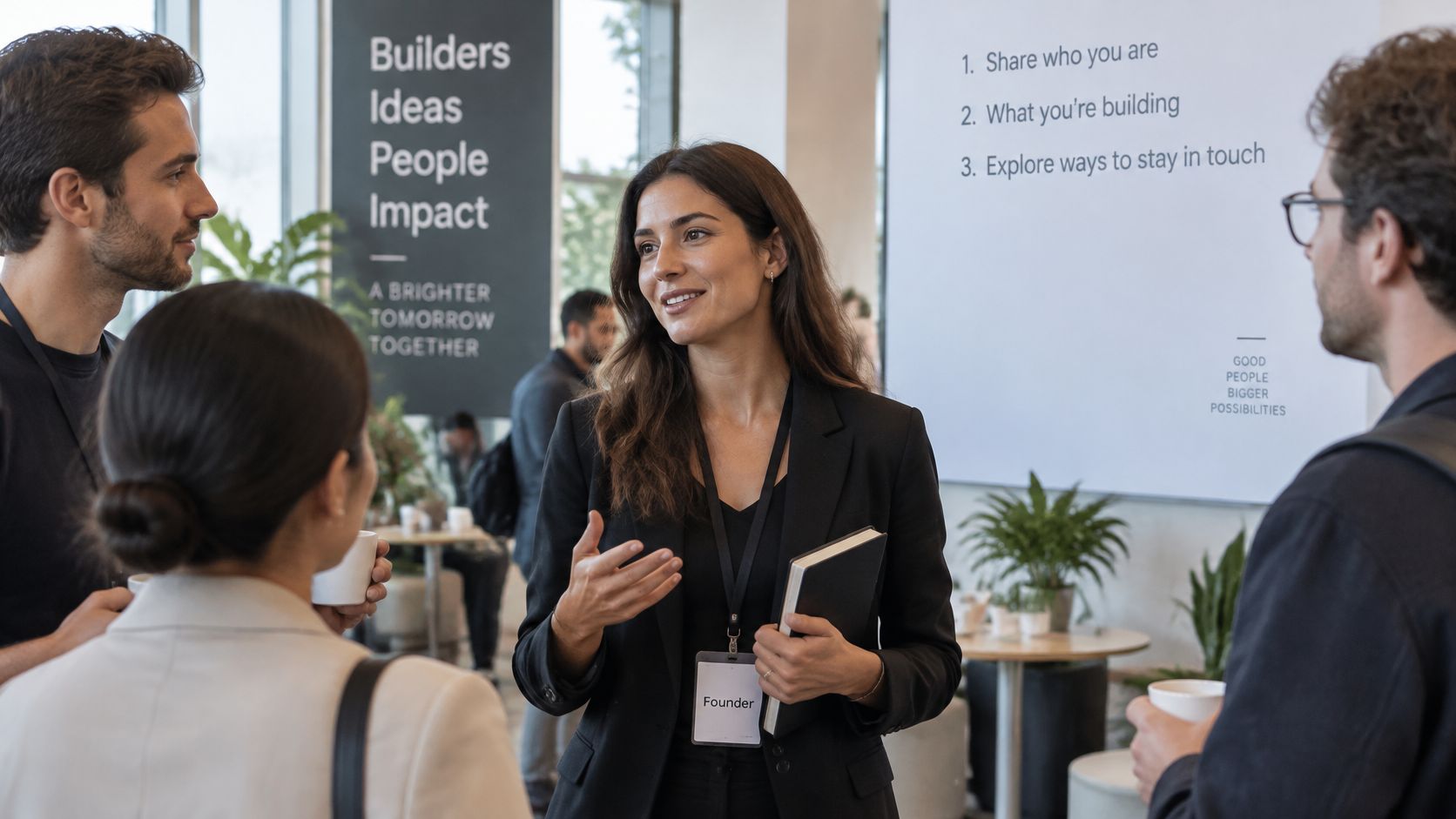
A script gives you a low-pressure way to begin, not words you must recite perfectly. Write your version down and rehearse it aloud. Then speak with one person at a time instead of trying to work the whole room.
If it would make arriving easier, go with a founder you already know or ask another attendee to join you for a short conversation. A clear problem and an honest learning goal give people something to respond to; you don't have to establish status first.
If you're new to the city as well as the Meetup, this guide to your first month of founder Meetups in Dubai can help you approach the room with a plan.
Choose one question you can ask within the first few minutes of the Meetup. Keep it tied to a real decision you're making, such as how another founder handles customer discovery or what they've learned from testing a prototype.
Follow Up Within a Day of the Meetup
An introduction only creates an opening. Follow-up gives the conversation a next action. While the details are fresh, note the person's name, the experience they mentioned and anything you agreed to do.
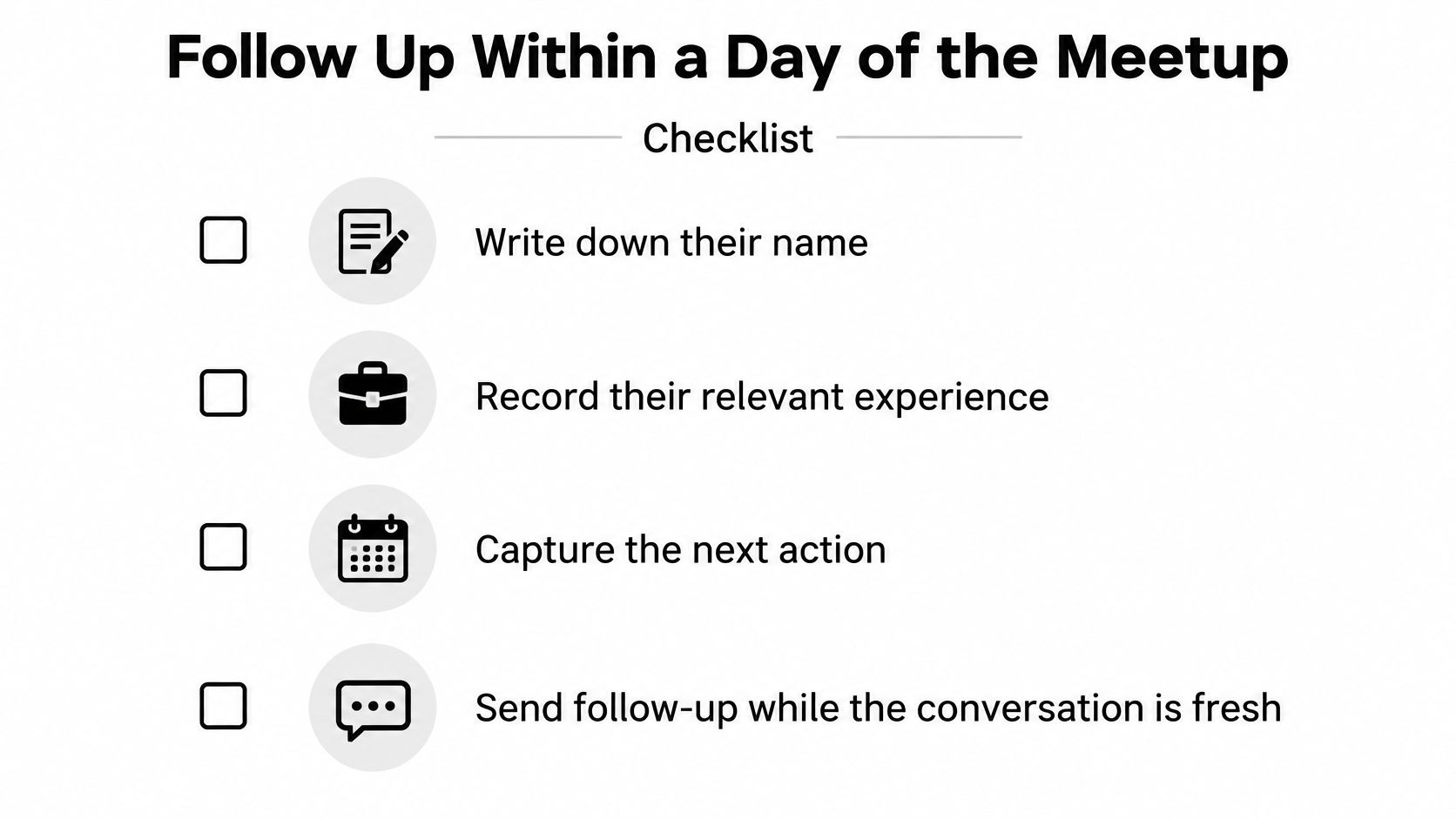
Send a short message within a day. Include the context, your specific request and a proposed next step, such as a brief call or feedback on a prototype.
Example: “Good to meet you at the Meetup. You mentioned clinic licensing workflows. Could I send you a one-page checklist and get your view?”
Keep the note brief unless the other person replies at length. As a courtesy, ask before forwarding anything they shared with you to a third party. And respect the community's confidentiality expectations: information shared within the Founder Connects community shouldn't be disclosed to third parties without express consent from Founder Connects.
For more ways to turn a conversation into a clear next step, use this networking follow-up checklist. If you're also reviewing how professional posts perform, this overview of LinkedIn analytics tools is a separate resource, not a substitute for following up personally.
Before you send the message, check that it includes:
- Name and context: Remind them where you spoke and what you discussed.
- One request: Ask for a specific response or piece of feedback.
- A proposed next step: Suggest a short call or a clear way to review something.
- A thank-you: Acknowledge the time and conversation.
Then note which follow-ups led to a real conversation and adjust your opening question accordingly.
Common Questions About Meetup Introductions
Does a founder need to book in advance?
Yes. A founder should choose a Meetup and book a seat through Founder Connects Meetups before attending, and plan to arrive on time. Founder Connects hosts Meetups in Dubai and across MENA, so a founder can choose the one closest to them. Walk-ins are turned away because room size is capped for quality.
Co-founders and investors are welcome at relevant meetups. Friends can only attend if they are founders or becoming one, so the plus-one only works if that person is building something.
What should a founder without revenue or traction say?
Lead with the learning under way. A founder without revenue should describe the problem they are working on and the evidence already in hand, such as customer interviews or a prototype test. A clear account of what they are testing gives peers a useful way to respond. Claiming traction that does not exist does the opposite, because peer rooms remember it.
As Thami Benjelloun puts it, "Test your product before saying you are a founder." An early-stage introduction works best when it names the problem, the current experiment and one specific ask, and lets traction enter the conversation once it exists.
What if a founder freezes or runs over time?
Fall back on the short version: who they are, what they build and one ask. That is enough to stay in the conversation.
Practising that core version aloud makes it easier to recover without rushing through a longer script. Most Meetup formats are capped at 15 to 100 founders, and small-table formats run with 8 to 12, so a compact introduction fits the room better than a rehearsed monologue anyway. Use the timing table at the start of the article as the reference for the full version.
Founder Connects is a startup community in Dubai and across MENA, with Meetups built around practical founder conversations and peer learning. Prepare your minute, bring one real question, and visit Founder Connects to find a Meetup that suits your next conversation.

Building in MENA? You don't have to do it alone.
Join 300+ founders in the Founder Connects Residency. Monthly squad calls, warm intros, $3M+ in perks, and much more. All for less than your monthly coffee budget.
Popular posts





Founder Connects is a premium tech founder community in Dubai and the world. Meetups, Residency Squads of 8–10, and a WhatsApp group of 600+ vetted founders.