

How to Update Trade License Details in UAE
Building in MENA? You don't have to do it alone.
Join 300+ founders in the Founder Connects Residency. Monthly squad calls, warm intros, $3M+ in perks, and much more. All for less than your monthly coffee budget.

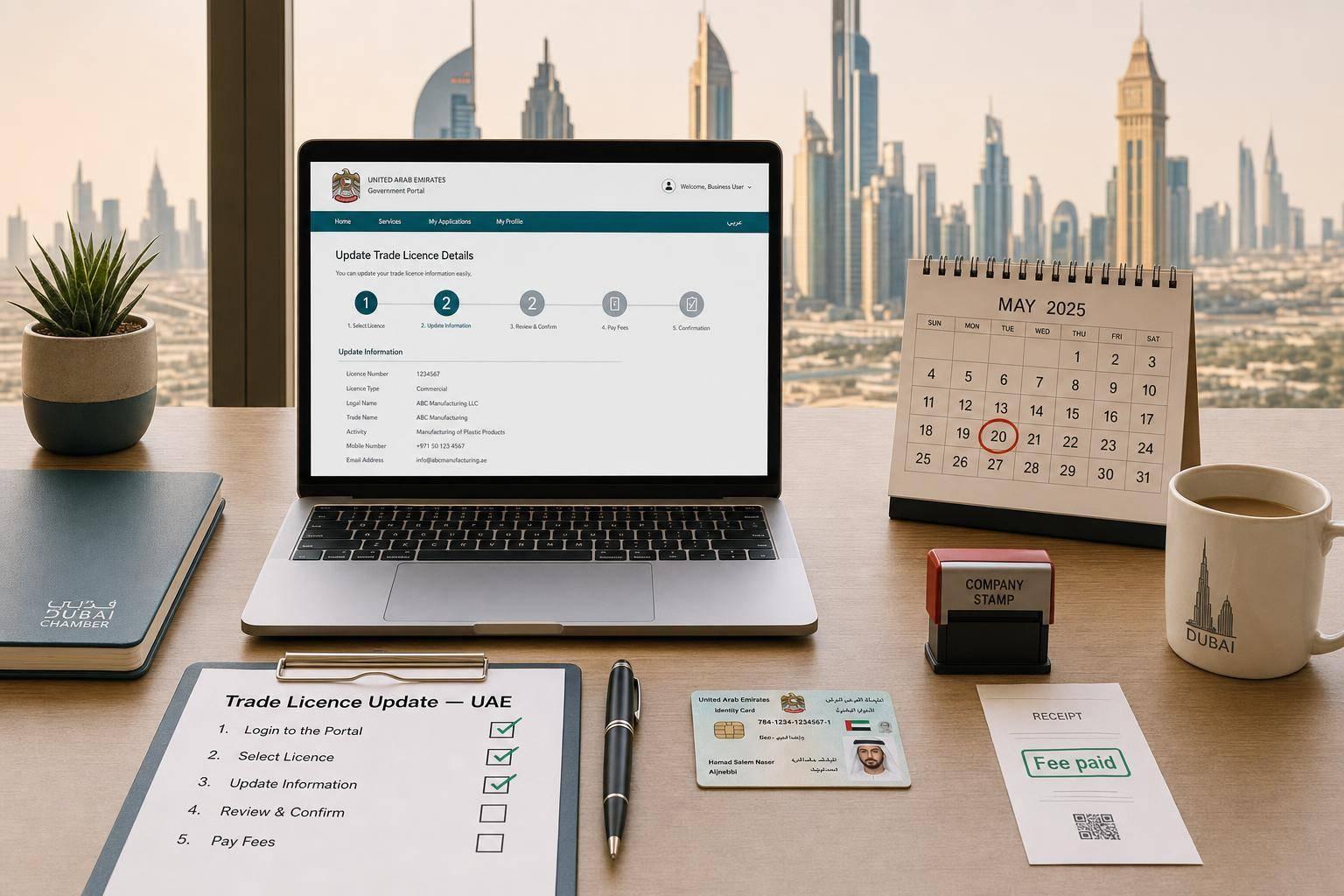
If your UAE trade licence details are wrong, you should fix them fast. Delays can affect banking, visas, tax records, and contracts. In some cases, fines can reach AED 300,000, and FTA update penalties start at AED 5,000.
If I were handling this, I’d keep it simple:
- check what changed: activity, name, address, owner, manager, or capital
- confirm where the company is registered: mainland or free zone
- collect the right documents for that amendment
- file through the correct portal or authority
- update linked records after approval: FTA, UBO, bank, visa files, and establishment card
A few points matter most:
- Mainland companies file with the emirate licensing authority, often through portals like Invest in Dubai or TAMM
- Free zone companies file through their own zone portal, such as DMCC or IFZA
- FTA records must be updated within 20 business days
- UBO records must be updated within 60 days
- simple changes often take 3 to 5 business days
- shareholder or legal form changes often take 5 to 10 business days
- regulated activities can add 2 to 6 weeks
Use this as a quick rule: first fix the licence, then fix every record linked to it. That’s the part many founders miss.
| Change | What I’d check first | Common extra step |
|---|---|---|
| Activity | Does the licence cover what the business does now? | Regulator NOC if the activity is controlled |
| Address | Does the lease/Ejari match the new office? | Inspection or zone approval |
| Ownership | Are MOA and UBO details changing too? | Notarised papers and share transfer docs |
| Trade name | Is the new name reserved and approved? | MOA or AOA update |
| Manager | Does the authority need a board resolution? | ID and approval papers |
| Capital | Is the capital going up or down? | Auditor report for reduction |
Below, I’ve pulled the article into a short, direct guide so you can see the steps, papers, timings, fees, and post-approval checks without reading every rule line by line.
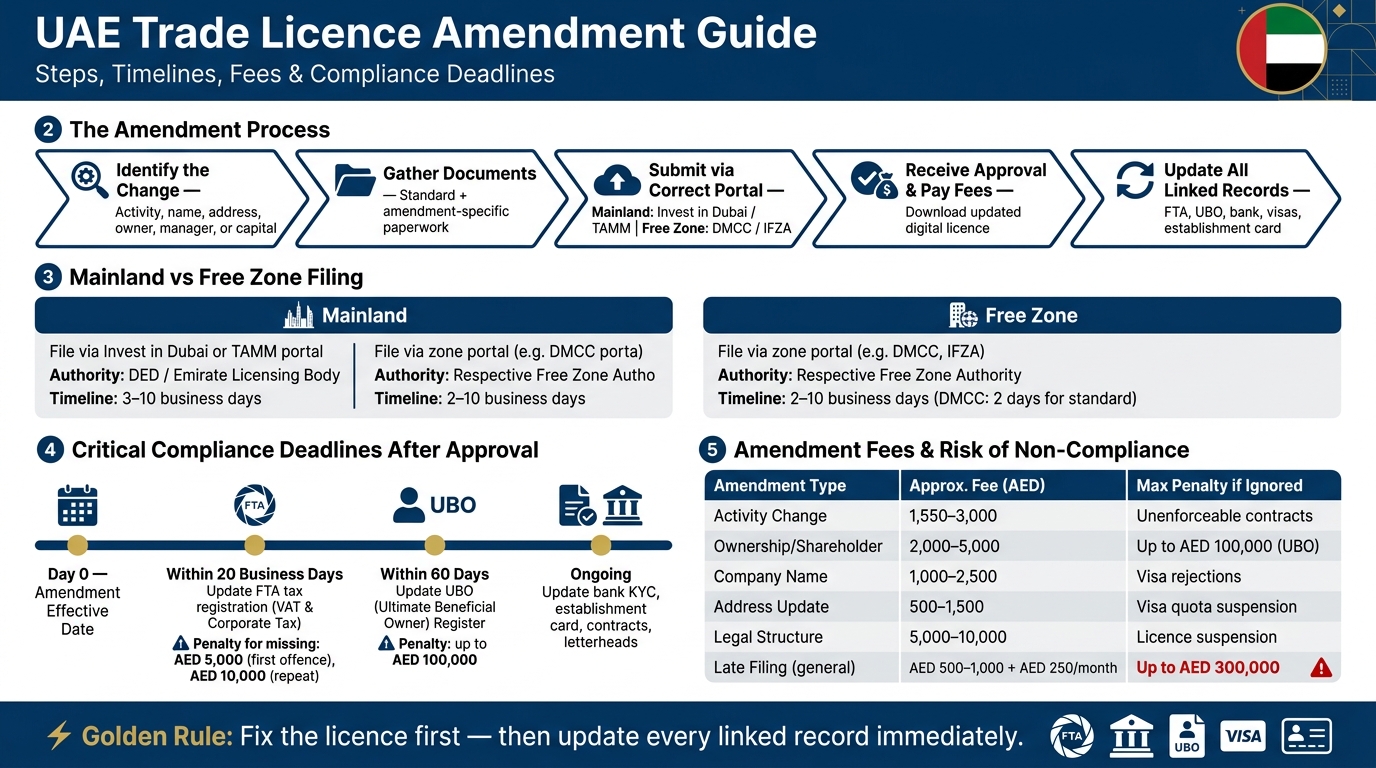
UAE Trade Licence Amendment: Step-by-Step Process & Key Deadlines
Don't ignore this FTA update or face AED 5,000 #UAEBusiness #TaxPenalty #Compliance
sbb-itb-f597d8f
Check exactly what needs to be updated before you apply
Start with your current licence. Put it side by side with what the business is doing today, and check it field by field. That simple review helps you pick the right amendment and spot any related approval you may need before you file.
Once the change is clear, gather the exact documents for that amendment category.
Match your licence activities to what your business actually does
Open your licence and note every activity listed on it. Then make a separate list of every service you provide and every product you sell today. If those lists don’t line up, you need to sort that out before you apply.
Working outside your licensed scope can weaken contracts, affect VAT treatment, and invalidate insurance cover.
Check these points before filing:
- Confirm that your new or planned activities fit your current licence type - trading, service, or industrial [3][8].
- Watch for stand-alone limits. Some activities, such as real estate or single-family office activities, can’t sit with other activities on the same licence [8].
- If the new activity is regulated, get the right NOC first - from the Central Bank, MOHAP, KHDA, or the relevant authority - before the licence can be updated [1][8].
Changes that can affect banking, visas, and compliance
Old records for shareholders, address, legal name, or management can cause direct problems with visa files or even lead to bank account freezes. One mismatch can throw off banking, visas, tax, and licensing records [1].
Banks ask for updated licence and MOA documents as part of KYC checks. If those records are old, freezes can follow [1][2].
If ownership is changing, update it in the same filing so your tax records stay aligned [1]. You also need to notify the Federal Tax Authority (FTA) within 20 business days of any change to your registered details for VAT and Corporate Tax [4]. Count that deadline from the amendment’s effective date, not from the date printed on the licence [4].
| Linked Record | What to Check | Authority |
|---|---|---|
| VAT / Corporate Tax | Update "Taxable Person" details within 20 business days. | FTA (EmaraTax) |
| UBO Register | Update beneficial ownership details within 60 days of any change. | Licensing Authority |
| Bank KYC | Submit updated licence and MOA before the next bank review. | Commercial Bank |
| Ejari / Lease | Must be valid and match the new address; check visa quota. | DED / Free Zone |
| Establishment Card | Reflect new name, address, or partners. | GDRFA / ICP |
With the required records identified, the next step is preparing the supporting documents.
Documents you need to prepare for your amendment type
Once you've identified the change, pull the matching documents straight away. Before you file, check the authority's own checklist too. The list below covers what most businesses are asked for.
Standard documents most authorities require
Get these ready before you start the application:
- Current trade licence copy (must be active) [8]
- Passport and Emirates ID copies of all existing and new shareholders, partners, or managers [4][10]
- Completed amendment application form from the relevant authority's portal
- Valid lease or tenancy contract for the registered address [10]
- Board or General Assembly Resolution for partner or manager changes [9][2]
If any document is not in Arabic, get it translated into Arabic by a certified legal translator. MOA amendments and board resolutions also need notarisation through the UAE Notary Public [2][9]. For portal uploads, stick to PDF, JPG, or PNG files under 5 MB [4][10].
Extra documents for activity, address, and ownership changes
The standard set isn't always enough. Some amendments need extra paperwork.
For activity changes, prepare an updated activity list. If the new activity is regulated, you'll also need a No Objection Certificate (NOC) from the right regulator before the licensing authority will handle the application. For example, that could be MOHAP for healthcare or KHDA for education [8][1]. In some free zones, an Operational Fitness Certificate (OFC) is also required [8].
For address changes, Dubai mainland applications need a valid Ejari certificate. Free zones usually accept a registered lease agreement or title deed [8][1][10]. Some free zones may also ask for an inspection or OFC before they sign off on the move [8]. If you're moving into a smaller space, check how it affects your visa quota before you go ahead [8].
For ownership or capital changes, expect a bit more paperwork. You will need a notarised MOA addendum, a Share Transfer Agreement signed by all partners, and updated Ultimate Beneficial Owner (UBO) declarations. If you're reducing share capital, a certified auditor's report is required [9][2]. Any MOA amendment also needs the formal consent and signatures of all business partners [2].
Document requirements by amendment type
| Amendment Type | Main Required Documents | Typical Approvals Needed |
|---|---|---|
| Activity Change | Revised activity list, NOC from sector regulator | DED/Free Zone Authority, Regulator (e.g., MOHAP, KHDA), OFC in some free zones |
| Address Change | Ejari (Dubai Mainland) or Lease Agreement, Title Deed | Municipality or Free Zone Inspection, OFC |
| Ownership Change | Share Transfer Agreement, Notarised MOA Addendum, Passport/EID of new partners | Board Resolution, DED/Free Zone Authority, UBO update |
| Trade Name Change | Trade Name Reservation Certificate, Amended MOA/AOA | DED/Free Zone Authority |
| Capital Adjustment | Amended MOA, Certified Financial Report (for reduction) | Auditor's Report, Board Resolution |
| Manager Change | Board Resolution, Passport and Emirates ID of new manager | NOC from current sponsor (if applicable), DED/Free Zone Authority |
File ownership updates before activity changes so your tax records stay aligned [1]. With the paperwork in place, you're ready for submission.
How to submit your trade licence update, step by step
Once you have the right amendment lined up and the documents ready, the next move is simple: file it through the correct authority portal.
How mainland companies file trade licence amendments
Mainland companies can submit amendments through the Invest in Dubai portal, the DET portal, or the Dubai Now app. Pick the amendment service that matches your request, fill in the form, and upload the required documents.
If the amendment involves a regulated activity, include the regulator's approval with the application. After submission, the system issues a payment voucher. You can then pay the fees in AED using a credit or debit card online, or at an approved centre.
Once the amendment is approved, download the updated digital licence from the portal. The licence number stays the same. Only the amended details are updated.
How free zone companies file trade licence amendments
Free zone companies need to use their own zone's portal to start the amendment request. In DMCC, this sits under Company Services. In IFZA, go to Licensing Services.
Submit the right amendment request and upload the required corporate documents. These may include:
- Lease agreement
- Board resolutions
- Other supporting files
If the portal asks for zone-specific approvals, upload those as well. After the authority finishes its internal review, confirm the request and pay the fees through the portal's payment gateway.
The revised licence is then issued as a downloadable amended licence or approval notice. DMCC, for example, handles standard amendments in 2 business days [8].
Timelines, status checks, and steps to take after approval
After you submit the request, track it in the same portal and respond to any authority queries fast. A small delay in replying can slow the whole process.
For mainland applications, simple changes like an address update or activity addition usually take 3–5 business days. Structural changes involving shareholders or legal form tend to take 5–10 business days [11]. If the amendment falls under a regulated sector and needs outside approvals, add another 2–6 weeks [11].
Once the amendment is approved, update every linked record straight away. That includes your bank, FTA, UBO, establishment card, contracts, and letterheads.
Fees, penalties, and compliance checks
Typical amendment fees and added costs
Government amendment fees change from one authority to another, so check the latest schedule before you set your budget. The figures below are a good planning guide before you file.
| Amendment Type | Approx. Fee Range (AED) | Additional Costs | Risk if not updated |
|---|---|---|---|
| Activity Change | 1,550 – 3,000 | External approvals or third-party NOCs, PRO fees | Unenforceable contracts; invalid insurance [1] |
| Shareholder/Ownership | 2,000 – 5,000 | Notarisation, MOA update, legal translation | UBO penalties up to AED 100,000; bank account freeze [1] |
| Company Name | 1,000 – 2,500 | Translation, new signage, rebranding costs | Visa rejections; branding/legal misalignment [1] |
| Address Update | 500 – 1,500 | New Ejari, inspection fees | Visa quota suspension; municipal fines [1] |
| Legal Structure | 5,000 – 10,000 | Legal drafting, liquidation costs | Operational downtime; total licence suspension [2] |
| MOA Amendment | 2,000 – 4,000 | Notarisation, translation | Invalidated board resolutions and signatory powers [1] |
Set aside a separate amount for translation, notarisation, and PRO support. Those extra charges can add up fast, even when the main amendment fee looks modest.
The bigger issue, though, is often not the filing fee. It's the cost of getting the timing wrong. Late filings usually start at AED 500–1,000, plus AED 250 per month until the issue is fixed [2]. Fines for failing to update licence records can go as high as AED 300,000 [1]. On top of that, tax-registration changes must be reported to the FTA within 20 business days from the amendment’s effective date. If you miss that window, the administrative penalty is AED 5,000 for a first offence and AED 10,000 for repeat offences [4][5].
Why keeping licence records accurate matters as your startup grows
An accurate trade licence is a basic compliance requirement. If your records are out of date, the knock-on effect can be messy: frozen corporate accounts, delayed visa processing, and contracts that may not hold up when you need them most [1][2].
This becomes even more serious when a startup starts talking to banks or lining up a funding round. During due diligence, investors and banks check your official company structure, authorised signatories, and registered business activities. They expect those records to match across your paperwork before they move ahead [3][1].
Once the amendment is approved, update every linked record before moving to the final summary.
Final summary: Steps to take before and after a trade licence update
Once the authority approves the amendment, the job isn’t done. A trade licence update is a legal record change, not just a form submission. So first, confirm the amendment type and whether the business is mainland or free zone, because that decides the authority, portal, and fee route [1][6].
Some regulated activities need prior approval from the relevant authority before you file [1][6]. Once that approval is in place, move straight to compliance updates.
After approval, make sure all linked records match the new licence details. That includes:
- Compliance records: FTA, UBO, visa files, and establishment card
- Banking records: bank signatory records and account details
- Operational documents: contracts, invoices, and letterheads
The timing matters. The FTA requires tax registration updates within 20 business days, and UBO records must be updated within 60 days of an ownership or structural change [1][4]. If the licence details held by the bank no longer match, banks may restrict or freeze transactions [2][6].
Before you submit anything, check the latest official checklist for your authority. Fees and timelines can change depending on the authority, so verify the current forms and portal steps directly on the Invest in Dubai portal for mainland companies or your free zone’s official portal for zone-registered entities [6][7][8].
FAQs
Do all licence changes need prior approval?
In the UAE, most licence amendments are formal legal steps. In most cases, you need approval first from the right licensing body, whether that’s the mainland authority or the free zone authority linked to your company.
This usually applies when you change your business activities, ownership, or company structure. You may also need to inform the Federal Tax Authority if core registration details change, so it’s worth checking the exact rules in your jurisdiction.
Can I update FTA details before the licence is amended?
No. If the change is tied to details on your trade licence, you usually can’t update your Federal Tax Authority (FTA) record until the licence itself has been amended.
The FTA will usually ask for official updated documents, such as an amended or renewed trade licence, to check changes like business activities, company name, ownership, or licence renewal.
What happens if linked records do not match the new licence?
If linked records don’t match the new licence, your business can run into compliance and day-to-day problems. Authorities, banks, and tax regulators share data, so even one old record can cause trouble. That can mean fines of up to AED 300,000, frozen bank accounts, invalid contracts, and visa delays or rejections.
To stay compliant, update your details with the Federal Tax Authority, your bank, and any other relevant bodies.
Related Blog Posts

Building in MENA? You don't have to do it alone.
Join 300+ founders in the Founder Connects Residency. Monthly squad calls, warm intros, $3M+ in perks, and much more. All for less than your monthly coffee budget.
Popular posts





Founder Connects is a premium MENA tech founder community. Meetups in Dubai and across MENA, Residency Squads of 8–10, and 400+ vetted WhatsApp founders (apply and screened).