
Kuwait Map in World Map: Strategic Asset Guide 2026
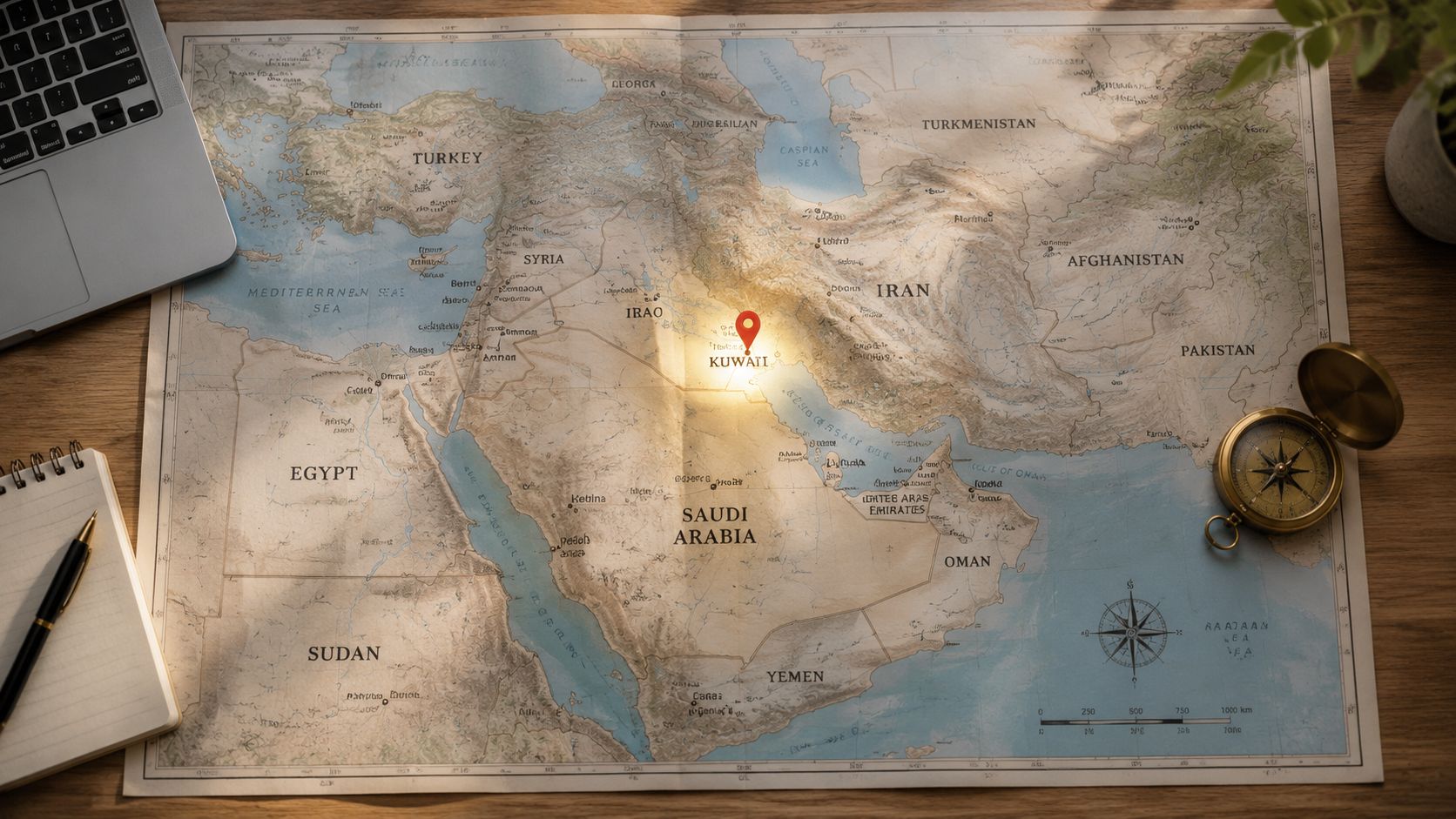
A founder usually starts with a simple question. You're reviewing GCC expansion options, someone on the team opens a regional map, and Kuwait comes up. At that point, the question isn't really where Kuwait is. It's whether that location creates a useful market, a logistical advantage, or an operational headache.
That's why a search for Kuwait map in world map matters more than it sounds. For a UAE-based founder, the map is the first filter. It tells you whether Kuwait is close enough for frequent travel, connected enough for distribution, concentrated enough for efficient sales, and structured enough for a focused market-entry plan.
If you're already comparing Gulf expansion paths, it helps to frame Kuwait alongside your broader UAE launch and operating model. A useful reference point is this practical UAE startup launch guide, especially if your Kuwait plan will run through an existing UAE base.
Beyond the Map A Founder's First Look at Kuwait
Most founders don't need another static map with a red pin. They need the business meaning behind the pin.
Kuwait looks small on a world map, and that visual impression is accurate. But small geography can be an advantage when a market is dense, urban, and easier to cover without building a heavy on-ground footprint too early. In practice, that changes how you think about sales coverage, partner management, and rollout sequencing.
What founders usually get wrong
The common mistake is treating Kuwait as either too small to matter or simple because it's compact. Neither view holds up well in execution.
A compact country can still be strategically important if it sits in the right regional position and if decision-making, commercial activity, and demand are concentrated. But compact doesn't mean uniform. You still need to know where activity clusters, how coastal concentration affects movement and infrastructure, and which parts of the market are worth prioritising first.
Practical rule: Don't use the map to decide whether Kuwait matters. Use it to decide how narrow or broad your first move should be.
The better way to read the map
A good founder reads Kuwait's location in layers:
- Global layer: Where does Kuwait sit in relation to trade corridors and the wider Gulf?
- Regional layer: How naturally does it connect to a UAE-led operating model?
- Local layer: Which internal zones matter once you start selling, hiring, or partnering?
That's the difference between a geography lookup and a market-entry lens.
Pinpointing Kuwait on the World Map
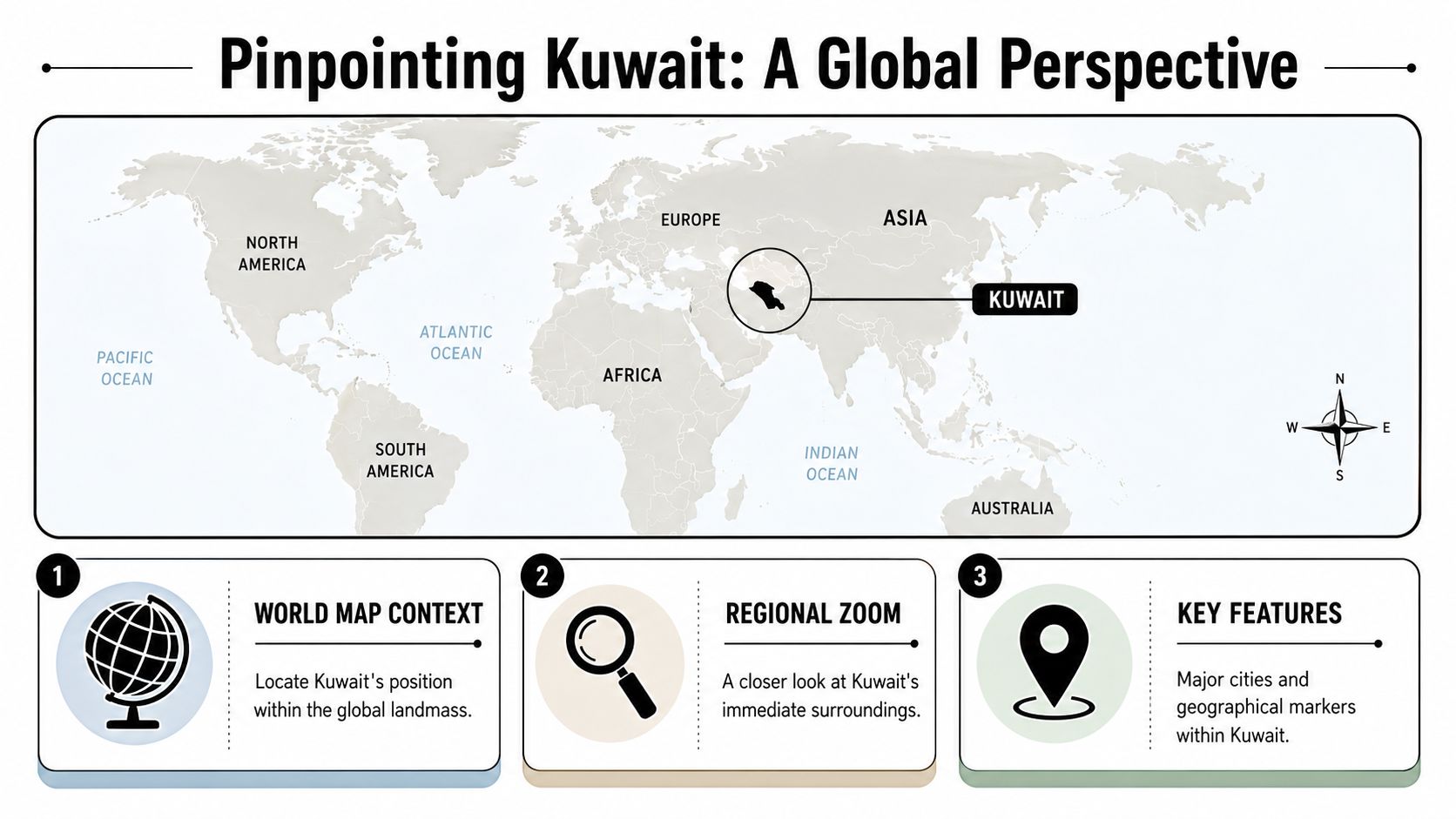
If you need the clean answer first, Kuwait sits at the head of the Persian Gulf in the northwestern corner of the Gulf on the Arabian Peninsula. It's one of the smallest sovereign states in the region, but its placement is far more important than its size suggests.
The map facts that matter
According to WorldAtlas' Kuwait map reference, Kuwait has an area of 17,818 sq. km and is bordered by Iraq to the north and west, Saudi Arabia to the south, and the Persian Gulf to the east.
That same reference also notes a coastline of about 500 km and identifies Kuwait's 6 governorates:
- Ahmadi
- Al Asimah
- Farwaniya
- Hawalli
- Mubarak Al-Kabeer
- Jahra
For a founder, those facts do more than answer a geography question. They show a country with a tight footprint, coastal exposure, and a manageable internal administrative structure.
How to visualise Kuwait fast
When someone on your team asks where Kuwait sits in a global business sense, use this simple sequence:
| View | What to look for | Why it matters |
|---|---|---|
| World map | Kuwait in the Gulf region | Confirms its place between Asia-facing and Middle East trade routes |
| Regional map | Borders with Iraq and Saudi Arabia, Gulf frontage | Helps frame logistics, access, and geopolitical context |
| Internal map | Six governorates around a concentrated urban system | Useful for market segmentation and local execution |
If your market-entry document still treats Kuwait as a single undifferentiated block, your map work isn't finished.
The founder takeaway
The phrase Kuwait map in world map sounds basic, but the practical reading is straightforward. Kuwait is small, coastal, Gulf-facing, and administratively compact. That makes it easier to scan, but it also means your assumptions get tested quickly. If your route plan, partner plan, or sales plan is weak, the market won't hide it for long.
Kuwait's Strategic Position in the Gulf
Kuwait's value in the Gulf isn't just that it exists near bigger neighbours. Its location shapes how infrastructure, distribution, and operating risk come together.
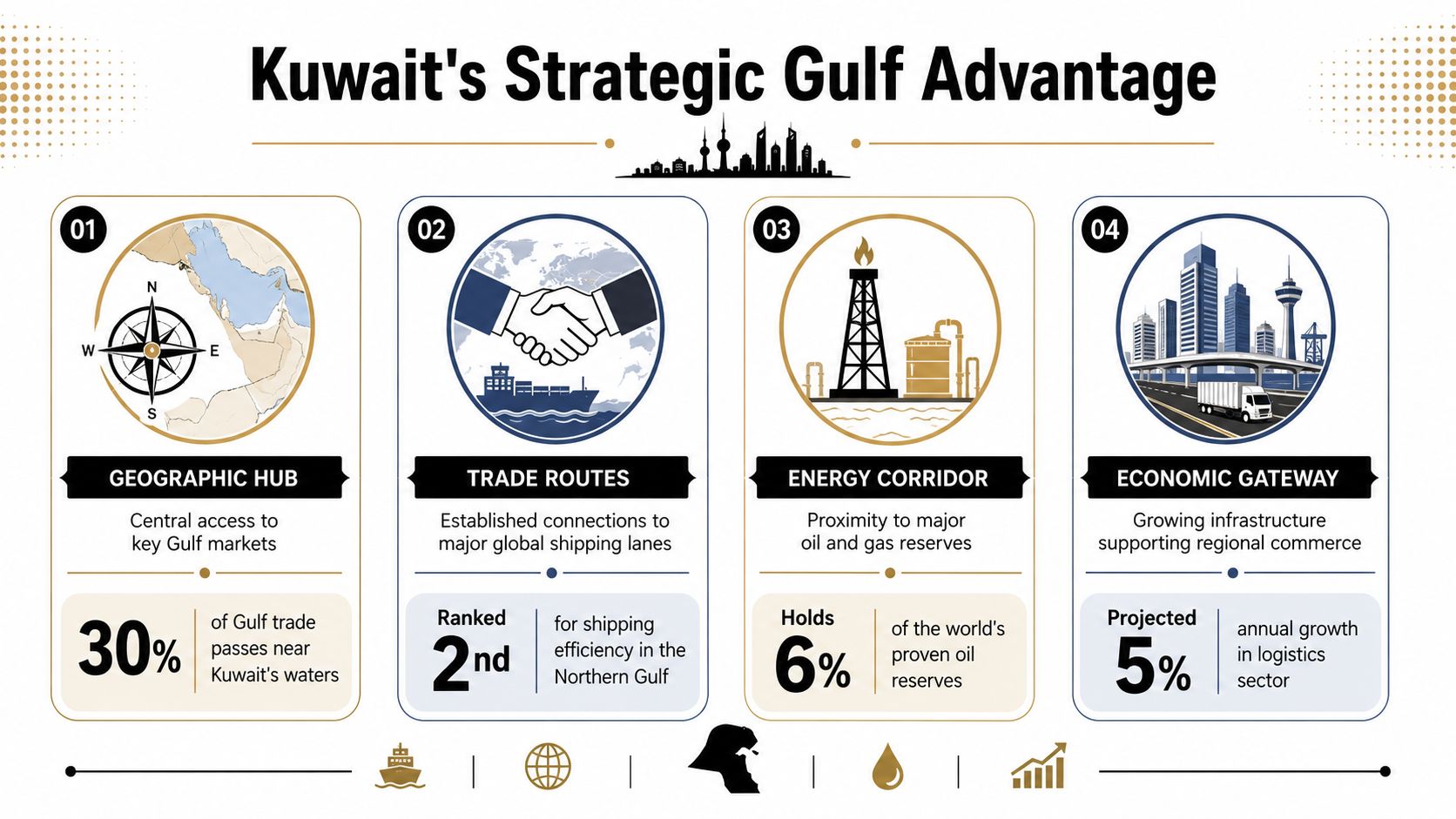
Kuwait sits at the northeastern edge of the Arabian Peninsula, and its coastline of approximately 500 km affects how business activity concentrates and how infrastructure needs to be planned, as noted in Wikipedia's location and physical geography summary of Kuwait.
What this means operationally
Kuwait is generally low-lying, with its highest point at 306 m. For founders, that matters less as a trivia point and more as a planning signal. In low-lying, coastal, desert environments, infrastructure concentration becomes a commercial reality. Teams often operate around the main urban and coastal axis because that's where movement, utilities, and access naturally converge.
That has practical effects:
- Logistics teams should stress-test coastal dependencies and route assumptions.
- Field sales teams can often work from a more centralised coverage model than they would in larger markets.
- Ops leads should account for heat, dust, and marine conditions when evaluating service reliability or site performance.
What works and what doesn't
What works is a centralised Gulf operating model with Kuwait added as a tightly managed market. UAE-based companies often do better when they treat Kuwait as a focused extension of regional operations, not as a fully separate standalone build from day one.
What doesn't work is copying a Saudi playbook into Kuwait. The scale is different. The route logic is different. The market is more compressed, so bad assumptions on territory design or service coverage show up quickly.
A founder doesn't need the biggest map. They need the one that shows where concentration creates leverage and where geography creates friction.
Why Kuwait's Location Matters for UAE Founders
Kuwait's geography becomes commercially interesting when you combine its size with its economic profile and population structure.
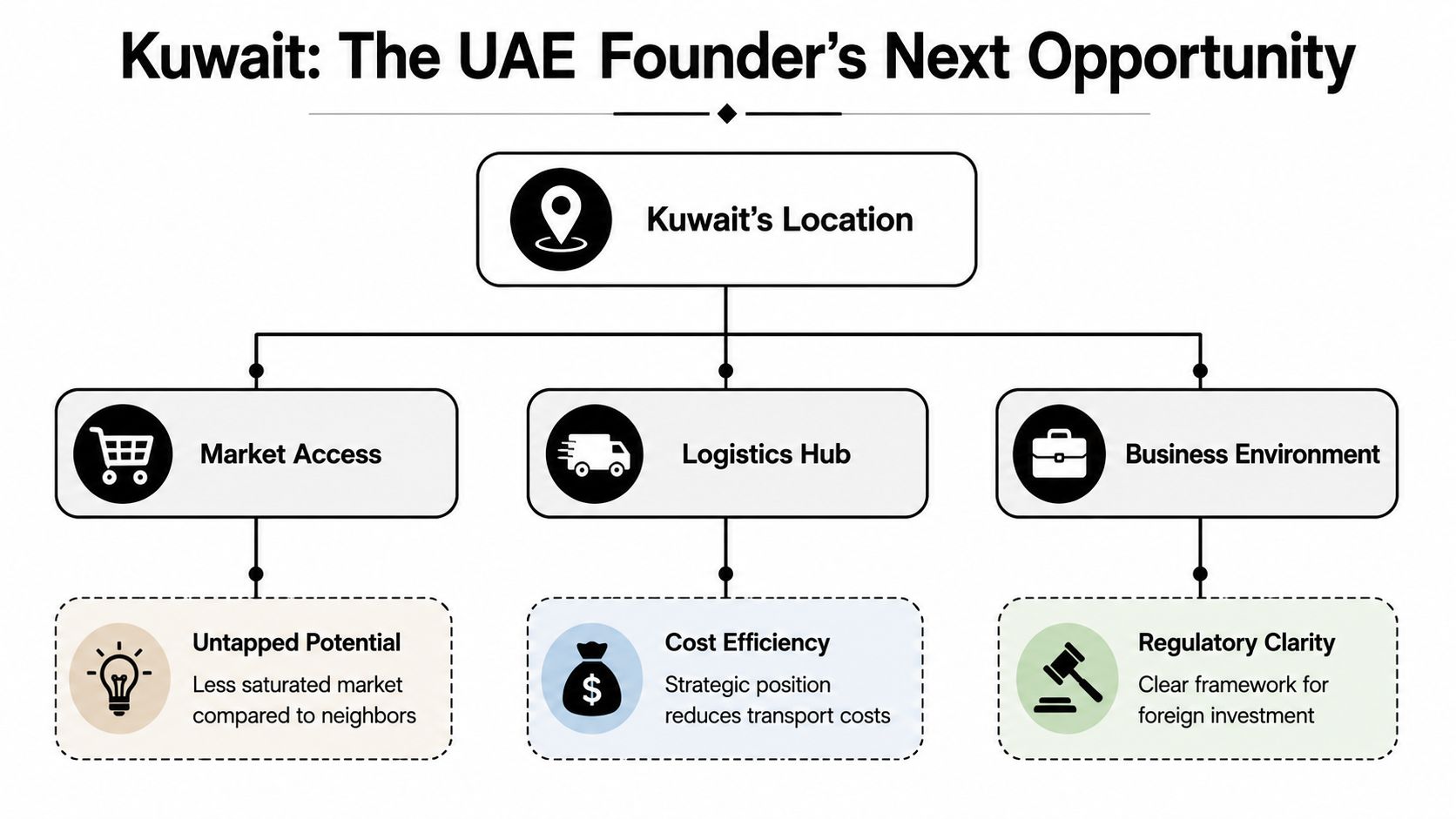
According to Britannica's Kuwait overview, Kuwait's population was 4.82 million in 2024, including 1.53 million Kuwaiti citizens and 3.29 million foreign nationals. That means expatriates made up roughly 68% of the population. The same reference reports a GDP of $134.76 billion and GDP per capita of $32,031.98.
Why that matters from a UAE base
For UAE founders, that population mix is familiar. If your company already serves expatriate-heavy customer segments, cross-border hiring bases, or regional B2B categories that depend on imported talent and international operators, Kuwait is easier to read than a market with a completely different demographic shape.
The business implication isn't that every UAE startup should expand there. It's that Kuwait often fits companies that already know how to sell into Gulf urban markets with mixed local and expatriate audiences.
One country, different operating zones
Many market-entry plans often become too blunt. Kuwait may look like a single compact market from far away, but founders still need governorate-level judgement.
A 2025 study by the MENA Startup Observatory found that 45% of UAE-based founders exploring the Kuwaiti market couldn't identify which governorate offered the best regulatory support. The same body of verified guidance notes that Kuwait's National Development Strategy 2024–2028 targets specific governorates as innovation hubs with incentives that mirror UAE-style frameworks.
That's why country-level enthusiasm isn't enough.
Use this simple decision lens before you commit resources:
- If you sell B2B services: identify where regulatory and commercial conversations happen.
- If you need local partners: map likely counterparties by governorate, not only by country.
- If you're testing demand: start in the zone with the clearest fit for your category, then widen.
A useful planning companion is this GCC expansion checklist for UAE startups, especially if you're comparing Kuwait with other regional moves.
Decision lens: Don't ask, “Should we enter Kuwait?” Ask, “Which part of Kuwait best matches our model, and what does that let us test quickly?”
A Practical Guide to Using Kuwait Maps
Once Kuwait is on your shortlist, stop treating maps as decoration. Use them as operating tools.
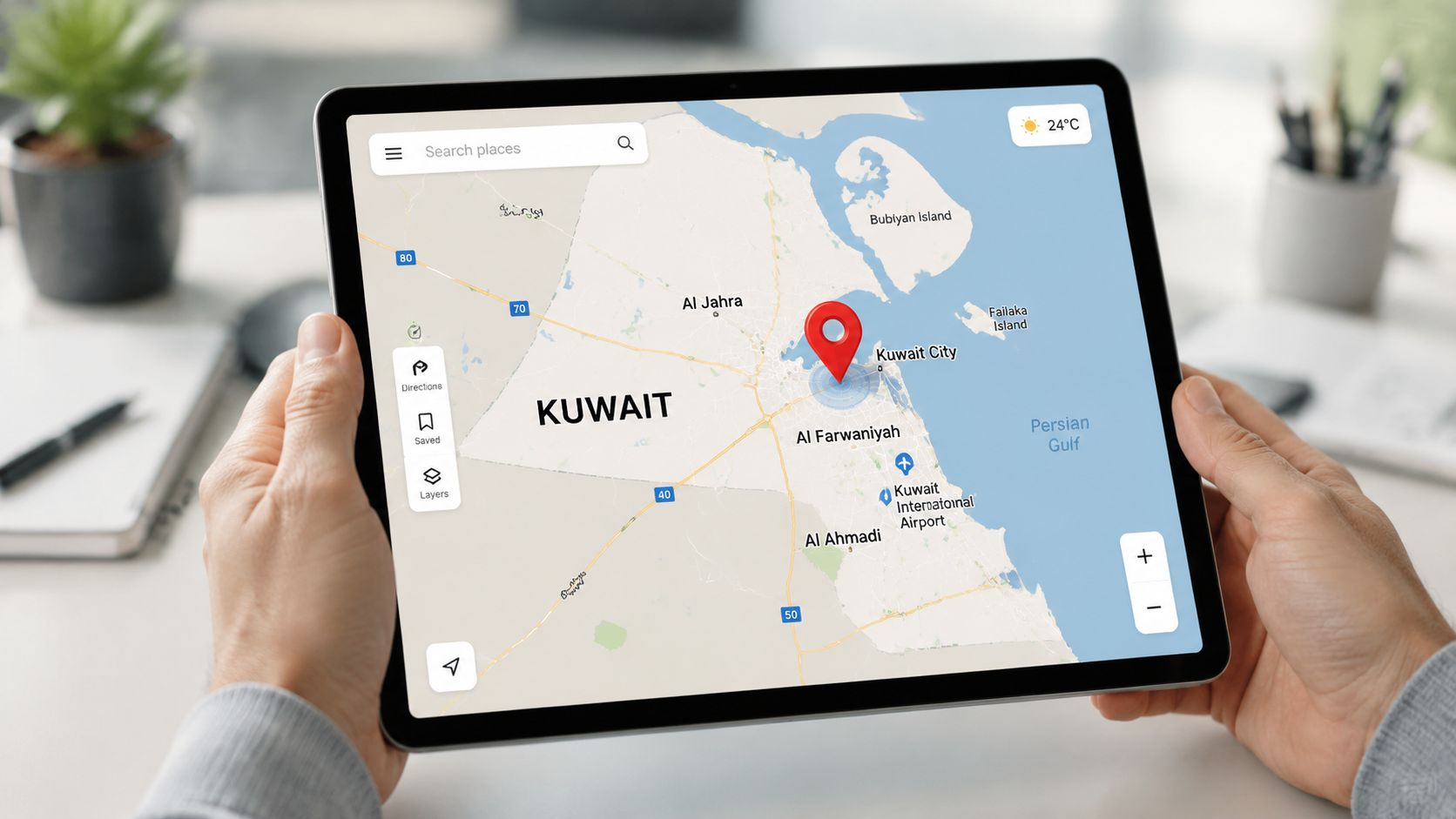
Four map uses that help founders immediately
Use Google Maps for first-pass commercial coverage
Mark customer locations, partner offices, warehouses, and government touchpoints. You're not looking for perfection. You're looking for clustering. If everything important sits within a narrow corridor, that supports a lighter launch model.Use Google Earth when physical context matters
This is useful for industrial, logistics, infrastructure, and site-sensitive businesses. Satellite view often reveals access constraints, coastal proximity, or operational layout issues that a plain political map won't show.Use governorate overlays in planning decks
Don't show investors or internal stakeholders a generic Gulf map and call it strategy. Add the six governorates and mark where you'll start, why that zone fits, and what the second zone would be if the pilot works.Use official administrative maps for compliance discussions
Legal, licensing, and local partner conversations often get messy when teams rely on informal screenshots. Pull an administrative map early and align everyone on the same boundaries and naming conventions.
A simple working template
For most early expansion work, I'd keep one live map with three layers:
- Commercial layer for leads, customers, and partners
- Operational layer for delivery routes, service areas, or site dependencies
- Regulatory layer for governorate-specific considerations
That setup is simple enough for a founder, ops lead, or growth manager to maintain without turning mapping into a full research project.
The best map isn't the most detailed one. It's the one your team actually updates before each decision.
Your Next Move Understanding the Kuwaiti Market
The useful reading of Kuwait on a world map is simple. It's a small, coastal, strategically placed Gulf market with enough economic weight to justify attention and enough internal variation to punish lazy entry plans.
That last point matters most. Verified guidance shows that 45% of UAE-based founders exploring Kuwait struggled to identify the right governorate for regulatory support, while Kuwait's development strategy highlights specific governorates as innovation hubs. So the next move isn't “research Kuwait more”. It's narrower than that.
Do this next
Pick two governorates and run a focused entry review with your team. For each one, answer:
- Which customer type would we target first?
- Which local partner profile would help us move faster?
- What regulatory or commercial advantage does this zone appear to offer?
- What would make us reject this governorate and choose another one?
If local discoverability matters to your launch, market scan, or partner outreach, a structured platform like LocalHQ's local SEO tool can help teams organise location-specific visibility work instead of treating Kuwait as a single undifferentiated market.
If you also need a better read on business credibility and ecosystem pathways, it's worth reviewing how the Kuwait Chamber of Commerce fits into market-entry planning.
The founders who move well in Kuwait don't start with a grand regional theory. They start with a map, narrow the field, and choose the right operating zone first.
Founder Connects helps UAE and MENA founders make moves like this with more clarity and less isolation. If you want practical peer insight, sharper market-entry thinking, and trusted founder conversations, explore Founder Connects.

Popular posts




The premier community for tech founders, investors, and builders. Connect, collaborate, and grow together.